

400,000+ business leaders (and teams at IBM, AWS & Zapier) start their day with The AI Report. 5 minutes. Plain English. No hype.
Philip Alm, Viss.AI: Why Code Beats AI Agents for Automation
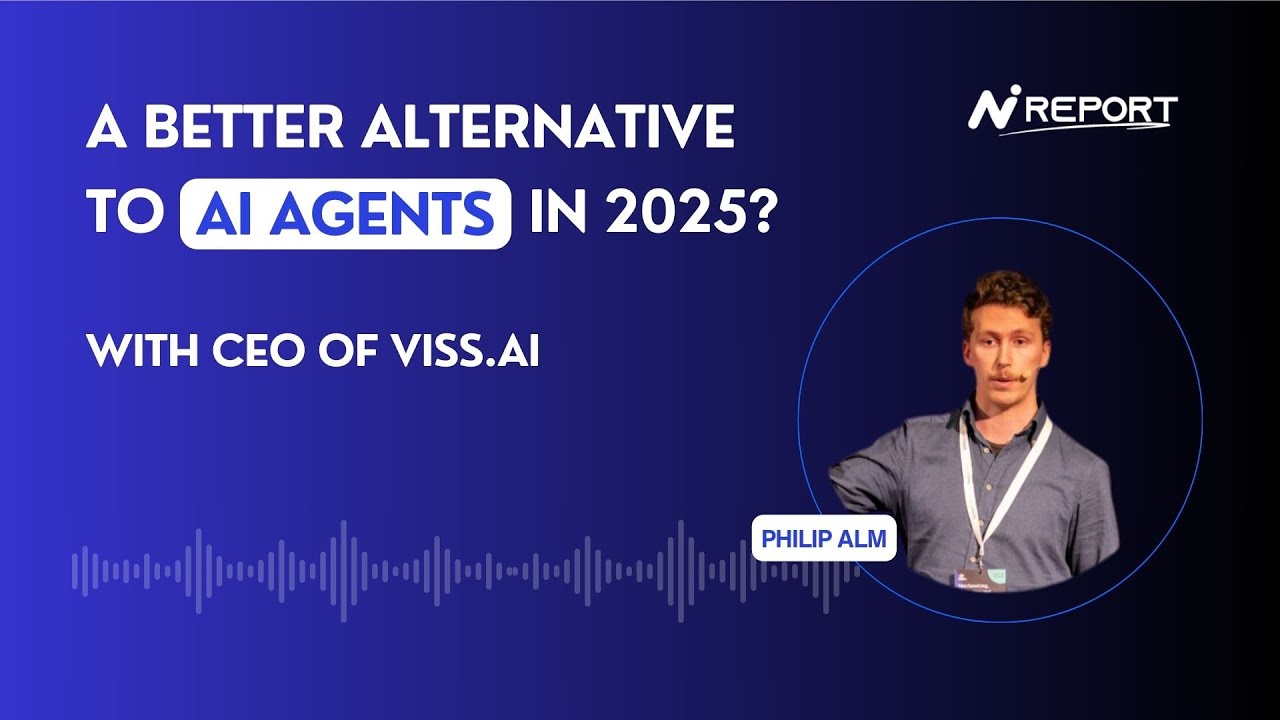
Viss.AI CEO Philip Alm explains why his team dropped pure AI agents after seven versions and now has AI write reproducible automation code.

Watch on YouTube · Listen on Spotify or Apple Podcasts
Philip Alm, co-founder and CEO of Viss.AI and Norditech, says pure AI agents will never be reliable enough for mission-critical automation, so his team stopped relying on them. After seven agent-based versions of the product, Viss.AI now uses AI to write reproducible code from plain-language descriptions. He tells host Liam Lawson how that works, why users can add their own API integrations, and why the company is still onboarding only large enterprises.
Key takeaways
- 11 versions, each rebuilt from scratch. Viss.AI has started over 11 times, spending much of its first three years on research into a few core problems. (16:24)
- Pure AI agents failed the reproducibility test. The first seven versions were pure AI agents. After about two and a half years, Philip concluded that today's large language models will never be 100% reliable. (16:56)
- Code is the fix. Viss.AI's agents now write code, because code that works once will run the same way every time. (17:32)
- Users can add any API in natural language. Language friendly APIs, built over the first two years, let customers connect apps Viss.AI has never integrated, using their own credentials. (30:12)
- Most automation mistakes are human error. People leave out the context in their heads, so the product asks for more information and teaches users to break tasks into steps. (22:54)
- Enterprise first, on purpose. Philip wants to avoid the generative AI pattern of prototypes that get 80% of the way, then lose subscribers within one to three months. (24:40)
- Builders and runners spread automation. One builder can hand a workflow to five runners, saving each of them 10 hours per week. (39:25)
Why did Viss.AI move away from AI agents?
Philip Alm says AI agents are powerful but expensive, and they have single points of failure: sometimes they simply fail. For mission-critical work that is not acceptable. If an AI pays salaries for 10,000 employees and mixes up one in a thousand, he says, the system has failed.
Viss.AI calls this the reproducibility problem: making sure an automation does exactly the same thing every time. The first seven versions of the product were pure AI agents. After about two and a half years of experiments, Philip concluded the problem might never be solvable with large language models as they are trained today, because they will never be 100% reliable.
So the team changed approach. Instead of having agents carry out the work, Viss.AI uses an AI software engineer in the background that writes code. Code that works once will probably work every time after that. Getting that right took another four versions, for 11 in total.
How does Viss.AI turn plain English into automations?
Philip Alm says the goal is to make automation available to everyone, so people talk about automations the way they talk about Word documents or PowerPoints. A user describes a task in words, such as finding 100 receipts in an email inbox and bookkeeping them in an ERP system, and Viss.AI translates it into code.
Workflows are built as steps, one per app. For Liam's example of Typeform, Google Sheets and beehiiv, a user would describe what to collect from the survey, ask for the results to be written into a styled spreadsheet, and then ask for an HTML email that sends a custom reply to every respondent. The workflow can run on demand, on a schedule or from a trigger in Slack.
Viss.AI needs no access to the user's computer. It needs access only to the API integrations involved, such as Gmail, handled in the background and encrypted. Data fetched in one step is available in every later step, so users refer to it in words, for example the Typeform answers from step one, instead of mapping fields or drawing arrows between nodes.
How do you stop an AI automation from making mistakes?
Philip Alm says most mistakes come down to human error: people think they can describe a task perfectly, but leave out the extra factors they have in their heads. The AI forms an idea that is similar to theirs, but not the same.
Viss.AI works on both sides of that gap. The product is designed to understand users better and to ask for more information when it needs it, while also teaching users to break a process into smaller steps. Philip expects that to stay a combination of both, because making someone else understand you is a communication problem humans have with each other too.
How is Viss.AI different from Zapier and Make?
Philip Alm names two differences: integrations and user experience. Every company uses its own mix of highly customized apps, and Zapier, he notes, has more than 8,000 integrations. Viss.AI spent its first two years building what it calls language friendly APIs, a better way for AI to understand how to communicate with APIs.
That lets Viss.AI build integrations efficiently, and it lets users add their own APIs in natural language. Adding an integration the traditional way takes three weeks to three months, Philip says, and a large platform cannot justify integrating small apps used by only a fraction of its users. In Viss.AI, a user could add one in minutes or hours. For widely used apps such as Gmail, Viss.AI sets up the integration and partnership itself. For anything else, the user supplies their own credentials, such as an API key or OAuth 2 details, and Viss.AI stores them so the workflow can run.
The second difference is the user journey. Rather than node-based tools that still need a lot of configuration, Viss.AI lets users describe data mapping, logic and branching paths in words. Under the hood, it is model agnostic: the team does not train its own models and uses whatever model produces good code and predictable responses.
Why is Viss.AI only working with large enterprises?
Philip Alm says Viss.AI is onboarding only large enterprises from a waitlist because many generative AI startups build impressive prototypes that get users 80% of the way, then lose them on the hard last 20%. The result is a burst of sign-ups, then subscribers leaving after one to three months and a very high churn rate.
Larger clients have more patience and closer relationships, which gave the team time to make the product work. Philip says that in the two months before the recording, the team felt it had finally found the right approach. The next hurdle before a global launch is onboarding material and guides that can bring on thousands of users without hand-holding.
Over the next three years, he wants Viss.AI to be easy enough for someone who has never touched programming or workflow tools. Viss.AI thinks of users as builders, who are more technical and create workflows, and runners, who just need to run them. Inside customers, he sees one builder hand a workflow to five runners, each saving 10 hours per week, before more builders follow.
How did Philip Alm go from Minecraft servers to an AI startup?
Philip Alm started programming at around 10 and made his first money online from Minecraft servers, which taught him marketing, monetization and upselling. Around 14 or 15, he realized that what you build in your basement is useless if no one uses it, and entrepreneurship became the next step.
His first public product, Convert Anything, was a file conversion web service built through UF, a Swedish scheme that lets high school students run a temporary business. Through it he met his future co-founder, David. His first job as a statistical analysis engineer led him into AI, predicting from production machine data whether small plastic parts would be good enough to use.
Norditech began as an AI and IT consultancy. Half a year in, David's frustration with salary payments led to the idea of teaching an AI to use their ERP system, then every system they used. The company spent almost three years bootstrapping that product while still delivering consulting work, then raised its first investment round and phased out the old projects to focus on Viss.AI.
What is the culture like inside Viss.AI?
Philip Alm describes a team of 10 people with a median age of 22, for whom the company is their life. After the company won the World Summit AI competition, the team held 50 interviews a month for a while, but chose not to overhire, looking for people who love the work and then making them as efficient as possible through upskilling.
He says the culture works on mutual respect: if someone is not working, the team assumes something is wrong and asks why. Mentors from Sweden's Science Park initiative shaped much of his early career, but he says no one advised the team to adopt its culture, and the advice was often the opposite. His partnership with David worked the same way. Philip was the meticulous planner and David the doer, and after a year or two of arguments, each became more like the other.
Which AI startups will survive?
Philip Alm predicts the death of many startups that simply add generative AI on top of an existing product. When a platform such as Google builds the same feature in, he says, those startups either die or have to pivot quickly, and perhaps one survives in each niche.
His second point is that the bigger shift will come from applying the AI that already exists. He puts AI use at around 20% of organizations in Sweden and 30 to 40% in the US. As that number climbs, he expects the efficiency gains to be a shock to the system, citing his own developers, where he says one engineer now does what 500 to maybe a thousand engineers do in a month.
What should new founders do with AI?
Philip Alm's advice is to build and validate quickly. With tools such as Lovable, a prototype takes minutes, so come up with ideas, build some of them, show them to people and measure their reaction. Not showing his work to enough people is something he says he missed completely.
In his words
"If no one uses it it's completely useless" (02:34)
"We want people to talk about automations like you're talking about Word documents or PowerPoints" (15:08)
"We've built 11 versions of our product so we've actually started over from scratch 11 times" (16:24)
"It's usually human error in the end" (22:54)
"You can build and validate very quickly" (57:16)
Chapters
00:00 The Journey of an Entrepreneur
05:55 The Birth of Norditech AI
11:36 Finding Product-Market Fit
17:08 Technical Challenges and Solutions
22:54 The Future of AI Automation
29:41 Navigating the API Jungle
34:37 The Power of Natural Language in Automation
40:21 Building a Strong Company Culture
51:52 Predictions for the Future of AI
57:09 Advice for Aspiring Entrepreneurs
About the guest
Philip Alm is co-founder and CEO of Viss.AI and Norditech, a Swedish company that turns plain-language descriptions into business automations. He started programming at around 10 and founded Norditech with his co-founder David as an AI and IT consultancy before turning it into a product company. At the time of recording, the team had 10 people and had won the World Summit AI competition. Philip on LinkedIn
About the host
Liam Lawson is CEO of The AI Report and host of The AI Report Podcast. Meet the team
Full transcript
Edited for readability. Quotes above are word for word from the recording.
Liam Lawson (00:12): All righty, we are back for another episode, a December episode of The AI Report live podcast. Today's guest is the co-founder and CEO of Viss.AI and Norditech AI, Philip Alm. We're going to jump into exactly what he does, how he's built this and what the application actually does for you today. In terms of Philip's background, from what I understand he's a very good public speaker, a born entrepreneur from all the projects I can see from his LinkedIn and interviews, and a winner of many prizes, including the number one startup prize at World Summit AI. So welcome to the podcast, Philip.
Philip Alm (00:52): Thank you so much, Liam. It's very much a pleasure to be here. I hope we'll have a fruitful discussion today.
Liam Lawson (00:56): I think it will be interesting, for sure. Let's start things off on an interesting note. The first question is going to be ambiguous for you: why do you build cool [expletive]?
Philip Alm (01:08): I think that's something I was kind of born into. They usually say I was born with a laptop in my hand, sitting very long nights at home as a kid, discovering programming at an age of around 10. Being able to basically create whatever you feel like, that freedom is something very unique. Finding that freedom and the capability to create whatever I wanted, to solve whatever problem I had myself, that's a freedom that motivated me to build.
Liam Lawson (01:49): Interesting. So it's really that independence, that freedom, that ability to conceive of an idea and then go and actually create it and bring it to reality. That's really what's driving these creations for you?
Philip Alm (02:00): Oh yeah, seeing them come to life. And especially, I think there's a turning point, because I usually say this when I speak: I started out building stuff very early. I had a friend whose father was an engineer, and he taught us programming, quite deep programming, which is not what you typically want to start with at a very young age. Then we started building all this cool [expletive], and it came to a point, around 14 or 15 years old, where I started realizing you can build however much cool [expletive] you want in your basement, but if no one uses it, it's completely useless. At that point I discovered this part of me where entrepreneurship became the natural next step: to take these creations and make sure they're actually bringing some value into society, not just a cool thing I have in my basement that I'm never showing anyone.
Liam Lawson (02:52): Interesting. So with that in mind, do you remember the first dollar that you made online, and with what application or product you got that dollar?
Philip Alm (03:05): Yeah, I do. Believe it or not, it was Minecraft, Minecraft servers specifically. I don't think I've ever mentioned this to anyone publicly before. I started building these servers, and not just actual servers: we built server infrastructure, but then also developed different ways of playing the game and released that. And I got into how marketing works, how you monetize products, how you do upselling. All of these concepts came naturally from that. So believe it or not, it was Minecraft servers the first time, but then we started trying everything. I still remember we went around the city and sold web pages to different pizzerias, for example. That was fun. There are so many ways you could make money online, and when you're 14 or 15 years old and starting to discover that, it opens up an entire new world of things you could potentially do.
Liam Lawson (04:11): Interesting. I hear many stories from lots of entrepreneurs of how they made their first dollar. Some are Amazon, some are drop shipping. I don't think I've heard Minecraft servers before, but I love it. We've all got to start somewhere.
Philip Alm (04:25): Yeah, it was a passion of mine as a kid, and then that evolved into mixing it with all my other passions: programming, servers, IT, then entrepreneurship, building a business around it. That ended up being quite a good business, but very stressful for a 16-year-old to manage when it came to its peak, while having 15 other interests at the same time that you want to try out.
Liam Lawson (04:51): Got you. Talk me through that. The earliest experience I can see on your LinkedIn is a tool called Convert Anything. If it's your first public one that I can see, tell me about it.
Philip Alm (05:06): Yeah. We have this thing in Sweden called UF, which basically stands for businesses for youths. It's a concept they've been running for quite a while: as a youth in high school, you're able to start a business under much friendlier circumstances than a traditional holding company or a company with actual stock. It's a temporary business that you have for a short amount of time, and you can convert it into a real business if it works. It's very flexible when it comes to taxes and things like that.
Convert Anything was a product with the same childhood friend I learned programming with. We made a web service to convert different file formats. These are very common today, but in 2015, 2016, I think it was 2016 or 2017 maybe, that wasn't really that common, and it was a super useful service. Through that service I actually met the co-founder of the company I'm running today, so it worked out.
Liam Lawson (06:14): Interesting. The impression I'm getting is that you're trying lots of things, doing any entrepreneurial venture that comes to mind. There are lots of opportunities out there: you're making websites for pizzerias, you're building online tools, and then at some point you pivot towards the world of AI. I can see that in 2020 you started Norditech. So take me through the first time you heard the words AI and machine learning and really understood them, and the path from there to actually founding the company.
Philip Alm (06:46): Yeah, absolutely. Like you're saying, I experimented a lot, which I loved doing in my youth. There are so many micro businesses I built that no one knows about, which were only for myself, to learn and to discover. But AI, I actually didn't know what it was when I first heard of it. I even remember, at 15 or 16 years of age, I did a project in high school where I presented a model that was capable of learning languages, which is very similar to the technique used for the large language models and generative AI everyone is hearing about in the news today. At that point I had absolutely no idea how it worked. I just found it really cool and thought, I have to show this to someone. That sparked the interest.
But it didn't really become anything real until I started my first job as a statistical analysis engineer of some kind, which then automatically transferred to: okay, let's do AI. It was a project where we were collecting data from production machines producing very fine, small plastic parts. We took all the data from the machine and tried to predict whether the part it was currently producing would be good enough to use or would have to be thrown away. That really got me deep diving into AI and realizing how much I loved it. And I can tell you, it wasn't fun at that point, because here comes a 17- or 18-year-old kid going out into a production industry where there are 50- or 60-year-old men who have been doing this for 20 years, and I'm telling them, maybe you should think about doing this instead. They didn't like that very much. So that experience was interesting.
Liam Lawson (08:34): I can imagine. When did you make the switch from working for someone else to taking that leap and saying, I'm starting my own company and running my own life now?
Philip Alm (08:43): I'm pretty sure I always had that in the back of my head. Even working for other companies, I still had my hobby businesses, whatever you would call them. They weren't making enough money, because I was testing out stuff. It was maybe 10 to 20,000 dollars per month, and then there are expenses on top of that, so it's maybe not enough to make a living from.
Then I met the co-founder I mentioned earlier. He had actually won a competition in Sweden for these youth businesses, and he met me at that same fair when I was presenting. After that we had breakfast and started talking about what we were doing, and it turned out both of us were really into AI. We had worked in the industry for quite a few years, even though we were quite young, and we decided to start this business together. We had all these AI and IT consultancy projects spread around with our customers, so: let's gather them under one roof and help each other solve all of these things on a slightly larger scale. That's how Norditech came to be.
Liam Lawson (09:50): Interesting. Do you remember your state of mind at that point? Were you scared, terrified, excited? What was going through your brain, and what was the conversation you had with your family?
Philip Alm (10:08): I was scared [expletive], for sure, at that point in time. I had started studying engineering at a university in another city, and after a while I started regretting that, because I had already worked in the industry for quite a few years, so there wasn't really that much new I could learn. I still remember calling David on the phone. We had already founded the company at this point, but it was just rolling a little on the side. I called him and said, just make sure we have enough money to pay for the absolute most basic stuff, and I will quit uni today and we'll get going. I was so sick of lying at home. That was during COVID as well, so you were lying at home with nothing to do, and I had also hurt my back, so I was lying in bed a lot. I remember this call so vividly, calling him and saying, just make sure we have enough to survive, I'll quit uni today and we'll just start working our [expletive] off. And that's what we did.
Liam Lawson (11:06): Something I'm so interested in figuring out about Norditech specifically: you mentioned you had a bunch of these products and services, a bunch of different things you were doing, and you were trying to bring it together under one roof. How exactly did you find your product-market fit? How did you find the clients you want to work with, the service you offer, maybe a product or a service? How did you really niche down into what you're good at from all of these different angles?
Philip Alm (11:35): I think in the beginning it was total chaos. To be more specific, we did consultancy services within AI and IT, and that opens up pretty much anything. Already half a year in, David, the co-founder, had this idea. He was so sick of doing salary payments in our company, and we said, why can't we just solve this using AI? We have to be able to solve this simple problem using AI. We got into this mode of thinking: let's teach an AI how to use our ERP system, which is where we did salary payments. Then we took that one step further: let's teach an AI how to use every single system we use on a day-to-day basis. Not just our ERP system, but our messaging services, our email, our calendar. Just teach it everything and see if it can perform different tasks. When we came up with that idea, around three and a half years ago, we instantly knew that's what we wanted to do, and we started transforming the consultancy business into a product business.
That's a hard thing to do, because you're stuck with all of these assignments and customers you need to deliver to. It was a really tough period: still delivering while bootstrapping, trying to save money and investing it into building a product that was really time consuming and consuming a lot of our funds, while not being able to work full time on other projects to bring in money. That journey was intense, for sure.
Liam Lawson (13:08): Has that journey now been completed? Have you completely switched from consultancy to this product or service, which I'm assuming is Viss.AI?
Philip Alm (13:14): Yeah, exactly, it's Viss.AI. That journey has been completely done. We bootstrapped, meaning you're earning money on the side to survive while you're building something, and we did that for almost three years in a row. Then we decided, okay, now it's enough, and started seeking investment. We brought on our first investment round in March [year unclear], and that gave us the freedom to fully focus on expanding our team, making sure we have a good team backing us, being able to build the product and phasing out the old projects as we go. Now we don't have any of those left. It's just Viss.AI for us, and it's been that for quite a while.
Liam Lawson (13:54): Awesome. Let's jump into this. I had a look over the website, and I can see that your mission statement is to make AI accessible to everyone. Talk to me about the genesis of the idea for Viss.AI and what you're really hoping to create with it.
Philip Alm (14:10): In a nutshell, what we want to do is make automation available for everyone. In this new era we're in with AI, you're able to just describe things in natural language, which is something everyone can do. It's like talking to a coworker, and then we transform these language queries into actual useful things. In our case, what's happening in the background is that you describe, say, "I want to find 100 receipts in my email and then bookkeep them automatically in my ERP system." You're describing this in words, but it's being translated into code in the background. We have built AI agents in the background that actually write code to perform these tasks. It's like talking to a programmer: instead of going to your IT department, you talk to the system, say "I want to automate this," and it helps you through the process.
The vision is very simple. We want everyone to be able to automate. We want people to talk about automations like they talk about Word documents or PowerPoints. Throw together a PowerPoint, throw together an automation. It's obvious, just solve it real quick. It shouldn't be that hard.
Liam Lawson (15:20): Yeah, that's the dream. As head of operations in our business, there are a million and one automations we would love to get involved with. I'd love to do this, and this, and this, but you need to either hire someone technical to build them or go through the steps of building them yourself. With that being said, how do you account for mistakes when translating natural language into coding instructions? How do you get it right every time?
Philip Alm (15:54): Yeah, that was a tough one, I'll tell you. You have these inherent problems with generative AI especially. You always have the problem of hallucination: it can just make stuff up, it can get things wrong one out of 100 times. If you're paying out salaries in a company with 10,000 employees and it mixes up one in a thousand, that's not acceptable. It's mission critical. It cannot fail. And I'll tell you this: we've built 11 versions of our product, so we've started over from scratch 11 times at this point and thrown everything out, because a lot of the first three years we spent researching. There were a few core problems we wanted to solve. The one you mentioned we call the reproducibility problem, which basically means making sure it does the exact same thing every single time.
You hear all this fuss about AI agents. They're really powerful, but they're really expensive and they have these single points of failure: they fail sometimes. Our first seven versions of the product were pure AI agents, and then we realized this is not going to work. It took us probably two and a half years of experimenting with AI agents to realize that this might never be solvable with the current type of AI we're building. You would need a new type of AI, not large language models the way we're training them today, with neural networks that take in text and try to predict upcoming tokens, or upcoming segments of text, because they will never be 100% reliable.
So we went away from that and started thinking, okay, let's just make it easier to build them in the first place, and we started making our tool write code, which I mentioned. Code is something we know works. We developers write code, it runs, and if it works one time, it's probably going to work the rest of the time. So if we could build this AI software engineer in the background that you're talking to, and make it write reproducible code that runs exactly the same every single time, that would solve all our issues. That took another four versions to get something that works, and today that's exactly what's happening in the background.
Liam Lawson (18:10): Interesting. Talk to me about that on a technical level. I come to you with my business: we work with Typeform, Google Sheets and beehiiv to send out emails, loads of different things. I say I want to be able to describe things in natural language. How do I get onboarded to Viss.AI, and what's actually happening? What access does it need, and what kinds of things can I perform with it?
Philip Alm (18:33): The way you access it currently is that you don't, because we have a very long waitlist and we're onboarding people as quickly as we can. But I'll be honest, we still want to do product development, so we're targeting high-level enterprises at the moment and then opening up more and more as we go. Working with big enterprises gives us flexibility: we can listen to them, work very closely with them, and we don't have to worry about overload and things like that. It's really good for us.
But let's talk vision, as it looks right now. If you have these apps, beehiiv, Google Sheets, Typeform, and you're collecting answers, putting them into a sheet, doing some data magic on it and then creating an email with it and sending it out, that's totally possible in the platform right now. You would add these three apps as steps: a step for Google Sheets, a step for Typeform and a step for beehiiv. In the Typeform step you would literally describe what you just told me, something like "collect all the answers from this survey we created and batch them up in a nice structured way so I can look at them." Then you say, "transfer all the data we found in step one to the spreadsheet and style it nicely with these colors." And the third one might be "create an HTML email that summarizes the data nicely and sends a custom reply to every single person who filled out the Typeform." That could be an automation. You describe it in words in these three steps and then run it, schedule it or trigger it from Slack, wherever you feel like.
Liam Lawson (20:14): Interesting, very interesting. Does this just work through a web browser, or does it need to be downloaded as an application? What level of access does it need to my computer to perform the actions?
Philip Alm (20:25): To your computer, it doesn't need access. What it does need access to, of course, is any external API integrations. If you're sending emails with Gmail, we need access to the Gmail integration, and that's done completely in the background, encrypted, like any application where you connect things together. You add Notion to Slack, for example, to be able to add stuff to Notion through Slack. That's an integration in the background, and it's exactly like that: Viss.AI just connects to Typeform in this case and pulls the data from what they call their API, which is basically an interface for developers to communicate with Typeform.
Liam Lawson (21:06): With that being said, the way you describe the process is pretty sequential: go and collect this data from the sheet, then do this, then do that. Is that how you account for potential mistakes as well? Because I could describe a complex process with eight different steps, and it might hallucinate at that point. Is it best practice to do it step by step?
Philip Alm (21:30): Yes, it's usually easier. This was actually one of the biggest problems we had to solve: people think they have a great idea of what they want to do and think they can describe it perfectly, and then you have an AI that you need to teach what you actually want. You have this thought, this is the problem I want to solve, and you try to describe it to the AI. It will have an idea of the problem you want to solve, and it might be similar, but it's not going to be the same idea, because in your head you're thinking of all these extra factors that you're not explaining to the AI. So how would it know about them? We had to work really hard both to make the AI understand the user better and tell the user, "I need more info to be able to do this," and to make the user understand that you need to break this down so it's easier to understand. I can open up a workflow from someone who's really good at this, read it, and have absolutely no idea what it's doing. And then you expect an AI to write an automation that does this when you can't even explain it properly.
So there's a balance you need to find: taking the user's idea and bringing it closer to the AI's understanding, while also making the AI understand more, ask questions and try to discover what the user actually means. That's a very interesting process for making it not hallucinate and not make mistakes. It's usually human error in the end. Almost every single time, it's that the human, in this case us, hasn't described it well enough.
Liam Lawson (23:04): Interesting. And everyone speaks in a different way, using different words, verbiage and vernacular. I speak differently from Martin, who speaks differently from Arturo, who speaks differently from you, who speaks differently from David, and so on. My natural next question is: will communicating with this AI go more in the direction of having more conversations with it, so it understands how you describe things better, or more towards educating the user to speak in terms the AI will comprehend? Or is it a combination of both?
Philip Alm (23:42): It's definitely both. You can't have one and expect that to be enough, because this is one of those problems that will always be there. It's never going to be solved, because you can't just transfer your thoughts into the machine, at least not yet. We're almost there, but that's a topic for another podcast maybe. Making someone else understand you is a communication problem that's inherent for humans in general. I'm communicating with you right now, trying to explain what Viss.AI is, and you will now have a picture of it in your head which most likely is not at all what I have in mine, even though I'm trying to explain it.
Liam Lawson (24:21): Got you. Talk to me about this from a business level. Right now you're only working with larger organizations, and there's a waitlist to get onboarded. Why have you chosen this approach rather than just releasing it as a SaaS and saying, there you go, it's $100 a month for a subscription, have fun?
Philip Alm (24:40): There are two major reasons. Number one is that we haven't been ready. Like I said, we did 11 versions of the product, because none of them really worked. Generative AI startups usually have this problem: they get 80% of the way and build these amazing prototypes that are extremely interesting to look at and to try. Then users sign up, start using it, come 80% of the way, almost build something valuable, and get really frustrated because that last 20% is really hard to solve. That usually means you boost your numbers in the beginning and can raise a lot of money, and then every new subscriber unsubscribes after one to three months and you have an extremely high churn rate. We didn't want that to happen, and we still don't, which is why we've been so focused on only taking larger clients. They have more patience. You're able to talk more and cherish the relationship as well, not relying 100% on the product instantly doing everything they want. That gives us time to make sure it actually works, which we feel we've now found.
That ties into the next point. We're still going to work with larger enterprises, even though we feel that in the past two months, pretty recently, we found it: this is it, this is what we're doing. Everything else comes on top of this now. We have to have onboarding material and guides. We have to be able to onboard maybe thousands or hundreds of thousands of people without needing to sit down and hold their hand for two hours. Creating that experience is the biggest hurdle from now on for us to be able to do a global launch, which we really still want to do. We really, really want to do that.
Liam Lawson (26:29): With that in mind, what do you foresee the next one, three, five, ten years looking like for Viss.AI?
Philip Alm (26:39): That's always a tough question, but it's pretty clear in my head for the next three to five years. This tool we've built is insanely powerful, but it's still kind of hard to use if you're not a technical person, even though we're lowering the bar for how technical you need to be. You don't need to understand flows, linearity in programming or data mapping. But it's still too difficult for an average 30- or 40-year-old person at a company who has never touched programming or workflow automation tools to just pick it up and instantly know what to do. Solving that is the vision for the next three years, and it will let us expand very quickly.
We have this concept we call builders and runners, which we push quite a lot. You have builders: more technical people, more patience. And then you have runners, people who don't necessarily even have to know Viss.AI exists. They just need to run something and get the value from it. It comes back to the basement thing I mentioned at the beginning: you can build stuff, but if no one runs it, it's useless. So we're trying to make it easier both to run workflows and to build them. Running them means meeting people where they need it, in Slack, in Microsoft Teams, in your email, instead of having to log onto an external platform, understand how to do things, add input variables and click run. That's not something a typical runner would do. That's in the future, for sure.
Liam Lawson (28:08): I like the verbiage there. I'm a self-professed runner as well. The way I always describe projects to agencies we work with, or people we hire for projects, is: I am a complete idiot, so make sure everything you do is in simple terms so that I understand it. As a user, I don't want to have to go into three degrees of complexity to understand a solution you've provided for me. And I think that's the majority of people. I don't know what percentage of people around the world are engineers or technical people, but I imagine it's 10% or less. I think 90% of people are idiots like me: why is this not working, make it work immediately for me. So yeah, I like that verbiage.
I want to jump into the product side of things. I've used some automation tools in the past, so I'm not a complete idiot, but I'm close to it. I've used Make, Zapier, stuff like that, and Zapier has a similar feature where you can describe what you want done in natural language and it builds it. How is Viss.AI different from that? What's your USP?
Philip Alm (29:15): This is the most common question we got in the beginning, especially when we started raising a financial round, because you do this competitor mapping, and it's not only Zapier and Make: you have 400 different AI startups trying to solve AI automation. It comes down to two major things that we always talk about. We do have something like a moat. We discovered that everyone's using different apps. Zapier has 8,000-plus integrations, and in the beginning we went to, let's say, a sales company with 50 different apps, and then to a different sales company in the same industry, and they have 50 different apps. There's a crazy number of applications people are using that are highly customized for exactly what they want to do. Solving that is actually what we spent the first two years doing. We built a system we call language friendly APIs. It's just a better way for AI to understand how to communicate with APIs, and it's also what lets us build integrations very efficiently.
That has now evolved to the point where the user of Viss.AI can just communicate with any API they want. We don't even have to be involved. They can add their own API using natural language, which opens up a whole world of things that were never possible. At Zapier, they have, let's say, 200 engineers just maintaining and working with APIs. And adding an API, if you're an engineer or have a tech background, you know it's [expletive] hell, sorry, excuse my language. No one likes it. It takes three weeks to three months, it's repetitive, boring stuff, it never works, there are always problems. Instead of three weeks to three months, someone could now add an integration that works in Viss.AI in a few minutes or a few hours. That's the biggest part of our IP, which we think will let us scale extremely cost efficiently and also open the door to a lot of possibilities.
Zapier can't integrate the small apps because it's not profitable. It costs too much to make them, even if an app is used by only 0.5% of their user base, which is still almost a million people. It's too much work, and there's not that much profit to gain from it. In our case, it's not even necessarily us doing it. The users can do it. That's the number one thing differentiating us from every single automation tool right now: building automatic integrations.
Liam Lawson (31:58): Interesting. Sorry, I just want to stop on that, because it's super interesting. With the process of developing these API integrations, is any authentication required? My understanding was always that Zapier has to form an official partnership with a company to get the API integration approved. Is that the case, or do you just need some sort of technical arrangement for these things to work together?
Philip Alm (32:25): It depends on the API. Take Gmail. It's a Google app, and Google has quite strict rules on how you're allowed to use their apps. We do the integration with Gmail ourselves, since there's no point in every single customer setting up their own Gmail integration, and in that case we have to set up some type of partnership. We have to apply to handle Gmail accounts, and you get a quota: you can use 100 accounts in your app now, and it goes up over time. That deal you have to do if you're Zapier, and we also do it for the bigger apps, because it's nice to already have a package of 100 or a thousand apps you can just use when you log into Viss.AI.
But for all the other ones, any minor or larger app, if you're integrating it yourself, it's just your credentials. Viss.AI never touches anything, which means it's basically like writing code on your own laptop that integrates with the API. There's almost no difference. We're just storing credentials for you so it can actually run in a Viss.AI workflow. That lets you get around the authentication problem, which is usually the biggest pain of building integrations: authentication never works. You're building it in natural language, and you're also solving the authentication that way, whether you're pasting an API key or describing how to do OAuth 2 callbacks, which is another integration authentication method.
Liam Lawson (33:53): Interesting. So if I understand this, it's a combination of both. On one level, you're building integrations in Viss.AI for the bigger apps people use a lot: Gmail, beehiiv, Typeform, Google Sheets. Then, if a business uses some unique SaaS product no one else uses, they connect to it at an individual level, and the AI is only writing code to authenticate with it. It's not actually touching it as a company, right?
Philip Alm (34:23): Correct. Basically, you're just prompting this AI, like prompting ChatGPT: connect to this API, here are the details about the API. You press enter and it builds it. So it's pretty much the same as interacting with any service.
Liam Lawson (34:35): I want to jump into the technical side of you guys as well. I'm assuming this technology you've developed is all proprietary. And one step deeper than that: are you running this off Llama or ChatGPT, or is it all built in house and trained on your own data?
Philip Alm (34:58): We actually don't train models at all. We did start out trying to train models ourselves, but you have to sink in so much money, especially on data collection and data verification, that it's just not worth it. We did fine-tune models at large scale to see if that would help us, but ended up just defaulting to any model instead. We tried to design the entire system to be agnostic to whatever model you want to use. It doesn't really matter which model writes the code. As long as it writes good code, we're happy. The same goes for the entire user experience and all the feedback you're getting: it doesn't really matter which model it is, as long as it produces a predictable response. We're probably never going to train our own models. There's no point. We're never going to be able to compete with large enterprises like Meta publishing open source models that are larger than anything you would ever train yourself. So we're just using models that exist on the market.
Liam Lawson (35:52): Interesting. Let's jump back to this competitive advantage for a moment. From what I understand, there are organizations out there of 10 people to 10,000 people, and a problem a lot of them face, which we've seen internally at The AI Report as well working with companies, is that they incur some level of technical debt. They might use outdated systems, micro SaaS products, niche SaaS, particular things, and so they can't use tools like Zapier or Make for everything, because they don't have the necessary API integrations for all their systems. Then you fill in that hole: we can automate anything. So one is the API integration, and two is that selling point of being able to automate anything in natural language. I stopped you at a certain point, and it looked as if you might have gone on to number three in terms of your competitive edge.
Philip Alm (36:52): Well, automating anything, I don't know if that's a competitive edge at this point, because everyone claims to be able to do that. The second most important thing is actually how we're designing the user journey. We're trying to remove all the blockers. You see these visual automation tools where you draw, add nodes, describe each part and still do a lot of configuration. We decided very early on that we just want you to describe it in words, and that solves everything: data mapping, flows, the logic behind it, breaking workflows into multiple paths, if this happens do this, if something else happens do that. So we've spent a lot of time building AI agents in the background that build the workflows for you, and on the user experience of interacting with them, in a very different way from node-based tools where you connect things yourself.
All the data you're using in a workflow, the Typeform responses, your spreadsheets, your emails, is just available throughout everything after you fetch it. So when you say you want to put the Typeform answers into the spreadsheet, you literally describe it that way: take the Typeform answers from step one and put them in the spreadsheet we created in step two. That's how you refer to data. It's not mapping data or drawing arrows. We removed all of that. Everything's available everywhere. Talk to your apps: that's what you're doing here. I think that user experience is still our biggest competitive advantage, outside of being able to integrate with any service. In reality, those are still the biggest ones.
Liam Lawson (38:42): It's the ultimate dream. The process right now, if we want something automated, is that I hop on a call with an automations expert or someone technical on the team, describe what I want, and then they go and build and map it. You're removing that middle step: someone can describe exactly what they want automated, and it's automatically built for them. There's no physical labor involved. I think that's the ultimate dream for most people: how do I do this with no technical experience?
Philip Alm (39:12): Yeah, absolutely. We see this again with the builder and runner concept. It's a trend we see inside companies, especially the ones currently using Viss.AI. They start out with one builder who builds one workflow, and then they start distributing it to five runners. All of a sudden you have five people running a workflow that saves each person 10 hours per week, and that's one workflow. Then they add two more builders, start educating the runners to become new builders, and it spins off by itself inside the organization. That's the effect we hope to see at scale once we decide to open it up for anyone. I think that's because everyone wants to automate. It's just too hard to get going, and there are technological barriers still stopping you: you don't understand flows, you don't understand data, problems that non-technical people have never even heard of. Lowering those barriers is going to be interesting in the next year.
Liam Lawson (40:18): Interesting. I think the audience and I got a very good understanding of how this works on a technical level, so I want to take things a little meta for a second and understand more about the founding of the business, how it's run and how scaling has happened. My first question, and what I'm always most interested in: one, how did you come up with the name, and two, how did you come up with the color scheme?
Philip Alm (40:44): I love it. It's so funny: the name actually came earlier than this version of the product. It stood for visual AI, Viss.AI.
Liam Lawson (40:57): Oh, I see.
Philip Alm (40:57): At that point we were actually doing something similar to the visual tools: nodes popping up, you see what's going on everywhere, lines flowing. Then we said, wait, why are we showing all this? No one wants to see this, no one's going to look at it. So we started removing that and making it fully text based. It just connects everything for you in the background, and you don't have to care about it. The name stuck around, because it became: okay, it's easy to have an overview, you see what the AI is doing, and that's still the visual part of the AI. So that's where it came from.
For the color scheme, we found this amazing UI and logo designer, every type of design you can think of he can do, who moved to Sweden when the Ukraine war started, unfortunately. He had family in Sweden, and they moved here to Stockholm. He was quite young. The average age, or the median age, in our company is 22, and we're 10 people, all working more than full time. He came here at 17, and we actually hired him to do app designs first. Then he became part of the entire team, and one day he said, your logo looks like absolute garbage, let me make you a new one. That one won and stuck around.
Liam Lawson (42:22): I love it. I've seen that method a few times, where someone is just honest with you, and I think that builds some sort of inherent trust. Here's someone who's pretty close to you and is probably relying on you for a wage, and he says, this logo is terrible and it needs redoing. If they deliver on that, it does build trust. And I think the name still sticks. Even though you've moved towards a model where you describe things in words, ultimately, how is it going to be understood unless you visualize it? You can tell me all about this, but until I see it in action, I can't really comprehend how it works.
At the point you were founding Norditech, you met your co-founder David at this conference. You were speaking, he was speaking. How have you found the process of having a co-founder? Are there any difficulties you faced? You're both entrepreneurs building your own stuff, so how do you decide: you do this, I'll do this, here's how we work together?
Philip Alm (43:28): Yeah, that was also absolutely horrible in the beginning. Look, I've always been this meticulous guy, planning way too much and trying to figure everything out before doing it, and David is the complete opposite. He doesn't give a [expletive]. He just goes out and does it, whatever it is: let's deal with the consequences, we'll learn as we go. That mix did not work at all in the beginning. The nights, I can tell you, the arguments. Good arguments, for sure, and very fruitful. It's just having two extremes. I was in full strategy, full planning mode, never doing anything, finding it hard to get out of bed to actually go and do the stuff I was talking about. He was the opposite: no planning, he just goes with it.
After a year or two of clashing together, it's kind of like being married: you start becoming the other person. And that mix ended up being exactly what made this work in the first place. We had these huge down moments where everything's absolute crap, products need to be delivered, we're running out of money, the stress is huge, and every single night you stay up until 11 and wake up at 6 to have enough time to solve these problems. In those times, what carried us was being able to support each other, one more active in just getting stuff done, one more active in strategy, and learning that from each other, so that now we're both somewhere in the middle. I think that's what made it work for us, and it's also what's going to make it work in the future.
Liam Lawson (45:11): It sounds like a relationship built on mutual trust, respect and admiration, and slowly over time you hopefully adopt a bit of each other's good qualities: you adopting a bit of let's just build something, get out there and work, and him building in some planning. I've certainly done that with my co-founders as well. Arturo is more long-term, enterprise focused: let's slow down, relax, focus on the bigger picture. Martin is throw [expletive] at the wall and see what sticks. That's part of the fun: you have these different personalities and a lot of arguments along the way, and there's some magic in there. If you can have arguments and maintain that trust and respect, it just continues to strengthen the relationship. We've seen that internally as well.
Philip Alm (46:02): Yeah, it's really, really nice.
Liam Lawson (46:04): Something I'm super curious about: you're saying the median age in your company is 22, and you're based in Sweden, so I'm assuming a mostly Swedish workforce. You have two different co-founders, one a meticulous planner, one more let's go out and get after it. What does your internal team culture look like? What are the north stars you abide by, and what's the attitude internally?
Philip Alm (46:32): We started thinking about how to even describe this to people, because for every single person in the company, this is their life. There's nothing outside of it. In the beginning, when it was just me and David, and then one or two more people, it was easy. There wasn't that much structure, and our lives were: wake up at 6 in the morning, get to work, go to bed at 10, get to work at 6 in the morning, every single day. It doesn't matter if it's Christmas, New Year's Eve, your birthday or a Sunday. That culture actually stuck with us the entire time, and we made sure never to force people into it.
When we started getting some traction, we won the World Summit AI competition, we won Sweden's biggest innovation award, and we had a bunch of articles in the biggest newspapers in Sweden, things like that. We got so many applications from people wanting to work here, which was really great. I'm not kidding, we had 50 interviews every month for the first while. That's what we needed to do, because it's very hard to find people who fit into a culture like this. We decided early: let's not overhire. Let's hire people we know love this, who are in it for this, who say this is why we live, this is what we want to do, and then make those people as efficient as possible. We do a lot of upskilling internally, teach each other as much as possible, use any tool we can and use Viss.AI as much as we can, so that we're as efficient as we can possibly be.
With that team culture, the Netflix "no rules rules" kind of thing came into play naturally. It's built, like you said, on mutual respect. If someone's not working, it's because something's wrong, not because we say you have to work. We know you usually want to, so what's happened? There's usually a reason. We live quite close to each other in the team. Some people are even living together in the same apartment, because that's how we work here. That team culture is extremely important, and we're going to keep it going forward too. We'll see how long that works. People get families, wives, kids, and that changes things, of course. But that's how it looks right now, and we'll take it as we go.
Liam Lawson (49:04): So interesting. Has any of the team culture been shaped by advice from your investors? You mentioned at the start that you'd raised investment, and I think it was two different rounds or from two different companies. Has there been any mentorship there, and has that changed how you've structured your approach to your internal team?
Philip Alm (49:24): Not so much from the investment. There's an initiative in Sweden called Science Park. It's not the typical science park where you go and there are companies around it. It's actually a company called Science Park, partially funded by the government and the EU, and they basically teach people about entrepreneurship. I got in contact with them when I was 15, very early, so they became my mentors, and that's where I got all my connections growing up. David, my co-founder, was actually the same.
But this culture we have, we've never been advised to have it. Quite the opposite, I would say: we've been advised not to have it, because you can get burnt out and stressed, you might not sleep well, there might be too much pressure, you're doing too much too fast, you're too young. All of that is really great input to get, but you have to wake up in the morning and feel that this is what you want to do. And if you don't anymore, look at why, understand yourself, why the people around you are acting the way they are and why you're acting the way you are, and work on personal growth and personal development instead. I think that's a core feature every single person on our team has. They always look at themselves, try to be objective and say: you're doing this, this is [expletive], change this, why are you doing this? You always have this self-criticism that you work with to understand and grow. I don't think many mentors actually helped with the team culture part, even though our mentors have been absolutely wonderful in so many other aspects of our lives.
Liam Lawson (51:02): Interesting. It's just something you have to shape for yourself, feel out what works for you, what makes you happy, what makes the team happy, and go from there and really drive forward. I love it. I want to wrap up with two questions that lead on to one another. I'm going to take things a step out of this for a second, out of you and into your thoughts in general. You're obviously very intertwined with the AI space. You're very informed, you work with it on a daily basis, you work with companies. What are your large-scale predictions for the AI space, or the automation space, in the next two, three, four, five years? And my sub-question after that: what advice would you give to entrepreneurs who are just entering the AI space and thinking they should start an AI or automation company?
Philip Alm (51:51): There are two predictions I'm pretty confident in, again in my opinion. We're going to see the death of a lot of startups, and by that I mean every single startup that is currently just adding generative AI on top of an existing product. We're talking about your emailing assistant, an assistant that writes emails, and then Google comes out with Gemini in Gmail, and all of a sudden all of the startups that built that are completely dead or need to quickly find a pivot that will help them survive the next year. We're still continuing to see those startups, and they will work short term without any issues. You can earn a lot of money from it. It's a quick cash grab, if you want to call it that. But as soon as products become more mature, there might be one startup that survives in each vertical or niche, and the rest are going to die out, in my opinion, because they're not actually providing any new value. They're just trying to capitalize on the market, which is fine. There's more than one restaurant in the world, and a lot of people are hungry. But we're going to see a lot of startups dying because they're having a hard time selling. It's going to be a very competitive market, and there's not going to be that much need to integrate generative AI on top of every single product. That's one prediction, for sure.
Liam Lawson (53:15): Do you want to talk about that one a little bit? I can imagine a lot goes into it. I say the same when I appear on podcasts. To give you context, I've been at The AI Report since we started in April 2023 and grew to [number unclear] subscribers, so I read the news and write the news on a daily basis. We've seen the same thing. In the start, especially in 2023, you were seeing a different ChatGPT wrapper every day, every second, every minute, and all these AI tools come about, and after a while they start to do the exact same thing. Within the past year or six months, what we've seen is that there tends to be one tool that's really good at an entire department's job. In marketing, someone might just say, I'll use AdCreative AI and it will do everything for that department. In operations, I might look at [tool names unclear], which have all those different features. There's usually one AI tool that does an entire department's job. So we've seen the exact same thing, and this makes entering the AI SaaS space specifically pretty difficult.
Philip Alm (54:36): Yeah, for sure. I think products that don't have that technical depth will probably struggle in the future. But then you also have the other side of things: all of these generative AI startups coming 80% of the way to solving something, where it's holy [expletive], this is insane if we solve this. The funny thing will be what happens when we start solving that last 20%, and when AI actually becomes applied at large scale. Research is great, and we're researching AI, but there's so much that already exists that can be done. We're always trying to build stronger models, but the models we have now are enough to build stuff for a lifetime. What's going to be interesting is when the application rate of AI comes up. In the Nordics, in Sweden, around 20% of organizations apply or use AI in some way. In the US that number is 30 to 40%, which is way higher, but it's not really that high if you think about it. When that number starts approaching 80, 90, 100% of people in companies using AI in some form, you're not going to see, like, 2x improvements in efficiency.
In our company, our developers have gone, in the last two years, from being really good, they were 10x developers just because they're so insanely talented, to multiplying that by 10 when the first AI tool came out, then by five, then by two, then by two again. All of a sudden one engineer is sitting here doing things that 500 to maybe a thousand engineers do in a month, which is insane. Imagine if that was every person in a company. As AI becomes more applied, which hopefully we can help with, since making it easier to apply the existing AI is kind of why we're here with Viss.AI, I think the efficiency in companies worldwide will be absolutely a shock to the system. How we'll handle the consequences of that is a deep topic, with many angles, both positive and negative, that need to be addressed.
Liam Lawson (56:49): With that being said, say I'm an 18-year-old who has just listened to this podcast, and I'm like, Philip, that's pretty terrifying. I want to be an entrepreneur, AI is the future, what should I do? What should I educate myself on, how do I enter the space, what advice would you give them?
Philip Alm (57:08): I would say, if I had been lucky enough to have these tools when I was 15 or 16 and discovering my passion for entrepreneurship: you can build and validate very quickly. It doesn't take long to build a prototype. You can prototype things with Lovable, which is GPT Engineer, and build a website or a small tool, a prototype of it, in minutes. You can build an automation in Viss.AI and put a nice interface on it. There are so many tools that let you prototype quickly, but you have to validate. That goes back to applying AI. Just build whatever idea you think of. You can come up with 20 ideas in a few hours, I'm sure, if you're really interested. Build some of them, show them to people, measure their reaction, and then decide what to do next based on that. That's something I missed completely. I did not show it to enough people, and I wish I had. So get people's opinions, because without them, again, you can build however much cool stuff in your basement you want, but if no one sees it and no one uses it, it's absolutely useless. And trust me, it's a lot of fun when people see the value you see in a product you've built.
Liam Lawson (58:14): What a full circle moment. We started the interview with why do you build cool [expletive], and the answer is: build cool [expletive] and get feedback as well. So we've finished on the perfect note. Philip, I want to thank you for taking the time. I know you're probably incredibly busy, so thank you, I really appreciate it. If anyone wants to contact you or find out more about the company, how do they go about doing that?
Philip Alm (58:39): The absolute best way is going to the website and finding my contact details there. I will answer. I answer everything.
Liam Lawson (58:51): Cool, perfect. You can't mistake it: Viss.AI. Thank you.
Get the five-minute AI briefing
Join 400,000+ business leaders who start their weekday with The AI Report. Subscribe free
