

400,000+ business leaders (and teams at IBM, AWS & Zapier) start their day with The AI Report. 5 minutes. Plain English. No hype.
Ian Wang, Adobe Express: Why AI Will Make Everyone Creative
Adobe Express product head Ian Wang on why everyone is creative, why most AI use is still copy and paste, and why chat alone won't replace editing.
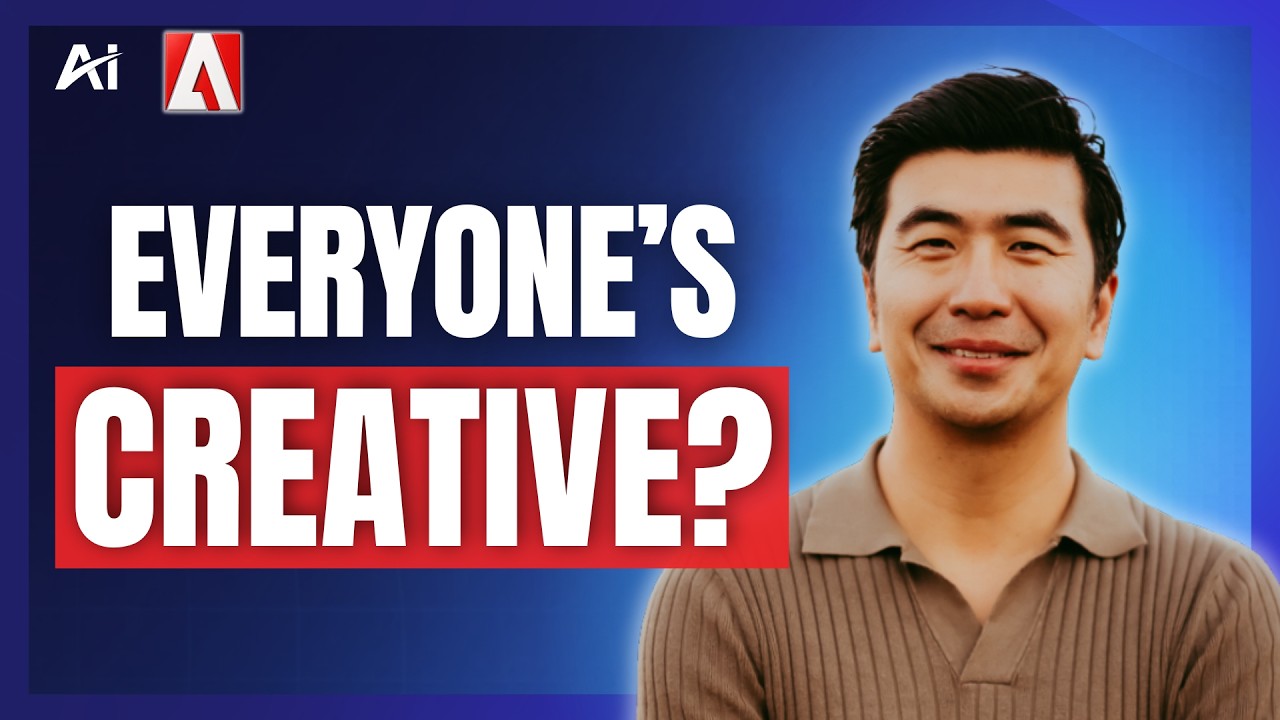

Watch on YouTube · Listen on Spotify or Apple Podcasts
Ian Wang, VP and Head of Product for Adobe Express, says everyone is creative, because creativity is really about having a point of view, and AI can help far more people turn their ideas into finished work. He tells host Liam Lawson why most people still use AI in a fragmented, copy-and-paste way, why enterprise creation needs brand context and governance, and why Adobe's coming conversational experience will still leave room for clicking and editing.
Key takeaways
- Creativity is having a point of view. Ian believes everyone is creative, and that people in any field, from journalists to bankers, succeed by combining a unique point of view with hard work. (03:30)
- Most AI use is still copy and paste. People use LLMs in a fragmented way, pasting between tools, so AI is not yet deeply reshaping work. Ian sees a massive opportunity there. (09:56)
- The assistant becomes a partner, not just a tool. The Express assistant can act as an advisor and subject matter expert that knows your brand, drawing on the expertise Adobe has built over 40 years. (09:56)
- From birthday invitations to the Fortune 500. Ian says Adobe touches more than 850 million users every month, so Express has to be easy to use from the bottom up while giving businesses deep enterprise and workflow controls. (12:14)
- Generated assets have to be accurate. A hospitality customer told Ian that a generated asset for its property in the Bahamas made up an additional bay that does not exist, which is why governance matters in regulated industries. (14:04)
- Conversation is the start, not the end state. Adobe is about to launch a fully conversational experience, but Ian says the magic is a hybrid: sometimes it is faster to click and type than to prompt. (18:00)
- Judgment beats lazy prompting. Without a point of view and real refinement, everything starts to look the same, which is how you get AI slop. (19:40)
Why does Adobe believe everyone is creative?
Ian Wang believes fundamentally that everyone is creative, and that creativity is much more than being good at taking photos, designing or drawing: it is about having a point of view. People in any field, whether journalists, photographers or bankers, succeed by combining that unique point of view with hard work.
That is why he sees Creativity for All as a great goal for Adobe. If everyone has a point of view, the question is how to maximize each person's impact, and Adobe's answer is expression in a visual or sensory way. Ian adds that many ideas are communicated far better when they are visual.
He knows the problem firsthand. As a product manager at Microsoft, he had plenty of ideas but struggled to communicate them and bring a broader team along. That pushed him into management consulting to build business acumen and learn to structure ideas, because, as he puts it, leadership is about rallying people together.
How did Ian Wang go from designer to Adobe product leader?
Ian Wang grew up in an artistic family, with a father who was an artist and a mother who was a composer, then discovered computers, coding and Flash in high school. He studied computer science and went to art school, studying film and design, and started a design and web applications business straight out of university before joining Microsoft.
Photoshop was part of the story from the start. His father used it, and Ian remembers the old welcome screen listing the names of the people who built the app and thinking he wanted to be one of them. He later used Photoshop, Illustrator and InDesign in design school, and now helps shape Adobe's products.
In between, he spent about five years in management consulting with an Australian boutique focused on corporate strategy, living in five or six countries, including six months in Dubai and time in Zurich, and working on agribusiness in New Zealand. He says the through line is a belief that you can combine the left and right brain, building depth in the arts, business and technology rather than taking adjacent roles, and thinking about everything from first principles.
What is Adobe Express?
Ian Wang describes Adobe Express as a quick and easy creation app and platform that lets people create standout, pro-quality content, made accessible to the masses. He groups that content into four types: design (brochures, flyers, invitations, banners), imagery (image editing and product shots), video, and productivity content such as presentations, longer documents and landing pages.
It is a platform as well as an app. Ian says Express capabilities run across the Adobe ecosystem and a third-party ecosystem: there is an SDK, it can live inside Acrobat, and Adobe powers the Premier League's fan engagement experience inside its app. The aim is to meet people where they are.
What is the AI aha moment for Adobe Express?
Ian Wang says most people now understand what an LLM does, but they use AI in their personal lives and work in a very fragmented way: copying from one tool, pasting into another and pasting back. That is not deeply reshaping work yet, and he sees a massive opportunity to change it.
His answer is an assistant that acts as a co-partner rather than a step-by-step tool. Beyond doing the work, the Express assistant can be an advisor and subject matter expert: if you want a product shot, it knows your brand and what works, and it brings the DNA and expertise Adobe has built over 40 years in a form that is easier to use day to day. Ian expects that bridge to be a big unlock.
How does Adobe Express serve both consumers and enterprises?
Ian Wang says Adobe touches the lives of more than 850 million users every month, a range that runs from someone making a birthday invitation for a grandson up to Fortune 500 companies. A mission to empower everyone has to be accessible from the bottom up, so the product must be very easy to use.
Inside businesses, the bigger problem is silos: pro and non-pro users, and different departments on different apps. Ian says Adobe is building an approachable layer underneath that everyone can use, but with deep enterprise and workflow controls, because in highly regulated industries governance is essential. A hospitality customer told him that a generated asset for its property in the Bahamas made up an additional bay that does not exist, which was not honest to its value proposition. Connecting the dots at that enterprise-grade level, without making the product unapproachable, is what excites him.
Will AI design tools become fully conversational?
Ian Wang says Adobe is very soon launching a fully conversational experience from start to finish, after releasing a number of assistants and sub-assistants in beta last year. The goal is to put the power of Adobe and its 40-plus years of DNA in your hands without you needing to know any part of the tool. Asking for a presentation in your brand format with a particular voice could remove the blank canvas problem and get you 80% of the way there.
But he warns against thinking in binary terms. Traditional, WYSIWYG editing does not go away, especially for high-stakes documents where collaborators come in. Sometimes it is simpler to click on an area and type than to ask an LLM to change a line. Ian calls the future a hybrid, using progressive disclosure so that every prompt saves you 20 steps until you want finer control, and he describes today's conversational experiences as a V1. He also sees partnerships with frontier model companies such as Anthropic as a new distribution channel, with Adobe bringing the domain expertise.
What skills matter most when AI can do the creating?
Ian Wang says having a point of view matters more than ever. Success comes from judgment calls, deciding whether to go left or right across hundreds of decisions a day. If you are lazy and just tell the AI to do it without refining, everything looks the same and you get AI slop.
People also form a point of view in different ways, which is why he does not see a conversational interface as the end state. Some people know what they want but need to see it: Ian's wife needed renders for everything during a renovation. Others are precise and language oriented. He says the tools have to keep people in the driver's seat while being multimodal, because people think very differently.
Why does Ian Wang do what he does?
Ian Wang says his work does not feel like work, because he gets to bring together everything he loves. Express was created from scratch only a few years ago, an ambiguous task that drew on his business experience, while he remains a designer at heart. Now based in Australia and running a global team, he gets up at 4:30 AM, and he says the people on his team bring creative outlets and passion to a product that changes very fast.
In his words
"I think creativity for all is a very great goal for this company because we believe everyone's creative, we believe everyone's got a point of view, but how do we maximize an individual's impact?" (05:45)
"Copy and paste from this thing, paste it in here. Okay, get some better ideas, paste it back." (09:56)
"Is it always efficient to tell the LLM, please change this line to blah? No, just click on the area and type, right?" (18:00)
"I think more than ever, having a point of view matters" (19:40)
"But I'm where I'm supposed to be, because I get to do all the things that I love and bring it together." (22:10)
Chapters
00:00 Ian's journey from designer to Adobe executive
02:00 Combining creativity, business, and technology
05:45 What "Creativity for All" actually means
07:44 What Adobe Express is and who it's for
10:00 The AI "aha moment" Adobe is building toward
12:15 Why context matters more than models
14:00 Serving everyone from consumers to Fortune 500 companies
16:05 Adobe's upcoming conversational AI experience
18:00 Why the future isn't prompt-only workflows
19:40 The skills that matter most in an AI-powered world
22:10 Why Ian loves building creative products
About the guest
Ian Wang is VP and Head of Product for Adobe Express. He studied computer science and went to art school, where he studied film and design, and started a design and web applications business out of university. He later worked as a product manager at Microsoft and spent about five years in management consulting with an Australian boutique focused on corporate strategy. He is based in Australia and leads a global team. Ian on LinkedIn
About the host
Liam Lawson is CEO of The AI Report and host of The AI Report Podcast. Meet the team
Full transcript
Edited for readability. Quotes above are word for word from the recording.
Liam Lawson: Ian, welcome to the podcast. All right, before Adobe, before Microsoft, before the NBA, I mean, I've done my research, come on. You founded Innovative Studios. Tell me more about that.
Ian Wang: You looked at my LinkedIn, so you know. Yeah.
Ian Wang (00:33): Look, I mean, so my dad's an artist and my mom was actually a composer, so I grew up in a very artistic family. Very helpful in some ways, also not helpful in other ways. Like, my dad could never help me with my math homework, for example. So I grew up always loving the arts. And I think in high school I discovered computers and coding and Flash and all of those things that are just very interesting to build. So creating a design agency was a combination of those things. I actually studied computer science and went to art school, studied film and design.
Before then, when I was in high school, I actually worked for a few agencies. It was better than working for fast food. It paid better than that. And so when I went to university, I was like, hey, I know all the best computer science and design students. Why don't I just create a business? And so that just happened out of university. I created a business and I was doing design and web applications for customers, and that's how it started. And then I got a real job. I went to Microsoft. But before that, that's what I was doing.
Liam Lawson: It must feel pretty circular, right? At that point you're using these design tools to build your business, and now you're the person on the other side of that, deciding what features go into the product that these business owners will use.
Ian Wang (01:58): Yes, yes. You know, I tell my team this. When I was a kid, my dad was an artist, so he used Photoshop, and I was so enamored with Photoshop when I first used it. When you first loaded up Photoshop, and this is back in the day, right, I don't know what version it was, it would show the welcome screen and it would show all the names of who built the app. And I was like, I want to be one of these guys. I never thought at the time that I'd work for Adobe, but it is full circle. Going to design school, I used all the products. I used Photoshop, I used Illustrator, InDesign, all of those things, and now I'm part of the company helping to shape the future there. So it's very exciting.
Liam Lawson: I'm curious about that through line. So we talked about that, we talked about the time at Microsoft, and then was it an M&A firm as well?
Ian Wang: Yeah, I also did management consulting, the typical McKinseys of the world. I worked for an Australian boutique that focused on corporate strategy. It's something you do when you're younger in particular. So I actually lived in five or six different countries during that time. I lived in Dubai for six months. I lived in Zurich. I did a lot of skiing at the time. I did agribusiness in New Zealand, which is an experience in its own right. Yeah, so I did that for about five years.
Liam Lawson: What's the through line between all of this, right? Because I'm seeing a lot of what seem like conflicting things to me: computer science, design, then working for an M&A firm, and then you're back in a design field. What is it about you that's got you in all these different roles in all these different countries?
Ian Wang (03:30): Yeah, I mean, a few different things. I think first, I always had this intrinsic belief, rightly or wrongly, that you could eventually use the superpowers of your left brain and your right brain, so to speak, and combine them. Having artistic parents, but really enjoying STEM and the sciences growing up, I was like, at some point I'll be able to combine them. And actually, at Adobe, I am combining them. But that was my intrinsic belief early on.
I wanted to find that intersection between the arts, business and technology. And so all my decisions were really about building depth of experience in each of those fields, rather than trying to find an adjacency. For example, I really wanted to learn strategy, and I was at Microsoft at the time. Obviously, Microsoft was a great place to grow up in, lots of mentors. And I also considered working in strategy within Microsoft. But that was too much of an adjacency, where you never really understand the purity of how to do something really well in that field. So instead I decided to go into a company that just specialized in that, to learn the tricks of the trade, so to speak. And eventually I thought I could bring it together.
But there's a common thread, which is fundamentally thinking about things from first principles. I just like solving problems and picking things up and asking. I mean, you do this a lot. You're ultimately trying to learn and ask these questions. And through asking questions, you also perfect the way you think.
Liam Lawson: I think I've used the phrase first principles about five times today in another interview. So it's definitely the way that I like to think. All right, something I'm curious about in your bio: creativity for all. Explain on a first principles basis why that works.
Ian Wang: Yeah, yeah. I think first of all, I believe fundamentally that everyone's creative. Often you can simplify that to, oh, you're good at taking photos, or you're good at designing something, or you're good at drawing. I think it's much more than that. I think ultimately creativity is about having a point of view. Anyone in any field is often successful because they combine a unique point of view, whether they're a journalist or a photographer or even a banker, whoever you might be.
Ian Wang (05:45): You combine your unique point of view with hard work. And I think creativity for all is a very great goal for this company, because we believe everyone's creative, we believe everyone's got a point of view, but how do we maximize an individual's impact? For a company like Adobe, our way to help is to maximize that impact through expression in a visual or sensory way, right? Whether it's sound or what you see, bringing all that together and helping people tell our story. So it's a very big call to action that I believe in, and so do a lot of the people on my team.
Liam Lawson: It seems to me, from my perspective, the thing you're solving for is confidence, right? For someone to want to express themselves, they want to feel confident in that. And because you're providing the tools that can get them from here's an idea to here's something that looks great, you're actually instilling confidence in the individual.
Ian Wang: And their impact, and the ability to communicate their ideas and get people to buy in and come along. Actually, a bit of a personal story related to your first question. I made the decision to move into management consulting when I was at Microsoft. I was a product manager; at the time, at Microsoft, they were called program managers, right, PMs. And the reason I did that was I had all these ideas, and I found myself struggling to communicate those ideas and struggling to bring a broader team along in a way that I thought was sufficient.
I realized early on that having business acumen and more effective abilities to communicate your ideas matters, because leadership is about rallying people together. You don't do things yourself. You really do it as a team. So I saw firsthand the importance of impact and communication. Management consulting is a field that's very focused on structuring ideas and structuring thoughts from a first principles basis and helping customers and clients, right?
Ian Wang (07:44): So that's what I hypothesized would be helpful for me, and I got a lot of personal benefit out of that. But coming to our mission at Adobe, a lot of people's ideas can be way better communicated if they're in a more visual way. A picture, they say, tells a thousand words. And we think that helps people level up their game for a bigger impact.
Liam Lawson: Adobe Express, for someone who doesn't know what it is: give me the message in a bottle.
Ian Wang: Yeah, it's a quick and easy creation app and platform, and I'll come to the platform in a minute, that allows people to create amazing content. We see it in four types of content. The first is design content. You hear a lot about design content here today: brochures, flyers, invitations, banners. You've got imagery, so image editing, that's a big one. If you're an e-commerce business, you have to do product shots, but there's also a lot of personal use for image editing. Video is a big source of content today; most of the world's content now is video. And finally, productivity: everything to do with presentations, longer-form documents, landing pages, things that you do for work as a knowledge worker, and how to better communicate your ideas, whether it's internally or externally. Those are really the big four when it comes to creation.
Ian Wang (09:56): And so Express really brings the ability to create standout, pro-quality content, but making it accessible to the masses. And it's an app, but it's also a platform, because we really are driving a lot of that capability across the Adobe ecosystem. We heard a lot about that over the last few days. But also with our third-party ecosystem, which I can talk to as well.
Liam Lawson: I think you're better equipped to answer my next question than anyone else. A big thing right now in translating AI to people is having an aha moment. For me, it was using Claude Dispatch and OpenClaw and understanding how functional this can be and how it can impact my life. And I'm curious, from your perspective, you speak to customers, you speak to users, you speak to your partners. What is the aha moment with Adobe Express?
Ian Wang: Yeah, I'm super excited about what all this innovation could mean for our mission with Adobe Express. I think today everyone understands what an LLM does and what a company like OpenAI and many of these players do, but a lot of it is in their day-to-day personal use or their day-to-day work, in a very fragmented way. Copy and paste from this thing, paste it in here. Okay, get some better ideas, paste it back. It's really not deeply reshaping work just yet, but there's a massive opportunity to do that.
With an app like Adobe Express, there are a few things. Number one, we used to have tools, and easier tools were things that were more step by step. They gave you a template. They were still tools. Now we have the ability to be that co-partner, that co-worker, that partner in your work. And the assistant is not only someone that can do your work, but also an advisor and a subject matter expert. So when it comes to creating great content, our Express assistant can actually tell you, okay, you want to do a product shot. We know your brand. Let me do that for you. And this is based on everything we've learned on the data side: this is what works. So it starts to really up your game and help you do a lot of these things. And secondly, it brings a lot of the DNA and expertise that Adobe's built over 40 years, and it can go deep into that sort of capability.
Ian Wang (12:14): But now it gives it to you in a way that is useful, right, and easier to understand. A lot of that is ultimately about making it really useful for your day-to-day work and being that bridge, which I think is going to be a big unlock for us.
Liam Lawson: I'll be honest with you, I'll be candid, right? Before I learned more about Adobe and what you were building, I was looking at Adobe Express and thinking, what's the difference between this and Canva? But through talking to you and talking to your executives, the importance of that context layer cannot be underestimated. All of that experience, the brand knowledge of the clients you work with in an enterprise context, is feeding so much into this that it just becomes so much easier. Talk to me about developing those relationships and how that feeds into the product eventually.
Ian Wang: Yeah. First of all, there are a lot of players in the market now in this creation game. They run across the gamut, and there's a new startup that emerges every day. Just to take a step back, Adobe today touches the lives of 850-plus million users every month. That's a lot, 850 million. And that's grown quite consistently. Over the last year, we grew 17% off of that base, off a base of 800 million, 50 million. 17% is a big number, and it will continue to grow. If you think about the 850 million number, that runs across the gamut, from your aunt doing her little birthday invitation for her grandson all the way up to Fortune 500 companies, and there's a lot of power in that spread. First of all, a mission like empowering everyone to create needs to be accessible bottoms up. That's number one.
Ian Wang (14:04): So we have to make sure that the application is very easy to use. And I say it's a platform because the Express product lives inside other places. We have an SDK; it can easily live inside of Acrobat. We meet people where they are. I don't know if you follow the Premier League, but we are powering the Premier League fan engagement experience inside of their app. And we have a lot of partners that we're working with right now to bring creativity to users where they are. So bottom up is a really important piece.
But then there's really growing with that user base. If you're in the enterprise or business context, it's really about breaking down silos, because that's the biggest problem, right? In the business context, you've got silos everywhere. You've got pro silos, you've got non-pro silos, and even within non-pro silos you've got different departments with different apps and so forth. So what we're trying to build is this very approachable layer underneath that everyone can have access to, but with deep enterprise controls and workflow controls, that only Adobe can do in a way that adds value to the customer. Because Adobe, as we heard over the last two days, is a massive player not only in productivity, but in creativity and in marketing.
And if you think about the content supply chain and the complexities of that, a lot of these industries are highly regulated, so governance is really important. Last year I was spending a lot of time with some of the hospitality customers, and they told me, Ian, we have to make sure every time we generate assets, it's accurate and it's towards our guidelines, because we have a property in the Bahamas, and we just made up an additional bay, and it doesn't even exist. That's not being honest to the value proposition, right? And you think about it, and you're like, wow, that's actually really, really important.
So really connecting the dots at that enterprise-grade level is something that I'm really excited about, but making sure that it's not unapproachable, because if it's just top down, that's not approachable. Our mission is to empower everyone. So we have that 850 million base and growing, and as people work into that ecosystem, when they're in a context which requires greater control, we can connect the dots. And I think that's what we're really excited about.
Liam Lawson (16:05): Let's talk more about that approachability and accessibility. I used to do a bit of video editing and a bit of design, so I used Photoshop and Premiere and stuff, and I found it difficult. It was a bit of a hump to get over. To be honest with you, this was 10 years ago, so it's different. I'm curious what's happening from a product standpoint to make that more accessible, to make it more user-friendly.
Ian Wang: Yeah. I mean, this is probably one of the most exciting spaces for us. We're very soon going to be launching a fully conversational experience from start to finish. We already launched a number of our assistants and sub-assistants at Max last year in beta, and we've been iterating and growing and learning from all the feedback. You can very quickly get to a point where the entire power of Adobe as a company and the 40-plus years of our DNA can be in your hands without you knowing any part of the tool. Right. And I think that completely changes the game in how you actually think about workflows, and how you think about how Adobe can be your partner in your goals. So for example, you could say something like, I'd like to create a presentation in my brand format to cover these goals, and I like the voice of XYZ. And we can immediately remove the challenge of the blank canvas problem and get you going, you know, 80% there.
But here's where people often like to be very binary about this: therefore it's just conversation, or therefore it's just that. The real magic is the hybrid of these kinds of capabilities. Does it mean that traditional WYSIWYG creation completely goes away? No. Because once you're focused in on a document that you're creating, a high-stakes document that isn't just transactional, you actually want to have collaborators come in. We still work as a team, right? You still need a focused state where you can actually work in that editor and do stuff.
Ian Wang (18:00): Is it always efficient to tell the LLM, please change this line to blah? No, just click on the area and type, right? So it's about that multimodal fusion of what still makes sense to click and type, what still makes sense to drag and drop, what still makes sense to do the way you traditionally do, and at what point. A lot of it is progressive disclosure. You might not want to do it immediately. We might give you something that you can look at straight away and iterate from, and every prompt actually saves you 20 steps. But at some point you might want to go deeper and have finer-grained control.
Bringing those different modes together in a way that makes sense is the magic of future user experiences. Think of the current conversational experiences as a V1 state, if that makes sense. And I think that's where we as a company can add a lot of value, because as we work with all these great partners like Anthropic or ChatGPT, it's a partnership: we have that domain expertise and they have these incredible frontier models. It's a new distribution channel for companies like us.
Liam Lawson: I want to tie a few different concepts that we've spoken about in this conversation into one thing: creativity for all, the idea of having a left brain and a right brain, and what we just spoke about here. This conversational experience sounds ideal to me. I'm not a person that can go on a laptop and figure it out; I'm not aesthetically inclined. So you're opening up a world of work that was previously unavailable to me. When you're thinking about creativity for all, and the different parts of the brain that can be activated, who do you think is most set for success in this new world of work? Now that these tools are available, what kind of characteristics, what kind of skill sets are most set up to actually engage with this new world of work?
Ian Wang: Yeah. I think, look, at the end of the day, again, coming back to first principles, right? What makes someone successful in general, outside of luck and hard work, which everyone refers to, is having a point of view. I come back to point of view. And so what is that? It's having a judgment call of, okay, I want to go left or I want to go right. We make hundreds of decisions every day, right? We iterate and get to an outcome. And I think more than ever, having a point of view matters, because if you're just being lazy and say, just do this for me, and don't really refine it, that's how you get AI slop. Everything's going to look the same, right? So really having that judgment call and saying, okay, I want to go in this direction, I want to go further in this direction, is really, really important.
But as a technology company, we also have to recognize that humans respond in different ways. So yes, they might have a point of view, but some people develop a point of view through looking at things visually. That's why I talked about the conversational interface as a V1; it's not the end state. In a lot of our experimentation, people kind of know what they want, but they need to see it. I just went through a renovation with my wife. She's a very visual person. She needs to see everything in renders. She can't really describe it. So for some people, the response is, do you want to go in this direction or that direction, visually, and then we iterate with them in a visual format.
Ian Wang (21:25): Other people can be very precise and prescriptive, and they're very language oriented, and I think a lot of people are different. So yes, we need to enable people to be in the driver's seat to direct, but how they do it, I think, is going to be multimodal, and we have to use different strategies because people think very differently, if that makes sense.
Liam Lawson: It does. I want to finish off with a personal question, something that I ask all of my guests. I encourage you to take five to ten seconds before answering. Everyone takes it a different way. Some people talk about work, some people talk about family, and it's completely up to you. Why do you do what you do?
Ian Wang (22:10): No, it's a great question. I don't feel like it's work, to be honest. And you've seen my bio, so it's like, why did you do all these random things? But I'm where I'm supposed to be, because I get to do all the things that I love and bring it together. And there's a lot of cross-pollination value out of it. With Express, we launched this only a few years ago. We created this from scratch. The task was ambiguous and it required me to draw on a lot of the business experience that I've built. I'm a designer at heart, and ultimately we're creating a product that specializes in visual aesthetics and communication.
Being based in Australia now, I have to get up very early. My team knows this, and they're like, how do you get up at 4:30 AM? But I like working on this stuff. It's very motivating. And I think this is the biggest part of why I'm proud of my team. To work on a product like this is such a rapidly changing environment. It's almost hard to keep up for any human being. You have to be very passionate about this. So a lot of people on my team, even engineers, are photographers on the side, or they have some random hobby like knitting, or whatever it might be. They bring a creative outlet and a passion to this job.
Liam Lawson: So you're saying you get up at 4:30 AM to work, not to run with the Bondi Run Club crews?
Ian Wang (23:44): So here's my problem. Someone asked me this this morning. I used to get up at 5:30 to do my workouts. Then when I moved to Australia, running my team globally, and luckily I have a global team, I said to myself, okay, it's just an hour difference. I used to get up to work out; I'll just get up an hour earlier. My workouts are now late in the day, and then it's competing with my son's soccer practice and all sorts of stuff. So I need to get into a better schedule, I think.
Liam Lawson: Ian, thank you for your time. Appreciate it.
Get the five-minute AI briefing
Join 400,000+ business leaders who start their weekday with The AI Report. Subscribe free
