

400,000+ business leaders (and teams at IBM, AWS & Zapier) start their day with The AI Report. 5 minutes. Plain English. No hype.
Denis Machuel, The Adecco Group: AI Agents in Recruitment
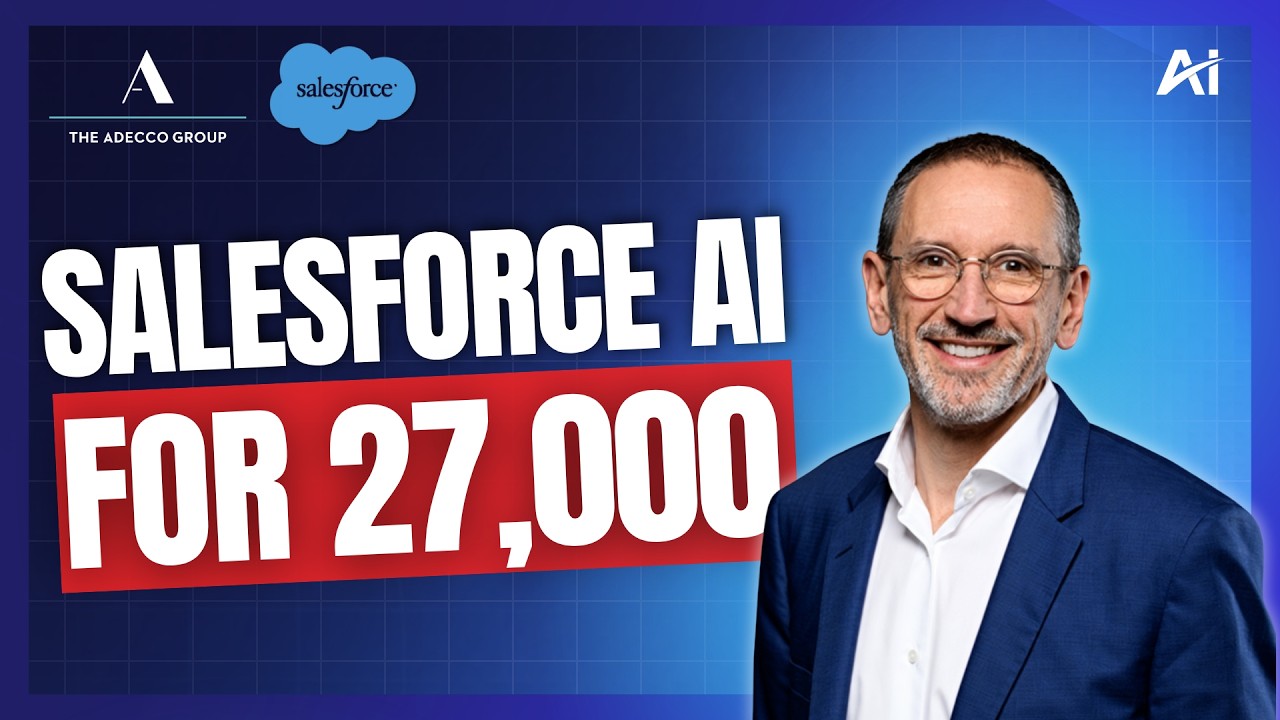
The Adecco Group CEO Denis Machuel on rolling out Salesforce AI to 27,000 people, and why half of its recruitment agent's early chats came after hours.

Watch on YouTube · Listen on Spotify or Apple Podcasts
Denis Machuel, CEO of The Adecco Group, says AI started paying off when the company stopped running pilots everywhere and scaled agents "narrow and deep" in its core process, recruitment. Recorded at Dreamforce 2026, he tells host Kyle Mair how Ada, its recruitment agent in the UK, handled half of its early candidate conversations outside working hours, and why the next challenge is orchestrating agents so humans step in at the right moments.
Key takeaways
- Narrow and deep beats pilots everywhere. After many AI pilots, The Adecco Group chose to scale agents on its core process, recruitment. (03:45)
- Half of Ada's early conversations happened after hours. At first, fifty percent of exchanges between the recruitment agent and candidates took place outside working hours, and candidate satisfaction was pretty high. (03:45)
- Language is no longer a barrier to scaling. Once agents are fluent, replicating them in other countries is easy, though cultural aspects still need care. (05:34)
- Coworker for 27,000 people. The Adecco Group was one of the first companies to sign Salesforce's unlimited deal and is deploying Coworker to 27,000 of its people, particularly recruiters. (06:37)
- Guardrails and unified data come first. A responsible AI charter sets guardrails, and having all its data in Data 360, which unites its Salesforce instances, has been fundamental. (08:41)
- Agents screen, recruiters connect. Agents now handle the hundreds of outreach calls and first-level screening, so recruiters spend more time on in-depth conversations and enjoy their work more. (12:09)
- Orchestration is the next challenge. Denis expects the coming year to be about agents working together smoothly, with humans in the loop where they add the most value. (22:26)
How did The Adecco Group make AI agents work in recruitment?
Denis Machuel says The Adecco Group started like many companies, with a lot of AI pilots everywhere, then decided it was better to go "narrow and deep" and scale agents on its core process, recruitment. It began in the UK with Ada, a recruitment agent that reaches out to candidates.
Denis admits he was a bit skeptical about how candidates would react. Two things surprised him. At first, fifty percent of the exchanges between Ada and candidates happened outside working hours, which gave people the flexibility to connect in the evening. And candidate satisfaction after talking to Ada was pretty high.
Is language still a barrier to scaling AI agents?
Denis Machuel says language is no longer an issue when rolling out agents across countries. The Adecco Group's core team for its first agents was based between Birmingham and Manchester. Once the agents had real fluency of interaction, replicating them in other countries became easy. Cultural aspects still need care, but language does not.
How are AI agents changing a recruiter's day?
Denis Machuel says agents now take on the outreach that used to fill a recruiter's day, leaving the recruiter to focus on in-depth conversations. Eighteen months ago, a client might ask for twenty profiles with specific skills in two weeks. To find them, a recruiter had to reach out to hundreds of candidates by phone and email, often without answers, before getting to the conversations that mattered.
Now the recruiter sends the agents. Over three, four or five days they reach out to people and check whether they are available, interested and have the right skills: a first-level screening. Meanwhile the recruiter can call new clients or have more qualitative conversations. Once the agents produce a shortlist, the recruiter can go into what Denis calls "the real human-to-human connection", digging into each person's motivation and context. He says recruiters tell him they enjoy their work much more.
How is The Adecco Group rolling out Salesforce AI?
Denis Machuel says The Adecco Group was one of the first companies to sign Salesforce's unlimited deal, which now includes Coworker, and is deploying Coworker to twenty-seven thousand of its people, particularly recruiters. He traces the partnership to a shared view that AI has to be "human centric", and says the rollout has created great appetite for adoption in a safe environment.
Safety matters because the company handles the personal data of millions of candidates. Since the beginning it has had a responsible AI charter to set guardrails, and having all its data in Data 360, which unites all its Salesforce instances, has been fundamental to its success.
Before the partnership, Denis describes AI use as individual and DIY, sometimes with personal ChatGPT accounts, with clear rules that company data could not be used there. Now the company is deploying in a professional way with clear intent on outcomes, and plans to measure productivity and quality more and more.
How will AI make recruitment more proactive?
Denis Machuel says the extra context agents gather on candidates will let The Adecco Group move from reactive to proactive. Instead of calling only when a role opens, it will be able to anticipate a candidate's aspirations and suggest an opportunity a few months out, acting more like a "career advisor" than a job provider.
The same applies to clients. As the company builds more insight into how the world of work is trending, it can help clients anticipate how their workforce will evolve, for example the profiles they will probably need in three to six months as technology develops, and work on the pipeline of talent to fill those roles.
How does The Adecco Group measure a successful hire?
Denis Machuel says The Adecco Group looks first at the speed at which it fills roles, because people who want a job want it quickly. It also tracks fill rates, client satisfaction, the retention of people it has placed and the satisfaction of those people. Cultural fit between a person and the work environment is fundamental, for example in environments with high safety regulations and constraints.
Is Europe behind the US on AI?
Denis Machuel says Europe is a bit behind on AI models, where the US is quite advanced and China leads on the other side, but not on adoption. He points out that the two CEOs Marc Benioff invited to his Dreamforce keynote, Roland Busch of Siemens and Denis himself, both lead companies headquartered in Europe. In his view, European companies have pretty much the same momentum in adopting and deploying AI as US companies.
On regulation, he says the US has a reputation for free markets and Europe for regulating a lot, and The Adecco Group advocates for something in between. The proper level of regulation might be useful, particularly as questions of AGI arrive, but fundamentally companies have a big responsibility for how they approach AI themselves.
What drives the CEO of The Adecco Group?
Denis Machuel says what gets him going is the company's purpose, to "make the future work for everyone". Profit and cash matter, he says, as the oxygen that keeps the body operating, but the purpose is what gives him the energy to overcome difficulties and to think about his responsibility to the millions of people who trust the company with the next chapter of their careers. The Adecco Group upskills and reskills more than a million people a year, and he sees agility as the fundamental value it brings to clients.
What will be obvious about AI agents a year from now?
Denis Machuel expects the big issue to be "the proper orchestration of agents". Many companies have deployed agents, but what will matter is how they work together smoothly. For a people company, that orchestration also has to bring humans into the loop at the right moments of a process such as recruitment, where they add the most value, because whatever AI is deployed, "it has to serve the humans".
In his words
"Of course you need to take care of some of the cultural aspects, but the language topic is no longer one." (05:34)
"Then you can go into what I call the real human-to-human connection" (12:09)
"The cultural fit between a person and the work environment is fundamental." (15:33)
"It's not only having the tech, it's how tech is really changing the work" (17:40)
"We have a great purpose, which is to make the future work for everyone." (20:20)
Chapters
00:00 Denis' background in computer science and AI
01:50 The scale of Adecco and the future of work
03:33 How Ada, Adecco's recruitment agent, works
05:22 Scaling AI agents across languages and geographies
06:19 Adecco's partnership with Salesforce and Agentforce
09:05 Moving from individual AI use to enterprise deployment
10:54 How a recruiter's workflow is changing with AI agents
13:34 From reactive recruitment to proactive career support
15:18 How Adecco measures the success of a hire
16:53 AI adoption in Europe versus the US
19:15 Regulation, responsibility and human-centric AI
20:12 What drives Denis as CEO of The Adecco Group
22:02 Why agent orchestration is the next big challenge
About the guest
Denis Machuel is CEO of The Adecco Group, a talent and tech company headquartered in Zurich, Switzerland. Its engineering business, Akkodis, supports clients on R&D projects, and its talent business covers recruitment, upskilling, reskilling and career transition. Born in France, Denis studied computer science, including AI courses, for his degree in France and the US, and moved into business early in his career. Denis on LinkedIn · The Adecco Group
About the host
Kyle Mair is Director of Partnerships at The AI Report. Meet the team
Full transcript
Edited for readability. Quotes above are word for word from the recording.
Kyle Mair (00:22): Hi Denis.
Denis Machuel (00:24): Hi Kyle, how are you?
Kyle Mair: Great, thank you. Thank you for finding the time to come and talk to me today on the podcast. I'm really interested to start with your background as a computer scientist many years ago, and how that ties in to your role today as CEO of The Adecco Group.
Denis Machuel (00:45): It's a pleasure. First of all, it was a long time ago, and I left computer science quite early in my career to go into business. But what's interesting is that as AI is now a super high priority for us and for so many other companies, I consider myself the one who has to ensure that we have the momentum on AI that's necessary to bring the company into the future. Of course, the AI courses I had when I got my degree, in France and in the US, are helping. AI has changed a lot. Artificial intelligence was very different years back. But it helps me frame and better understand what's happening, even though I have some distance from the pure technology. It helps frame the direction, and also understand a little bit of what all our tech partners are talking about in the conversations I have with them.
Kyle Mair (01:50): I want to give our audience a sense of the scale of your company. In my research, there are 300 million applications per year that you're managing. And also how AI can help scale that even further.
Denis Machuel (02:08): The Adecco Group is a talent and tech company. On one side we have an engineering business called Akkodis, which helps our clients on all their R&D projects. On the talent side, we cover the whole life cycle of people wanting to get to work, and all the HR and talent topics our clients have, from recruitment to upskilling, reskilling and career transition, all that kind of thing. What we do is intermediate the world of work and the world of people on a constant basis. We have a great purpose, which is to make the future work for everyone. In this particular moment, with the AI revolution coming in, what is absolutely critical is understanding the changes that are happening in the world of work, which are massive. I think it's a fantastic opportunity for us: on one side, accompanying our clients, who are sometimes a bit lost in translation in what is happening to the workforce and their organization with AI, and on the people side, making sure that we bring people along.
Kyle Mair (03:33): I want to touch on the keynote on Tuesday and the voice agent Ada. When was the first time you heard one of these AI conversations, and what was your reaction?
Denis Machuel (03:45): Very early, we tried to look particularly at the recruitment process. We started by doing a lot of AI pilots everywhere, like many other companies, and then we figured that it was better to go more narrow and deep and really scale agents on our core process, which is recruitment. We started in the UK with a recruitment agent that started to reach out to candidates, and this agent has been called Ada. What struck me was the quality of the interactions that were happening. I must say I was a bit skeptical at the beginning about how the candidates were going to like it or not. It turns out that at first, fifty percent of the exchanges between the agent and the candidate were happening outside of working hours. That means we were providing flexibility to the people we talked to, so they could connect with us in the evening if it was convenient for them. And second, the satisfaction of people after their conversation with Ada, our agent, was pretty high. So that was a surprise for me.
Kyle Mair (05:22): That's a real yardstick for how far AI has come. Being Scottish and having a thick accent, it can now understand me. It's definitely advancing at a fast pace.
Denis Machuel (05:34): Yes. We started to scale our agents in the UK, but not in Scotland: our team was based between Birmingham and Manchester. That's where we had a core team to start the work. What's been striking is that once your agents really have fluency of interaction, when you replicate these agents in other countries, of course you need to take care of some of the cultural aspects, but the language topic is no longer one. It's super easy to roll out agents in various geographies, and language is not an issue.
Kyle Mair (06:19): On your partnership with Salesforce, it was announced this week that you have Agentforce 360 Unlimited Enterprise. How has it been working more closely with Salesforce and Marc on this? And how does the Data 360 layer play into everything you do?
Denis Machuel (06:37): We see Salesforce as a great partner to us. Several years back, and that's what I was mentioning in the exchange I had with Marc during the keynote, we loved the fact that we had the same vision around AI: that the way we think about AI has to be human centric. As a people company, we want AI to be people centric. That resonated very well with Salesforce and their values, so that's how we all started. When the agentic momentum started, I believe Salesforce saw us as really trailblazing some of the technology. We were one of the first companies to sign this unlimited deal with them, which now includes Coworker. That's great, because we benefit from a whole suite. The reason we did that is that we could easily cascade and deploy Agentforce across our company and make it available to so many people. We've announced that we're deploying Coworker to twenty-seven thousand of our people, and our recruiters particularly.
That has generated great appetite for adoption. People want to try it and use it in a safe environment, and that's what's critical. Now to data: we deal with the personal data of candidates, millions of candidates who trust us. What's fundamental is to make sure that we operate in a safe and secure environment. Since the beginning, we've put in place a responsible AI charter, so that we have guardrails in the way we operate AI. And having all our data now in Data 360, which unites all our Salesforce instances, has been fundamental to our success.
Kyle Mair (09:05): It's amazing, the partnerships that are coming along in AI at the moment. Your partnership with Salesforce leads on to Anthropic. Before these partnerships, was there high adoption of the frontier models in the organization, whether that was OpenAI or Claude?
Denis Machuel (09:27): I would say there was more individual adoption. People were doing a little bit, sometimes with their own personal ChatGPT. We've been very clear that people can use ChatGPT for personal use, but of course they cannot use company data on that kind of thing, and we have good guardrails on that. I would say before, it was more of a DIY type of thing, and we are now really deploying in a professional way, with very clear intent on what the outcome is. We're going to measure the outcome more and more: the productivity and the quality this helps us generate. We believe that with Coworker we can totally reinvent that. As was presented during Marc's keynote, you can completely reinvent the environment in which our employees are going to work, and create many more great insights, be it for our salespeople, our recruiters or even our internal functions. We're super excited, and it has created higher momentum and a higher appetite.
Kyle Mair (10:54): I wanted to touch on the 27,000 recruiters. They're obviously a very important part of the organization. Today's a Thursday, so it's their Thursday morning and they're going into work. What did that look like 18 months ago compared to today? And what do you think it will look like in another 18 months?
Denis Machuel (11:13): That's a great question, because that was precisely the problem we tried to solve. Eighteen months ago, take this recruiter. He arrives in the office in the morning and receives an ask from a client saying, I need twenty profiles with this kind of skills in two weeks. To get these twenty profiles, the recruiter would have to reach out to hundreds of candidates, make calls, send emails, not get answers, and so on. Some people would want to call back after, or they are not available during the day. It was this very, very cumbersome task before the recruiter would actually be able to have a more in-depth conversation with the people he or she believes are the right people.
Denis Machuel (12:09): What happens now is that the recruiter sends the agents, and as I said, these hundreds of calls go on for three, four, five days. He comes in the morning, receives the requisitions from the client, then sends the agents. As the agents go, they reach out to people and check whether they're available, interested and have the proper skills: a sort of first-level screening. He can do other things. He can call new clients, or call candidates about more qualitative things. Once the agents have worked and come up with a shortlist of people, he can have much more qualitative conversations with the candidates, because all the mundane information has been collected. Then you can go into what I call the real human-to-human connection, where you go deep into the motivation of the person, the context in which they've been working, and so on. And what our recruiters are telling us is that they enjoy their work much more, because they do more of what they like to do.
Kyle Mair (13:34): And in the future, with the trend continuing?
Denis Machuel (13:36): What's going to happen is that we are now taking in so much more context around a candidate that we're going to be able to do two things. On the candidate side, we'll be able to really better anticipate their aspirations. Rather than being reactive and saying, when we have a need, hey, are you interested, we will be able to be proactive and say, hey, I have this in mind, maybe not for now, but this opportunity in a few months, are you interested? It will be more like a career advisor than just providing a job.
Kyle Mair (14:23): So it's the satisfaction of everyone involved, from the director to the candidate.
Denis Machuel (14:27): Exactly. And on the client side, because we will develop more and more insights on the way the world of work is trending, we're going to be able to be more proactive with our clients and help them anticipate the evolution of their workforce, saying, in three to six months you will probably need these kinds of profiles as technology develops, for example. Then we can proactively work on the pipeline of talent that can fill these roles in that timeframe. This is totally reinventing the business, from being reactive to proactively helping people in their careers and our clients with their workforce management.
Kyle Mair (15:18): When you're working with clients, what is the main KPI? It's not just getting people in the door to fill the role, it's getting the right fit. Is it the length of time someone stays, or what kind of metrics do you look at for the success of a hire?
Denis Machuel (15:33): First of all, we look at the speed at which we're able to fill roles. People wanting a job want it quickly, so we look at that. We look at fill rates: when we receive a requisition, what's the percentage of positions we're able to fill. We look at both sides: the client's satisfaction, are you happy, and the retention of the people who have started thanks to us. And also the satisfaction of the people themselves: are you happy with the environment, what's the fit? The cultural fit, and that's an important point: the cultural fit between a person and the work environment is fundamental. Some environments have high safety regulations and high safety constraints. You want to make sure that the people who work in these environments have the culture and the practices that fit. All these kinds of things are part of satisfaction, both on the client side and on the people side.
Kyle Mair (16:53): That's really interesting. In the same vein, in terms of culture, I want to talk about Europe and the US. I know you studied in the US, but you were born in Europe, is that correct?
Denis Machuel (17:08): Yes, I was born in France. And The Adecco Group is headquartered in Zurich, Switzerland.
Kyle Mair (17:15): I wonder about your opinion on technology and advancement in Europe and in the US. If you listen to the news, there's a lot about Europe being so far behind, but doing the research into The Adecco Group, you can see that maybe this is just the headlines. I'd love your opinion on Europe and the US overall.
Denis Machuel (17:40): It's a difficult question. It's definitely true that if you look at the biggest players in the pure AI world, you have the US, which is quite advanced, and of course China on the other side. On these models, Europe is maybe a bit behind, even though open source models are now quite developed at a bigger scale. The one thing which is interesting is the way companies adopt AI, because it's not only having the tech, it's how tech is really changing the work, right? And changing the companies. Look at this: who were the two CEOs that Marc Benioff invited to his keynote? Roland Busch from Siemens, a European company, and myself, a European company. We both operate worldwide, but we are headquartered in Europe. In Europe there is a momentum which I would quantify as pretty much the same in terms of how companies adopt AI, want to move ahead and want to deploy. So I wouldn't see a big difference from an adoption perspective between Europe and the US. It's true that on the pure tech side, with the LLM providers and so on, yes, they are...
Kyle Mair (19:15): But it's important to pick your battles, and almost to pause, wait to see where the technology goes and implement it correctly. I think that's what Marc was highlighting.
Denis Machuel (19:27): Right. I think there's this reputation of the US being more oriented to the free market, and Europe having a tendency to regulate a lot. We advocate for something probably in between. We believe the proper level of regulation might be useful, particularly as we enter into questions of AGI and that kind of thing. But fundamentally, I think companies have a big responsibility in how they themselves look at AI and how they embark on that journey.
Kyle Mair (20:12): I want to talk about you personally. As a CEO, what drives you to get out of bed in the morning and go run a company?
Denis Machuel (20:20): I mentioned earlier we have a great purpose, which is to make the future work for everyone. What gets me going and gives me the energy, like so many of our employees, is that particular purpose. Yes, of course, top line, bottom line, profit, cash: this is important, because it's the oxygen that makes the body operate. But fundamentally, when you have a bigger purpose, that is what gives you the energy to overcome the difficulties and to really think about the responsibility you have for the millions of people who trust us to find the next chapter of their career, to help them grow, to help them learn. We upskill and reskill more than a million people a year. This is fundamental. That's what gets me going.
It's how we support people to navigate their careers on one side, and on the other, the fundamental value that we bring to our clients, which is agility: the agility to ramp up resources, sometimes to ramp down, to become learning organizations. In R&D, with our engineering business, we bring the agility of R&D. We are a great actor that supports so many people and clients with this great purpose of making the future work for everyone. This is what gets me going.
Kyle Mair (22:02): You can tell you have a real, vibrant energy for your work, which is always admirable. I've got one final question. If we were to speak again next year at Dreamforce, is there something that isn't obvious today that you think will be obvious in one year's time?
Denis Machuel (22:26): I think from a technology perspective, a critical thing that many companies need to crack, and the tech needs to crack as well, is the proper orchestration of agents. Many of us have deployed agents, but what will matter is how all these agents can really work together in a smooth way. And on the other side, back to our foundations: we are a people company. What we believe is that the orchestration of agents needs to ensure that the human in the loop happens at the right moment in whatever process we have. We believe that human-centric AI has to make sure that humans come in at the moments of the process, whether it's a recruitment process or any other one, where they bring the most value. That requires a higher level of orchestration to really understand where these key moments are, where humans have to be there. Because we believe that whatever AI will be deployed, it has to serve the humans. Thank you very much, Kyle. Thanks for the conversation.
Kyle Mair (23:45): Thank you, Denis.
Get the five-minute AI briefing
Join 400,000+ business leaders who start their weekday with The AI Report. Subscribe free
