

400,000+ business leaders (and teams at IBM, AWS & Zapier) start their day with The AI Report. 5 minutes. Plain English. No hype.
Eli Bixby, Cradle: Active Learning for AI Protein Design
Cradle co-founder Eli Bixby explains why AI protein design runs on active learning, usually hitting customer goals within two or three lab rounds.
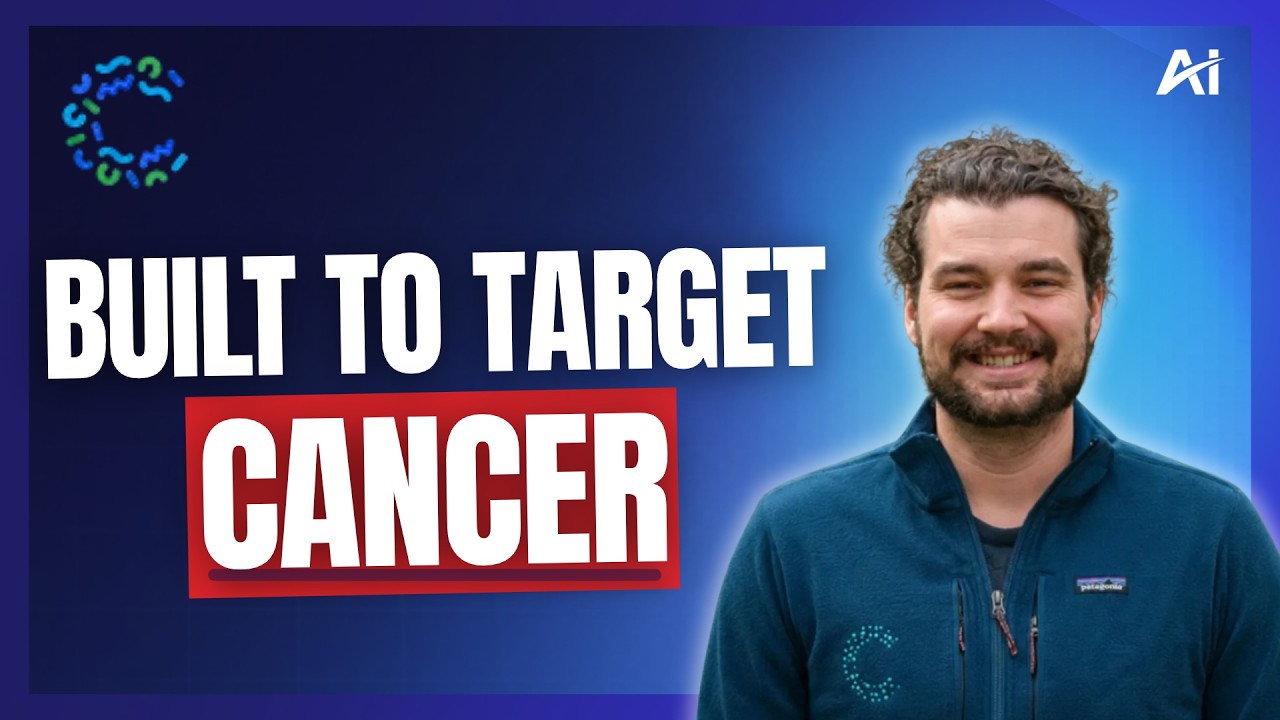

Watch on YouTube · Listen on Spotify or Apple Podcasts
Eli Bixby, co-founder and Head of ML at Cradle, tells host Liam Lawson that AI for protein design works differently from the LLMs most people know: Cradle's models recommend which experiments to run, learn from the results and usually reach a customer's goals within two or three rounds. He argues that biology's biggest data problem is that most of the data it needs has not been collected yet.
Key takeaways
- Active learning, not a static model. Cradle's models recommend which experiments to run next, retrain on the lab results and repeat. Eli says it usually takes two or three iterations at the outside to hit a customer's goals. (31:52)
- Most of biology's data has not been collected yet. Because of that, the choice of base model matters far less than in natural language, and Cradle's ablations on base models generally show no difference downstream. (27:44)
- The competition win came from careful tweaks. In a 2024 public protein design competition with more than 1,000 submissions from 130 teams, Cradle modified an existing protein with function-preserving mutations rather than designing from scratch, and improved it. (03:25)
- Customers define what good looks like. They bring the assays and the target values, such as one number of at least five and another of no more than two, and Cradle optimizes toward them. (09:38)
- A yearly subscription, no cut of the drug. Cradle charges by the number of projects a customer plans to run. One customer told Eli that about 40% of the things it takes into clinic end up in litigation over revenue sharing. (18:38)
- Engineered proteins are generally safer than the chemicals they replace. The body is well evolved to get rid of proteins it does not like, unlike molecules such as PFAS. (15:38)
- Biotech with five or ten people. Cradle's goal for the industry is a small team with a specialized wet lab, a network of contract research organizations and design tools. (26:14)
What is protein engineering, and what does Cradle do?
Protein engineering is the discipline of studying, tweaking or reimagining proteins so they do jobs nature does not already do, and Cradle, says Eli Bixby, writes the software platform that brings machine learning to the people doing that work. Eli describes proteins as incredibly sophisticated nanomachines that biology uses for most of the interesting things it does, from clean manufacturing and pest control to therapeutics and diagnostics.
Cradle's customers work in pharma, agriculture and industrial biotech. There are probably enzymes in your laundry detergent, Eli points out, and the requirements change by industry: a therapeutic must bind its target without binding healthy cells, avoid triggering the immune system and survive long enough in the body to work, while an enzyme put into a plant has to survive without killing it or changing how it behaves.
How did Cradle win a public protein design competition?
Eli Bixby says Cradle won by reading the rules literally: make a set number of modifications to a known protein, and the best performer wins. Some entrants redesigned the protein from scratch. Cradle took an existing protein, based on a therapeutic already on the market, and made changes meant to preserve its function. The design ended up improving it.
The goal was a protein that sticks more tightly to a cancer target, EGFR. Cancer cells can display their "rogueness" on their surface, Eli explains, and antibodies that recognize those surface proteins let the immune system attack the cancer cells. The design was zero shot: with no data on that target, the model used evolution's own sense of what keeps a protein's function the same.
How is scientific AI different from LLMs?
Scientific AI is about learning what nobody knows yet, while LLMs produce more of what already exists, according to Eli Bixby. He puts the question for scientific machine learning as "how well can these methods help us learn things that we don't know as a species?"
For years the field worked in a predictive mode, with AlphaFold as its pinnacle: predicting a protein's structure from its sequence. Cradle focuses on a generative mode in which the model recommends what data to collect next. Customers run those experiments, bring the results back, the system retrains automatically and designs the next round. Eli calls this iterative active learning and compares it to the scientific method itself.
Because biology happens in batches, on plates with 96 wells, Cradle also had to teach its models to design whole sets of experiments at once. On each round it retrains the model weights.
Why is most of the data biology needs still uncollected?
Most of the data biology needs is still uncollected because the measurements of properties that matter for a product, such as how long a protein survives in the body or what it binds to, have not been sufficiently collected, Eli Bixby says. Public databases hold something like 250 million observed protein sequences, which is enough to train a model on what a plausible protein looks like but not on what a customer means by good.
That is why Eli is skeptical of anyone claiming to solve these design problems zero shot. Cradle monitors this closely across many design problems and does not see it happening, which is why it chose active learning.
Why doesn't Cradle take a cut of the drugs its customers develop?
Cradle does not take a share of revenue because Eli Bixby sees it as a software design tool, and because revenue sharing ties pharma up in disputes. Customers pay a yearly subscription based on the number of projects they plan to run, and Cradle's experts help them as needed.
Eli cites a stat from one customer: of the things it takes into clinic, about 40% end up in litigation about revenue sharing. His comparison is that "AWS didn't get a cut of Netflix because Netflix used their load balancer". He hopes the model makes it more viable to be a smaller competitor in an industry he describes as an oligopoly.
How does Eli Bixby think about the ethics of building tools for pharma?
Eli Bixby says every technologist should ask how responsible they are for the fruits of their labor and how much control they have over it. Some categories are off the table: Cradle will not work on bioweapons. He sees many of the industry's systemic problems at the intersection of pharma and capitalism, driven by concentration, and hopes a tool-based business model encourages change.
He also says a heroic amount of effort goes into making drugs safe before they reach humans, with eight or ten completely different tests as proxies for how something will behave in the body.
What are peptides?
A peptide is just a short protein, Eli Bixby explains, sitting between small molecules, which act like the body's broadcast system, and proteins, which work like point-to-point communication and can be made incredibly specific. Peptides carry the drawbacks and the benefits of both. GLP peptides, for example, are broadly signaling molecules with some specificity in how they signal.
For his own health, Eli sticks to medically approved treatments used on label. His advice is "it's boring, but fiber, sleep and exercise".
Is AI repeating the mistakes of recommendation algorithms?
Eli Bixby worries that it is. He has worked in machine learning since 2014, when he started at Google, and calls these fantastic tools whose deployment is having very uncomfortable side effects for society. The race to the bottom is not new, he says: it was the story of recommendation algorithms, with consequences in device addiction and bubble building in society.
He thinks people who helped design these tools have a responsibility to ease that discomfort, and finds it odd that a tool which owes its existence to human expertise is being deployed in ways that undermine the value of human expertise.
In his words
"how well can these methods help us learn things that we don't know as a species?" (06:57)
"the story in biology is that most of the data that we need is uncollected" (27:44)
"usually it takes two or three iterations at the outside to do that." (31:52)
"AWS didn't get a cut of Netflix because Netflix used their load balancer" (20:02)
"I think everybody benefits when they try to figure out why something is hard." (49:56)
Chapters
00:00 What protein engineering is and what Cradle does
02:42 Winning a public protein design competition
05:28 Zero-shot design and iterative active learning
07:23 Predictive AI like AlphaFold versus generative design
09:19 How customers define what good looks like
12:10 The many requirements behind a successful protein
15:04 Are engineered proteins safer than the chemicals they replace?
16:58 Cradle's business model and why it skips revenue sharing
21:14 Wrestling with the morality of the work
24:29 Who can use Cradle and the future of small biotech teams
27:05 Inside the models: from 250 million proteins to useful designs
32:04 Retraining models and designing experiments in batches
33:43 What gets tested before a drug reaches humans
36:42 Cradle's founding vision
38:28 Self-experimenting, and how AI has shaped Eli's outlook
41:36 Is AI repeating the mistakes of recommendation algorithms?
43:51 Fiber, sleep, exercise and what peptides actually are
49:24 What Eli wishes more people understood about biology
51:25 Why Eli does what he does
About the guest
Eli Bixby is co-founder and Head of ML at Cradle, which builds a software platform that brings machine learning to protein engineers in pharma, agriculture and industrial biotech. He has worked in machine learning since 2014, when he started at Google. Eli on LinkedIn · Cradle
About the host
Liam Lawson is CEO of The AI Report and host of The AI Report Podcast. Meet the team
Full transcript
Edited for readability. Quotes above are word for word from the recording.
Liam Lawson (00:00): All right, Eli, welcome to the podcast.
Eli Bixby (00:03): Thanks for having me.
Liam Lawson (00:05): We're going to take a trip back to what is now 10 years ago for me and have basically an hour-long biology lesson, perhaps more in depth. I have a lot of personal curiosity about this, but I want to start off with something simple. Imagine we're at a dinner party somewhere. I work in marketing, I run my company, and I turn to you and say: what is protein engineering? What do you actually do for work? What is Cradle? Take me from there.
Eli Bixby (00:39): I think starting with what protein engineering is, and maybe even backing up to what proteins are and why we care about them, is a good idea. They're these incredibly sophisticated nanomachines that biology has built to do most of the interesting things that biology does. If we want to do things the way biology does them, like clean manufacturing, pest control and so on, and if we want to interact with biology when we're building therapeutics or diagnostics, proteins are one of the best tools we have. So that's the why you should care about proteins.
Protein engineering is about the fact that nature doesn't do all the things we would wish it does. So sometimes we need to tweak proteins, or even completely reimagine proteins that don't exist in nature. Protein engineering is this discipline of saying: we have proteins, we can study the ones that already exist in nature and try to use them to do different things, but we can also tweak them, or build designs inspired by proteins, and use that to accomplish whatever task we're hoping to accomplish.
As for what Cradle does and why machine learning is relevant: this is an incredibly hard thing to do, and any little edge you can get is one you take. Machine learning has shown a lot of promise in the last few years in helping with this task across a variety of areas. So basically Cradle writes a software platform that provides machine learning to the people who are trying to do this.
Liam Lawson (02:42): I want to bring this in to land for a lot of people. I was doing my research beforehand and looking into the competition you did in late 2024, the Adaptyv Bio public design competition. From what I understand, there were over a thousand submissions from 130 teams. You ended up winning it, and it was for designing a protein that could stick tightly to a cancer target. Can you talk about the significance of what you actually did there? Because you're designing proteins that can literally help cure cancer, if I understand correctly.
Eli Bixby (03:25): Yeah, I think that's the idea. In that competition specifically, the rules were basically that you need to make a certain number of modifications from any known protein, and the protein that performs best will win. We took that very literally. Some other people took it to mean they had to completely redesign the protein from scratch. But we took a protein, we tweaked it, and we made those tweaks with the goal of preserving function, and ended up improving it. I think this is where you see the initial bifurcation between optimization and what you might call de novo design.
Ultimately, in this kind of competition, you're trying to get something that sticks more tightly to the target, whatever it is. In this case, cancer cells have gone rogue, and sometimes they show that rogueness on their surface in a way that lets you get antibodies that recognize those surface proteins. Those antibodies then allow the immune system to attack the cancer cells. There are a bunch of different ways of solving that problem, but that's one of them.
Stepping back from this particular therapeutic, and our design is based on a therapeutic that's already on the market, there's a question about benchmarking in these public competitions more generally, and how good a job they do at representing the state of progress in the field. That's also interesting to dig into. So there are a bunch of directions we can go from there.
Liam Lawson (05:28): Talk to me about the benchmarking. Did you zero-shot this when you were making the design?
Eli Bixby (05:34): Yes. This is why I said we were making these mutations with the goal of being function preserving. When you don't have any data, you don't really know what good means. It's not like we'd shown this model binding to this EGFR target. We just have a model that generally has a concept of function preserving, and it uses whatever evolution's concept of function preserving is. So it says: this is how evolution would continue to evolve this protein if it were trying to keep the function the same. That's what the zero-shot design protocol looks like.
Eli Bixby (06:02): Then, if you use Cradle, you come back with the data that the zero-shot design, which we call our diversification functionality, asked you to collect. You bring that back, the system automatically trains models, and you can use those models to design another round. So it's iterative active learning. This is really where you depart from the AI that's in the mainstream, which is these very static models based on the sum total of stuff on the internet.
Eli Bixby (06:57): I think this is part of what makes scientific ML so interesting to me. You're really asking how well these methods can help us learn things that we don't know as a species. That's a very different regime from asking how I can produce more of the stuff that's already out there, which is the regime these LLMs are operating under.
Liam Lawson (07:23): To make sure I'm understanding this correctly: the companies before this, AlphaFold for example, were using what existed currently and making iterations of it. What you're doing is trying to preserve the function but design something entirely new. That's where the demarcation lies.
Eli Bixby (07:45): The amount of newness becomes a philosophical question pretty quickly. But ultimately the field has for a long time been in a predictive mode, and you can see AlphaFold as the pinnacle of that. Predicting a protein's structure from its sequence was one of the hardest predictive problems in biology, and AlphaFold was a huge improvement in our ability to do that.
Eli Bixby (08:15): What we really focus on is a generative mode. People use the successor models of AlphaFold to do generative design, and we also use them for generative design sometimes. But the idea is that you're making recommendations about what data to collect towards solving a problem. That's a fundamentally different way of using machine learning than, for example, LLMs. They are also doing something generative, but the difference is the active learning context, where you're really trying to recommend the best set of data to collect in order to progress towards your goal.
Liam Lawson (09:19): I'm wondering how you codify this. You mentioned that the goal was, if we took evolution ten iterations forward, that's what we're aiming for with this zero shot, right? How do you actually codify that into the model, or around the model, to work in that manner?
Eli Bixby (09:38): Sort of. For the initial bit, where we're using evolution as a guide, the great thing about going and collecting data is that our customers actually get to tell us what matters to them. They get to say: I care about this value for this assay and this value for that assay. I want this number to be at least five and this number to be not more than two, and so on. Then we get to depart from what evolution cared about and start going into the real engineering.
Eli Bixby (10:08): What that looks like is that the customer is really the expert in their problem. They've done all of the literature review. They've designed this target so that it's easy to work with in the lab. They've developed the assays and made sure they work well. They come to us, and we say: what does your assay panel look like, and what are the values you need to hit in order to turn this into a product that goes out into the world?
Liam Lawson (10:45): Sorry, can I stop you? Assay panel, can you explain that for me?
Eli Bixby: Assay is just scientist for test. The very simple version is that we put some clear liquids into a box, and it spits out a number.
Eli Bixby (11:06): When you think about what microbiologists are doing in the lab all day, a huge amount of it is developing tests. There's a famous analogy that biology is like finding an alien radio in a field somewhere. You have no idea how any part of it works, you only have one of them, and you have to figure out how to take it apart without breaking it, while also understanding what it does. So it's an incredibly tricky problem to develop these assays, and we really want to leave that expertise in the hands of our customers. They're really expressing what they want from the optimization algorithm.
Liam Lawson (12:10): What would they want? Can you be specific about what exactly they'd be looking for?
Eli Bixby (12:14): There are all sorts of problems. In a therapeutic context, you want something that's functional, but you also want something that's safe. You want something that binds, for example, to the target on the surface of the cell in the EGFR example we were talking about. But you don't want something that binds to the surface of healthy cells, because you're going to recruit the immune system to kill the cells that are bound. You also don't want something that causes your immune system to panic, think it has an invader and start attacking your healthy cells. You need something that survives long enough in the body to actually work as a treatment. And if you're receiving it orally, you need something that isn't digested by your digestive system. If the drug in that pill gets eaten by your digestive system, you don't get any benefit from it.
So there's an incredibly large number of requirements, and that's just our pharma clients. We also work in agriculture and in industrial biotech. There are probably enzymes in the laundry detergent you use. Like I mentioned, there's a huge list for pharma and another big list for industrial biotech. For laundry detergents, the ultimate test is putting it in a laundry machine and seeing if it works better, but there are lots and lots of tests they run leading up to that. Similarly, we've had agriculture customers putting enzymes in plants for various applications. There, it has to survive, it has to not kill the plant, it has to not change how the plant behaves, and it has to still be safe. So there's a whole huge list of requirements around these products.
Liam Lawson (15:04): Can I ask something? I remember watching the movie Dark Waters, the one with Mark Ruffalo about forever chemicals and PFOAs. I'm curious about regulation around the lifespan of these proteins you're creating. Did that come in after an event like that? Can you ever really know the long-term effects of these proteins and peptides, or is it a guessing game?
Eli Bixby (15:38): Biology is complicated, and giving definitive answers is hard. One thing I will say is that, in comparison to the chemicals they are replacing, they are generally much safer, because the whole natural world has been trying to do things to each other with proteins for a long time. Your body is exquisitely well evolved to get rid of proteins it doesn't like. Whereas if you look at something like PFAS, it's a molecule shape that your biology has no experience interacting with and no metabolism evolved to destroy. So I think these are generally much safer than whatever chemicals they're replacing, and that's basically owed to the fact that these are the tools nature uses to do these jobs, for the most part. In fact, in a therapeutic context, one of the biggest challenges is getting these proteins to stick around long enough to do the job we're asking them to, because the body is so efficient at getting rid of them.
Liam Lawson (16:58): I'm curious about the business model. Imagine I'm your accountant for a second. A pharmaceutical company signs up for your platform. What are they paying for exactly? Is it a subscription, a per-project fee? And where does the handoff of liability come? At what point do you give them the results and they take them and do what they want with them? Are you involved in licensing?
Eli Bixby (17:26): We're a software design tool. They pay for a subscription, and that subscription is based on the number of projects they plan to run with our tool. With that subscription, we have experts who will help them figure out the best way to use the tool. We have some customers who have been using us for a while and are relatively hands-off, running large numbers of projects by themselves. So it's a yearly subscription, and we're there whenever they need us. There's not a handoff. This is a very novel interaction mode for pharma, for tools that are involved in the design loop to the extent that we are. There are some oldies but goodies that follow a similar model, but we're really trying to stay in this tool-based software regime.
Eli Bixby (18:38): More broadly, pharma really suffers from the problem that everybody wants a piece of the upside, and that makes it really hard to get anything done. There's a stat I heard from one of our customers: of the things they take into clinic, they end up in litigation about revenue sharing for about 40% of them. That's just not a world we're interested in engaging with as founders. We want to make a useful tool and sell that useful tool to people for money, and we think that's reasonable. But it is a strange one in terms of business models in pharma.
Liam Lawson (19:29): My business mindset would be that I'd want one percent of the licensing deal. If Johnson & Johnson comes to you and says they're going to use your platform, and they design some new drug, maybe a new peptide, and I want to get into peptides in a second because I'm thoroughly confused by them, and it ends up making billions of dollars a year, you've been paid X amount for the tool but they've got all the upside. It doesn't seem wise financially, but clearly it's working.
Eli Bixby (20:02): I think the hope is that, over time, smaller companies will become more and more viable as more folks take this business model. To some extent, it's being the change you want to see in the world. This is not how any other industry operates. AWS didn't get a cut of Netflix because Netflix used their load balancer. It's a bit odd. There's so much that goes into making a drug, and anyone claiming to be the definitive element of that incredibly complicated process has quite a lot of hubris, I think. Ultimately there is a huge upside, but there's also a massive downside, and your ability to say how much you're moving the needle one way or the other is pretty limited in the long term.
Liam Lawson (21:14): I want to jump into the plumbing in a second and talk more about the models, the software and the technology you've developed. But where my mind goes is how you wrestle with the liability and the morality of it. Most of these pharmaceutical companies are incentivized to do two things. One, make money, and they probably make money by making drugs and products that are most useful to the end consumer and bring a positive benefit. When you work with these companies, they pay to use your tool to develop something new and sell it to the market. Presumably that's a positive thing for the environment, for people and for the human race. There's also the possibility that it goes the other way: they develop something that's not beneficial, or only beneficial for a few people. How do you wrestle with the morality of that?
Eli Bixby (22:21): That's a great question. It's a question every technologist should be asking themselves: how responsible am I for the fruits of my labor, and how much control can I exert over that? There are some categories, like bioweapons, that we are not going to work on. More broadly, are there systemic problems in the pharma industry? Absolutely. Honestly, a lot of those problems are at the intersection of pharma and capitalism, and they're made better if it's viable to be a smaller competitor. A lot of those problems are due to the crazy concentration in the pharma industry, the fact that you have this oligopoly. What I hope, at least, is that we have a business model that encourages a little bit of change in that direction within the industry.
Eli Bixby (23:49): For me, that is worth doing. We also get to ensure that a lot of great science gets done along the way, and there are downstream benefits from that science that we may not know about, aside from the product that gets created. That's how I think about your broader question. But certainly there are moments when you feel the system is not behaving the way we'd like it to.
Liam Lawson (24:29): Fundamentally, you're democratizing access to tools for developing new proteins and drugs. How would that work? Say I came to you tomorrow and said I want to use the wet lab to run an experiment and design something new. How much knowledge, experience, credentials and money does someone need to work with you?
Eli Bixby (24:52): Well, you have to have your own wet lab. That's the starting place, because our wet lab is reserved for methods and model improvements. We don't do contract work in our wet lab for customers. It's entirely to A/B test different versions of our algorithms or to improve our models. That already is enough of a filter.
Eli Bixby (25:17): There are other people working on the other side of this problem. There's a company we've worked with a little bit called Adaptyv, in Switzerland, which is doing this for a specific set of assays: they have a software service where you can just order the assays. The democratization, if you will, of access to manufacturing DNA and proteins has been ongoing for a long time. There are a couple of companies where anyone with a credit card can go and order some DNA. If you try to order the smallpox virus, you might get flagged by some systems there. So we're not single-handedly doing this. A bunch of people are working on the broader problem of how to give the pharma industry the low barrier to entry that some other industries, like consumer tech, have.
Eli Bixby (26:14): We talk internally about the future we'd like to see in biotech, which is that you could get a lot done with a five or ten person team, with a small specialized wet lab that's maybe running your unique assay, and then a network of CROs and design tools. A CRO is a contract research organization: fee-for-service labs, basically.
Liam Lawson (27:05): Can you take me into the plumbing? I've done a bunch of podcasts recently with people trying to build mathematical superintelligence and imbue some sense of truth into these AI models. The lesson I'm learning about LLMs in general is that fundamentally they are predictions. I'm curious how, when you're trying to infuse some degree of originality and generate something new, that actually works on a technical level. Take me through everything. Are you using your own models? Other models? What software and tech are you building around that?
Eli Bixby (27:44): For quite a while now there have been, at the very bottom level, these unsupervised protein language models or protein structure models, and now lots of models that do both. Those are what kicked off this whole field to some extent: the ability to use all of this unsupervised data that's lying around to build models that understand the basics in a plausibility sense. There are a lot of analogies to the LLM world. The real challenge then becomes, to use the LLM analogy, what should it say? That's where you go into a design space.
What we do is take these base models and run a lot of ablations on which base models to use and whether it's useful to add data here or there. The story in biology is that most of the data we need is uncollected, which means the base models matter a lot less than in a domain with a lot more collected data, like natural language. So generally these ablations turn up negative results: we don't see any difference downstream. We take these models and specialize them to the local problem space you're working in with your protein, using a smaller slice of this basic, unsupervised protein data.
Eli Bixby (29:33): When I say unsupervised data: scientists have done the heroic work of curating all of this DNA data that you can turn into proteins, because that's what biology does. It takes DNA, turns it into RNA and turns that into proteins. So if I see this DNA, I know this protein was out there. They've curated it all into massive databases with something like 250 million different protein sequences that have been observed out in the world. You can take all of that unsupervised data and train a model that knows what plausibility is like. That's our starting place.
Then you have to specialize that plausible model to be useful. You have to go from plausibility to whatever the user's concept of goodness is, and this is where the data has not been sufficiently collected. There are a lot of axes to the design problems I was talking about earlier. How do we make it stick around in the body? How do we make it bind to the things we want it to bind to and not to the things we don't? For a lot of these design problems, there's not enough data to do this zero shot. There are some people out there claiming they've got there, or that they have a method to get there, and this is where I start to get really skeptical, because we monitor this pretty closely across a lot of design problems, and we really don't see that being the case. That's why we've landed on an active learning approach.
This has a lot of symmetry with the process of doing science, or really the process of learning about anything. If you don't have the knowledge you need, you have to think about what knowledge you need to go out and acquire, and the most efficient way to do that. So we make a recommendation: here's the set of things we think you should test in your next batch of experiments.
Eli Bixby (31:52): When you have that data, bring it back and we'll update the models accordingly, and we'll keep doing that until you hit your goals. Usually it takes two or three iterations at the outside to do that.
Liam Lawson (32:04): What exactly are you updating on the models? The weights and biases? The data set? Tell me more about that.
Eli Bixby (32:09): We're retraining the weights. In terms of the actual modeling, there are a few innovations. We have some clever ways of putting all of this data into one model, rather than having a bunch of models you need to take a census of. The other thing that's really critical is that we do plate-based design. Biology fundamentally happens in batches. There are these 96-well plates, which look nothing like a dinner plate: a little plastic square with 96 dimples in it, so you can run 96 experiments in parallel. More fundamentally, because biology is so noisy and so complex, you generally want to do a lot of experiments at once. So one of the questions we had to answer was the right way to guide this experimental design question, and that's something we also have to instruct our models how to do within that training. Dealing with that has been one of the challenges we've had to overcome.
Liam Lawson (33:43): You mentioned the 96 plates. I might sound like an idiot here, but I'm going to say it anyway. I'm curious what you're actually testing on. You said at the start that these proteins are being developed for a bunch of different things: some for crops and plants, some for humans. In my mind, the best way to test these drugs would be on the subjects themselves, but you can't just test random drugs on humans. So what is actually in those plates, what are you testing, and is there a future where we can recreate the human body and test drugs on that directly?
Eli Bixby (34:32): This methods development I was talking about: biology, like everything else, has to contend with the fast, cheap, good triangle. In methods development, you can choose to do something quickly or in high throughput, you have a certain budget, and the test has a certain quality as a proxy for the downstream phenomenon you care about measuring. That's why methods development is such a big part of biology. And as you mentioned, in the clinic they won't let you put just anything in a human. You've got to convince them. The way you convince them is by showing a bunch of numbers across a bunch of tests that the FDA recognizes as good enough proxies for how the thing will behave in humans. At the limit, those tests are what's in these little dimples.
Eli Bixby (35:53): Because humans are so complicated, you don't run one set of tests. To have a good proxy for how something will behave in a human, you need to run eight or ten completely different tests of completely different properties, because there are so many ways it can go wrong. Our comments about the pharma industry earlier aside, there is a heroic amount of effort going into making sure these things are safe when we put them into humans. It's a testament to how hard the problem is that we're still wrong sometimes.
Liam Lawson (36:30): You previously worked at Google for a long time before this, right? What was the vision when you co-founded Cradle with your co-founders? How has that changed over time, and what does it look like going forward?
Eli Bixby (36:52): It has stayed relatively consistent: we want to build a tool that's really useful for this particular set of problems in biology. We had, and still have to some extent, a bioindustrial vision from the start. That's where a lot of us came from. The problem is that it's a pretty fledgling industry, and it doesn't have enough money to support the amount of technology development we need to do. So we expanded to pharma, and we've also found pharma to be fascinating and a good place to apply this technology. So the vision has been relatively consistent, as far as startups go. The goal is to have a lot of users and scientists benefiting from this tool, and then downstream, a lot of humanity benefiting from it. And as I mentioned at the outset, doing things more like the way nature does them has a net positive impact on our health, the planet's health and so on.
Liam Lawson (38:28): I want to know how your professional experience and knowledge have infused your personal life on a few levels. One, AI. Two, you're truly aware of how different proteins, peptides and drugs work. I'm wondering whether you've experimented with experimental drugs or peptides on a personal level to improve your life. Peptides are all the rage right now, and I want to get into how they work in a second, but I'm curious what that looks like for you.
Eli Bixby (39:14): When you've been part of the early safety testing process for drugs, the idea of becoming a stage one guinea pig for yourself, by yourself, with no one requiring you to or paying you to, seems pretty insane to me. Randomized controlled trials are the standard for a reason. There's a lot that can go wrong, and you don't always know it's going wrong until it's too late. So for the most part I stick to medically approved things, for on-label usage.
On the other part of your question, how AI has infused my life: it's been a really interesting industry to be part of. I started being involved in machine learning in 2014 at Google, so over the last 12 years I've seen the change in the industry and how it has interacted with the outside world, in both positive and negative ways.
Eli Bixby (40:48): I think it's made me a bit more conscious of the questions you brought up earlier: how do you know whether the impact you're having is positive? I think these are fantastic tools. But the way they're being deployed is having some very uncomfortable side effects for society, to borrow a drug analogy. And particularly as technical people who contributed to the design of these tools, I think we have a responsibility to ameliorate that discomfort.
Liam Lawson (41:36): I don't know if you've been paying attention to the media, Twitter and YouTube recently, but there are a bunch of people who have recently left OpenAI, Anthropic and other frontier labs saying we're all racing towards zero: that there aren't many safety protocols in developing these models and it's a race to the bottom. They've been offered million dollar pay packages to stay on and not say anything. A lot of researchers are coming out saying we don't really have a direction, we're just going to see what happens.
Eli Bixby (42:11): And this isn't new with AI, by the way. This was the story with recommendation algorithms. You've seen the consequences of the race to the bottom there in our addiction to our devices and, more generally, in the bubble building in society. It's concerning that we seem to be repeating our prior mistakes as a society. I don't really know what to do about that as an individual, other than say out loud the things I know to be true.
Liam Lawson (42:52): There's not much you can do, right? You can best educate and prepare yourself, but there's not a lot you can do as an individual. I guess there are different incentives for the individual this time around. With social media, the incentive for the individual was easy dopamine, gratification and social connectedness. That was the promise. But with AI it's much more of a commercial opportunity. The promise of AI for most individuals is that you'll make more money and your life will be easier because AI is going to take the work.
Eli Bixby (43:33): And for a tool which fundamentally owes its existence to human expertise, being deployed in a way that undermines the value of human expertise is an odd choice.
Liam Lawson (43:51): Taking things back to a personal level. You said you only use approved pharmaceuticals, because why would you be the first guinea pig? But I'm curious about other things, maybe tinfoil hat theories about how you conduct yourself. I look into this a lot. I'm very curious about how the body works and how it affects my mental state. I've been looking into the gut-brain axis and the vagus nerve. I'm very careful about the water I drink, the chemicals in it, and whether my deodorant has heavy metals in it. Having such a deep understanding of biology, how do you conduct your everyday life to guard against this?
Eli Bixby (44:43): I mostly try to listen to people who know a lot more about this stuff than me, and it's boring, but fiber, sleep and exercise. We know a lot about how good those three are, and we've never had anything bad to say about them. That's where I'd start. There's not really much else, advice-wise, that I try to adhere to. It's a boring answer, unfortunately, but that's where I am.
Eli Bixby (45:11): Don't get me wrong, peptides are a fascinating area of research and a fascinating new class of drugs, and we actively work with companies developing peptides.
Liam Lawson (45:46): Can you explain what a peptide is? What does it do, why is it classified as a peptide, and how does it work in the body?
Eli Bixby: A peptide is just a short protein. Think of a spectrum. Small molecules go everywhere. They say very general things; they're the broadcast system of the body. Proteins are more like point-to-point communication. They can be made incredibly specific. The immune system, which is like the police state of our body and gets to say what is and isn't you, uses proteins to recognize everything. Everybody's got an ID badge, and you get your ID badge scanned. That scanner is a protein, and the badge is a protein. If you really need specificity, you go to proteins.
Eli Bixby (46:38): But proteins are big, they're slow to move around, they're very fragile, and it's expensive for the body to make a lot of them. It's expensive for us to make a lot of them too, when we're doing protein engineering. Peptides are this in-between, which has all the drawbacks and all the benefits of both, and I think that's why people are interested in them. The GLP ones, for example, are broadly signaling molecules in the body, and they signal lots of different things. So they're broadcast-like, but they have some specificity in how they do that broadcasting. That's a very vague answer, and it's impossible to say anything about biology in less than three hours that isn't full of caveats, but that's more or less the state of it.
Liam Lawson (47:49): But the appeal of peptides is that they aren't doing the actual work by binding. They're just signaling certain systems to produce more or less of a certain molecule. Ozempic and Mounjaro, for example, essentially destroy your appetite by signaling that you're not hungry. I could be wrong, but I'm pretty sure that's my understanding of it.
Eli Bixby (48:12): Yeah. But to be clear, signaling is like eighty percent of being a multicellular organism. When you say not doing the actual work, you've got to expand your definition of work to include communication, which is an odd thing for me to be saying to a marketing professional.
Liam Lawson (48:37): I'd call myself a marketing professional. But the appeal is that it's not doing the core job, it's just telling something to do its job more. It's not replacing the job.
Eli Bixby (48:49): It's not breaking down the fats and sugars manually. It's not part of the core metabolism. If you were to make only one division of proteins, you would have the proteins that do things by signaling, and the proteins that do things by turning smaller molecules into bigger molecules, or bigger molecules into smaller ones. Those are what we call enzymes. We work on enzymes as well, but mainly in the bioindustrial context.
Liam Lawson (49:24): I want to finish with a broad question about your company and then a personal question for you. You have discussions with people who have no understanding of biology. Our audience isn't biologists; the people who subscribe to our newsletter and watch our podcast are mainly senior execs. What do you wish more people understood about what you're doing and why it matters?
Eli Bixby (49:56): I think everybody benefits when they try to figure out why something is hard. Everything people are trying to do, with mixed levels of success, is harder than you think it is, and that's definitely true of anything related to biology. Everyone would benefit from understanding how complex this is. That may make them a bit more cautious, but it's also good to appreciate when people are doing work on your behalf that you don't even know about: all the hidden work that's done to keep you safe, to let you survive in situations you normally wouldn't, to give you a great abundance of food and, at the outside, clean laundry. I think it enriches your experience of the world.
Liam Lawson (51:25): That's a fair point. As a self-proclaimed imbecile, I'd look at biology and think, surely they can solve that by now, that seems like an easy problem. But that's just my ignorance, so discussions like this are important. You're bang on. My last question: I ask all my guests the same question to finish. The one piece of context I'll give you is that everyone takes it in a different direction. Some people talk about family, some talk about purpose, some talk about work. If you get someone who's too corporate, they talk solely about spreadsheets and Excel. I encourage you to take five to ten seconds before answering. So Eli, why do you do what you do?
Eli Bixby (52:22): You asked earlier about my time at Google and why I left. For me, the opportunity to build a tool that supports scientists in doing science I want to see happen is the best outlet for my skills and labor that I can imagine. Getting the opportunity to support our collective advancement of knowledge, even playing a small part in that, is really special, and so is being able to do it in an environment where I can build it as a tool.
My answer might have some people asking: why not be in academia, then? Anyone who has spent a lot of time in academia knows there's not a lot of support for tool builders there. We're fortunate in microbiology that there are a lot of commercialization niches that care deeply about getting new science done. So the fact that I can take that fortune and double down on it by building useful tools that make doing that science easier, and get paid to do it, is something that, when I reflect on it, is a nice opportunity for some gratitude.
Liam Lawson (54:32): Awesome. Two things, Eli. First, thank you so much for taking an hour out of your day to talk with me. It's been incredibly interesting. And second, if people want to find out more about who you are and what you do, how do they go about doing that?
Eli Bixby (54:48): You can definitely find me at most of the conferences related to what I'm doing, and it's always great to have a conversation in person. I'm not much on social media, as you might have guessed from my somewhat curmudgeonly answers to the previous questions. But if you want to learn more about Cradle, we're on LinkedIn and our website is cradle.bio. You can also always give us a shout: press at cradle.bio is our most open email address.
Liam Lawson (55:41): Thanks, man.
Get the five-minute AI briefing
Join 400,000+ business leaders who start their weekday with The AI Report. Subscribe free
