

400,000+ business leaders (and teams at IBM, AWS & Zapier) start their day with The AI Report. 5 minutes. Plain English. No hype.
Sooz Young, Technology Coaching: Gamified AI Training
Sooz Young of Technology Coaching explains how gamified, hands-on lessons teach AI and automation, and why enterprises need to invest in training again.
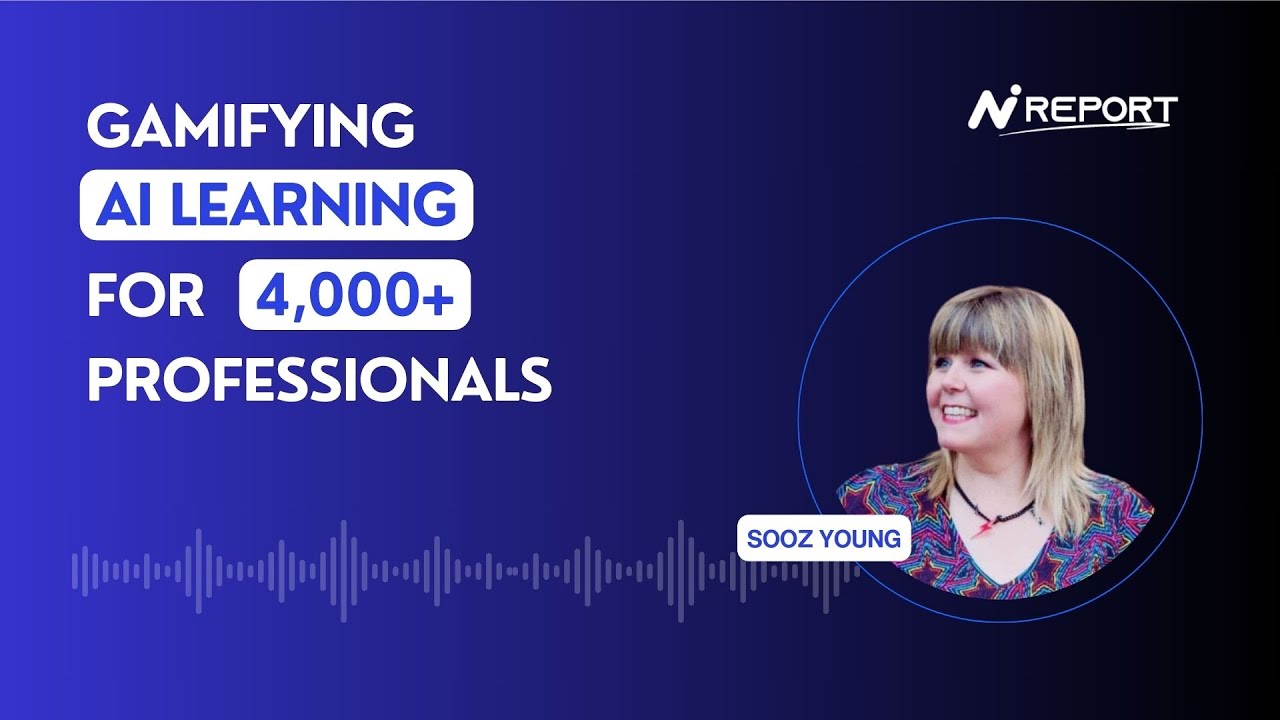

Watch on YouTube · Listen on Spotify or Apple Podcasts
Sooz Young, director of Technology Coaching, says AI and automation are best learned as shared, hands-on experiences rather than lectures, and that fundamentals matter more than keeping up with every update. She tells host Liam Lawson how teaching English in Japan, four years as a trainer at Apple and a Facebook digital skills program shaped her gamified approach, and why she thinks enterprises need to start investing in training again.
Key takeaways
- Learn AI by doing it together. Sooz teaches through interactive learning experiences: in person, groups get a learning outcome broken into sections, examples tied to their work, then tasks and games that force them to talk and collaborate. (30:16)
- A digital mindset has six parts. Innovation, web presence, social media marketing, cyber security, AI and automation, and making decisions with data. She says they only work together, alongside human skills like creativity and communication. (24:05)
- Teach algorithms with a paper clip and a cup. Teams write instructions using only six words to move a paper clip into a cup, then swap with another table. Most of the time the other table's algorithm fails, which shows why instructions need clear rules. (34:50)
- Fundamentals outlast tool updates. Apps and operating systems update almost daily, so Sooz recommends courses that teach the fundamentals, so each change is not too big a leap. (45:20)
- Generic courses don't land with enterprise staff. Employees can't see how a general course applies to them, so her enterprise work is bespoke to each company's systems, such as Microsoft 365 and Power BI. (42:02)
- Training budgets were the first cut after COVID. Sooz says every business cut training budgets, and NHS Scotland has stopped all in-person training. She wants enterprises to start investing again. (42:49)
- AI works like three staff members. Sooz says AI and automation are the only reason she could go from a team of 10 back to a team of one or two. (48:43)
How did teaching English in Japan shape Sooz Young's approach?
Sooz Young went to Japan to teach English for a year after studying applied music at university and being made redundant from her first job, and ended up staying for four years. She taught at a conversation school, working with learners from young people to 80-year-olds through gamified learning experiences, and says that is where she learned her work ethic.
She describes Japan as a culture built on learning: students are generally in education from 6:00 a.m. until 10 or 11 at night, and teachers are respected. In the UK, she argues, teaching is often treated as a fallback, and people in the workforce who are offered learning opportunities often don't take advantage of them. Her point is that everybody needs to keep learning to grow and to establish themselves as an expert.
How did Sooz Young go from Apple trainer to founding Technology Coaching?
Sooz Young spent four years as a trainer at Apple, starting in 2011, helping individuals, businesses and staff get more out of their technology. Irregular hours pushed her into legal corporate work as a technology trainer at a Silver Circle law firm with 26 offices in 16 countries, where she developed training and ran the learning management system that tracked compliance training.
With people asking for help on the side, she spent two years studying business, digital skills and marketing and planning her finances before setting up Technology Coaching. A big first client, then Google Digital Garage, followed. After someone from Facebook saw her LinkedIn posts, she was asked to deliver Facebook's digital skills training to 3,000 people through its partner company, which she did in 2019, with a follow-on project planned across seven countries in Europe. She had built a team of 10 with an office in the city center when COVID hit and took many of those opportunities away.
What is CPD accreditation, and why does it matter for AI training?
Sooz Young explains that CPD, continual professional development, is a requirement in roles such as accounting, engineering, medicine and law: professionals must complete a certain amount of CPD-accredited training every year to keep their license, and a lawyer with 10 years of experience may need 16 to 20 hours a year. The training has to be tracked in a learning management system so employers can show their people are compliant.
She says CPD-accredited courses in AI, automation and cyber security will be super important as the AI revolution continues, because they help people stay ahead of the curve and strengthen their CV.
What is a digital mindset?
Sooz Young defines a digital mindset as six core competencies: innovation, web presence, social media marketing, cyber security, AI and automation, and making decisions with data. An idea needs a web presence, marketing to drive people to it, cyber security to protect you and your customers, AI and automation to make the process work better, and data to make decisions, because we live in both the physical and the digital worlds.
Alongside the technical side, she focuses on essential human skills such as creativity, teamwork, collaboration and communication, which she says technology can sometimes take away. The framework grew out of the Facebook digital skills program, which had six courses on the same topics, and she has since made the courses more gamified and up to date.
How do you teach AI in a way people enjoy?
Sooz Young says AI has to be taught as an experience, either with other people or with the technology itself. In group sessions, people are given a learning outcome broken into sections, each with a learning point, examples related to their work, and tasks and games to play with the tools while discussing what they are doing. When we only use technology, she argues, we lose our human uniqueness.
To explain algorithms, she gives teams paper, pens, a cup and a paper clip, and five minutes to write instructions using only the words up, down, forward, backwards, grip and release. Teams then swap instructions with the next table, and most of the time the algorithm doesn't work, which shows why instructions need clear rules. Another exercise has people use Google Lens on a phone or iPad to search for objects around the room and discover its translate option.
She adds that a post-COVID generation is so socially isolated that many people struggle to work with others, and that whoever runs an online Zoom or Teams session needs to know how to make everyone feel included.
What AI tools does Sooz Young teach businesses?
Sooz Young says her AI and automation course teaches prompt engineering with ChatGPT, after first explaining what a language model is. Through a funded practical training course, learners build competency in ChatGPT, Gemini and Copilot for use in the workplace.
For enterprises, the training is bespoke to each company's setup. Big corporates generally run on Microsoft 365 and Power BI, she says, so the work covers data, data analytics and data infrastructure as well as AI. With Copilot now built into tools like Word, staff are being prompted by features they have never seen before, and training gives everyone the same baseline to work from.
Why are enterprises falling behind on AI training?
Sooz Young says training budgets were the first thing every business cut after COVID, and in-person training largely disappeared; NHS Scotland, she notes, has stopped all in-person training. When she tried to sell general courses, employees couldn't see how they applied to them, so most learners have been individuals and small businesses who see the need.
She says enterprises have got to wake up and invest in training, and hopes money will be made available in 2025 to help people develop in their roles. In two years' time, she predicts, we won't be having the conversation about AI anymore.
How do you keep up when AI tools change every few months?
Sooz Young says you can't: even as an Apple trainer, she would arrive to find an update she had to learn before customers came in. That is why she recommends courses that teach fundamental knowledge, so that when the technology changes you understand why it happened and where it is going next.
She estimates most people use around 20 to 30% of what their phone can do, because they only use what they have picked up from friends or family. Getting more from any technology means investing in yourself, your team and your company to learn it intentionally, and for a business owner, she calls implementing AI and automation an absolute no-brainer.
How does Sooz Young use AI in her own business?
Sooz Young says she uses a lot of automation, and uses AI almost like three staff members, with ChatGPT helping with the writing. Going from a team of 10 back to a team of one or two has only worked because she has AI and automation in place. She credits skill stacking, learning one thing and then the next, for getting her where she is.
What is next for Sooz Young and Technology Coaching?
Sooz Young says Technology Coaching plans to launch a community learning experience platform in 2025, with a book to go along with it. Her focus is helping as many businesses as possible get up to date, and she sees social media shifting to be less about the business and more about the people.
For anyone planning a future-facing career, she suggests looking into data, AI and cyber security, and stacking skills in multiple ways, because we are moving into a no-code world. Technology Coaching's website also offers an ultimate AI tools list of more than 800 AI tools, split into categories.
In her words
"We are human we are social and when we only use technology we lose all of our human uniqueness" (30:56)
"We live in both the physical and the digital worlds there's no separation from them" (24:59)
"We can never ever keep up to date with the technology but we need to have the fundamentals to understand how it's going to work" (46:28)
"It's less about the business and it's more about the people" (50:53)
"It's about letting the technology work for us and not the other way around" (51:02)
Chapters
00:00 Introduction and Background
02:02 Teaching Experience in Japan
06:19 Cultural Differences in Education
10:11 Transition from Education to Corporate Training
15:03 Shift to Entrepreneurship
19:30 Genesis of Technology Coaching
23:44 Adapting to COVID-19 and AI Education
27:07 The Rise of AI in Everyday Technology
28:32 Interactive Learning Experiences
33:05 Teaching AI and Automation
38:40 Understanding Algorithms Through Collaboration
40:33 Practical AI Training for Enterprises
44:04 Future Trends in AI and Education
50:14 Vision for 2025 and Beyond
About the guest
Sooz Young is director of Technology Coaching, which delivers CPD-accredited training in AI, automation and cyber security built around a digital mindset. She studied applied music at university, taught English in Japan for four years, and was a trainer at Apple for four years before working as a technology trainer at a Silver Circle law firm. Through Technology Coaching she has delivered training for Google Digital Garage and Facebook's digital skills program. Sooz on LinkedIn
About the host
Liam Lawson is CEO of The AI Report and host of The AI Report Podcast. Meet the team
Full transcript
Edited for readability. Quotes above are word for word from the recording.
Liam Lawson (00:11): All righty, we are back for another episode of The AI Report, live. Today's guest is Sooz Young. We actually met in the same co-working space in Glasgow. We definitely did not have enough time to actually get to know one another, because there are so many areas of our lives that actually cross over, and we only learned this in the week that I was leaving the co-working space to go elsewhere, which is an absolute travesty. But we're going to jump into those different points today. Sooz, from what I understand, you're the director of Technology Coaching. You empower people with the essential skills of a digital mindset, which is more important and pertinent than ever. You deliver CPD-accredited courses, you work in AI, automation and cyber security, and you have maybe the cutest dog on the entire planet. I think that's what originally got us talking to each other, because I think you spoke to Disco more than you spoke to me.
Sooz Young (01:09): Likely. It sounds like me. But I think that's mostly the case because I do have the cutest dog ever, so it doesn't surprise me at all. But I'm glad that he got us to be able to chat to each other, because once we did open those conversation lines, as you said, there was a lot for us to discuss that was in alignment with each other. So it's nice to pick this back up again now that you're over the other side of the world.
Liam Lawson (01:36): 100%. And three things immediately come to mind: travel, where I want to jump into your experience in Japan and what that was like, but also education, and AI and automation as well. I think those are the three areas that we cross over in the most. So take me back to that time. I was looking at your LinkedIn history, and you spent some time in Japan teaching. Tell me about that. What was that experience like?
Sooz Young (02:02): I did. So I think I'll go a step before that, to the reason why I went to Japan. I studied applied music at university, so that meant I specialized in all things to do with the music industry. If you think recording and sound production, music and film, music animation, video production, video animation, recording and sound, marketing, all that fun jazz stuff, right? All that good stuff about using computers effectively to be creative with your technology, because we were all using Macs at that time. And I absolutely loved it. I was obsessed. After university, of course, what I wanted to do was set up a recording studio, because that's what you think when you're 20 years old and you go get a degree in music. But that didn't happen. I went and got a job and then got made redundant, because it was still just as hard back then as it is nowadays, moving into the workplace and getting a job after university. So I was like, screw this, and I just decided to look up "working in Japan" on Google.
I'd done quite a lot of experience at university doing mentorship through what was called the Summer Academy at [name unclear], which was part of the university where I studied. I worked with young people through that time, and it was gamified learning experiences that we did to help them improve when they would go back into school. They would come to the summer school, and it was just a lot of fun. We had kids from Spain, we had kids from England, we had kids from Scotland that would come to the summer school, and we would just do fun things with them for two weeks, and then they would go back.
So, as I said, I looked on Google for working in Japan. The first thing that came up: apply for a job in Japan teaching English. I went, great, went online and filled that form out. They called me the next morning to ask me to come through to Edinburgh, which, being in Glasgow, is the other side of the country, for an interview. So I went for an interview. It was a group interview, then you had a one-on-one interview, and you had a written test to do. Then they called me two weeks after that and told me that I had a job in Japan for a year, and I was like, amazing. So in three months' time I was going to Japan to teach English out there.
I was only staying for a year, and I ended up staying for four years. During that time I really found how to work effectively. I learned my work ethic. I was so obsessed with everything about Japanese culture. I kind of had that "Turning Japanese" feeling, if you know that song. It's like an '80s song or something, and I really felt like that when I was out there, because I was so engrossed with the culture and the way that they worked and the way that they respect, and the way that they utilized technology as well. They were already way technologically advanced, and there are things that we do now that they've had for 20-odd years. That was always what was fascinating for me as well.
So I taught English out there, working with young people all the way up to 80-year-olds, again with these gamified learning experiences as part of that. It was fascinating, and I loved every single part of it. Then I came back here and got a job at Apple, and I became a trainer at Apple for four years after that. So I was able to use not just my university experience of recording and sound, music production, video production and creating films, but also my educational experience, helping people utilize their technology better. At that time I was working with individuals and businesses as well as the staff, helping to support them to better utilize their technology. So I've worked with thousands upon thousands of individuals, either on a one-to-one or a group basis, to help them get the most, both technically and creatively, out of their technology, using fun learning experiences as part of that. It's all about enjoying this tool that we have in front of us, which is what all technology is: a tool to enhance our lives. That's really how we should approach it, and as we move into our AI chat, we'll talk about that a little bit more.
Liam Lawson (06:19): I want to stop on that, if I can.
Sooz Young (06:22): I know, I told you I can ramble, right? I definitely ramble.
Liam Lawson (06:24): So the two things I'm most curious about there: you've got Japanese society and culture, and you've got the society and culture in the UK, specifically Scotland. What were the biggest differences that you noticed, first in the teaching and education style, and secondly in the learning style, the way people consume education, the way people learn?
Sooz Young (06:49): It's vastly different. Vastly, vastly different. The way that they learn in Japan, even just from a language perspective: they have three language systems. They've got hiragana, katakana and kanji. Kanji are the Chinese characters, hiragana are the Japanese characters, and katakana are the English words translated into Japanese but written through... I know it's complicated. So this is what people are like: "Oh God, how do I understand AI or coding?" And you're like, there are countries doing this already, just with how they communicate through their language systems. They have three language systems based off of the 46, 47 vowel sounds that they have, which are A, E, I, O, U, but they're pronounced differently over there. So they learn differently. They've got to learn these symbols, and they read differently. Their back to front is the opposite way of ours, so they start at the back of a book and read the other way. I can't do it visually here, but right to left instead of left to right. So they read the opposite way to how we do over here.
So when they're learning, they have to use the visual representation, because each of those three language systems has a different character, with a sound that's associated to it. Now, when we think about English, we have 26 letters in the alphabet. Those letters, those symbols, are put together in some sort of format, and that format is then what's translated into a word. And then when you think about the English language, and also being a Scottish person, or a Glaswegian, we have words that we use which are different from other people as well. That's what Japanese people find challenging when they come to learn English: they can read and write very well, but they can't speak it as well, which is why they have what are called conversation schools, or eikaiwa, which is what they're called out there. That's what I worked at, a conversation school, where I helped people communicate effectively through the language that they were learning. So they were learning writing and reading as well as conversation.
An example: if I was to say to you "to catch up," catch up can have multiple explanations of what it means. To catch up means that we can meet at a time and converse about things that have happened in our past. If I say, "Let's have a catch-up," and you think of the word catch and you think of the word up, you would think that's to maybe grab something and then put it up into the air. So there are lots of these phrases that you would have to teach as a language, which is different from the structure of how a sentence is put together in the Japanese language. So it's interesting, right? It's really fascinating, this type of stuff, and that's what I loved about being able to teach conversation and communication in that sort of way, because it's different, and there are differences in that.
Liam Lawson (09:50): Was there anything that was superior about the British or the Scottish education system, and vice versa, or anything that you've taken from the Japanese system where you're like, this is the way we do things? Because I can imagine your teaching style is probably some amalgamation of both systems.
Sooz Young (10:10): Well, I didn't teach in the Japanese school system, because it was a conversation school. But what I do teach are gamified experiences: things that are fun, things that use all different types of senses and all different abilities to learn, sight or sound, all of our approaches to learning, because we are all individual and it's all about how we learn. I had to learn how to read somebody, whether they understood something or not, without them telling me. I could look at a person and go, they don't understand what I'm saying, because we didn't speak the same language.
But what's massively different from a cultural point of view is how frequently they learn. In Japan, generally everybody has the same holidays. They'll have Golden Week, which is a week in May, they'll have Obon, which is a week in August, and they'll have New Year, because that's their annual celebration, and that's one to two weeks off. Everybody has the same holidays. Schools don't have summer off; they might have two weeks off in summer. And as they move from kindergarten to elementary to middle school to high school, they are generally in education from 6:00 a.m. all the way through until 10 or 11 at night.
Liam Lawson (11:26): Jesus.
Sooz Young (11:26): I know. Totally different from the 9 to 3 that they get here. And it means that they are not only doing stuff that's... I'm on a podcast, sorry. They're just dropping something off at my door. Sorry, I knew the dog would start barking there as well. Come here. This is all live as well, isn't it? Sorry, Liam.
Liam Lawson (11:48): It is indeed. It's all good, it's all good.
Sooz Young (11:51): So yes, they are in school all day. If they're not in school, they're studying. If they're not studying, then they're doing something homework-wise to be able to learn. So you have a culture that is based on learning and has this ethic of wanting to develop and wanting to improve, and it's just built into the culture. That's where you then see it in work ethic, in how people move into the workforce and how they actually do their job. There's a real culture of respect out there. If I compare that to here, we don't have that same culture of respect. In Japan I was Suzu Sensei, right? So I was a teacher. I was seen as, "Oh wow, you're a teacher, that's amazing." When in the UK, being a teacher means that you're a washout, you failed, you can't do, so you teach. And that comes from American media. It comes from what's presented in the media and not what's real life.
Actually, everybody needs to learn. The only way that anybody can grow or develop or function or establish themselves as an expert is by learning and development. So when you have people in the workforce in the UK who are given learning opportunities, they don't take advantage of it. They don't take it as an opportunity to evolve and to grow. You get people that are stagnant in their behaviors. You don't see people developing themselves. They want to get things for free, they want to get things done for them, when actually, you're taught that learning is a great thing and that we all do it on a day-by-day basis. The thing that we can't live without, which I'm waving my phone about, is all about learning in some sort of way. So it's just changing that mindset. I think that is different, because it's taught from such a young age, based around respect and development, and we don't really seem to have that over here in Western culture. I'm not sure if you can relate to that.
Liam Lawson (13:52): Well, it would be difficult for me to speak too much on it, because I've not done years of education. But my mom, for example, was a head teacher at a primary school for 20, 25 years. I was on the phone to her a couple of weeks ago, and she was basically telling me about the decline in the respect, attention span and so on of children, especially over the past 10 years. It's got worse and worse and worse. I imagine you could speak a lot on this as well, but similar to my mom, she can speak on this for 45 minutes, and I know that you probably can too, so I'm going to move the conversation along. Where we left off, you were talking about how you'd moved into Apple as a trainer and an educator. What I'm wondering is, at what point did you move from that space of being an educator, a teacher, a trainer, into the entrepreneurial space? Was that something that was always on the docket, that you always wanted to do, or was it just a natural progression? How exactly did that switch happen, and why did it happen?
Sooz Young (15:01): It happens because of years of corporate, as is generally the case. I absolutely loved working at Apple and I loved the environment that I was in. However, you are a tiny part of a huge conglomerate, which is a corporate, and that's really what anybody will say within a corporate environment. I also wasn't working effective hours. You were working all the hours, all the days of the week. You wouldn't have two days off next to each other, so it became quite laborious on your physical and mental well-being. So I needed to find another opportunity, another role that gave me more consistent hours and a more consistent environment to work in.
So I moved from Apple to legal corporate, as a technology trainer for one of the Silver Circle firms. There's the Magic Circle, which are the top law firms in the world, and the Silver Circle are the ones just underneath that. I worked for one of them. They had 26 offices in 16 countries, and my role there was to help develop training and also look after the learning management system for people coming on any of the technology courses across all of those offices. Whenever they had a big rollout in IT infrastructure, there had to be training as part of that, and it was my role to make sure that that compliance training was effectively marked in their accreditation. This leads into why CPD accreditation is super important, because lawyers, doctors, anybody within an accredited role has to get a certain amount of CPD hours every year in order...
Liam Lawson (16:43): Just on that, for a second: what is CPD exactly? Explain that for me and the audience.
Sooz Young (16:47): Yeah, of course. CPD is continual professional development. It is a requirement of some of these generally high-end roles, like accountants, engineers, doctors and lawyers, that they have to do a certain amount of CPD-accredited training every year in order to keep their license. If you're a lawyer that's been doing it for 10 years, you may need to get between 16 and 20 hours of CPD accreditation every year. They can choose what that accreditation is; however, it has to be marked effectively in an LMS, which is a learning management system, so that it is tracked through to their accreditation service. So when people buy that service, or if a company has these people on their books, they can say that these people are compliant. They are keeping themselves up to date with the new things that are happening, not only in their industry, but also things that will enhance their role.
Which is why courses like the ones that I've got, and courses that you guys are developing as well, are going to be super important, especially around AI and automation and cyber security, all of these things that are protecting people as we move into this new industrial revolution, this AI revolution, which we're already on the path of at the moment. Keeping ahead of the curve by getting yourself CPD accredited means that you are making yourself better on your CV, on your resume, and making sure that you are ahead of the curve, because you have an accreditation that's CPD accredited, for your business or for you as an individual.
Liam Lawson (18:25): So from what I can see, you've been running your current venture for around seven years, right?
Sooz Young (18:32): That's right, yeah.
Liam Lawson (18:32): So this is kind of pre what we're commonly using AI for. I'm not sure if you'd heard of it at that point, but I'd certainly not heard much about it, apart from I, Robot with Will Smith. So let's move back to that time. You're getting sick of this corporate environment, you're never having two days off in a row, and at some point you decide to make that switch and start up your own venture. One, I want to hear about the genesis of that, and two, I would love some explanation behind your CTA as well. I've seen it at the end of your LinkedIn bio: "Why choose us," and you put "proven track record with 4,000 people upskilled," "practical, no-nonsense training," which I love, "commitment to long-term success and support," and then "Ready to take the next step? Let's unlock your team's potential and drive your business forward." So let's start with the genesis, and I'd love to hear how you came to those specific things as your CTA.
Sooz Young (19:28): Yeah, awesome. So in legal corporate I was able to have a 9 to 5, so I was able to have time back and some money to spend, and I knew that long-term I wanted to get out of the corporate sphere. I had so many people coming to me on the side for help and support, continuing from what I was doing at Apple previously, because they knew that I could help. Now, I'm talking 10 years ago, right? 2015. Not everybody had a smartphone 10 years ago. People were still just getting introduced to smartphones. The Apple Watch had just come out, wearable technology at that time. So there were still people that needed that hands-on support, and they were coming to me on the side, and I was like, why am I still in corporate? Why am I still doing this? I've got tons of people asking me for help. There's a total market here for me.
So whilst I was doing two years of legal corporate, I studied, I learned, I went on courses to learn not just how to run a business, but also further digital skills and further marketing. I utilized the income that I had, and I worked out my finances at that time as well, to make sure that I could run a business, because I couldn't just start a business without understanding that I needed money and clients coming in to be able to do that. So I spent two years doing that, and then I just took the big bite, because I got a great opportunity, and I think that comes from the people that I've worked with. I'd worked at Apple for four years as a trainer, I'd been teaching in Japan before that, I was working in legal corporate, and I got a big client as soon as I set up Technology Coaching. It really allowed me to set up Technology Coaching, because I got a big client right off the bat.
From there I got Google Digital Garage, so I was delivering training in Edinburgh for Google Digital Garage, which was another big client. I could tick that off as one of the big guys that I'd got. And then from there, again, I was posting on LinkedIn, because LinkedIn is the B2B, as they say, because it totally is. I was posting on LinkedIn what I was doing, and then somebody from Facebook saw that, and they were looking for a training provider in Scotland to deliver their digital skills training program. I got asked to meet with their partnering company to deliver training to 3,000 people, to give them a Facebook digital certification, and I did that in 2019. So by the end of 2019 I had worked with Google Digital Garage, and I was partnering with Facebook. We were just finishing off that project and starting up their next project, and this project was going to be in seven countries across Europe, and I was going to be designing the training, the next level of business training that would go out to small businesses.
And then COVID hit, right? COVID hit and took a lot of those opportunities away, which most people can understand. At that time I'd built my team up to 10 people, and we had our office in the city center, so COVID took a big toll on the training environment, as you can understand. But when it comes to what the CTA is on the LinkedIn profile, that's the credibility that we have. We've partnered with the biggest companies in the tech space to provide training not just to their people but to other people as well. That just comes from experience and skill stacking, as I talk about it. It's my skills and experience in different areas that have stacked up in these different categories to get to that point.
Liam Lawson (23:14): Speak to me about that shift, and perhaps this might lead into your adoption, learning and delivery of AI education as well. It sounds as if, pre-2020, pre-COVID, you've got a lot of these big clients, and you're doing specific client work for Facebook, for Google, for these other organizations. COVID hits. You'd grown to 10 people, and that obviously changes your business structure. From what it sounds like now, and correct me if I'm wrong, you now have something that's more of an internal training program that you deliver, a specific education system on AI, automation and other things. So one, how did you first learn about AI, and two, what does your core offering look like now? How do you deliver these training courses on these specific subject areas?
Sooz Young (24:02): Yeah, great, Liam. The concept of a digital mindset is based upon six core competencies: innovation, web presence, social media marketing, cyber security, AI and automation, and data, so making decisions with data. They all work together; they don't work individually. You can't come up with an idea and then not have it represented online in some sort of way through a web presence. You then need to drive people towards it through marketing and digital marketing strategies, usually through social media marketing. You need to make sure you're protected and your customers are protected through cyber security. You need to implement ways of automating that process through AI, implementing the tools to make it work better for you. And then you're working with the data at all times, which is where the decisions are made from. So they work together to make a complete digital mindset, because we live in both the physical and the digital worlds. There's no separation between them.
And we need to use our unique human traits, which are our creativity, our teamwork, our collaboration, our communication, all these essential skills that we have, the key skills that people are looking for in job roles, which technology can sometimes take away. With our phones now, we send text messages, but actually having a call with somebody, speaking to somebody, or when they ask you a question, answering that question back verbally, out loud: these are the skills that we need to develop and enhance, which is what we try to do through building a complete digital mindset. So both the technical and the essential skills, through gamified learning experiences.
This came not just from my experience of working with these big companies; it was part of what the Facebook digital skills program was. They had six courses, which were these topics: innovation, web presence, social media marketing, cyber security, AI and automation, and making decisions with data. But I'd been introduced to using AI while I was at Apple. If you think back, I started at Apple in 2011, which sounds freaking ages ago now, but they were using AI tools at that time. That's when Siri started to get announced, where we could talk to our phones. That was freaking mind-blowing. I was there at Apple when Steve Jobs was still alive, and when Steve Jobs passed away, the company totally changed. It became a really different company to work for after that, and the process, how they helped and supported, and all these evolutions with the technology changed within that as well. So I saw how AI was being used and how it was going to be developed, through working at Apple and understanding the operating systems, how they were going to work and where they were going to move forward.
Which is interesting. I don't know if you saw the OpenAI announcement yesterday. They've been shipping everything, and it's built into iOS now. Apple Intelligence: ChatGPT is going to be built into iOS. And I was like, I knew that Apple wouldn't let OpenAI get away with just being the leaders in AI. Not a chance. They would have to make sure it was built in. So that was just my little excitement yesterday. I was like, I need to go get a new phone right now, so I've got Apple Intelligence straight off the bat.
But yeah, as part of the Facebook program, we delivered an AI and automation course, and what I've done is develop these even further. I've made them even more gamified, I've developed them with the most up-to-date information, and I showcase how connected they are with both the essential and the technical sides of the brain. That only comes through my experience of being an educator and understanding that people need their human traits, which are our essential skills, to work with the technology, these tools that we develop, to make them work for us.
Liam Lawson (28:08): I want to touch more on AI in a second, but before we do, I'm very intrigued about your exact delivery mechanism for this training, and that might be part of the secret sauce, so divulge what you want to. We're talking about six core competencies to succeed in the digital environment, and automation is obviously a very big part of that. You've had a wealth of experience in being able to gamify this. You've worked with thousands and thousands of students. You understand to a very granular degree how people learn, and you're really exemplifying the gamification, making sure people have fun and enhancing the human elements as part of that. If I come to you and I'm like, "Sooz, I'm a complete [expletive] idiot and I need to be educated right now on this, get me up to scratch," on a granular level, how do we do that?
Sooz Young (29:04): I think it's challenging to do it from an individual point of view, because I think these need to be taught as experiences, whether that's experiencing it with other people, or experiencing it with the technology and how the technology works its way back with you. I like to think of what I do as interactive learning experiences. As you are learning the concepts, you're interacting with the other humans that are learning it at the same time, through teamwork, communication, collaboration and problem solving. So you're maybe given a task and you've got to come up with a solution, using the technology to help you, or working out how you can use that within the technology. Or, if you're doing it self-led, then you're doing it through some sort of gamified technology experience, which could be through some of the tools that are out there: gamified learning, point-based systems. I'm not going to diverge too much into that, because I can go off on a massive tangent, but if you look up gamification, you'll learn what those things are.
So for an individual coming in, it would always depend on what their needs are and what their challenges are. But if we're delivering these in person, it is usually in a group format, where people are given a learning outcome, so what it is that they're going to achieve. That's broken down into sections, and in each section they're given a learning point. That learning point is then established through examples, those examples are related to them as individuals or to their working environment, and then they're given some tasks and games to play using the tools, but having to talk about it, having to tell each other what they're doing, having to discuss and collaborate. Because this is what makes us human. We are human, we are social, and when we only use technology, we lose all of our human uniqueness.
This is why we focus on essential skills. What we're finding now in the workplace is that we've got a post-COVID generation that is so socially isolated that, now they're in the workplace, they're really challenged with being able to work with other people. We also have a lot of anxiety within people, because they don't want to leave their homes, because they're so used to working from home. We have offices forcing people back into five days a week in the office; we're seeing that with large corporates. But you're also seeing the other side of that, where you're now starting to get four-day work weeks, and people with hybrid working models as well. So the way that people work, behave, communicate, collaborate and do teamwork is all completely different, and they need to learn how to do that differently. We can't do things the same way that we've done before, because it doesn't work.
How do you create a fun, exciting experience in an online Zoom or Teams meeting, unless the person that's leading the meeting knows how to do that, knows how to engage the people that are on the session, and create an experience that's going to allow everybody to feel like they're included and that they're a part of it? It's so different. When you shut that laptop down, nobody's there in the room. But if you're in a meeting room in the office, everybody has their small talk afterwards, or they're maybe discussing the program, they're going to get a cup of tea or coffee together afterwards, they'll maybe go for lunch. So how do you replicate that experience online? There's a lot of work to be done. People are still navigating and understanding how to best do this. There are lots of tools out there that are helping people do it, and I've seen lots of different things happening across big corporates and how they're trying to navigate that space as well. So I don't know what the right answer is, but I know what we try to do is create interactive learning experiences, building on those essential skills while teaching the technical skills at the same time.
Liam Lawson (33:03): I'd love it if we could hone in specifically on the AI and automation modules.
Sooz Young: Sure.
Liam Lawson (33:10): I'm not sure if your experience has been the same, but writing the newsletter, the majority of 2023 up until maybe midway through this year has been primarily individual, direct consumer interest: people trying out different tools, chat, stuff like that. Only really within the past six months have we started to see a real switch in B2B adoption, implementation and training of the workforce. It's really been within the past six months that, for businesses, the penny has eventually dropped, and they've been like, "Oh, it's not something that we can afford to be scared about. We actually have to educate ourselves on this." So I'm wondering, with all of those factors you described, people maybe being socially isolated after COVID, and you trying to implement this level of humanity and human social interaction into your education, how exactly do you teach something that is so dependent on technology itself, like AI and automation, in a way that people can become socially gratified and actually enjoy that learning as well?
Sooz Young (34:18): Okay, I'll give you an example. If I was to ask you this question, what is an algorithm, what would you say?
Liam Lawson (34:24): I couldn't put it into words. Is it instructions? Is it a way for people to understand how to do one thing, or leading into another thing?
Sooz Young (34:36): So how I would approach that question is maybe get them to give me an answer, and then I go, okay, well, really an algorithm is a set of instructions given in a certain order, based upon certain rules. So I'm going to say: okay, you have paper and pens on your table to write with. You have a cup on one side of the table and a paper clip on the other side of the table, and you're only allowed to use the words up, down, forward, backwards, grip and release. You have to try, using those six words and writing on your paper, to get the paper clip from one side of the table into the cup. The only caveat is that you can use measurement in some sort of way, but you have to tell the people how you're going to use that measurement. Now go together in a team. You have five minutes. Go and write that out on a piece of paper.
What I've done there is ask them to try and understand the concept of what an algorithm is: a set of instructions. They now need to try and write a set of instructions, only using a certain set of parameters, to get one thing to move into another thing, in this example a paper clip into a paper cup, and they've got to work together to do that. So you've got four or five people discussing how they're going to do it. They're then trying it and practicing it, so they're using teamwork, collaboration and communication. They're using their writing skills. They're problem solving to work out if that's the right thing. They're testing, they're iterating that process, and they're doing it within a time scale: they've got five minutes. Then, once they've done it, they've got to swap that algorithm with the table next to them. The cup and the paper clip are put back in their original places, and they've got to read the instructions from the other table to see if that algorithm will work for them. And most of the time it doesn't, because we've not given it clear instructions, the right rules.
What this does is help them understand that process. So rather than just asking, "What's an algorithm?" and hearing, "An algorithm is a set of instructions," they're really embodied in that full experience, and they're building on their essential skills to be able to do it. So when we talk about learning in that type of way, it's building upon what we do as humans, understanding what the technology does, and then moving that into the technology experience. That gives an example of just one part of a task that we would teach in an AI and automation lesson.
Another thing we might do: Google Lens, for example, is a great tool for helping people understand how using the camera can help discover where something else is online. When Google Lens came out, it came out two, three years ago, but people didn't know about it. It came out in 2019, and we've been teaching it since then, but it's only really now that it's built into Chrome, it's built into Google, it's just everywhere for people to use. So we would give people an iPad, or get them to download the Google app on their device, and then go around the room and search for something using the camera on their phone. Then we ask them to look at it and go, okay, can you translate with that? If you're going on holiday, when would that be useful for you? Then they would look at the functions of that tool and see that there's a translate option, so when they're going on holiday, they can take a picture of something, or upload that picture into Google Lens, and then show it to another person to help them communicate effectively with that person in another language. Does that make sense? So there are ways of helping people understand the technology and the tools, but teaching them in different ways.
Liam Lawson (38:38): Interesting. So what it sounds like to me is you're teaching them the foundational knowledge to actually understand how this technology works and how it operates, right?
Sooz Young (38:51): That's just some examples of what we do. You asked for a bit of an example, and that's just a couple of examples of some of the games that we play. But relating to what corporates are looking for, or what the industry is looking for now: because the tools are built in now, like Copilot is built in, a lot of people doing their jobs are now getting asked questions by the technology that they've never seen before. They're writing a sentence in Word or something, and it's saying, "Do you want Copilot to finish this for you?" And they're like, "What the heck is Copilot?" So now these enterprises are going, okay, we need to upskill our staff on how to do this. Generally, technology has either been seen as something that needs to be taught to our staff, or as something our staff do not need to learn, because they have technology at home. But what enterprises don't understand is that everybody has a different piece of technology, as I'm holding up a phone here, and how they interact with that piece of technology is very different from the next individual. So by giving your staff the ability to learn in the same way, you give everybody a baseline to be able to work from.
Liam Lawson (40:07): Tell me about that baseline on a practical level. If you're going into these B2B organizations and enterprises, on a practical level, are you teaching them prompt engineering, how to use a specific tool, or more of a holistic understanding of how it works? How are you teaching a practical understanding of how to implement it within B2B and enterprise organizations?
Sooz Young (40:33): Yes. So in the AI and automation course, we teach prompt engineering with ChatGPT. We use ChatGPT, and we explain: this is how you prompt engineer, this is how you train the AI. Because we've got to learn what a language model system is before that, and we've learned all of that to get to this point. Then we go, okay, how do we work with an AI? How do we train this AI? How do we engineer it, how do we make the AI work for us on our behalf? You have to go through that journey to help the learner understand what that process is.
Enterprise-wise, it's generally specific to what that company's needs are, because every company has a tech setup that's specific to it. Generally, big corporates are working with Microsoft, Microsoft 365, and they're using Power BI, so they're heavily working on data. So it's not just AI. It's data and data analytics and data infrastructure. It's all of data and AI together. We're currently partnering with Data Lab to deliver some training through them, which we've done for the last two years, and our current one is practical training with AI. We're teaching ChatGPT, we're teaching Gemini and we're teaching Copilot as well, so that our learners doing this course have competency in those three platforms that they can use when they're in the workplace. So it's workplace learning that they're getting through these funded courses that we're able to provide.
But when I'm working individually with businesses, it is bespoke to the systems that they're using, because I don't think you should just put them on any general course. If you're an employee of a company... and this is the problem that I found trying to sell our courses this year: they can't see how it works specifically for them, so they won't be part of it. So it's mostly individual learners that are wanting to upskill, or small businesses, that are getting on the courses at the moment, because they see the need and they want to improve their lives for the better. But I think enterprises have got to wake up. They've got to invest in training if they're not doing it already.
Training budgets have been cut since COVID. That's the first thing that went from all businesses. All of them, absolutely all of them, cut the training budgets. So any type of training is gone, any in-person training has gone. For example, the NHS, well, NHS Scotland, has now stopped all in-person training. All training has to be done online now, as an example. So you're making it difficult for people to learn, communicate and collaborate with each other by doing that, but you're also saying that you're willing to stop training your staff because there's no budget for it, because the budget needs to be spent elsewhere. So I hope that as we move into 2025, or whenever you're listening to this, maybe you're in 2025, there's money being made available to help you develop in your role, to help you get the most out of your technology, to help your team develop, to help you work better, collaborate and communicate, and keep up with the times. Because I think in two years' time we won't be having the conversation about AI anymore.
Liam Lawson (43:59): Talk to me about this. This is what I wanted to jump into. Talk to me about 2025 and 2026. You've got a pretty unique insight, in that you're in the education space, you have these six core competencies, you have an insight into enterprises and businesses and what they're doing, and you're obviously very up to date with the news and the AI and automation space in general. You've got your finger on the pulse.
Sooz Young (44:26): Your report does a lot of that as well, though, doesn't it, Liam?
Liam Lawson (44:28): We try, we try. So looking ahead to 2025 and 2026, keeping in mind the rapid pace of innovation, what are you earmarking as areas that you want to look into, or where should people really be looking as a space for education, in such an ambiguous space? How do we know that the AI tools that we're using today aren't going to be outdated in the next three months, right? Because it's a possibility.
Sooz Young (44:58): True, it is very much true. I think OpenAI has an almost daily update to their app. I use macOS, and macOS maybe has an update every two days for the operating system, and I'm sure it's the same across all the other operating systems out there, Gemini being the same, Microsoft platforms being the same as well. This is why fundamental knowledge is super important. If you have the fundamental skills, then you understand how the technology can evolve. If you just learn what's happening right now, then you don't know how it got to that point, you don't understand why it's moved on to that next stage, and how it's going to move on from there.
So I recommend, if any business is investing in any sort of training, or any individual listening wants to invest, that you attend a course or take a course online that gives you some sort of fundamental knowledge, so that when the technology changes, you understand the process of why that's happened or where it's going to head next, and it's not too big of a leap for you to get a hold on. We are never going to be up to date with the technology, ever. Even as a trainer at Apple, I would come into work one day and they'd had an update, and I'm like, [expletive], I've got to learn this right now, before people come in and ask these questions. We can never, ever keep up to date with the technology, but we need to have the fundamentals to understand how it's going to work, how it's going to impact our lives, and how to make it work for us.
Liam Lawson (46:38): Right, yeah. How it impacts us matters, right? It's all good and well to teach you the theory of how it works, but people don't really, excuse my French, give a [expletive] unless they can understand and really grasp how this is going to affect them on a personal level. Am I going to make more money? Am I going to make less money? Am I going to have more spare time? Am I going to have less time? How does this actually impact me and my family, my friends, my social life and my happiness?
Sooz Young (47:10): Yeah. I mean, if I ask this question to the audience as well as yourself, Liam: if you were to look at your phone, how much of your phone do you actually use? I bet it's around 20 to 30% of the capacity of what that phone can actually do for you, whether you're an iPhone or an Android user or a Google user. It does not matter. You probably don't use that phone to its full capacity, because you use what you've learned, or what one of your friends has told you that you can do, or your family members said, "Oh, you can try this as well." You're not intentionally going and learning it unless you want it to improve your life in some sort of way: you want to take better pictures, you want a process for connecting your apps to what else you've got stored elsewhere, or you want to do one thing better. You're only going to do that by going and learning how to do it, so it can enhance your experience of using that piece of technology.
The same can be said about your brain, right? How much of our brain do we actually use? It's the same with the technology. How much of the technology do we actually use? You need to take that step to invest in yourself, invest in your team, invest in your company, to get the skills to make it work for you. For a business owner, it's an absolute no-brainer to implement AI and automation tools into your day-to-day existence. It doesn't make sense to me if you're not. Why would you take all these tasks that you do by hand?
How am I using AI? I use a lot of automation, and how I use AI is almost like three staff members at the moment. Having ChatGPT to do the work for the writing is really, really helpful, and automations have to be in place to make sure things can work well while I don't need to be there, or can't be. Those are the two things that let my business grow and develop. Going from a team of 10 back to a team of one or two has only been able to work because I have AI and automation in place, and because I've had this knowledge since way before it went into the stratosphere. That's the only reason I've been able to be where I am right now and have Technology Coaching running as it is: because of the skills that I've got. Skill stacking is what I call it. You learn one thing, then the next thing, then the next thing.
Liam Lawson (49:34): I usually finish the podcast by asking my guests to provide some sort of advice on how people should get up to speed, but you, as a born educator, a born teacher, have basically spent the last 52 minutes and 9 seconds explaining exactly how to do that. So I don't even feel as if that's the right question to ask. Instead, just round up everything: what do the next three, five, 10 years look like for you? What are you picturing for your business? Where would you like to be?
Sooz Young (50:12): Yeah. So currently, for 2025, we will have our community learning experience platform launched, with a book to hopefully go along with it. That didn't make much sense, but yes, with the book to go along with it. It's that time of day for me as well. It's probably early in the day for you, but it's quite late in the day on a Friday for me now. So that will be launched in 2025. I think for me it's about helping as many businesses as possible get themselves updated. What we're seeing is a change in social media, and you might see this yourself as well: it's less about the business and more about the people. I think we need to remember that we are people living in a technology world, and it's about letting the technology work for us and not the other way around. So the more that our uniqueness, our authentic selves, come across in how we use the technology and interact with the tools, the better these tools can work for us.
And if you're looking to evolve into careers that are going to be future-focused and future-facing, then look into data careers, AI careers and cyber security careers. They are going to help, because we're moving into a no-code building world. So you want to look at gaining skills in other ways and stacking your skills in multiple ways, so that you can become that person who is invaluable to any company because of the unique skills that you have as a human.
Liam Lawson (51:51): I love it, I love it. If people want to hear more from you, learn what you're doing, or get in touch, how do they go about doing that?
Sooz Young (51:57): Yeah, they can go to technologycoachingonline.com and connect with me there, or on social media via Technology Coaching. Also, on the website we've got an ultimate AI tools list, which is over 800 AI tools that they can access, split into different categories, so they can see what AI tools are out there, go and have a play with them, and start to interact with the technology to see how it's going to work better for them too.
Liam Lawson (52:26): I love it. Sooz, thank you so much for coming on. I appreciate your time.
Sooz Young (52:29): And you know I can talk about this all day long.
Get the five-minute AI briefing
Join 400,000+ business leaders who start their weekday with The AI Report. Subscribe free
