

400,000+ business leaders (and teams at IBM, AWS & Zapier) start their day with The AI Report. 5 minutes. Plain English. No hype.
Lindsay Rosenthal, Cred Marketing: AI and LinkedIn Video
Cred Marketing founder Lindsay Rosenthal on turning one call into a month of video, why video builds B2B trust, and how AI speeds up content marketing.
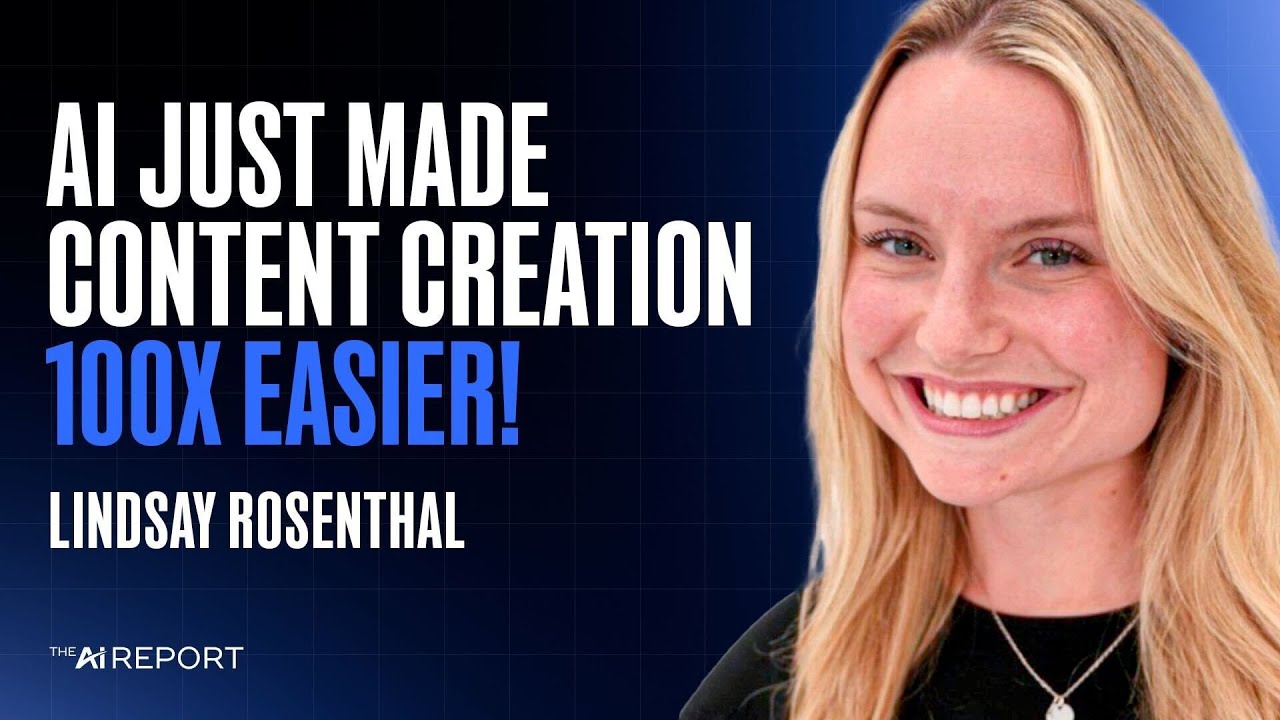

Watch on YouTube · Listen on Spotify or Apple Podcasts
Lindsay Rosenthal, founder of Cred Marketing, says video is the best trust builder a B2B brand has, and that AI lets marketers execute far faster while the new ideas still have to come from people. She tells host Liam Lawson how her agency turns one call into a month of video for executives, why the first seconds of a video matter most, why she kept posting video on LinkedIn when people told her it didn't belong there, and why she is building Synnc, a platform for B2B brand partnerships with what she calls employee creators.
Key takeaways
- One call becomes a month of video. After a pre-call on the client's audience, pain points and roadmap, Lindsay writes the questions and hooks, coaches the executive on camera, and her team edits the videos for LinkedIn and other platforms. (06:46)
- The first seconds matter most. Hooks are nailed down before the call, videos stay concise at around a minute, and the whole video speaks to the ideal customer's problems. (09:22)
- AI replaced hours of research. With a background in finance rather than marketing, Lindsay uses AI to get up to speed on the many industries her clients work in. (11:30)
- Video built her business on trust. She started posting video on LinkedIn about a year and a half before the recording, when people told her it did not belong there, and calls it the best trust builder ever. (13:55)
- B2B buying needs far more trust than B2C. Enterprise software takes many sales calls and touch points, which is why Lindsay sees B2B partnerships with thought leaders and employee creators taking off. (19:57)
- AI fluency is her first hiring filter. For new graduates, she says, using AI as a thought partner for everything means no one has to work like an entry-level hire anymore. (29:54)
- AI speeds execution, people invent. Because models are trained on past marketing, she expects creative marketers to come up with new campaigns and use AI to execute them 100 times faster. (39:15)
How does Lindsay Rosenthal turn one call into a month of video?
Lindsay Rosenthal says her agency's process is simple: a pre-call, one recording call and an edit. In the pre-call she asks who the client's target customer is, what their pain points are, how the company solves them, what is on the roadmap and what the executive's own thought leadership and vision are. She then writes the strategy for the recording: the questions, the hooks and notes to work through. Some founders read it closely and add their own notes; others just want to hop on the call.
On the call, the first step is often small fixes to camera angle and lighting, because many executives have not done much video. She tells clients they don't need a professional setup, pointing to the All-In podcast as a show whose setups are not visually amazing but work because you can see the faces. Then she coaches them through the topics and hooks, and her team edits the videos and returns them ready for LinkedIn or any other social platform.
The idea grew out of a gap she saw: everyone needs to create content to build thought leadership, sales and marketing, but busy entrepreneurs don't have time to figure out video on their own.
What are the fundamentals of a good B2B video?
Lindsay Rosenthal says the most important part of any video is the first couple of seconds, which is why her team nails down every hook before the recording. She contrasts this with the old B2B format: an hour-long webinar that opens with ten minutes of names and backgrounds before getting to the point.
After the hook, she focuses on two more things. Keep it concise, ideally one short video of around a minute. And speak directly to the ideal customer, so the whole video is about the problems they have and how the company, product or service solves them. Hook, concise, right audience: that combination, she says, goes a long way.
Why are CEOs moving onto video?
Lindsay Rosenthal says the executives she works with lead large companies and are getting pressure from their own CMOs, who see leaders such as Mark Zuckerberg posting videos and argue that if the CEO isn't talking on social media, the company is missing out. Liam frames it as the era of founder-led brands.
Lindsay is in favor. As a consumer of content, she says, these are the people she most wants to hear from, because they have the most brilliant minds and are doing the most interesting things.
How does Lindsay Rosenthal use AI in her content business?
Lindsay Rosenthal calls AI her best friend. She started her company before AI tools were widely available, when preparing for content calls meant hours and hours of research. Now she can ask AI for reports on what is happening in a client's industry, such as security, and where it is heading.
That matters because her own background is in finance, not marketing, and she creates content with people from many industries. More broadly, she says AI has helped every marketer create more, faster and better, whether they work at an agency or are building a personal brand on LinkedIn on their own.
Why is video on LinkedIn such a strong trust builder?
Lindsay Rosenthal says video built her business. She started posting video on LinkedIn about a year and a half before the recording, when people told her video content did not belong there. Fresh out of college, she reasoned, no one had a reason to care who she was, and video was the absolute best way to build trust. Over that period, she says, she grew the company, bought a house and hired her sister.
She explains the psychology through word of mouth. People once took recommendations from their neighbors; now buyers spend much of their time on social media, and trust comes from familiarity with the people whose content they see. The more often you show up in an ideal customer's feed, the more that trust compounds, and the more expensive the product, the more trust it takes.
The payoff shows up in sales. By the time she gets onto a sales call, she says, it is not really a sales call any more: prospects tell her they have been watching her videos for months and just want to know the next steps. She expects many more people in sales and marketing to start creating content for that reason.
What is Synnc and what is employee creator marketing?
Lindsay Rosenthal describes Synnc as a B2B influencer marketing platform she was building at the time of the recording, which she expected to go live within a month or a couple of months. Over the previous six months on LinkedIn, she says, partnerships between B2B brands and B2B thought leaders and creators skyrocketed, which reminded her of the first makeup brand partnerships on YouTube around 2010.
Today's B2B partnerships mostly involve influencer-style LinkedIn creators. Synnc aims at what she sees as the rest of the iceberg: employee creators such as CMOs, heads of marketing and heads of sales, who have real influence but have not yet been approached for brand partnerships. She coins the term employee creator marketing for it and predicts it will be huge in 2025. The platform is also her answer to a scaling problem: it removes the bottleneck of her being the face of her agency.
How is B2B influencer marketing different from B2C?
Lindsay Rosenthal says the biggest difference between B2C and B2B influencer marketing is the level of trust a purchase needs. Buying a $5 drink or a $20 makeup item takes very little trust. Buying enterprise software takes many sales calls and a lot of touch points on social media, and partnering with thought leaders is one of the best ways for marketing to build that trust.
She argues that the tools built for Instagram and YouTube creators don't fit LinkedIn and the professional world, so the main competition for Synnc is less a specific company than the old way of thinking about creative partnerships.
What will LinkedIn and B2B marketing look like in the next 12 months?
Lindsay Rosenthal says the way to predict where a social platform is going is to watch the features it has been adding. For LinkedIn, that is video: she sees changes to how video appears in the feed almost every week, and since LinkedIn is part of Microsoft, she assumes the roadmap behind those changes was planned months earlier.
She predicts that by the end of the year LinkedIn will have a TikTok-style algorithm that serves content based on what people actually watch rather than who they follow, using what LinkedIn already knows about users' roles and viewing habits. If TikTok were shut down, she adds, video creators moving to LinkedIn could speed that up.
She also expects B2B brand partnerships to get more creative, following the path B2C took from simple sponsored videos to influencer houses and brand trips. In B2B, she pictures meetups of thought leaders at conferences, dinners and shared experiences, and more partnerships with people whose credibility comes from their job title rather than their follower count.
Will AI replace creative marketers?
Lindsay Rosenthal does not think AI will invent tomorrow's marketing. Large language models are trained on past examples of successful marketing, she says, while the marketing that succeeds tomorrow is often the marketing that hasn't been done yet. Her view of the successful marketer of the future is someone who still thinks creatively and uses AI to execute 100 times faster.
Liam adds two sides. AI is getting better at original reasoning, but many people in the space describe 2025 as the year of tastemakers, because trends catch on for human reasons that no model can predict. He also argues that people crave human connection, and expects a swing back toward community and in-person meetings, with AI turning recordings of those interactions into content.
Are you a creator or a consumer?
Lindsay Rosenthal expects a divide. Some people will use AI to produce more, do better work and spend less time working so they can focus on friends. Others will be pulled in by ever-better algorithms and stay consumers. Her question for every young person is whether they are spending their time consuming or creating, because consumers fall behind while creators find it easy to stay on the cusp.
She practices it herself: she focuses on LinkedIn rather than other social platforms, and sends her daily phone time report to her sister, paying her if it is ever over two hours. She expects more products and trends that make it cool to use technology less, and more in-person elements in marketing. Liam puts it as using technology rather than being used by it.
What does it take to build a career with AI today?
Lindsay Rosenthal says the first thing she looks for in any hire is a willingness to go all in on making AI their buddy. Tools such as Claude, Gemini and ChatGPT are better than ever and not hard to learn, and someone who can take a meeting recording, expand on it and follow up within 20 minutes stands out. Because AI gives entry-level people so much help so quickly, she says, no one has to be entry level anymore.
Asked about being a woman in AI and tech, she says she has built her own agency since college and has never thought about it much. Her bigger point is that it doesn't matter who you are or where you are: her team members are across Asia, and AI can even help people whose first language isn't English write in the tone they want. Her motto, make life dynamic, means learning fast, failing fast, building, traveling about half of each month and spending time with the people she loves.
In her words
"By the time I get onto a sales call it's not even a sales call" (23:22)
"This content can do the trust building for you" (23:12)
"Marketing that is often successful tomorrow is the marketing that hasn't been done yet" (39:22)
"No one has to be entry level anymore with these AI tools" (31:51)
"You don't need a professional setup" (07:43)
Chapters
00:00 Introduction
00:38 One call, one month of video
02:28 Growing up on camera
04:11 The era of founder-led brands
04:52 Why CEOs are moving onto video
06:17 Turning a one-hour call into content
08:41 Shoddy setups and the fundamentals of a good video
11:14 How Lindsay uses AI for research
12:59 Scaling a personal brand and video on LinkedIn
15:38 Synnc and employee creator marketing
18:16 How B2B influencer marketing differs from B2C
20:46 Trust in the digital age
23:50 Lindsay's five- to ten-year North Star
26:26 Inbound, outbound and profile views
28:09 Hiring for AI fluency
31:56 No room for mediocrity
32:32 LinkedIn's video algorithm in the next 12 months
36:16 More creative B2B brand partnerships
38:52 Why AI won't invent tomorrow's marketing
42:34 Human connection and in-person community
44:40 Creators vs consumers
46:25 Screen time, phone diets and social media rules
50:44 Using technology vs being used by it
51:45 Being a woman in AI and tech
54:07 Make life dynamic
55:32 Why Lindsay does what she does
56:53 Where to find Lindsay
About the guest
Lindsay Rosenthal is the founder of Cred Marketing, an agency that creates video content for executives and entrepreneurs from a single recording call. She started her podcast and her agency from her college dorm room, has a background in finance, and at the time of this episode was building Synnc, a B2B influencer marketing platform. Lindsay on LinkedIn
About the host
Liam Lawson is CEO of The AI Report and host of The AI Report Podcast. Meet the team
Full transcript
Edited for readability. Quotes above are word for word from the recording.
Liam Lawson (00:38): Lindsay, hello.
Lindsay Rosenthal (00:38): Thanks for having me on your podcast, Liam. It's great to be here.
Liam Lawson (00:41): Of course. I'm excited. To get started, I want to jump into something that has caught my attention and everyone's attention: one call to get one month of video. Tell me a bit more about how you came to that as your tagline and how effective it's been for you.
Lindsay Rosenthal (01:02): I've been creating content for myself and for top executives and entrepreneurs around the world for years now. I started it back in my college dorm room, and it was honestly just a hack to be able to talk to the top minds around the world, first of all to try and get a job, and then I realized there were a lot of cool opportunities in entrepreneurship. So it's been this business I've had for a long time now, helping top minds create content.
I realized very early on that everyone needed to create content and get their voice out into the world. There's no better way to create thought leadership, sales and marketing. And second, I also realized that content takes time. It's not super easy. You and I have grown up in the social media world, we understand it like the back of our hand, but not everyone has, and entrepreneurs are busy. They don't have time to sit on camera trying to figure out how to do video content.
So I found this nice hole in the market where I could help people who have amazing stories and amazing backgrounds, or who are just solving really cool problems, create content in a really easy way: one call, a whole month of video content. That's where I started my agency and my entrepreneurial experience, and it's grown from there. That's how that works.
Liam Lawson (02:28): Are you always confident on camera, or is that something that came with time? I see you all over my feed, just like Jeremy and Jake, and it's the same people cycling through. You said you started back in college. Was there any hesitation, or is that something you've built over time as a muscle?
Lindsay Rosenthal (02:48): I've always been outgoing on camera. I started my podcast back in my college dorm room, so at this point I've had a lot of experience being on camera. But then again, we've grown up on social media. It's something we've done since middle school: taking videos, talking on videos, posting on Instagram to your 24 middle school followers. It's just something that's exciting as a young person.
As we come into the world of careers, we're used to social media. We'll probably talk a lot about the rise of LinkedIn and video content on LinkedIn, but I think it's a natural tendency to have more video content and more content creation, thanks to AI, but also because as young folks come into the world, it's how we communicate. Social media is how we get our news, and it's how we connect with friends and family. So having content creation and social media be an integral part of businesses, more and more, especially on LinkedIn, is a natural thing. Sure, I started my podcast and my agency back in college, but I think content creation and social media will become more and more of a thing in the professional world in the years to come.
Liam Lawson (04:11): I think we're really entering the era of founder-led brands. We're seeing that across pretty much every vector. There can be a company with, I don't know, 12 million followers on LinkedIn, but they'll get the same engagement as someone with 30,000. It really is this age of founder-led brands.
Something you mentioned at the start is that you work with a lot of C-suite executives, maybe people in older generations, and you're creating content for them or walking them through this process. Could you dive into the clientele you see the most, and maybe some misconceptions or reservations they have? What does that conversation look like?
Lindsay Rosenthal (04:52): The people I work with are leading huge, huge companies. They've built these companies, and basically it's the CEO or CTO, and they have their CMO in their ear saying, okay, we've built this crazy thing, but Mark Zuckerberg's on camera doing these cool videos. Satya just released a video a couple of days ago talking about the future of Copilot. They're seeing these videos from the top and thinking, okay, it's time. You are head of this amazing AI company. We have to get you on video too.
So there's been this big push from the Mark Zuckerbergs of the world, and the people right below that level are saying, okay, we need to do that too. Everyone's on social media. If you, the CEO, aren't talking on social media, what are we even doing? And I'm all for it. These are the people I want to consume more content from. They have the most brilliant minds and they're doing these crazy things. Like you said, founder-led content is huge nowadays, but these people are the ones doing the interesting things, so they might as well be sharing content. There are so many benefits of sharing content on LinkedIn, but as the consumer of this content, it's just amazing.
Liam Lawson (06:17): Talk to me about that, because CEOs are obviously very busy people. I know from doing operations for our company how stacked my schedule is and how little time I've got to actually record content and think about all this. Could you jump into the how? For example, I'm a CEO and I come to you for your services, and I say, okay, I've got no time. I've got a one-hour window. How are you taking that one hour and actually producing content for me, driving leads and driving business?
Lindsay Rosenthal (06:46): It's super simple. We usually do some sort of pre-call to basically ask: who's your client? Who is the target customer? What are their pain points? How do you solve them? We nail down their roadmap, what's to come, and also their own thought leadership and vision for the company. Afterwards we hop off the call and I create all of the strategy for the call: the questions, the hooks, some notes we can go through on the call. I send it all over. Sometimes founders love to really read through it and add their own notes. Some people don't even care and just want to hop on the call.
Then we hop on the call. Some of these people haven't done as much video, so usually the first little bit is: can we move the camera a little this way? Can we get a little better lighting? Just coaching through the best visual. I always like to say you don't need a professional setup. I love the All-In podcast so much, and if you look at those setups, they're not visually amazing, but it doesn't really matter as long as you can see the face. It doesn't have to be perfect. It's about making the best of the setup they have.
Then we go through all the topics and the hooks. We all know how important it is to have the beginning be super interesting and captivating. So we have all the topics in the strategy beforehand, and then on the call I coach through the best practices of video, because I've been creating video very frequently for years now. Afterwards we hop off, my team and I edit all the videos and return them, and they're ready. We focus a lot on LinkedIn, but they're ready for any other platform, TikTok if it's still going to be around, any social media platform to post on.
Liam Lawson (08:38): I can speak personally to having shoddy setups. Three podcasts I recorded this week were on top of a microwave I found in my Airbnb. I was trying to get to the right recording level and I couldn't find a standing desk to put my laptop on. I've bought one now, but the first three podcasts of this week were recorded on a microwave, and I had big guests. I had Eric Jorgenson on, who wrote The Almanack of Naval Ravikant, and I felt like such a fraud because I was recording on a [expletive] microwave out of my Airbnb. But as you said, it doesn't really matter as much as long as you focus on the fundamentals. Dive into those fundamentals for me. What are they?
Lindsay Rosenthal (09:22): Fundamentals of a good video. As I mentioned, the most important part is the first couple of seconds. That's why before the call we have all the hooks nailed down. That is the most important part. For these founders and executives, in the past, all B2B video content was an hour-long webinar where they spend the first ten minutes saying, okay, my name is John Smith, this is my co-founder Michael, here are our backgrounds, and today I'm going to present the future of AI. No one cares. But they don't consume content the way we have since we were young, and they don't understand these fundamentals as well.
I will say that the people I work with are extremely intelligent. They learn so fast. So it's about getting the best practices and the foundation down, which is the fundamentals of the beginning, the short video stuff. From there it's keeping the topics and the explanation concise. Concise is a really big one: keeping it all in one short video, around a minute, versus super long. That's really important.
So: the beginning, concise, and really speaking to your ideal customer, having the whole video talk to the problems they have and how you are solving them with your company, your product or your services. Having that hook, being concise and speaking to the right person goes a long way to making a really good video.
Liam Lawson (11:14): Where does AI fit into the conversation for you? You mentioned hooks. I know a lot of people use ChatGPT to generate content for this. How do you use AI to help you scale and grow?
Lindsay Rosenthal (11:25): I have to say AI is my best friend. I absolutely love AI. I created this company in the pre-AI days, and AI has really helped me become more efficient. Before content calls, I would be doing hours and hours of research. Some of that I've learned along the way, so I don't have to do as many hours of research, but part of it is thanks to AI. It's so much easier to go out there and say, give me a million reports on what's happening today in security and where the future of security is going.
I've been creating content for different industries, and my background is not even in marketing, it's in finance. So being able to have AI help me become a thought leader in many different industries, because I help people from many industries create content, has been a big help.
In the whole landscape of AI and marketing, I think it's helped everyone create more, create faster and create better, and it's going to continue to do that for all marketers alike, whether that's my marketing agency, every other marketing agency or every other marketer. I have lots of thoughts on the future of AI and marketing, but I think it has a unique spot to help us all become better marketers, whether it's my agency or a solo person wanting to create their own personal brand on LinkedIn.
Liam Lawson (12:59): I really want to dive into your future predictions for this space a little later in the podcast. But something I'm really curious about: you are a personal brand, right? So when people book a call with your company, Cred Marketing, I assume they want to be on a call with you and speak to you, because you're who they've seen on their feed for the past six months. How do you think about scaling? Are you physically going to be on every call? You only have so much time in a day to hop on calls. Are you going to expand the network of people who work with you? How do you think about that?
Lindsay Rosenthal (13:35): I actually have an innovative take right here. I've had my marketing agency and have helped so many founders create content for years now, but I'm not stupid. I see the writing on the wall: these tools are getting better and better. I saw video coming to LinkedIn. I started posting it a year and a half ago, and people said, what are you doing? Video content is not for LinkedIn. Stop it, go post that somewhere else. And I said, no, you don't understand. I don't care if it doesn't perform as well with the algorithm. This is what built my business and the trust in my business: videos. I was fresh out of college. Why would anyone care who I was? No one did. But video content was the absolute best trust builder ever.
I've been able to build this amazing company over the past year and a half. I bought a house, I was able to hire my sister, and I really scaled this agency, which has been amazing. But where I'm at right now, video on LinkedIn was a really unique vision a year or a year and a half ago, and now we're all seeing it. The writing is on the wall, but the opportunity hasn't even hit its full cusp. The algorithm is still coming to be. There are so many cool things happening with it that it hasn't come to fruition yet in terms of how big it's going to be. I heard someone today say that video on LinkedIn is like YouTube back in 2010. The opportunity is huge.
But at this point I'm already looking ahead to what else I want to build beyond the marketing agency, because yes, there are bottlenecks in scaling. We could talk more about it, but I'm already creating a new technology platform for the future of B2B partnerships between awesome employee and CEO creators and B2B companies. We're in the process of building out this new tech platform, which would solve the bottleneck of me being the face of Cred Marketing, my marketing agency.
Liam Lawson (15:38): Can you talk more about that?
Lindsay Rosenthal (15:41): This is all new and coming out, so this will be some of the more cutting-edge stuff. I've been able to build my own brand on LinkedIn, and over the past six months on LinkedIn I saw the number of partnerships between B2B brands and B2B thought leaders and creators absolutely skyrocket. And I thought, this is new. This is 2010 YouTube, when people were doing the first little makeup brand partnerships, like, this is my Hoola bronzer. That was forever ago, and this is just starting to emerge.
I think we're very much at step one right now, with these B2B brands partnering with more influencer-type roles, like me and you, creators on LinkedIn. But I feel like that's the tip of the iceberg. What we're building is basically a way for B2B brands to partner with employee creators: CMOs, heads of marketing, heads of sales, people who have real influence that these brand partnerships simply have not touched yet. So we're going out there and grabbing not just the tip of the iceberg when it comes to B2B influencers, but the whole freaking thing.
We're building that right now. It will be live not too long from now, a month or a couple of months. So I'm really excited to start to tread ahead on the future of B2B influencer marketing. There are lots of ways AI will play into that, but I think it's going to be huge for the future of personal brand creation in B2B and the new form of what I'm coining employee creator marketing. I think that's going to be absolutely huge this year, in 2025.
Liam Lawson (17:36): Employee creator marketing. All right, I've noted that down. I'll get the editors to clip that and make sure we've got it for years to come. If that becomes a term, you're being officially credited with it.
Lindsay Rosenthal (17:47): Thanks.
Liam Lawson (17:49): The timing of this podcast when it comes out is probably going to be around the time you release that. We talked before about how one of the things you enjoy most about being on a podcast is throwing ideas back and forth and brainstorming a little. Obviously you've done a bunch of research into why you do this, what you want to do with it and what competitors are out there right now. How will your company or your product be different from what's currently offered?
Lindsay Rosenthal (18:16): The company is called Synnc, S-Y-N-N-C. The biggest competitors right now: influencer marketing is no new thing. We've seen influencer marketing for years across platforms, and there are a lot of companies that have created really great stacks for creators on Instagram and YouTube. But this creator scene for B2B, the more professional world, is completely different. LinkedIn, the employee creator and the technology needed to serve them are so different from creators on Instagram and YouTube. It's a whole different ball game.
So there's a really unique opportunity right now to create technology that serves these two parties. This whole scene of marketing is exploding. It's like when we were transforming from Vine to TikTok, with new algorithms and a new type of platform. We're seeing new algorithms and a new type of platform on LinkedIn. So when it comes to the biggest competition, I think it's less about specific companies and more about the old style of thinking from the past about creative partnerships. B2B influencer marketing is a whole other world of products and companies.
I think the biggest difference between B2C and B2B is the level of trust. To buy a $5 beverage or a $20 makeup item, the level of trust you need is not very much. When it comes to buying enterprise-level software, you need a whole lot more trust. You need ten sales calls, you need a bunch of touch points on social media, and the best way for marketing to build trust is to partner with thought leaders. That's where B2B influencer marketing fits in really well. So when you come down to the biggest competitors, it's the older, more B2C-level platforms that have been around for longer.
Liam Lawson (20:46): You touched on it a little there, but I was wondering if we could break down that concept of trust. How have you built trust in your own brand? And if we get into the psychological aspects of it as well: you seem like a very analytical person, and I imagine you've thought about this a lot. Break down trust for me in the digital age we're in.
Lindsay Rosenthal (21:06): Trust is everything in a digital age. I think you said it beautifully: it goes back to human psychology. A thousand years ago, if your neighbor said to buy this wine versus that wine, that's what you'd do. But now we don't really talk to our neighbors as much, at least here in America. So it's all about getting word of mouth and recommendations from the people we do talk to. That could be family members or friends, but we spend a whole lot of time on social media nowadays. Maybe a few of us try to limit our time, but your buyer sure is spending time on social media, and that trust really comes from familiarity with the person whose content they're seeing on social media.
I think the biggest trick to successful sales and marketing comes down to building that trust, and the best way to do it is through social media. The more you show up on the timelines and feeds of your ideal customer, the more the trust compounds and compounds. There's that whole saying that before someone buys from you, they need seven, eight, nine, ten touch points, and that's the idea of trust building up over those touch points. There's also a correlation with the price of whatever you're selling. If it's huge enterprise SaaS software, you need way more trust, and there are also a lot more people to convince within the buyer circle.
If you want to continue to be successful in sales and marketing, it's all about building that trust. I think we're going to see a lot more people in marketing and sales start to create content, because it gives you a crazy edge. You're not just trying to build that trust real fast on a sales call, where you have two seconds to build trust and say the right things with that human psychology. This content can do the trust building for you.
With my company and the agency I've built, by the time I get onto a sales call it's not even a sales call. It's more explaining exactly how it works and next steps, because they say, oh, I already know you. I've been watching your videos for months. I already understand your vibe and what it is, so let's figure out what's next. So I think trust really, really directly correlates with contact points on social media. It's a numbers game, and I think we'll see more and more of that creation on B2B LinkedIn this year for sure.
Liam Lawson (23:50): As you said, it's a numbers game, and you're obviously playing a long-term game. You said you started putting out content on LinkedIn around a year and a half ago, and you've been consistent with it. You're obviously a person who plans a lot into the future, with this new business, with where things are going, analyzing trends. Where do you see your entire ecosystem, your personal brand, your business, this new business, in five or ten years' time? What's your North Star?
Lindsay Rosenthal (24:23): Social media, especially when you're creating content on an early opportunity, is often pretty hyperbolic. I'm really excited to continue creating content. I love doing it. I've done this since college with my content creation and podcasting. I love doing research, being super curious, going out and figuring out what's next, creating videos or podcasts about it and sharing it with the world. That's something I love as a person, so I'm excited to continue doing that on LinkedIn. The more you do that, the more people see it and share it, and you grow as a personal brand. And a personal brand obviously helps and serves the future of the company.
When it comes to Synnc, the B2B influencer marketing platform, I'm so excited to grow it. At the same time as I'm growing my personal brand as a B2B thought leader, this is on the same wave: growing the ability for top B2B brands to partner with B2B creators all over the world. So it's all on a very similar path, with one fundamental thought: B2B is just getting started when it comes to building these brands and this content creation. I'm all in on it. We can see past successful use cases in B2C, with solo creators and where that's all gone, so it's only logical to say we're seeing the same inklings of day one to day ten of B2C. I can't wait to see where this goes. It's definitely the right place to be building and growing any type of company. There are so many things in the market that need to be built around this, and I'm excited to be a part of it and steward the next five years forward.
Liam Lawson (26:26): Hell yeah. I assume you get a ton of inbound. Do you ever do any outbound for your marketing agency right now?
Lindsay Rosenthal (26:36): Most of it has been built by inbound over the years, which is so exciting. I think the majority is inbound. Another key metric I always try to check in on is profile views. I think of that one as half inbound, half outbound, because they're coming to your profile. They've seen your content or they've seen you floating around somewhere and they want to know more. So I find that one's a midway between inbound and outbound, and I definitely capitalize on that.
From there, I do outbound for specific clients. Our use cases have worked so well that sometimes I'll take a similar profile of person and go out and do outbound to that type of person. I've had such great, successful use cases with companies that are forward-looking, tech-focused, pretty large and wanting to expand the thought leadership of their own CEOs and C-suite executives. So I can do outbound to targeted companies, because I know it works with very similar companies. I do a mix, I would say majority inbound. I always capitalize on those profile views that LinkedIn gives us, which, thank you LinkedIn, those are the best. And then I sprinkle in some outbound with companies I know would benefit from video content on LinkedIn.
Liam Lawson (28:09): Interesting. As your business continues to grow and your agency continues to scale, I imagine at some point, if you're not already doing it, you might have to hire a new person. Say you had three months to train someone fresh out of college to be the best possible employee, to give them the best possible chance to help you grow your business to the maximum possible scale. What resources would you give them? What skills would you ask them to develop? What traits would you be looking for? What YouTube channels or podcasts would you point them to?
Lindsay Rosenthal (28:49): A couple of different thoughts. My initial thought: my sister is now working for my companies with me, but it's kind of unfair because she's literally like my twin. She's the same as me. I'm sure every founder wishes they could duplicate themselves. Everyone wants to. If only I could have another me, I'd be even more successful. I don't want to brag, but I have another me, so that's exciting. She has the exact same mind as me. That's not answering the question, but it's been absolutely huge for being able to scale. She's so sharp and figures things out faster than I do, so having her in my corner has been amazing. I also have other team members.
But if I were to hire someone, what would I look for, and how would I help them in the right direction? The answer is so simple: if they are already, or will be, willing to absolutely go all in on making AI their buddy along the way. That is the most necessary thing for me to hire anyone, and I know it's the same for every other founder and executive right now. It's hard to find jobs. There are jobs out there, but for the jobs that are out there, you'd better show that you're a superstar at using AI. These tools aren't that hard. Claude is amazing, Gemini is better than ever, ChatGPT is better than ever. Having them as your thought partner throughout everything is the absolute must right now.
For anyone coming out of college, it's about knowing these tools so well and then demonstrating how you use them with everything. You have a meeting, you take the recording, you expand on all the thoughts 100x, and you follow up 20 minutes later. That's absolutely blowing people away. Instead of an entry-level person having to go get help from a superior, you can get so much more help so much faster using AI. So for anyone who wants to go farther in their career or level themselves up, making AI their buddy for everything is the ultimate hack right now.
You and I are in it every single day. We watch every new item that comes out, every single new update to ChatGPT, but not everyone follows it as closely as us. So the folks who keep it in their back pocket and use it all the time will find a way to rise in this world. There are fewer CEOs and executives looking to hire for entry-level positions, but there is opportunity, and they are looking to hire if those entry-level people aren't acting entry level. No one has to be entry level anymore with these AI tools, which is pretty cool.
Liam Lawson (31:56): You're bang on. I don't think there's any room for mediocrity anymore. There's just no space for it. We live in a meritocracy, so the people who can do more, who are more efficient and have some self-control, persistence and patience, and who are self-directed, have the biggest chance to succeed that we've ever had in our entire lifetime, in our entire existence as humans, because we've got all this technology at our fingertips. It's super exciting.
I want to find out more about your predictions. You guessed LinkedIn video content was going to be a big thing a year and a half ago. Where is the AI space, and where is the personal branding space, going to be a year and a half from now?
Lindsay Rosenthal (32:50): When you want to look at where a social media platform is going in the next 6 to 12 months, simply look at the features they've been instilling over the past couple of months. The first one has been the video content algorithm. I don't know how much time you spend on desktop versus the mobile app, but every week there's an edit to the way they're showing video content in the LinkedIn feed. The speed of optimization, moving it this way versus that way, whether it goes full screen when you land on it: it's changing like crazy. So I know they're putting developer hours and product vision hours behind this, and once it's live in our app, that's after a couple of months of meetings, emails and work before they actually push it out. LinkedIn is part of Microsoft, so the things on the roadmap have already been thought about and figured out over the past handful of months. So I think this year there's going to be a huge push toward perfecting the video experience on LinkedIn, because we've already seen them working on it.
What I mean by that is, when TikTok came out, it absolutely transformed content on all of social media. In the past, you told the algorithms, Liam, that you like AI, you like travel, you like to learn about entrepreneurship, and you like to learn from Michael and John and Susie. So they would show you Michael, John and Susie and the videos they post about entrepreneurship. But when TikTok came out, they said, I don't really care who you follow. I honestly don't care at all. You actually tell me exactly the content you want. You spend four seconds on the entrepreneur video versus one second on the dog video, so we're going to show you more entrepreneurship videos. They have this crazy knowledge of you as a consumer of content.
LinkedIn and Microsoft have this too. They know how long we spend on what content from which people. They even know our roles. They know we're a CEO, that we're in marketing, that we're in AI. So for them to create an algorithm that serves up marketing, AI and business content is so possible. They have all the information. It's not outside the realm of possibility. So I'm saying that by the end of this year we're going to have a TikTok-style algorithm that's actually interesting. Right now it's so beta and all over the place, but I think we'll get an actual one where you think, wow, I'm learning a ton of stuff on here. And I think this will only be expedited if TikTok gets closed down and those amazing video content creators start to come over here as well. Even more amazing content will help out the algorithms. So I definitely see that coming in these 12 months of marketing. From there, the question was what I think is coming for marketing predictions?
Liam Lawson: Yeah.
Lindsay Rosenthal (36:16): I think the rise of video is going to be huge. And as I mentioned earlier, this whole brand partnership thing is going to be huge. Right now we've seen brand partnerships in the form of videos and carousels on LinkedIn, but we can see a similar trajectory to B2C forever ago. They started with the get-ready-with-me, here's-the-little-makeup-thing videos, but then the brands said, okay, we've got to figure out something a little more innovative. This isn't bad, but let's think of some new things. So they started sending huge houses of influencers to Coachella, which was super interesting, and they had brand trips to Fiji and Mykonos, all these things that were a little different and a little more interesting.
I think this year will be that for B2B. We're already seeing brands asking how they can get a little more interesting in these campaigns. We saw the amazing Notion campaign on LinkedIn a couple of weeks ago. So I think soon we're going to see brands saying, okay, let's do something more interesting. What I predict is that we're going to have meetups of thought leaders at conferences, where they do cool dinners and cool experiences, or they bring everyone together around an experience here and there. I think this is going to be a year where partnerships become more and more interesting.
I also think a lot of these partnerships are going to be not just with the traditional LinkedIn influencer we see today, but around the CMO at an AI company, or the head of sales at this company, or this person at that company. We're already starting to see that a little. Even companies I'm talking to right now with Synnc about B2B brand partnerships say they want to focus on people who have real cred. And cred in B2B partnerships is not just the number of followers. It's literally your role at X company. That is so much cred when it comes to B2B partnerships. So I see a lot of these brand partnerships going toward more interesting things with more interesting people and the interesting jobs they have. So: video content, interesting partnerships, and AI making all of this absolutely turbocharged.
I have an interesting take, and I'd love to hear your thoughts on it, on the future of AI in marketing. AI is making marketing easier to execute: more things, done better, more content, the whole gamut. But because of how these LLMs are trained today, on trillions of past examples of successful marketing, and because the marketing that is often successful tomorrow is the marketing that hasn't been done yet, I think AI will have a very interesting place in the future of marketing. It's not going to create new marketing campaigns for us. We create the new marketing campaigns as people, as creative marketers, and then AI makes the execution a hundred times faster than in the past. So the future of a successful marketer is someone who's still creative and still thinking outside the box, but using AI to execute 100 times faster, because AI isn't trained on what hasn't been done yet. That's my take on how AI is affecting marketing. I'd honestly love to hear your thoughts, because you're deep in the mix with AI marketing.
Liam Lawson (40:10): I think AI gives you the ability to execute your voice at scale, and I think there are two components to that. One: in the past, people said AI is not able to think for itself, right? And we just had those developments around a month ago where it passed the ARC-AGI framework, its ability to execute original thinking without any training data. It passed what we thought AGI was. So it can think for itself.
But on the opposite side, if you follow Greg Eisenberg and other people who are huge in the space, a lot of people are talking about how 2025 is essentially the year of tastemakers, which is exactly what you're talking about. Because AI is trained on all this past data, it's still not really able to predict what the future is, and perhaps that's our unique value as humans. It doesn't really make sense why things are popular. We just try something, decide something, and then it catches on. There's not really any real logic behind it. So I don't think AI is ever going to be able to take that over. I think our ability as tastemakers, and to think originally, will stay human.
And a big component we need to keep in mind is that we like these new trends because humans are behind them, because humans are doing them, you and me. It's not because it's a good idea, it's because other people do it. Planking wasn't a good idea back in the day, but people did it because other people were doing it. That's a critical component. I don't think anyone can say for sure why things catch on, but there's a human element to it, and that's important.
We see that with everything. I have conversations with CEOs, founders and heads of AI companies every single day, and they're all saying the same thing. Everyone's very excited about AI automating all these laborious tasks no one wants to do, but it's all in pursuit of having more talk time as human beings. If you're in sales, it's so you have more talk time as a salesperson. If you're doing content, it's so you spend more time in front of the camera, and after that AI does your job from there.
So I think you're right. Things are just going to get weirder and more interesting, and naturally, as humans, we crave human connection, so we're going to optimize for that more and more. To take things more broadly again, I think we've swung too much the other way. If you're on YouTube, Instagram or TikTok all day, you're getting social gratification to some point. If you're sitting on your phone scrolling Instagram, your brain thinks this is real and that it's getting social gratification, so you won't go outside and talk to people. You won't go to a restaurant and meet your people, you won't go to a cafe and strike up a natural conversation. You spend more time by yourself. We swung too much that way, and I think it's going to swing back the other way, where we really start to prioritize in-person meetings. I've got a friend who does coffee and bagels with founders. He's in Arizona at the moment. So I think we're going to move more toward community and in-person interactions, and if you have a camera recording that interaction, it can then be used by AI on the back end to generate content. I'm a true believer that, as humans, social connection is what we want to optimize for.
I don't know if you've ever read the book or seen the movie Into the Wild, about Chris McCandless. To take an even wider perspective: he graduates college, is disillusioned with life, donates all of his life savings, something like 50,000 USD, and goes on this trip for six months to a year, trying to understand what happiness and adventure are. He eats some dodgy berries out in the wilderness of Canada, and as he's dying he writes that happiness is only real when shared. I think that's true, and I think we've lost a bit of that. I think we're eventually turning this corner where we ask, what the [expletive] were we doing staring at phones for the past three years? Let's move toward talking to other humans again. I hope that answers the question.
Lindsay Rosenthal (44:40): I totally agree. I think there's going to be a divide, though. There will be a lot of people who say, okay, I'm over the phones. I want to use AI to get more output and become a better marketer, and spend less time working so I can focus on my friends. But there's also the dark side, where AI algorithms are becoming so good that they're pulling people in, and people aren't working as much anymore, because it's harder to get a job. You need to master AI to get a job. So I think there's going to be a massive divide, and as young people, it's going to affect you and me more than anyone, because we're not 30 years into our jobs.
The people who can say, okay, these algorithms are great, I'm going to use them to find my target audience and sell products to them, or to be better in my job, will do well. But the people who are still consumers instead of creators with AI, who have that consumer mindset and, like you said, consume all day and think it's real social time when it isn't: that's definitely a path some people will still go down. So being conscious of whether you're just consuming all day or actually creating is a huge question every young person needs to be asking today. How am I using my time, as a consumer or a creator? Because if you're going to consume, you're going to fall behind in everything. But if you're going to create, it's pretty easy to stay on the cusp of everything and continue to rise ahead. I'd love to hear your thoughts on that too.
Liam Lawson (46:22): I think you just need the mental strength to be able to pull yourself back from it. Personally, the only social media I've got is LinkedIn. I don't have Instagram or TikTok or any of that, because that was never good for my brain. I deleted it when I was 19. I'm 25 now. I realized at a young age that it wasn't making me happy. But I see other people my age, 25, and I'll go out with some friends, not so much anymore because I've been very careful with my time and who I spend it with, but in the past I'd go out with people and they'd be on their phone every ten minutes, opening it and scrolling through. We're out for dinner right now. You realize we're having a social interaction?
So I don't know. Maybe it's going to be everyone for themselves, or there's going to have to be some sort of institutional change, where the education system or the government gets involved and says, we actually need to make a change here. We saw that in Australia, I'm not sure if you've seen it. Australia banned social media for people under 16 or 18, I think, which is probably a smart decision. How old are you?
Lindsay Rosenthal (47:36): I just turned 24.
Liam Lawson (47:36): All right, so around a similar age. We were quite lucky that we grew up at a time when social media was just becoming a thing. I remember people starting to use Snapchat and Instagram at around 14 or 15, so we know what life was like before that technology. Now we're going to have generations that don't know what life is like without that technology, which is terrifying. So the government, probably this year, will be...
Lindsay Rosenthal (48:03): I wouldn't be surprised if we see phone diets coming out and things like that, where it's cool to be without the phone. I think it's cool to be without the phone. I'm the same way. I don't spend any time on any other social media platforms. My focus is on LinkedIn, and I think that creates the richest life possible.
So I think this year we'll see an expedition toward using technology in more meaningful ways, and it might be cool to have products and technology that help us not use AI and technology in less meaningful ways. The way we saw a lot of trends this past year, like walking clubs and pickleball, I wouldn't be surprised if in 2025 we see phone diets. For example, and this is really funny, I send my phone time report to my sister every single day. I still work on my phone, so I still need it, but if it's ever over two hours, I have to send her money. It's something I want to hold myself to, because I don't want to spend my entire life on my phone. So I can see this type of trend, or even technology that makes this trend helpful and actually makes it happen, spreading. I think that's a good idea for your startup: any sort of technology that makes usage of this tech more meaningful in promoting the human experience.
I think we can even see that play into marketing trends. Instead of just virtual posts from B2B thought leaders, it's bringing people together and having the serendipity of what happens when you get top AI creators together at an event. I think that's going to be really, really popular this year when it comes to marketing trends in general: that in-person element. It's also going to be interesting to see what happens with TikTok. This podcast will probably come out after that, so we'll already know. But a lot of things will happen this year at a more macro level in how we are as humans and the way we interact with tech, because it's moving so fast and getting so much better on every single front. It takes a lot of self-determination to not use the technology to a crazy extent, but I think some products will come out that make it cooler to not use tech as much.
Liam Lawson (50:41): Something you mentioned there, which I think is interesting, just to wrap this part up: you said the word use, right? I'm using the technology, you're using the technology. I think the people who have eight hours of screen time per day are being used by it. It goes back to the documentary The Social Dilemma, where it talks about how, if the product is free, then you are the product. All of the top tech CEOs, everyone in a high-up position, minimizes their screen time and doesn't go on it. All of these top creators you'll see on platforms are creating on the platforms, but they're not being used by them. They're using them as a tool. That's the way to think about it: how can I use this to my advantage rather than being used by it, and be really careful with your time as well. I could speak about this for hours because I'm really passionate about it, but I want to bring things back.
I've got three questions, actually personal questions, that I'd like to finish off with. Firstly, how do you find being a woman in the AI and tech space? I don't have any perspective, because I've never been a woman. Is that any different? What's that like?
Lindsay Rosenthal (51:56): I've never really thought about it that much, honestly, because post-college I went on to build my own agency, and I've never been in a workplace with the internal culture where you might see some discrepancies here and there. So I don't really have any negative or positive feelings about it. I think there's never been a better time to be a person anywhere in the world. The bigger take is that it doesn't matter who you are, your gender, your location, your background. You can find an amazing company and build it yourself, or work for someone else. The opportunities today are just incredible. The world has never been smaller.
A lot of my team members are across Asia, and I'm pinging people 24 hours a day on WhatsApp from all over the world. All my friends on LinkedIn are all over the world. So whether you're a woman or anything else, it's such a cool time to be alive and such a cool time to build anything. Even if English isn't your first language, the outputs of AI are so good that they immediately make your language and terminology flow and make more sense. You could literally create your own output generator: grab a podcast of very casual American talk and train your GPT generator on it. This is the tone I want, casual, not awkward or super formal. You put in your email, use the generator, and it outputs casual, conversational talk for the email. You can do that. So I think this is the absolute time to be alive, no matter who you are or where you are in the world. There's so much opportunity.
Liam Lawson (54:00): I'm not sure if you'll remember this, but if you do, I'd love it if you could expand on it for me. "I make life dynamic." What does that mean?
Lindsay Rosenthal (54:10): Make life dynamic. I travel probably half the month, every month. I'm everywhere. I like to learn fast, I like to fail fast, I like to build things, I like to try new things and meet new people. I think the best way to live life is a life of new things all the time with the people you absolutely love the most. That's always been a North Star for me: how can I have my best friends and my sister next to me, and how can we travel here, travel there, do new things, share new ideas, learn new things, build new things and fail fast? To me, that is living life dynamically, and that's how I want to live forever. I'm happiest when I'm learning, working super hard and experiencing new things. So if I am living life like that, then life is successful for me.
Liam Lawson (55:13): I love it. I'm a massive proponent of that myself. I've been traveling for three years now as well, so I get it. The entire reason I do this is for the experiences: new cultures, new people, new languages, new foods, new activities, putting yourself in uncomfortable scenarios and learning new things. Massive proponent of it.
I've asked this last question to a few people. You might have just answered it, but I'm curious if your answer varies. Take this as you see it. I'm not going to provide any further explanation. Why do you do what you do?
Lindsay Rosenthal (55:51): Like you said, I think it's similar. I think that life is criminally short, and we have such a short amount of time to do it all, see it all, love deeply, learn, fail, build and grow. So I go all in. I wake up every single day at 4:30 a.m. Unfortunately, I live in Seattle, and that's when the rest of the world is up, so I wake up every day at 4:30 a.m. But I travel two weeks out of the month and I spend a lot of time with my loved ones. I do what I do in order to live the biggest, most amazing, most depthful life possible, learn so much, meet so many cool people and build huge things. I do what I do because I like a challenge, I like to build things and I like to move fast.
Liam Lawson (56:49): I love it. And if people want to hear more from you, get in touch, learn more about what you do, or get a month's worth of video from one hour, how do they go about doing that?
Lindsay Rosenthal (57:03): Perfect. Everyone can find me on LinkedIn, Lindsay Rosenthal. I'm there. I post content every single day, so you can't miss me.
Liam Lawson (57:15): All right, perfect. I appreciate you, Lindsay. Thank you so much for your time.
Lindsay Rosenthal (57:19): Thanks so much for having me on, Liam. Appreciate it.
Get the five-minute AI briefing
Join 400,000+ business leaders who start their weekday with The AI Report. Subscribe free
