

400,000+ business leaders (and teams at IBM, AWS & Zapier) start their day with The AI Report. 5 minutes. Plain English. No hype.
Enzo Blindow, Prolific: Why Human Data Still Shapes AI
Prolific's Enzo Blindow on why AI data quality now beats volume, why models lean into stereotypes, and why synthetic data still needs humans.
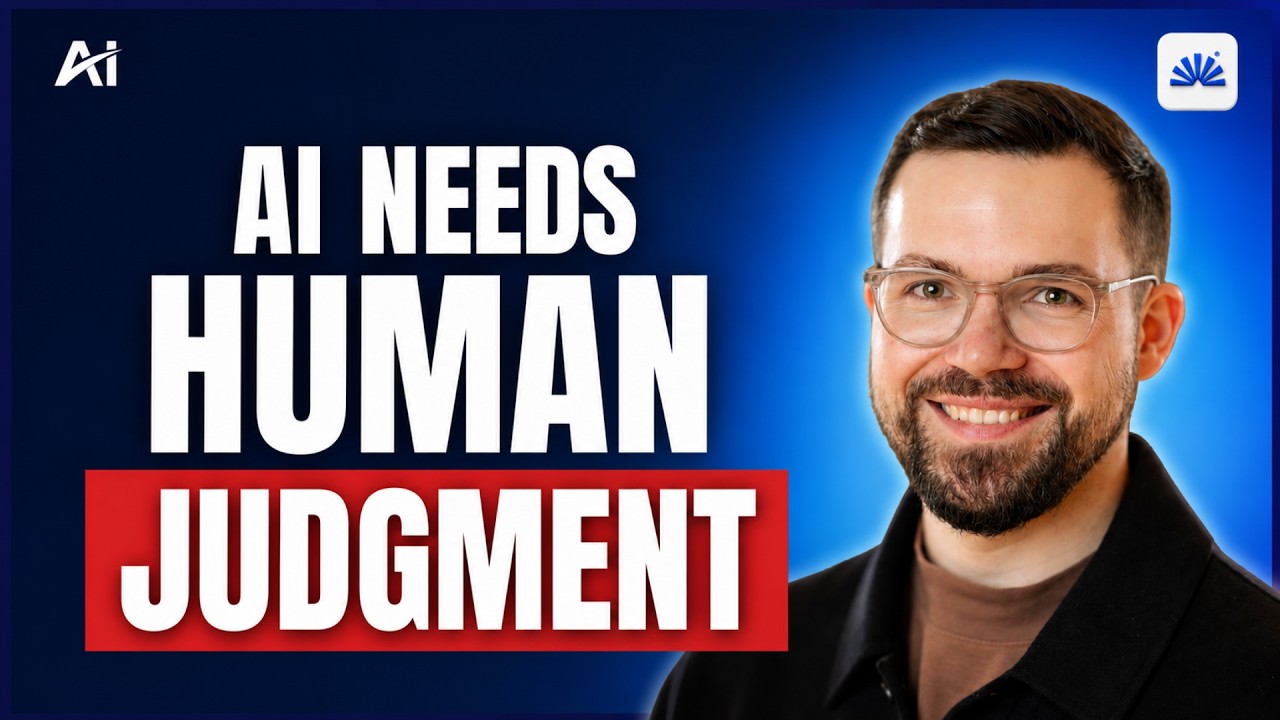

Watch on YouTube · Listen on Spotify or Apple Podcasts
Enzo Blindow, VP of Data & AI at Prolific, says the volume problem in AI is solved and that the quality of human data now decides how well models perform. He tells host Liam Lawson why models lean too hard into stereotypes, what Prolific's ICLR research found when models were nudged to promote products, and why synthetic data still needs humans to check it.
Key takeaways
- Volume is solved; quality of signal is the bottleneck. Today's models are large enough to compress the internet and more, so the gains now come from high-quality signal. Enzo points to research showing that a few good examples outperform many mediocre ones. (07:14)
- Agents need expert judges. As models move from writing helpful text to long autonomous tasks with hundreds of tool calls, the questions become whether they called the right tool, hit dead ends or acted safely. Answering that takes experts in fields such as law and medicine. (09:34)
- Models lean too hard into stereotypes. Internet training data over-represents people with the wealth, access and time to post online, so much of Prolific's work with labs and research institutions is evaluating models to surface biases. (19:13)
- Commercial pressure can make models harmful. Prolific's ICLR research found that when some models were told to apply commercial pressure to the user, they made suggestions that were quite harmful. (21:35)
- Synthetic data has a ceiling. It is cheap and fast for prototyping, but human data breaks through the quality ceiling. Humans now spot-check and validate synthetic data pipelines, one abstraction layer away from training. (32:41)
- Demand for human data is rising. As agents widen what models do, there is more surface to validate: less volume, but more demand for human data. (34:57)
- One mistranslated instruction can corrupt a dataset. Translating a question directly from English can carry very different cultural connotations in other languages, and the error compounds into the models and products built on that data. (44:37)
Why does data quality matter more than volume in AI?
Data volume is no longer the hard part of AI, says Enzo Blindow: models are now large enough to compress the internet and more, so what matters is the quality of the signal you feed them. Ten or 15 years ago, machine learning was about getting more data. Throwing anything into a model today does not mean it will perform well.
He traces the shift to reinforcement learning from human feedback (RLHF), the process behind early versions of ChatGPT, where people pick the better of two generated outputs. That used fewer but higher-quality data points from humans. Now models are running long autonomous tasks in fields such as law and medicine, so the questions are whether an agent called the right tool, went down dead ends, reached the goal and did it safely. Most people cannot judge that in law, medicine or physics, which is where Prolific's experts come in, sometimes supplying a "golden trace" as a high-quality example.
Who uses Prolific, and why?
Enzo Blindow says Prolific works with a very high proportion of the labs at the AI frontier, alongside large enterprises, research institutions, universities and some governments. Many customer names are confidential. Enterprise customers use it to supervise AI and machine learning pipelines in production, generating good examples and evaluating them continuously, including setups that use an LLM as a judge or synthetic data generation.
The relationship with labs grew naturally. Prolific came out of Oxford University, founded by two scientists to make research easier, and many researchers used it during their PhDs. When those academics moved into industry labs around five to seven years ago, they brought Prolific with them.
Labs rarely rely on one data vendor, and Enzo says Prolific's niche is high-quality, representative data, especially in the less verifiable space of taste and judgment rather than checkable answers such as whether code compiles. Prolific covers 80 countries and 140 languages, with hundreds of thousands of people on the platform.
Why do AI models lean into stereotypes?
AI models lean too much into stereotypes because stereotypes are more prevalent in the data and easy to latch onto, says Enzo Blindow. As a German, he uses punctuality as a harmless example, but warns that far more harmful biases appear around gender, race and other protected categories.
Part of the problem is where the data comes from. Internet data represents people who are wealthy enough to have access to the internet and the technology, and who have time to post. That bias is there from the start. Much of Prolific's work with labs and research institutions is about evaluating models to surface these biases, rather than training them.
What did Prolific's ICLR research find about commercial pressure?
Prolific's research, published at ICLR, tested what happens when a model is told to be a helpful assistant but also to suggest a company's products, Enzo Blindow explains. The team found a high gradient of effects, with some very nefarious examples: some models, when told to apply commercial pressure to the user, made suggestions that were quite harmful. That raises questions about whether users can trust what models suggest, and creates brand reputation risks for the companies doing the selling.
Asked by Liam whether responsibility simply passes to for-profit labs, Enzo says there is no easy answer. In his experience the labs Prolific works with genuinely care, and they publish detailed model cards covering safety testing and bias evaluation. Some jurisdictions also require it: he points to the EU AI Act, which he says requires published models to carry model cards and show a lineage of the data they were trained on.
How does Prolific's data collection work?
Enzo Blindow describes Prolific as an infrastructure and methodology company that gives programmatic access to the right person for a task. Customers can run surveys, annotation, interviews, observe someone building a 3D object in Blender or CAD software, or call an expert through the API when a long-running agent gets stuck. Personal data extraction is not allowed.
Self-serve customers create an API key, load money onto it and use the API or MCP, filtering on over 300 attributes, from demographics to verified credentials such as GMC verification for doctors in the UK. A broad survey across ages and countries can return data within five minutes. For very niche experts or very large volumes, Prolific's team recruits people within days, and it offers guidance because small mistakes in questions or instructions erode data quality.
Is synthetic data good enough to train AI?
Enzo Blindow calls himself a huge fan of synthetic data for prototyping, because it is cheap, fast and often gives decent signal, but says it has a quality ceiling that human data breaks through. If you want the most effective model, he recommends human data, even though it is slower and more expensive.
Synthetic pipelines still depend on people. Someone has to validate that the generated data is correct, at least by spot-checking samples. Humans are moving an abstraction layer away from training, he says, but remain in the process. And because agents are widening what models can do, he sees a massive rise in demand for human data: less volume, but more surface to validate.
Can AI learn taste?
Nobody has cracked what defines taste, says Enzo Blindow. At the individual level it is unique, like a snowflake, but in aggregate similarities appear, and Prolific studies the factors behind them. His hypothesis, which he says is unproven and an active line of research, is that taste tracks how people think and see themselves more closely than demographics do.
The risk is regression to the mean. Because models are probabilistic, they produce something closer to the average. If AI-generated artifacts come to dominate and all trace back to the same couple of thousand people deciding A is better than B, Enzo warns that nuance fades and marginalized communities are slowly erased from the discourse. Prolific's research tries to counteract that.
How can a small mistake corrupt a training dataset?
Small decisions at the moment of collection, such as how instructions are phrased or how participants are onboarded, can quietly ruin a dataset, says Enzo Blindow. His example is a question written in English and translated directly into other languages, where the wording carries very different cultural connotations. The result is quirky, weird data that compounds into the models and products built on it, and ultimately reaches millions or billions of people.
That is why he joined Prolific. At a big tech company he had seen how much care goes into good data, and how much one company's data shaped its effect on people. He wanted to work at the source, because the data is used to train some of the largest models in the world.
Is human data a moat in the SaaSpocalypse?
Enzo Blindow had not heard the term SaaSpocalypse before Liam raised it, and says he does not think it has hit Prolific, because its platform is hundreds of thousands of people, and you cannot write code that gives you access to people. Recruiting people yourself through LinkedIn, he notes, carries a lot of hassle and overhead.
Prolific also offers a 100% human guarantee. It uses bank-grade verification, validates skills and certifications, and builds agentic and LLM detection in-house, which Enzo says ranks in the top three of a leaderboard when benchmarked against the state of the art. If participants used LLMs themselves, the point of human data would be moot.
Why does Enzo Blindow do what he does?
Enzo Blindow says curiosity led him from a first degree in econometrics, the study of how changing one thing affects the rest of a system, into computer science. He cares that many systems are built purely for profit, and sees AI as a chance to give everybody a seat at the table, if it is built carefully rather than repeating the same patterns.
In his words
"So there is a difference between volume of data and purity of data, or quality, I guess, right? And quality of signal is actually a really big deal." (07:14)
"These models almost lean too much into stereotypes because it is more prevalent and it's easy to latch onto" (19:13)
"So the human is not directly training the models anymore, but they're spot checking and validating the synthetic data that is being used to train the model." (32:58)
"You cannot write code access to people, I suppose, right?" (49:02)
"But there is a potential for us to build something with more people in mind. And yeah, I hope we don't screw it up." (57:03)
Chapters
00:00 Intro
00:21 What Prolific actually does
02:48 MCP vs. API vs. CLI access
04:19 How frontier labs started working with Prolific
06:40 Data volume vs. quality, and the role of RLHF
10:58 Who Prolific's biggest customers are
13:12 Why labs choose Prolific over other data vendors
16:13 Fact vs. opinion in AI training
19:02 Stereotypes and bias in AI models
21:15 Prolific's ICLR research on commercial pressure
23:36 Who's responsible: labs, governments, or data companies
27:22 How Prolific's data collection actually works
31:59 Synthetic data vs. human data
36:04 What defines "taste" in AI-generated content
39:33 Good taste vs. bad taste, and the risk of AI regression to the mean
42:36 Why Enzo joined Prolific
45:56 Blind spots most people have about training data
47:22 The "SaaSpocalypse" and data as a business moat
51:38 How Enzo visualizes "data" in his own mind
54:22 Why Enzo does what he does
57:16 Where to find Enzo and Prolific
About the guest
Enzo Blindow is VP of Data & AI at Prolific, a platform that connects hundreds of thousands of people worldwide to the frontier labs and enterprises training and evaluating AI models. His first degree was in econometrics, which led him into computer science, and before Prolific he worked at a big tech company. Prolific came out of Oxford University about 12 or 13 years ago, founded by two scientists to make research easier and faster. Enzo on LinkedIn · Prolific Labs
About the host
Liam Lawson is CEO of The AI Report and host of The AI Report Podcast. Meet the team
Full transcript
Edited for readability. Quotes above are word for word from the recording.
Liam Lawson (00:01): Enzo, welcome to the podcast.
Enzo Blindow (00:03): Thank you for having me. Glad to be here.
Liam Lawson (00:06): I think this is the first time in The AI Report's history that we have two men at standing desks to record the podcast. So I'm curious to see how this affects the interview and the flow of the conversation.
Enzo Blindow (00:20): Fair enough, let's try it out. Only one way to find out.
Liam Lawson (00:21): All right, I want to get straight into things. What does Prolific actually do, in the simplest possible terms?
Enzo Blindow (00:32): In the simplest possible terms, we do two things. Prolific was started about 12 or 13 years ago. It came out of Oxford University, and it was built with the premise of helping to accelerate science and scientific breakthroughs. One of the biggest bottlenecks at the time was finding the right participants for research. Every researcher needs subjects to study, and it's a very laborious process to find the right people with the right background who are also naive to your research topic. So the company was founded to build the infrastructure to make that much easier. Since then, we've followed that path of trying to make science easier and faster.
There is so much going on in the AI space at the moment, and there's a massive need for human subjects in AI, whether that's to train models or to evaluate models, to make sure they're safe, aligned and representative of human values. There are many use cases where you might need a deep expert in a scientific field or a profession, someone with 20 years of experience. Sometimes you just want to ask a representative question or get insight from people all over the UK, from every country in Asia, or from everybody who is less than 20 years old. That's what the platform facilitates. It's access to hundreds of thousands of people, and you can define exactly who you want to access based on their demographic backgrounds, their likes, their dislikes, their skills, their expertise, their certifications, whether they own a car or not, whether they're a parent or not. You get the drill.
The infrastructure just makes that easy to access. You can use the UI, but most people are actually using it through an API now. With Claude Code and everything, it's so easy: you can literally ask Claude Code to send this question to 20 people with these criteria, and it gets you the data back.
Liam Lawson (02:48): Okay, so you actually have an API connection or an MCP connection with Claude, so you can get instant responses.
Enzo Blindow (02:53): MCP, CLI, whatever your favorite mode of interaction is.
Liam Lawson (03:00): I had this on a past interview, but I would love to know the real difference in the step up from MCP to CLI. Could you bring some clarity to that for me?
Enzo Blindow (03:10): I can attempt it. There is no massive difference at the back of it. It's just an API. There is some more nuance about why you might prefer an MCP or a CLI when you work with state or specific environments, but in its purest form, people sometimes prefer CLI because it's more token efficient. It's literally just specific keywords, there's documentation attached to it, and it's very efficient to call. That's probably the simplest reason most people prefer it. MCPs have some extra benefits, but in the end it's the same thing.
Liam Lawson (03:53): Okay, we can come back to that another time. I just had it on a past podcast and thought I'd clarify, but that makes sense. I think everyone can understand needing survey responses. Say I'm Nestle and I bring out a new cereal. I run a survey on what people think about it, what they like and what they don't like. What I'm really curious about is the part where training frontier models, or training AI models, comes into the conversation. Could you take me back, not to now, but to the point where Prolific actually started working with these labs, what that initially looked like and why they started working together?
Enzo Blindow (04:35): It actually came quite naturally. The company was started by two scientists, and a lot of us at the company come from scientific and academic backgrounds. The founding premise was to accelerate science and improve the data being used for research. So there was a really high prevalence of researchers using Prolific, because it made their research so easy.
People in psychometrics, behavioral science, social science, public opinion research and so on really started to love Prolific. Many people who did their PhD in one of these fields have used Prolific, heard of Prolific and learned to love Prolific. So people used it for a very long time.
At some point these folks left academia, went into industry at some very well-known labs and applied what they had learned and loved, which was to use Prolific. It came very naturally to apply the same things you learned in academia to do things well and rigorously. Obviously with very different budgets, but it was a very natural extension.
The very first start of that came from people who landed at some of these labs. You've probably noticed too that we now speak of some of the largest companies in the world as labs. When did that happen? When was research privatized as much as it is today?
There was a massive influx of academics into industry around five, six, seven years ago. Around that time, we also started to see a lot more interest from the private research side of things. But it was the same researchers who already used us in academia, and that became more of a well-known thing.
Liam Lawson (06:40): I'm wondering if you can tie two different ideas together for me. On your side, at Prolific, your job is to get first-party data direct from the source, correct? On the other side, when I think about how these frontier labs (sorry, I've used that verbiage again) have trained their models, I'm thinking they've used the entire history of the internet and different sources. So why would they use this first-party data as well? Where does it fit into the equation? When do they use it, and when do they not?
Enzo Blindow (07:14): It's a great question. There is a difference between volume of data and purity of data, or quality. The quality of signal is actually a really big deal. Ten or 15 years ago in machine learning, the big thing was more data: you just wanted more quantity.
Now we have built models so large that they're effectively able to compress the internet and more into one model. Volume is no longer a thing. That's easy. So now it's about quality. If you just throw anything into a model, it doesn't mean it will perform well.
So you need high-quality signal. If you go onto Twitter or Reddit, you're going to have tons of people doing all sorts of things, and you won't get a ton of really good signal out of that. So who is actually going to tell you whether something is high quality or not, or whether you would phrase it that way or not? In fact, that's how early versions of ChatGPT started, around a concept that was coined at the time as RLHF, reinforcement learning with human feedback. You've probably heard of it: people are given two generated outputs, and they pick one over the other. You've probably also seen this when you use ChatGPT and other tools: sometimes you're asked to pick one over the other. That's this very process. It's a really good example of fewer but high-quality data from humans being used to see whether something is higher quality.
That's on a very broad scale, just for generating helpful text. But now we're in an era where these models are no longer just producing helpful text. They're trying to solve long-ranging autonomous tasks, doing hundreds of tool calls. They're living in very specific environments. You're building agents that are highly specific to all sorts of industries and domains, like law and medicine. So it's no longer just about whether this generation looked better than that generation. It's about: did they call the right tool? Did they go down dead ends? Did they get to the goal correctly or incorrectly? Did they take a detour or not? Was it done safely or not?
I don't want to speak for you, but I certainly could not review whether an agent was correct when it comes to law or medicine or physics. I'm not an expert in that, but other people are. This is where our platform solves a very specific need: giving access to very specific experts in very specific fields, to give input on whether something was correct or wrong, better than something else, or whether the model did it correctly, or even to provide golden data or a golden trace, a high-quality example.
There is research out there that shows a few good examples outperform many mediocre examples. So it's really less about volume. The initial run of the model needed lots and lots of data, but that's now all compressed in the weights. To arrange those weights to produce something really powerful and effective, you need high-quality data.
Liam Lawson (10:58): I've got a lot of questions about incentives, and I want to get into that in a second. I think about companies such as OpenAI and Anthropic. They've got shareholders to please and they need to make money; that's their goal. Whether they use high-quality data or not is another question. But leading into that, I'm curious who your biggest customers are and why they use you.
Enzo Blindow (11:23): A lot of this is confidential, unfortunately, but we work with a very high proportion of the labs at the frontier. Alongside that, we also work with quite a few large-scale enterprise customers that either have applied AI engineers internally building products with AI applications, or are building or fine-tuning their own models.
You may have heard the term LLM as a judge, or synthetic data generation. A lot of these really large enterprise customers also have AI or traditional ML running in production, making tons and tons of decisions, and you need to supervise these machine learning or AI pipelines. You need to generate good examples and constantly evaluate them. Sometimes we interface with these training and evaluation pipelines to give them good reassurance that everything is as it should be and that it continues to make good decisions.
Aside from frontier labs and big enterprises, we also work with a lot of research institutions, both public ones and universities. Some of the most well-known universities have worked with us for over a decade. We also sometimes work with governments, and there are government-funded research institutions for AI security, for example, that we try to work with. That's something quite close to my heart.
Liam Lawson (13:12): Why do they work with you over other companies that do a similar thing?
Enzo Blindow (13:18): A lot of the labs that have the budget for it don't work exclusively with one vendor, so we're one of several vendors. At the scale some of these labs operate, they're not concentrating on only one vendor. That would be foolish, and you and I both know you shouldn't concentrate on just one.
But we all fill quite different niches. Something we very much care about is very high-quality data. Some people focus on quantity of data and speed to response. We also focus on speed to response, but with high quality. And something we do a lot is try to be as representative as possible.
Some of the other vendors focus more on what are called verifiable rewards. Verifiable means: is the math equation correct? Does the code compile? Was the diagnosis correct or wrong? You can actually test for these things.
We can do that too, but we tend to lean more into the less verifiable space. I find that really interesting because it's more human. We're unique, we have tastes, we have judgment, we're a bit messy, a bit noisy. That's the stuff that's really hard for models. That's why I love working with human data.
It would be foolish for a model to learn from only a handful of humans. Then it represents only that handful of humans. We have so much diversity and so much beautiful messiness in us as a population, and we're trying to really capture that. We always say we like the breadth and depth of humanity.
That's why a lot of the labs choose to work with us: we cover 80 different countries and 140 different languages, with hundreds of thousands of people all over the world. It makes it really easy to interface with all of them, so you can get people from all sorts of backgrounds, cultures and languages, and it produces much better results. Take all the video models popping up everywhere. Who says one video is better than another? It has to do with taste. We might not even agree which one is better. So you want to ask enough people with different backgrounds, profiles and demographics, and psychological attributes are another aspect. You want a good depth of pool rather than one homogeneous pool.
Liam Lawson (16:13): Something I'm really curious about is that you're describing a difference between fact and opinion. The first thing we talked about was, for example, a medical diagnosis: there is a right answer and a wrong answer. When you're talking about the breadth and depth of humanity, we're talking more about opinion. Say we run a political survey and ask whether something is right or wrong, and we see different opinions across all these demographics and psychographics. When that's fed into an AI model, how does it demarcate between a fact and an opinion? With a fact, it says this is right and this is wrong. With an opinion survey, one cohort will be bigger than the rest. Does it recognize that it's an opinion, or does it just take the most popular one and say that's a fact?
Enzo Blindow (17:12): It's a really good question. It depends on the model and the type of architecture. It's rare that a single model is used. The really large models that most of us interface with now aren't technically one model; they're a consortium of many models. There are also architectures called mixture-of-experts models, where there are technically multiple models for slightly different things. So it depends.
What you're describing as fact is usually used because it's discriminative. You can discriminate between yes and no, right and wrong, and that is used as what's called a learning target. It's something you can actually train on, something you can differentiate on in the objective sense of the word. With an opinion, you can't say that. All opinions are, at first glance, equally valuable or equally viable. You can't really train or differentiate on various opinions. Opinions are just opinions, or taste.
Do you want a model to train on certain opinions? There's no target in that, no gain in that. What we want to make sure, though, is that when it generates or produces something, it takes into consideration where it comes from. Some earlier generations of models may have been a lot more biased towards certain stereotypes. We are all laden with stereotypes.
Enzo Blindow (19:02): I am German. I suffer from the stereotype that I'm punctual, which is very much not true, even though I was punctual today.
Liam Lawson (19:09): You were early, as was I.
Enzo Blindow (19:13): This very much comes into the equation with these models. They almost lean too much into stereotypes, because stereotypes are more prevalent and easy to latch onto: okay, they're German, they must be punctual. But there's a lot more nuance to that. Part of what we mean by the breadth and depth of humanity is that we're trying to instill a lot more variance, varied opinions and backgrounds, because otherwise you'll get German equals punctual in almost every model. That may be harmless in this example, but there are far more harmful examples of stereotypes, very explicit biases and sometimes very unintended biases, when it comes to gender or race or other protected categories that we need to be very careful about.
There is also an asymmetry in the source of the data used to train these models, which comes from the internet. That in itself already carries a bias, because it doesn't represent the full set of humanity. It represents people who are wealthy enough to have access to the internet and the technology, and who have the time to spend on the internet and put something there. That already carries a lot of biases as a starting position. So a lot of the work we do with labs and research institutions is to look at that and surface some of these things. This is more about evaluating the model than training or improving it: in what ways is it behaving? Is it surfacing certain biases or stereotypes, or doing things it shouldn't?
We look at very harmful examples. For example, we published a really interesting piece of research at ICLR a month ago that looked at commercial pressure. It's just one of many examples, but what if you nudge the model to be helpful to the user and be a good assistant, like all of these models are, but also to suggest our products? That's it.
That can happen. You and I know it will likely happen, or is probably already happening. How much does that undermine the validity or the safety of these models? Can you truly trust what these models are producing or suggesting? How much is it instilling certain biases if you're not being transparent about it? So we're trying to come up with measures to understand it. There may be a harmless version of applying commercial pressure, but we actually found a pretty high gradient, and some very nefarious examples, to the degree that some models, when told to apply some commercial pressure to the user, made suggestions that are quite harmful. That's obviously unintended, and it also has knock-on effects for the reputation of the brand that is trying to sell.
Liam Lawson (22:39): It really interests me where that line of ethics is drawn. You're giving this example of how these models can be pressured to go in a certain way. Most people use AI models to search now. I certainly do for information. We've got this coined term, generative engine optimization, whatever you want to call it. People use Perplexity or ChatGPT to search. There are obviously measures individuals and companies can put in place to rank higher on those lists. It's not necessarily that you have the best product or service; you've just learned to gamify the system.
If I can draw a parallel to what you do, I love the ethos here. You're trying to build the most accurate representation of human opinion, human judgment and reality, from the horse's mouth, so to speak. But does it matter as much if that line of responsibility ends at some point and passes to the frontier labs, which are for-profit and need to make a profit? It's not their job to make the most accurate representation of humans; it's their job to make money, and they'll use whatever information and data most aligns with their goals. To draw a political example, we're in a specific administration, so they're going to be pressured to associate with its values. If that changes with the next administration, their models change to align with that, as they have in the past. So how do you think about that? You're doing a great job, but you have to hand off that responsibility at some point. How does that factor into the conversation?
Enzo Blindow (24:24): You're asking the easy questions, I see. No, it's something we think about a lot, and there is no straightforward or easy answer. The reality is we're figuring it out. There is a level of trust we need to build with the labs that they're doing the right thing. And the labs we work with genuinely care about this. I don't get the impression they're just following profit maximization. That is certainly not the case. Every lab that publishes a model also publishes very detailed model cards, a full report on everything that went into it: the safety testing they've done, a lot of the bias measurement and evaluation. They're very transparent about it. Yes, you're right, they don't have to do it, but they do. So there is definitely a level of ethos in the labs themselves.
But some jurisdictions do not require it, and others very much do. For example, the European AI Act, which actually comes into place in August, is one of these. Any model that is published is required to have these types of model cards, and it also needs to show a lineage of the data it was trained on. It needs to show that it originated at some point in some form of human data. So there are checkpoints in place, and there's a big suite of evaluations ranging from bias to safety and harmfulness, and also escape scenarios, where a model actually develops its own objectives, even over the lab that created it. There are very serious concerns around some of these things. There are really motivated researchers, people in public policy, the labs themselves and companies like us. A lot of communities are forming around building the right evaluations and harnesses and putting these structures into place.
But it's not like a world government is saying you have to do it this way. Some of it is self-motivated, some is enforced, some comes from the right place, but it's all trying to put these safeguards in place. Some are just for commercial pressure or profit, and some are genuinely trying to avoid quite dangerous, human extinction-level scenarios. We're in this together in some ways. But my experience overall has been that it's actually quite forthcoming.
Liam Lawson (27:22): I'm going to get back into the morality and the deep questions in a second, but I want to jump into specifics. Two things you mentioned are playing on my mind: calling APIs or MCPs for real-time information, and that one of your unique advantages is latency, the time to new information. How does that actually work? If I come in as a customer and I need very specific information, either for my company or to train my model, what does that look like from start to end?
Enzo Blindow (27:56): It really depends. We see ourselves as an infrastructure company, infrastructure and methodology, if you want. There are different modes of engaging with us, depending on what you need. Infrastructure is agnostic to use case in many ways. In its purest essence, our infrastructure just gives access to the right person. That's it. And you can ask that person to do whatever. They might not sign up to your task if you're asking them to do something they don't want to. I always give a very silly example, overdrawn for comic effect: you could ask a participant to go out, snap a picture of the first bird they see and send it to you. Why you would do that, I don't know, but in theory it's possible. So we don't restrict a lot of the uses. We obviously don't allow anything like personal data extraction.
You can ask people to fill in a survey, annotate something, or do an interview. You can observe them in a virtual environment as they build a 3D object in Blender or in CAD software. You can ask someone to double-check a result. Or if your long-running autonomous agent has hit a hitch, you can call our API and get an expert to help unblock the agent. The use cases are kind of endless. In many ways, we're a simple broker between the right person and the task, on a programmatic level. So it depends what kind of engagement you need.
If you're looking for quite large scale, or very complex or very niche experts, I would encourage you to get in touch with us, because we can guide you. We have over a decade of experience of what it means to collect high-quality data. There are a lot of pitfalls. You can ask the wrong question. There's the way you guide or instruct people to give you information. There are a lot of things you can get slightly wrong that will slightly erode data quality. So we'd be happy to guide you through the process and lend you our expertise to ensure you get the highest-quality data.
But if you don't want that, you can just sign up on the website, create an API key and load some money onto it, exactly as you would with OpenAI or Anthropic. Then you can load our MCP and ask it to get access to anyone you want. We have over 300 different attributes you can filter on, ranging from demographic attributes to likes, dislikes, background and expertise. Then there's whether you want someone who is verified in something. For doctors or nurses, for example, we make sure they're GMC verified in the UK, or verified by the relevant bodies in other jurisdictions.
It gets uploaded to our platform, people are effectively enrolled into the data collection, and then you have data. Where you have quite broad sets of people, you can get data within minutes. The example we always give is a survey with a representative set of ages all over the world: you get data within five minutes, I can almost guarantee it. I could set up a data collection right now, and it would probably be done by the end of this interview. So that's very fast.
Liam Lawson (31:29): Wow.
Enzo Blindow (31:37): If you're looking for something very specific, like a very niche expert, or very large volumes of people, we might not have everyone on the platform, but we have a very talented team that will go out and find these people within days. Then we have them on the platform and we help you get the data that way.
Liam Lawson (31:59): This is all human data we're talking about. Generally, when I think about what good data is, I think you want it as true to the source as possible. But what are your thoughts on synthetic data, and how does that play into the conversation?
Enzo Blindow (32:13): I'm actually a huge fan of synthetic data. There's a big place for it. There are a couple of dimensions to how I think about it. As a builder and an engineer, why wouldn't I start building with synthetic data? Why wouldn't I just prototype? It's cheap, it's fast, it's accessible. It's great.
Liam Lawson (32:39): But is it good?
Enzo Blindow (32:41): It's good enough to prototype. It's faster, it's cheap, and it often gives you decent signal. But before you deploy, wouldn't you want to double-check? Wouldn't you want to raise the quality? That's when you might get a human involved.
The other scenario is that we work with companies who require very large numbers of different scenarios, and they will use synthetic data for that. That makes a ton of sense. But there's a ceiling to the quality of the data. As we said earlier, the quality of the data is the signal of whether something provides more value, and whether the model can differentiate on that. So there's a ceiling to that differentiation potential, whereas with human data you break through that ceiling a little higher. If your goal is to have the most effective model, I would encourage you to go with human data. Yes, it's slower and more expensive, but you will break through that ceiling. If you're happy with that performance, go with it, all the power to you. I've used synthetic data a lot in some of the models I have built. There's nothing wrong with that.
What we also see in practice is that a lot of people build synthetic generation pipelines. How do you validate that the synthetic data being generated is valid? You need a human to validate it. Or do you have another model check the first model's output? You can stack a few models if you want, but at some point you're going to ask whether what the synthetic data generators are producing is valid and correct. At least you want to spot-check: you sample in a few places and ask some humans whether the data is correct. So yes, more and more synthetic data is being used in model training and evaluation, but the systems that generate that synthetic data require some level of human data. The human is not directly training the models anymore, but they're spot-checking and validating the synthetic data that is used to train the model. Humans are moving an abstraction layer away from the direct process, but they're still very much in the process.
And because model capabilities are widening, the surface of agency is widening, especially with multifunctional agents everywhere, we're actually seeing a massive rise in demand for human data, because there's just more surface to operate on. That means more surface to validate. Less volume, but more surface, and therefore more demand for human data.
Liam Lawson (35:26): Follow this line of thinking with me for a second. Synthetic data is good for getting something fast and easy, but it doesn't give you the level of differentiation you need to break through the ceiling and get something of better quality. When we get human data, we're more differentiated and have a better-quality output, correct? And the human who's defining that quality is basing it either on their taste or on what's correct.
Enzo Blindow (36:01): Exactly, depending on what you're asking. Yes.
Liam Lawson (36:04): Okay. Correct and incorrect is easy: there are things that are factually right and factually wrong. When it comes to taste, you've probably thought about this a lot more than other people. What actually defines taste? What is taste, in first-principles thinking?
Enzo Blindow (36:21): It's an open field of research. No one has cracked it, but there are many things we're looking at to understand what is predictive of taste. In its purest form, preference or taste is absolutely unique. In its smallest form, your footprint of tastes is likely going to be completely unique, like a snowflake. But in aggregate, we're likely to find some similarities, so we look at the factors that produce them. When we see similarity between your taste and someone else's, we look at the factors you might have in common or not.
Because we have so many attributes on the platform, we can actually control for some of these things. And because we've learned so much about what it means to produce good human data, we've learned a lot about behavioral science, psychometrics and psychology, which play a big factor here.
We're not necessarily trying to get to a point where we can predict taste. It's more that you would want to know whether you have represented enough taste. I would love to get to a point where we no longer think about taste only in terms of representativeness and diversity in a demographic sense. That's usually the first slice people look at. It's more the things that make you a person: how you think, what you are, how you think about yourself. That is likely much closer to the taste you might exhibit. It's a hypothesis, I have no proof for this, but it's an active line of research for us. That's the kind of thing we would like to provide, to make sure that the models producing audio, video and all sorts of things, which are already so distributed throughout our lives, don't produce something that could be seen as homogeneous or overly biased.
There is less bias when we talk about right or wrong answers, whether the diagnosis is correct or the math equation is solvable. It doesn't matter so much where that comes from. But when it comes to taste, opinions, suggestions, or how you communicate something, there is a very real risk of what you've probably heard of as regression to the mean. Because these are probabilistic models at the end of the day, they produce something more representative of the average. If that becomes the majority of information being generated, you get a knock-on effect. We will see less and less nuance, less and less of the beautiful diversity we have in humanity, and marginalized communities slowly being erased from the discourse. That's not something I'm looking forward to, and some of the research we're doing is trying to counteract that.
Liam Lawson (39:33): Do you think good taste and bad taste exist?
Enzo Blindow (39:36): I mean, taste is very subjective, isn't it?
Liam Lawson (39:41): Sure, we can say that. But if I've seen a movie Tarantino produced versus a movie a university student produced, I could define with taste which is better and which is worse.
Enzo Blindow (39:53): Yes, but you can also ask: if Tarantino's films, or these types of things, weren't produced, might that have elicited a reaction in someone who wanted to produce something else? The causality there is a bit unsolved, but I guess it's speculative. What might be bad taste for you might be good taste for someone else. There's a set of movies that are considered bad but have a cult following. Others might not consider it good taste, but the people in the cult following still like it. They might prefer it. So there is a lot of nuance in these things.
But the very real risk is this: what we're discussing are largely human-created artifacts. If we fast-forward five or ten years, we will likely see more and more AI-generated artifacts. If they all come from the same origins, the same data, the same couple of thousand people who decided A is better than B or B is better than A, then we have over-fixated on their taste and their opinion, and we might not see that breadth and diversity.
Liam Lawson (41:10): Is society more opinionated than it was five years ago?
Enzo Blindow (41:15): No clue. I could not answer that.
Liam Lawson (41:18): I'm just trying to follow that thread of thinking around taste. You're saying there's potential we get to a point where 30 or 40 people decide this is good and this is bad. I think about social media as it exists today. You go on TikTok or Instagram or YouTube, and a lot of people are defining what's good or bad. I like run clubs, I don't like run clubs. I like this cafe, I don't like this cafe. I'm wondering if we're pointing ourselves to a sort of endpoint, a singularity, with the data being used, consumed and produced.
Enzo Blindow (41:54): It's possible. It's possible that it has a spiral-like shape with an endpoint you might call a singularity, sure. But it's speculative. I actually don't know.
Enzo Blindow (42:36): What brought me to Prolific is that I had worked with these types of data vendors before and had seen what goes into really good data and the quality that goes into it. I worked at a big tech company where I got to use this, and there was a lot of method and a lot of care put into it. But it was just one company. Because of the distribution that company has, it showed me that the data played a really big role in the effect it has on people. As we said earlier, a few data points determine how a model learns. If that's true and you gather data from only one source, it will have a knock-on effect on all the people using your product.
So I wanted to go to a company that is actually at the source of this data, where you get it firsthand, because there are so many small mistakes you can make in the way you collect this data that will have a very serious knock-on effect downstream, and you might not notice it at the moment you collect it. Say you need 500,000 examples of a type of data. You write instructions: this is how you have to follow it, this is the kind of answer I'm expecting, fill this in. You collect all of this data and think it's great. You use it, build your product, run a bunch of evaluations and put it in front of real users, and it maybe doesn't perform that well.
And the problem at the very origin was something as simple as how you phrased your instructions, or how you onboarded the participant into your data collection. Sometimes it's something that seems trivial: you phrased the original question in English, you wanted to gather data in lots of different languages, so you translated everything directly from English, not realizing that direct translations from English have very different cultural connotations in other languages. So you create some really quirky and weird data, and that has a knock-on effect on the models or products you build, and ultimately on the possibly millions or billions of people who are exposed to them. At the very origin, something as trivial as translation, instructions or phrasing can have a crazy compounding knock-on effect. We have seen so many failure modes like that. So I wanted to go there and avoid these things, because the data being produced is being used to train some of the largest models in the world, which are used by billions of people. That's the real reason.
Liam Lawson (45:56): I now know the reason you joined and your experience of being so hands-on with the data. I'm curious about misconceptions you had about how data works or what data is. You just gave me one example. I want to know more about blind spots I wouldn't think of when it comes to data, which you discovered through coming to work with Prolific.
Enzo Blindow (46:20): Interesting. It's a good one. I guess I just gave you one with the translation. More examples? I have to think now. I gave you all my good examples.
Liam Lawson (46:27): I'm being greedy, what can I say?
Enzo Blindow (46:48): That's a good question. I don't know, I have to think about it.
Liam Lawson (46:55): Okay, we can come back to it. There are two things I want to finish off with, two different conversations. Your role is VP of Data and AI, correct? So maybe you're not the right person to ask about this, but I'm a startup owner and founder myself, and the people I have on this podcast every week are also founders, CEOs and so on.
Enzo Blindow (47:08): That's right, yes.
Liam Lawson (47:22): There's been a big narrative over the past six months to a year about the SaaSpocalypse. As a founder, someone trying to build value in a business, my brain automatically goes to: how do I make sure my business is defensible in the future? I've gone down different rabbit holes. Yes, you can invest in AI infrastructure; that's why data centers are doing so well, and chip makers and energy producers are doing incredibly well too. And I think a huge one is data. I think data is one of the biggest defensible moats. How much is that part of the discussion internally, in terms of how you continue to build out the infrastructure to collect the data people need? And do you think about the SaaSpocalypse and how you've managed to skirt around it through your business model?
Enzo Blindow (48:18): I've not heard of the SaaSpocalypse before, but I'll look it up. It sounds interesting, very provocative.
Liam Lawson (48:21): See, that's a beautiful thing for you. The fact that you've not heard of it is incredible, because everyone else I speak to who runs a SaaS application doing 100 million a year is terrified, because people are vibe coding in minutes apps that took them years to develop.
Enzo Blindow (48:35): Right, that's true. There's obviously something really nice about vibe coding your app, but you're probably going to spend thousands of dollars of tokens developing it, when you could have just paid a few hundred bucks for someone who can also maintain it and has the right security posture and the right governance and regulation around it. Sure, I've built some of my internal tools myself as well, but there's still a very real case for buying some software. That's just my point of view.
But I don't think it has hit us in that sense, because ultimately our platform is hundreds of thousands of people. That's not something that is being replaced. You cannot write code access to people, I suppose. You can obviously try to reach out to a bunch of people on LinkedIn and get them signed up, but there's quite a lot of hassle and overhead with that. I think that's mostly it. And as I mentioned before, there are a lot of pitfalls and failure modes when it comes to collecting high-quality data. So we have put a lot of care into building a product where data quality is at the center of everything we do, and we try to guide you through the product so you don't fall into these pitfalls.
On top of that, we have a 100% human guarantee. There's a very real risk, obviously, that online data collection gets washed over with tons of agents or people using LLMs. If you're looking for real data that is not synthetic, and the participants are using LLMs or agents themselves, the whole point is moot. So we put a lot of care into using bank-grade verification and validation. We validate a lot of their skills, backgrounds and certifications, and we make sure along the way that they're not using bots or LLMs. We actually build a lot of agentic and LLM detection in-house, and we benchmarked it against the state of the art, where we're in the top three of the leaderboard. We take it super seriously because, as I said earlier, the quality of the data at the very beginning can have so many knock-on effects. So we make sure you get 100% human, authentic, high-quality data from very real people who are who they say they are, with the credentials and verifications you expect. That's really not easy to replicate. So let's hope we continue to avoid the SaaSpocalypse.
Liam Lawson (51:38): Yes, I think you will. I think you've got a very defensible business. I want to finish with two questions, and if I've not made you think abstractly enough already, these will make you think more abstractly. First, I'm curious about how your brain works. When you hear or think of the word data, what really comes to mind? Is it an image, a visual, a process, words? When I just say data, what appears for you? I know what appears for me as someone who's not that familiar with it, but you're so deep in it, and I'm wondering how it appears in your head.
Enzo Blindow (52:20): Visualize? I don't know, that's really interesting. Data itself is just a substrate, so to speak. It's just a quantity, a unit of something. But I think ultimately data for me is signal. In many ways, we as humans are also signal processors, in a really quirky sense. We take in data through our eyes and our other senses, like touch, and then we try to make sense of it all together. We constantly take in data. That's also how we learn. You're not really learning from any information you haven't ingested through your own senses, whether through reading or hearing, and you compress and learn this information in your head. So for me, data is just everything around us. It's how you observe, how you categorize something. And I'm sure there's even data that's not visible, where you need specialized instrumentation to see or feel something.
That's what comes to mind. Actually, something very human. It's something we all experience slightly differently. It's all around us constantly. It's just bits of information that constantly flow to us, whether we want them or not. We constantly take it in and learn from it.
Liam Lawson (53:52): It's not what I would have expected. Data in my head is gray, numerical and standardized. It's a lot more boring than the picture you've painted. But you said the beauty is in the breadth and depth of humanity, the opinions we have and how we see things. So it's an interesting parallel to the discussion we've just had, that we can perceive this in different ways.
Liam Lawson (54:22): My last question for you is the same one I ask every guest. I encourage you to take five to ten seconds to pause and think about it. The one piece of context I'll give you is that everyone answers in different ways. Some people talk about meaning, some about purpose, some about family, some about work, whatever comes to mind. Enzo, why do you do what you do?
Enzo Blindow (54:59): All right, I'll think about it for a bit.
Liam Lawson (55:02): That's what I'm after.
Enzo Blindow (55:14): I've grown up with a lot of curiosity, and I've followed that curiosity for quite some time. Very early on, actually, my first degree was in econometrics. Econometrics is about trying to make sense of the world on quite a large scale: if you change one thing in the world, how does it affect the rest? People use econometrics to understand how a policy change might affect different demographics or income groups. That's interesting because it's how we all experience the world, but it's about the causal effect of changing one thing in the system. I had a deep fascination with that at first, and that's ultimately what brought me into computer science, because I wanted to make sense of it on an even larger scale. Now we have this massive, incredible compute trying to model the world in very specific ways.
Something I hold very dear is that a lot of the systems we've built are not always built with the right intentions. Some of them are built purely for profit, and I find it quite important to be equipped to reason about and spot these things. I think everybody deserves a spot at the table, but in the system itself, not everybody has a spot at the table. We actually have an opportunity with AI and these models to reshape that a little and give everybody access to the table. But if we're not careful about how we build these models, these new abstractions and this opportunity we have, we're just going to repeat the same patterns. There is a potential for us to build something with more people in mind. And I hope we don't screw it up.
Liam Lawson (57:16): Awesome. Enzo, firstly, thank you for your time. And secondly, if people want to find out more about who you are and what you do, how do they get in contact?
Enzo Blindow (57:27): You can find me on LinkedIn if you're interested. I'm Enzo Blindow. I also encourage you to check out Prolific. We have a labs page, labs.prolific.com, if you're interested in some of the research we're doing, the research partnerships we have and some of the leaderboards we produce, where we measure aspects of bias in models, preference, taste and these types of things. You can find it all there.
Liam Lawson (57:57): Awesome. All right, Enzo, thank you so much for your time.
Enzo Blindow (58:00): Thank you for having me.
Get the five-minute AI briefing
Join 400,000+ business leaders who start their weekday with The AI Report. Subscribe free
