

400,000+ business leaders (and teams at IBM, AWS & Zapier) start their day with The AI Report. 5 minutes. Plain English. No hype.
How to Measure the ROI of AI Training
Learn how to measure the ROI of AI training by connecting adoption, productivity, quality, & time savings to real business outcomes, not just completion rates.
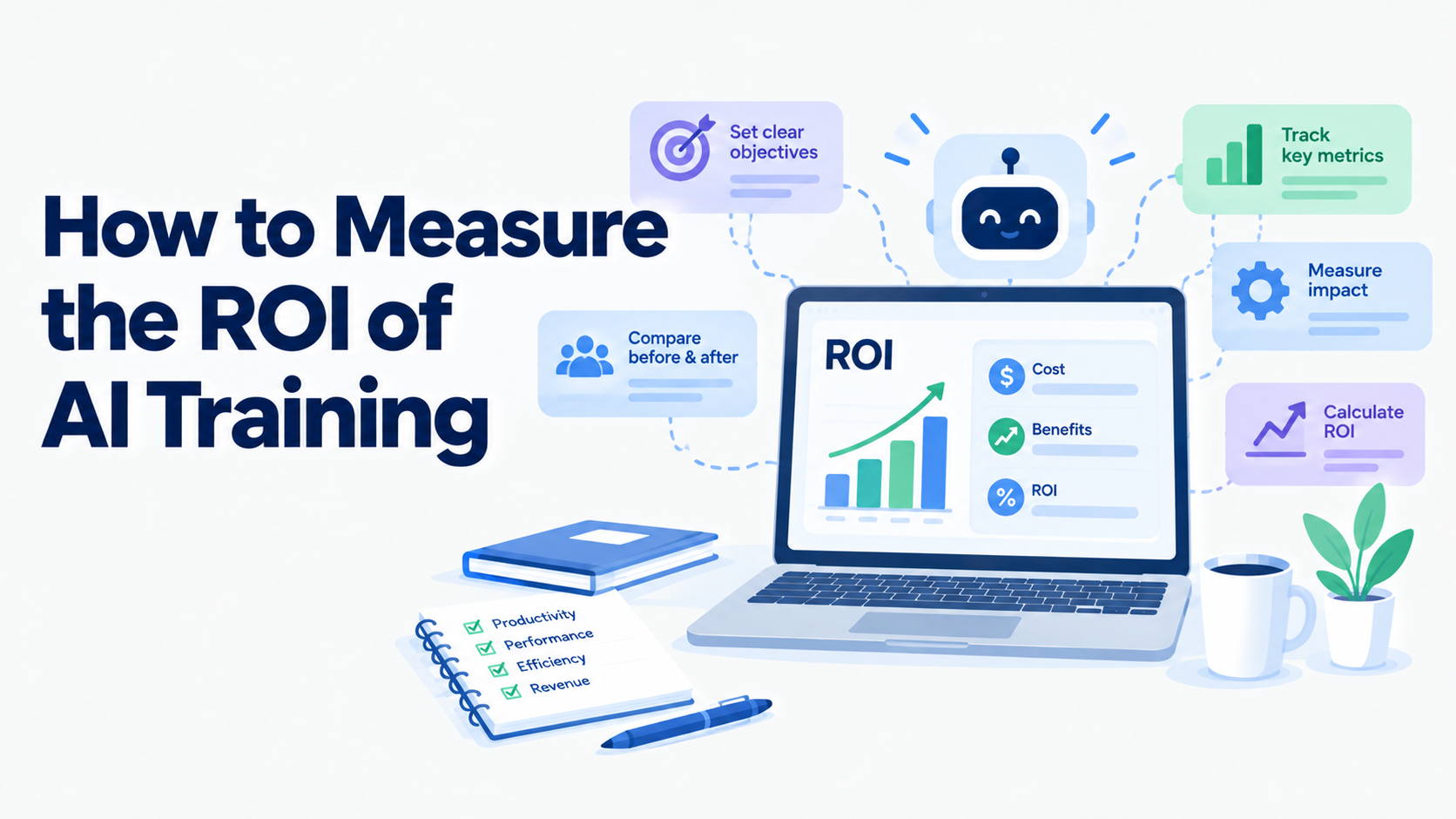

Most organizations can tell you how many employees completed AI training. Far fewer can tell you what that training actually changed. According to McKinsey's research on the state of AI, only about a quarter of organizations adopting AI report a measurable impact on earnings, and the gap usually isn't the technology. It's that training gets measured by completion rates and satisfaction surveys instead of the outcomes it was supposed to produce. Calculating the ROI of AI training requires a different set of metrics, ones tied to adoption, productivity, quality, and time savings that actually roll up to something the business cares about.
Here's a practical way to build that measurement.
Why login counts and completion rates aren't ROI
Adoption is climbing across the board. Recent workforce data puts individual-level generative AI adoption in the U.S. workforce at roughly 40%, with a much smaller share, around 12%, using AI daily rather than occasionally. Firm-level adoption sits lower still, and it varies sharply by company size. None of these numbers, on their own, say anything about value delivered. A workforce that logged into an AI tool once during training and never opened it again looks identical to a heavy adopter in a simple activation metric.
This is the trap most organizations fall into when trying to measure the ROI of AI training: treating "people used the tool" as the finish line rather than the starting point. Real measurement needs to track what happens after activation, not just whether it occurred.
Build measurement in four layers
A more complete way to measure the ROI of AI training separates the question into four distinct signal types, moving from surface-level to substantive:
Activation: Are people actually using the tool at all, and how often? This is the easiest metric to collect and the least meaningful on its own, but it's a necessary baseline. If activation is low months after training, nothing downstream will show up either.
Behavioral proficiency: Are people using the tool well? This means looking at the kinds of tasks employees are delegating to AI versus keeping for themselves, whether they're using more advanced features over time, and whether usage patterns look more like genuine workflow integration or occasional novelty use.
Business outcome: Is usage moving a metric that actually matters, like cycle time, error rate, cost per task, or revenue per employee? This is the layer most organizations skip, and it's the one that actually answers the ROI question.
Governance: Is the usage safe, compliant, and sustainable? A productivity gain that comes with a rising rate of data-handling incidents or compliance near-misses isn't really a gain, and it needs to be tracked alongside the upside.
Connect training to specific, measurable outcomes
The strongest ROI of AI training case studies right now share a pattern: they tie training directly to time, cost, or quality metrics rather than login counts. A few examples worth learning from:
One large pharmaceutical company scaled a self-service AI platform to tens of thousands of trained employees, who went on to build thousands of specific internal use cases at a modest average operating cost per tool. Separately, the same company's use of an AI coding assistant cut the production time for a category of clinical documents from over ten weeks down to about ten minutes for trained teams. Another global pharmaceutical company's internal AI assistant reached tens of thousands of monthly users, with the large majority of surveyed employees reporting genuine time savings on routine tasks and a strongly positive feedback rating.
What connects these examples isn't the size of the company. It's that each one measured a specific before-and-after: time to complete a task, cost per output, or a direct survey of time saved, rather than reporting a training completion percentage and calling it done.
Watch for the capability gap that silently kills ROI
A recurring finding worth building into any measurement plan: efficiency gains from AI adoption depend heavily on how well-trained the workforce actually is, not just whether the tool is available. Leaders in recent workforce surveys tie inadequate AI skills directly to specific downstream risks, including a meaningful share who point to inaccurate decision-making and a similar share who cite an inability to keep pace with competitors as a direct consequence of weak AI literacy.
The flip side matters just as much when measuring the ROI of AI training. Where AI literacy is strong, leaders report faster decision-making, stronger innovation, and more accurate outputs at meaningfully higher rates than where it's weak. Most current productivity expectations from AI adoption land in a broad tens-of-percent efficiency range, but that range depends entirely on employees knowing how to use the tool well, not simply having access to it. This is the core argument for measuring training ROI carefully in the first place: the technology itself is a multiplier, and it multiplies whatever capability level it's given.
A practical measurement framework to actually run
Put together, here's a workable structure for tracking the ROI of AI training over time:
Set a baseline before training starts. Capture current cycle times, error rates, and costs for the specific tasks the training targets. Without a real baseline, any post-training number is just a guess dressed up as a metric.
Track activation and proficiency for 60 to 90 days post-training. Look at usage frequency, which features get used, and whether usage is growing or fading. A steep drop-off after the first few weeks is an early warning sign worth investigating before waiting for a quarterly business review.
Measure the specific outcome the training targeted. If training was meant to speed up a specific report, drafting process, or customer response time, measure that specific task, not general productivity in the abstract. Broad productivity claims are hard to attribute; a specific before-and-after on one workflow is not.
Layer in a governance check. Track whether faster or higher-volume AI usage is introducing new compliance, security, or quality risks that would offset the gains if left unmanaged.
Report the full chain, not just the headline number. Show the line from training completion, to activation, to proficiency, to the actual business outcome. This is what makes an ROI of AI training figure defensible to a CFO rather than a number that sounds good but can't survive a follow-up question.
Stay current on what's actually working
The organizations getting real return on AI training are the ones adjusting their measurement approach as fast as the tools themselves change. Subscribe to The AI Report for ongoing coverage of how organizations are training their workforce and proving out the results, so your own measurement approach keeps pace with what's actually driving value.
