

400,000+ business leaders (and teams at IBM, AWS & Zapier) start their day with The AI Report. 5 minutes. Plain English. No hype.
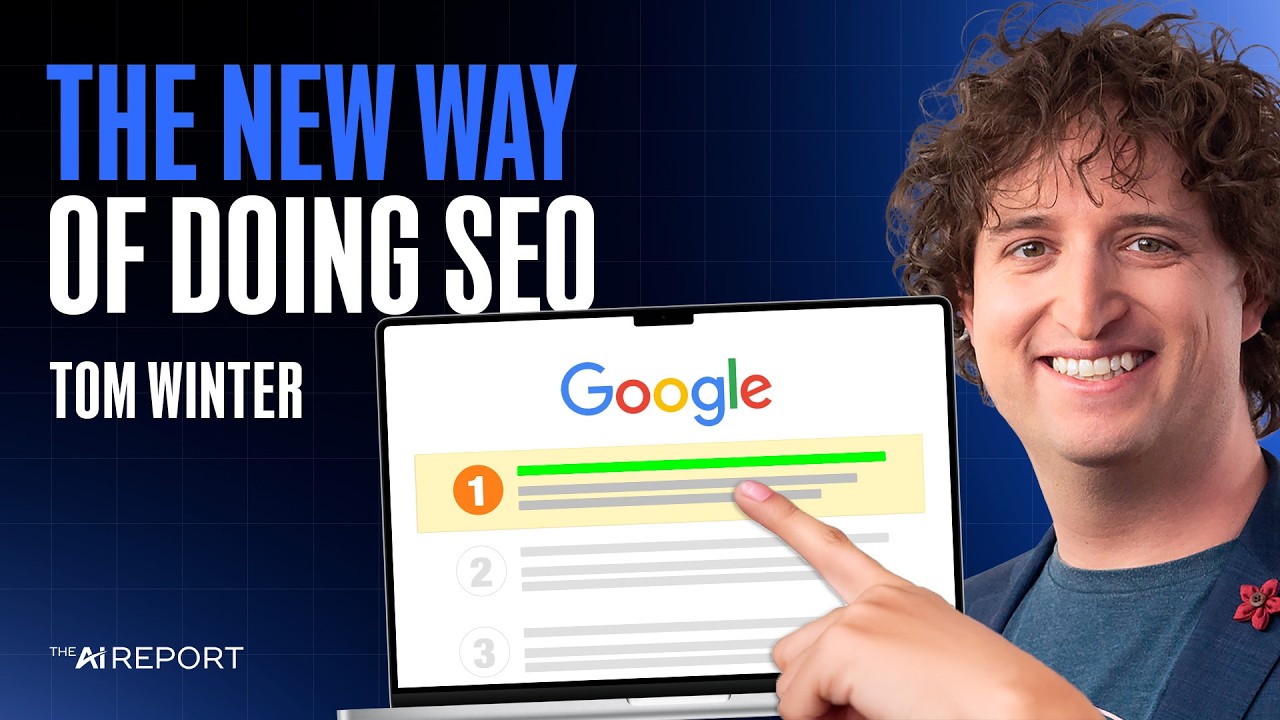
Tom Winter, SEOwind: How to Rank on Google With AI
SEOwind co-founder Tom Winter on why Google's goal hasn't changed, how AI agents read Search Console data, and how to build authority in small niches.

Watch on YouTube · Listen on Spotify or Apple Podcasts
Tom Winter, co-founder of SEOwind, says AI has not changed what Google rewards: for 25 years it has wanted to give people the best possible answer, and it is simply becoming a better referee. What AI changes is the process. He tells host Liam Lawson how SEOwind uses AI for the research behind an article, how his team built AI agents that act like a data scientist for Google Search Console data, and why authority starts in small niches.
Key takeaways
- Google's goal has not changed. Tom says Google has wanted to bring people the best possible answer for 25 years. The rules are the same; Google is just becoming a better referee. (01:24)
- AI workflows follow steps, AI agents design the path. A workflow is a fixed if-this-then-that process, such as downloading keywords, clustering them and predicting an outline. An agent gets a task and access to tools, and works out its own route. (07:23)
- Research is 80% of the work. At SEOwind, research and context make up 80% of the work. Writing the article is the last 20%, and good context is what stops AI from hallucinating or producing fluff. (13:37)
- Agents can stand in for a data scientist. Tom's team built an orchestrator agent that answers natural-language questions about Google Search Console data in BigQuery by calling SQL, analysis and visualization agents. (17:48)
- Content and authority are the two pillars. A great article is a palace in the desert: nobody visits unless you pave the roads. Authority comes from backlinks, social mentions and deep coverage of a niche. (28:00)
- Win small ponds first. Google lets a site into small ponds of keywords, then bigger ones as it grows. Tom's advice is to become the Wikipedia of a really small niche before going broad. (30:02)
- Eight hours or one and a half. Tom says an article that takes eight hours by hand takes about 20 minutes with SEOwind plus an hour of editing, yet many people still choose the eight hours because the draft is not perfect. (43:17)
Has AI changed how Google ranks content?
Tom Winter says AI has changed much less about Google rankings than people think. From day one, Google's rule has been to bring the best possible content to the people asking for it, and that has not changed in 25 years. When someone claims a new algorithm changes everything, Tom's view is that Google is becoming a better referee, but the rules are the same.
What has changed a lot is the process of SEO. Tom treats AI as a tool, a colleague or a teammate that brings better results and a better ROI: it helps teams create better content, analyze more data much faster, and find and predict new keywords.
What is the difference between AI workflows and AI agents?
Tom Winter says AI workflows follow a fixed, step-by-step process, while AI agents are given a task and design their own path to solve it. He traces the shift from the launch of ChatGPT's chat interface, when most people asked simple one-off questions, to using AI through the API at scale.
That is where AI workflows came in, built on an if-this-then-that mindset. His content example: download the keywords, cluster them using embeddings, scrape pages, use the scraped content to predict the outline, and so on until the article is built. At first you had to be a developer to do that; tools such as Make.com then let non-developers drag and drop the whole process.
AI agents work differently. An agent, or an orchestrator, has access to multiple tools and other agents and works out which ones it needs, so nobody has to map every edge case in advance. Tom expected 2025 to bring more and more agents, while noting that AI workflows are still far better for anything process oriented. He gives ChatGPT's o1 model as an example of a general agent that reasons through how to answer before answering.
Will AI replace junior developers and SEO specialists?
Tom Winter agrees with Liam that AI has broken the development path for junior and mid-level roles, in development and in marketing. Tom once helped build a tool that tests developer skills, and he says HR teams are still not talking enough about the problem: companies need experts who understand how things work, but juniors are the ones who become those experts.
He admits he does not have an answer to how people will grow into senior roles. Building AI agents still takes senior developers who understand what is happening underneath. Liam argues that education is designed around passing tests rather than independent thought, which is becoming more valuable. Tom says the one skill he wants to teach his daughters is how to solve problems.
How does SEOwind use AI agents with Google Search Console data?
Tom Winter says SEOwind is mostly an AI workflow with a lot of ifs, but his team has been building AI agents to analyze Google Search Console data. SEOwind writes articles based on research: about 80% of the work is research and context, using vectors to analyze and combine information, and writing is the last 20%. AI, he says, is a logical engine, not a search engine, so it needs that context.
Google Search Console shows which keywords a site ranks for and the clicks it gets. Tom explains that it can be a list of 70,000 keywords, so analysts export it to BigQuery, but getting trends out of it takes a data scientist who knows SQL. After hearing people at conferences such as BrightonSEO discuss the problem, his team built an orchestrator agent that takes a plain-language question and decides how to answer it. It can call a SQL agent that queries BigQuery, plus agents that combine tables, interpret results in plain terms, draw graphs or build prediction models with machine learning.
Tom calls the results exciting and scary. Because the system accesses specific sources and can call APIs and run code, he says it does not hallucinate the way a normal chat does. He compares it to a doctor's assistant that retrieves research using retrieval augmented generation (RAG) to suggest which examinations a patient needs.
Do you need to code to build AI agents?
Tom Winter says that, at the time of the recording, building real AI agents still required a developer. AI workflows can be built in drag-and-drop tools such as Make.com, but most products marketed as agents are still workflows. He found developer-oriented frameworks such as LangChain, considered CrewAI the closest thing to a simple way of building an agent, and ended up building SEOwind's own framework.
He calls AI agents the topic of 2025. In his view the low-hanging fruit in building better LLMs has been picked, so the gains now come from more context and a better understanding of the specific task, which is what agents provide.
How do you get Google to rank your content?
Tom Winter says ranking comes down to two pillars: content and authority. On content, value is quantifiable: more citations, more numbers, better answers and less fluff. A simple AI prompt such as "write me an article" produces fluff with no intent and no research behind it, so the way to stand out is to add what a basic prompt cannot: data, opinions, expert input, screenshots of a process, and outgoing and internal links.
Content alone is not enough. Tom compares a great article to the best palace in the world built in the middle of the desert: nobody visits if you do not pave the roads. Google looks at hundreds of factors, but simplified, authority comes from backlinks, people talking about you on social media, and deep coverage of a niche.
His advice is to become the Wikipedia of a really small niche. Google, he says, lets a site into small ponds of keywords first, then gives it bigger ponds as it grows. Do not try to cover all of marketing; fill the gaps in one specific topic and grow gradually.
What is E-E-A-T, and how does Google measure it?
Tom Winter explains E-E-A-T as experience, expertise, authoritativeness and trust: rules for building content that is as valuable to the reader as possible, written by someone with authority in the niche and full of data. Fluff and hallucinations, from AI or humans, destroy trust.
As for how Google measures it, Tom says SEOs can only hypothesize. Google is likely using AI to identify and quantify it, and it can see user behavior on its own site: if someone clicks a pizza recipe and comes straight back to Google, the page did not answer the question. His advice is to think logically rather than in a complicated way. Does the content give people the value they are looking for? "If it looks like spam, it's spam."
How do AI search engines like Perplexity change SEO?
Tom Winter says AI search has changed a lot: he sees more and more traffic coming from Perplexity and ChatGPT, and he would not want to be Google right now. People want answers here and now, which is why Google introduced AI Overviews. The question he cannot answer is how Google answers questions directly and still makes money from ads, since adding ads to an AI assistant's answers would break the model. Perplexity, by contrast, charges a monthly subscription.
He is not afraid of AI Overviews as an SEO. They give short answers, and the full answer still lives on a website. His example is a pizza recipe: there is not enough space in Google's results to show every image and step, so Google still has to send people to the full recipe.
How would you learn AI SEO in six months?
Tom Winter says he would focus a new hire on AI tools that solve specific problems, rather than on prompting. He does not insist on SEOwind: use whatever tool gives you the quality and output you want. Specialized tools and agents increasingly do the prompting for you. SEOwind's article process uses about 30 prompts, and he says filling them in by hand with data would take five or six hours, longer than writing the article from scratch.
Prompting is still worth testing, he says, to learn how to talk to ChatGPT, Claude or Gemini, which he calls chat storming: brainstorming with chat. Beyond tools, he would teach people to break patterns, keep an open mind and not be afraid of trying things. Tom says he loves to be proven wrong, because then he can be better.
He also pushes back on all-or-nothing thinking. If an article takes eight hours by hand, he says SEOwind can compile it in about 20 minutes, plus about an hour of editing: one and a half hours at most. Many people still choose the eight hours because the AI draft is not perfect out of the box.
Can companies afford not to adopt AI?
Tom Winter says companies that refuse to adopt AI will drive themselves out of business. Some larger companies tell him they cannot implement AI because they would have to let 50% of their staff go. His answer: if you do not implement AI, you will basically have to let 100% of your staff go in a year or two. Companies that do implement it will be more competitive and grow, he argues, rather than shrink.
Liam expects companies to become leaner and more merit-based. Tom admits AI agents are getting scary in how good they are, but argues for combining human and AI strengths, an approach he calls cyborg methods. People bring experience, customer conversations and product knowledge that AI has not learned, and that is what they can add.
In his words
"Google is becoming a better referee" (01:29)
"It's a logical engine not a search engine" (14:19)
"If it looks like spam it's spam" (37:36)
"I really love to be wrong and I love to be proven that I'm wrong because then I can be better" (41:43)
"AI has superpowers we have superpowers let's not fight against each other let's find a way to combine these powers" (47:40)
Chapters
00:00 Preview
00:31 How the SEO landscape has changed with AI
02:53 From ChatGPT to the API
05:42 AI workflows explained
07:15 How AI agents differ from workflows
08:56 The broken path for junior developers
12:09 Education and independent thinking
13:18 How SEOwind uses AI
15:12 Google Search Console and BigQuery
17:48 Building an AI data scientist with agents
21:52 Do you need to code to build AI agents?
25:39 What Google values in content
27:54 Content and authority: the two pillars
31:15 AI search engines and AI Overviews
34:23 E-E-A-T and how Google measures it
38:05 A six-month crash course in AI SEO
42:36 Eight hours vs one and a half
45:15 Why companies must adopt AI
47:10 Human superpowers and cyborg methods
49:04 Where to find Tom
About the guest
Tom Winter is co-founder of SEOwind, an AI tool that writes SEO articles based on research. He has also helped build a tool that tests developer skills, and he says the best place to reach him is LinkedIn.
About the host
Liam Lawson is CEO of The AI Report and host of The AI Report Podcast. Meet the team
Full transcript
Edited for readability. Quotes above are word for word from the recording.
Tom Winter (00:00): [Opening clip] We have to treat it as a tool. It's a tool that helps us bring better results, to have a better ROI. The whole process of SEO has changed, and it's changing more and more, because we can use AI as an additional teammate or an additional tool, a really important tool that can help us bring better results. It's all about finding the tools that are easy to use. You don't have to figure out how to prompt things, because that is really, really difficult. If you don't implement AI, you have to basically fire 100% of your staff in a year or two.
Liam Lawson (00:31): How has the SEO landscape changed in the past two years with the introduction of AI? What's now relevant that wasn't in the past, and what's now irrelevant that was relevant in the past?
Tom Winter (00:44): First, a lot has changed, and everybody sees that. Second, not much has changed. If we're looking from Google's perspective, from day one Google had a simple rule: we want to bring the best possible content to the people who are asking for it. That didn't change at all in the last 25 years. They still want to bring the best quality and the best value to the end user. If you're asking a question, they want to provide you with the best possible answer.
So from the perspective of SEO, if anybody says the new algorithm is changing everything, to be honest, not much is changing. Google is becoming a better referee, but the rules are the same. The end goal of Google is just the same.
Looking from that perspective, not a lot has changed. But we have new tools, and we have to treat AI as a tool: a colleague, a best friend, a teammate, but basically a tool that helps us bring better results, to have a better ROI and get better output. That has changed a lot. The whole process of SEO has changed, and it's changing more and more, because we can use AI as an additional teammate, a really important tool that can help us bring better results. We can create better content, we can analyze more data much, much faster, we can find new keywords, predict new keywords, and a lot of other things to improve SEO. But that's very vague, just the top of the iceberg. If you go into the nuances of SEO, there's a lot in the process that can be changed, that a lot of people have already changed, and some things we will be able to change in the future.
Liam Lawson (02:53): Talk to me about that. Before we hopped on this call, we talked about predictions and how they can sometimes be true and sometimes not. What are you foreseeing in how the SEO landscape will change with the current AI tools, and with new inventions that come out as well?
Tom Winter (03:10): Before I go into predicting the future, I need to talk a little bit about the past, and what has happened in the last two and a half years. I know AI began far earlier, but basically we see the beginning of AI as ChatGPT launching the front end, the chat view of AI. I used GPT-2 or before, but I could only use it through the API. For most people, the beginning of AI was the launch of ChatGPT: a chatbot we can talk to that answers our questions. That was the amazing thing that happened a little over two years ago, in December. We were able to talk to the computer, and the computer responded to our questions.
Then we asked it a lot of different questions. We wanted to see whether it would respond to everything. Most of what we started with was easy back and forth, or simple one-off questions rather than a whole discussion. We asked a question and retrieved the data, a very simple usage of chat. Then some developers saw they could use it for coding, still a very simple way of using the tool. More marketers used the tool as is, and they thought, we're becoming much more productive. But it was still a conversation between them and ChatGPT, which is very easy.
There's a whole prediction about development: that we won't need junior developers, mid developers, maybe even senior developers. I have two daughters. Two years ago, if you had asked me what they should become to have a really great job in the future, I would have said, become a developer. That's amazing. Right now, you know what, maybe that's not the best idea. But let's see.
Then it started to become more complicated to use AI, because we started to use it mostly through the API. If you want to do something at scale, something that is replicable, you have to use it through the API. So we used AI through the API, and we built something called AI workflows. It's still the mindset of if this, then that. Let's say we are creating content: first download the keywords, then cluster the keywords using embeddings, then use the keywords for this, then scrape something, then use the scraped content to predict the outline, and so on, until you build the content. That is an AI workflow: a simple, step-by-step process to create something. I just gave you an example of creating content, and this is how we humans do it. Whenever we want to write an article, we have a clear process. We do the research, we write an initial draft, we optimize it for SEO, we add internal links. That's the process we go through.
This is where it started to get complicated: doing the same process we humans did by hand, but using AI. You had to be a developer to start doing that. Then came the moment where you could use, for example, Make.com to drag and drop the whole process as a normal, non-developer human. And now it becomes interesting, because this is exactly the moment we are in. More and more people are talking about AI agents. How they differ from AI workflows is that they're independent in finding the solution. You give a question or a task, they have access to multiple tools, and they design the path to answer your question. You don't have to think in the if mindset, finding edge cases: if you find this, go this path; if you don't find this, go that path. You don't have to think about a linear way of solving a problem. You have an agent, an orchestrator, that solves the problem for you, because it predicts what tools, or what other AI agents, it needs to solve the problem.
That's the interesting part of 2025. We will see more and more agents that help us resolve problems, and we won't have to think about how to resolve them. It will be a kind of black box, though not exactly, because we can see exactly what they did. That's my prediction for the future. I'm not saying AI agents are the solution to everything, because I still think AI workflows are far better for something process oriented. But agents will help us solve things we weren't able to before.
Liam Lawson (08:56): I really want to dive into AI agents specifically, and how you're using them now. But something I've been noticing as a thread across multiple conversations is what you mentioned there. You've got two daughters, and two years ago you'd have told them to go become developers. And we probably won't need junior developers anymore, and mid developers might become obsolete as well, but we're still going to need the people at the very top who can say, this is good code, this is not good code. It's a Catch-22. How do you get a top developer? You can only get someone to that level by them becoming a junior developer, then a mid developer, then a top developer.
It's the same with AI agents and processes. You described how we've been using AI workflows, and maybe now you've switched to AI agents. Before, you had to think out the process, if this, then that. You had to mentally go through it. Now you're saying AI agents are here, so you can have an agent think through that process. But if you've never been able to think through the fundamental process yourself, AI agents become a catch-all solution and you lose your ability to actually think and conceive of ideas. The ability to think and conceive of processes, enact them with pen and paper and write them down, is going to become an absolute superpower.
Tom Winter (10:29): I totally agree with you. This is the Catch-22 of the 21st century: the development path is broken. One of the tools I helped build was a tool to test developer skills, mapping out the skills of developers. I've talked with so many people in HR, and to be honest, I don't know why HR is still not talking more about the broken development path of any kind of person. We need the experts, as you mentioned, who have the knowledge, because you have to understand how it works. And all of a sudden junior positions and mid positions, and not only in development but also in marketing, are not that much needed. So how will you grow into a senior developer, and how will you understand everything happening on the back end, to be able to tell an AI agent what you want and check whether it's doing the right stuff? That's something I don't have an answer to. I would love for someone to speak about it. I really don't know. But with AI agents, what I see is that we need senior developers who actually understand and can work with them to develop them. It's extremely hard for a normal human being to understand everything that's happening there.
Liam Lawson (12:09): I want to get someone on from the Department of Education, or people high up in UK education, because realistically the problem we're now facing is that our education system is flawed for the tech ecosystem we're entering. Our education system is designed so that you can be good at doing tests, not so you can be good at independent thought. Independent thought and the ability to think have never been more valuable, and will become increasingly valuable in the future. So we need to fundamentally change how we think about education, and that process has to change, which, I'm from the UK, is unlikely to change.
Tom Winter (12:53): I really don't know what will happen from the education perspective. If I can be honest here, I don't think my kids will have a job. That's my opinion. Still, they have to learn how to solve problems, and that's the one skill I want to teach them: how to solve problems. And all the rest.
Liam Lawson (13:12): We could go down this tangent for around three hours. I would love to, don't get me wrong. But let's circle back to AI agents. How are you using AI agents currently, if at all?
Tom Winter (13:23): I'm working on one tool right now, which is SEOwind. SEOwind is a tool that helps write articles, but based on research. For us, 80% of the work is the research: using vectors to analyze things, putting things together, and then being able to provide context to AI to write the article. Writing the article is the last 20% of the work, the cherry on top. That's the easy part. The context, providing all the information AI needs so it doesn't hallucinate and doesn't create fluff, is the hard part. It's like a human: if we're writing an article, we have to do the research, and then based on the research we take something from here and something from there, put it all together, and write the article. AI is the same. It's a logical engine, not a search engine. It has add-ons that help it act as a search engine, but it's a logical engine, just like the human brain, so it can put things together, and that's an amazing thing.
So SEOwind is an AI workflow most of the time. I'm simplifying, but basically it's an AI workflow with a lot of ifs. If this, then that, and it goes like a workflow. But one thing we've been trying in the last two or three months is playing around with Google Search Console data. I've talked with many people at conferences, one of them BrightonSEO, and a couple of people there were talking about exporting data from Google Search Console to BigQuery.
Liam Lawson (15:12): Can you explain what Google Search Console is for the layman, such as myself?
Tom Winter (15:19): Google Search Console is the data we get from Google about the clicks we're getting and the keywords we're ranking for, to understand what traffic we're getting from Google to our website. There's a lot of true data there that people want to analyze, but it's very, very hard to analyze, because it's just a list of, let's say, 70,000 keywords across the last year. So what data analysts do is export this data into Google BigQuery. BigQuery is like a gigantic table, something you can analyze with SQL. Data scientists prefer to have it in a table so they can retrieve the data.
At a lot of conferences there are talks about how to get the data into BigQuery and retrieve the data you want using SQL. The problem is that exporting the data is extremely easy, a couple of buttons, and there are instructions for it. But if you want to retrieve the data, for example trends on your website, or which categories of keywords people are clicking, where you're growing and where you're losing, you need a data scientist who knows SQL to retrieve it from the table. Otherwise you're a fool with a tool. You have data, but you don't know what to do with it. It's spaghetti. It's really hard.
A lot of people at conferences were talking about this: we have data, we don't know what to do with it, and you need a data scientist to retrieve specific things from it. From my perspective, I thought, what if we could talk to our database in natural language, the way we are speaking right now? I would love to get this and this, can you help me with this and that, and the database would get you the information. The problem is that you have a question, you don't know how to resolve it, and you need an answer. There's a gap in between, and in the normal world you need a data scientist in that gap.
So we started to play around with AI agents to imitate data scientists. We created an orchestrator that defines how to answer the question. You ask the orchestrator a question, the orchestrator defines how to answer it, and the orchestrator, the main AI agent, has a couple of other agents it knows of and can ask. For example, there's a SQL agent that can write a SQL query to BigQuery and get an output, a table that answers the specific question. There can be others: a data manipulation scientist, kind of a person who gets a couple of tables together and puts them together to reason about them. There can be somebody who interprets the results, who tells you in layman's terms, look, we see these kinds of trends. There can be another agent that visualizes it in a graph. There can be another agent that builds prediction models using machine learning.
Liam Lawson (19:08): Do these agents currently exist in your workflow?
Tom Winter (19:13): Yes, they do, and this is what we're playing with. To be honest, on one side it's exciting to see how good it is, because I can just add additional tools to the orchestrator, and then it thinks, okay, I want to use this one for this, and that one for that. It makes decisions about what it can do with the tools we give it access to. It's a combination of other AI tools and normal programming: it can have access to an API, it can run code, it can do additional non-AI things, and that's how it resolves the problem. But it resolves the problem in its own way. We can build on top of that basically anything we want.
As I said, the results are very exciting on one side and very scary on the other, because it can do things a normal chat can't. It has access to multiple sources, it decides what to access, and it doesn't hallucinate, because it accesses specific things. That's really amazing.
For people who don't know SEO, to give you an example, I predict there can be a medical doctor that has access to the whole database of all the research in the world. It retrieves data about specific research, then provides that data to the AI engine, because these are probably the most likely diseases this patient can have, and based on that it can predict that you need this, this and this examined, and resolve the problem. This way we can mimic exactly a doctor, with far more knowledge, because it's not only the knowledge an LLM has: it can retrieve additional knowledge using RAG, retrieval augmented generation, to get additional context for this specific patient. You can apply that to any niche. If you have a question that is not easy to answer, and you need additional data, steps or data points, that's the perfect environment for AI agents.
Liam Lawson (21:52): A lot to unpack there. I want to do a bit of a deep dive on SEO and how we can become Google's best friend in a second, but just to finish off on agents: do you need technical knowledge to build these AI agents? If we get granular for a second, what specific tools or websites were you using to build them?
Tom Winter (22:18): If you're looking at AI workflows, again coming back to the process, you can definitely use tools like Make.com or similar tools where you drag and drop the process that has to be done, add some ifs, and it's done. With AI agents, I tried to look for solutions, to be honest. I found some frameworks, like LangChain for example, but it's a developer-friendly framework. There aren't many solutions out there that can do it. Everybody talks about AI agents, but most of the solutions we see on the market are still AI workflows, the if mindset: if this, then that. AI agents are more like, I have a task, I want a solution, design me the path. I don't want to show you all the edge cases of what can happen in between, because I don't know, and I don't want to predict that.
So for AI workflows, there are definitely plenty of tools out there, and they're very interesting. AI workflows are really amazing for some tasks, and AI agents for others. But with AI agents, to be honest, you need to be a developer at this point. I haven't seen a tool that can handle the whole orchestration and manage it. So we did it on our own. We started to work on our own framework to build the AI agent we want, and it's basically our technology. We were looking for a framework that would simplify it, and didn't find it yet.
Liam Lawson (24:02): Interesting. That's very contrary to what you see out there on YouTube: build your own AI agents with no code and no experience whatsoever. It's that YouTube cycle. Every person with an audience is saying this right now.
Tom Winter (24:18): From what I know, the closest to building an AI agent in a simple way would be CrewAI. But new ones are coming every single day. To be honest, if there is one topic of 2025, it's AI agents. Everybody wants to build them. Why? Because we've reached a kind of limit. The low-hanging fruit in building better AI is done. You will build a better LLM, but to be honest, the new things will not significantly improve the LLM. So what you need is more context, a better understanding of the specific task you're doing, and AI agents are a solution for that. One of the best-known AI agents out there is the o1 model by ChatGPT. We don't know what happens underneath, but it's basically a general AI agent that does a lot more tasks and thinks things through. It has reasoning underneath to first work out how to answer the question, and then answer it based on the specific task.
Liam Lawson (25:39): Let's talk about SEO. How do you make sure your web page or your article is Google's best friend? What does Google need to know about your relationship to rank you higher, to rank you the highest, to put you at the top of its search rankings? How do I communicate with Google to make that happen?
Tom Winter (25:57): We're coming back to the origin of Google, before AI, 25 years ago: value, and value. We have to bring the best value to the end user. And we can talk about the definition of value. What is value in an article? For me it's actually quantifiable. You can see there are more citations, more numbers, better answers, less fluff, and everything that can stop a user and make them look. If I see a link, that's an easy thing I can spot as a user: okay, I want to read more about this number, I want a source for this, I want to see this graph, I want to see these additional things.
If you go to AI and ask a simple question, like write me an outline for this keyword, or write me an article based on this, you get fluff. It won't be filled with information. It has no intent, no goals. It didn't go through data or do additional research. It's like using AI as a search engine. So we have to differentiate ourselves from what anyone can do with a simple AI prompt, and deliver all the data AI should include in the article. As I said, the things I see as simple to understand are additional data, additional opinions, additional expert input, maybe some screenshots of a specific solution going through a specific process, outgoing links and internal links.
Liam Lawson (27:37): So that's anything we as humans perceive as value. But on Google's end, how do they quantify how high they'll rank an article? What are the actual key components on the back end? Is it that it's got links, it's got pictures? Specifically, what are they?
Tom Winter (27:54): Again simplified, I see two main pillars: one is the content and the other is the authority. On one side, we can build content that is valuable. Let's assume we're building a palace, the best possible palace, in the middle of the desert. Who will visit it if you don't pave the roads to the palace? Even if it's the best palace in the world, nobody will visit it, because nobody knows it's there. So content is important. The palace is the content we're producing, and the other thing is the authority. Of course Google perceives it in a different way. It has 200 or 500 factors it looks at, maybe even more, it doesn't matter. But simplified, I would say authority and content. On one side we have to focus on the content, and on the other side we have to focus on our authority.
Building authority in the normal world takes time. You're building a podcast, and it took you a while to build authority on your podcast and show people you have an amazing podcast. It's all about time and the effort to promote it. It's a slow process, unfortunately. If I simplify authority again, it's definitely getting more backlinks, more people talking about you on social media, and probably larger coverage of content in a specific space, to be the Wikipedia of a specific niche, but really a niche, something small. You have The AI Report, which you're mentioning. Everything connected to The AI Report is your niche. That's where you have coverage, and that's where you're building organic traffic.
From Google's perspective, what I see is that Google will let you into small ponds first. Then, when you grow, it will give you another pond of keywords where you're an authority, and then another one and another one. Once you build your brand into becoming a hotspot of this world, you can talk about the whole of marketing. Until then, find the ponds where you're really an expert and fill in the gap. Just fill in the information about this specific niche, a really small one, and then grow it gradually. Don't talk about, for example, the whole of marketing, because Google will never let you into that pond. They will start with something small. That's how you build authority, from being small to being larger.
Liam Lawson (30:49): I think that's true across all different vectors. It's true of Google rankings, but it's also true of podcasts. If our podcast was just about AI in general, why would we trust you for the whole of AI? It has to be more specific, and that's why we focus on practical use cases: what can you do today. It does ring true across all vectors.
Something I'm very curious about, and I'd love if you could give me an explanation of it: how do AI search engines fit into this whole equation? We've got the likes of Perplexity, and obviously ChatGPT has a search function as well. How has this changed SEO, if at all?
Tom Winter (31:36): It's changed a lot. From my perspective, I can see more and more traffic coming from Perplexity, Google or ChatGPT. I wouldn't like to be Google right now. There's a lot of push, and it can be stressful to be Google right now. But it definitely changes things. People want answers here and now. There are predictions that in, I don't know, 20 years people won't be able to read whole books, that they'll just want small pieces, and that's how they'll take in information. They'll ask a question, and if they're writing something, they'll just get bits and pieces from the search engine. I think this is driving how search will work. Search engines want to answer the question, so they're using more AI to try to resolve the problem a person has. That's why AI Overviews were introduced by Google. But the big problem, which I don't have an answer to, is how Google can answer the question right here, right now, and still make money from ads. I don't know. Perplexity uses a monthly model: you pay $20 per month and you get your answers there.
Liam Lawson (33:01): I'd much rather pay $20 a month than have them sift through loads of ads.
Tom Winter (33:07): Exactly, because an AI assistant works only if it gets you the best possible answer. If you add ads into the equation, you probably influence the search with money, which basically breaks the whole model. So I don't know what the answer is right now. We can definitely see more and more AI Overviews, but to be honest, as an SEO expert, I'm not afraid of that, because these answers are really small. It doesn't have an impact on my business, because the big answer is something I can answer on my website, and Google has to push people to my website.
Let's go with a pizza recipe. From the technical perspective, if you look at it from the UX perspective, there's not enough space on Google to give me the whole pizza recipe there. It can give you a snippet, something short, but it has to push a person to the whole pizza recipe to show all the images and all the steps you have to take to make a perfect Neapolitan pizza.
Liam Lawson (34:23): So interesting. Let's dive more into your business, SEOwind, and the methodologies you use. I saw one acronym on your website, E-E-A-T, or EAT. Could you dive into that for me? What does it mean?
Tom Winter (34:48): I'll be honest, I never remember. It's experience, expertise, authoritativeness and trust. That's exactly what it stands for. I can never remember it exactly, but basically this is what I was talking about. It's all about providing value to the end user and being the authority in the niche. When you're talking about E-E-A-T, you're talking about how to build content in the proper way. You have to add experience and expertise, be an authority in the niche, and make it full of data, so you build trust in the things you're talking about. If you're creating fluff, or if you're hallucinating, even as a human, it doesn't create trust. These are the rules you should write content by: be as valuable to the end user as possible. That's the simplified version.
Liam Lawson (35:55): That all makes sense conceptually. What I'm struggling to understand, or want to grasp, is how Google consumes that and puts it into rules on their end. I can say something's authoritative, but how does Google take that article and say, yep, that's actually authoritative, that person has respect, that actually makes sense? How are they defining and qualifying things on their end?
Tom Winter (36:22): That's definitely a difficult question, and a lot of SEOs would love to get a direct answer. We can only hypothesize on this topic, because we really, really don't know how they do it. But they're definitely using AI to identify and quantify it. They're also the owner of Google Analytics, so they have plenty of events they can watch. Even if they don't use Google Analytics data, they see from their own site what people are doing. If you ask, can you find me a recipe for Neapolitan pizza, and you go to a recipe and then come back to Google, what does that mean? Simple: you didn't get an answer. That's something they don't want. So there are plenty of indicators they see, apart from crawlers that crawl the page and look through the whole thing to understand what is there. I think we should stop thinking in a complicated way and start thinking logically, as humans: does this content give me the value I'm looking for? Easy as that. If it looks like spam, it's spam. Easy.
Liam Lawson (37:39): Interesting. It's really taking things back to first principles. It's so curious to hear that even people deeply involved in the SEO game don't really know how Google ranks these things. You have a grasp on it, but the specifics of how they measure things are a bit of a black box. That's really interesting.
Tom Winter (38:03): Exactly. We can only hypothesize.
Liam Lawson (38:05): Let's take a hypothetical example, and you let me know what you think. I come and say, I've quit The AI Report, done with my job, but I want to go and work for Tom Winter. And you have six months to make me an AI SEO god: to make me as effective as possible, the most effective employee, to make you the most money and grow your business, or just to be an SEO expert in general. What would you teach me in terms of theory and fundamentals? What courses would you put me through? What tools would you tell me to learn? How would you give me a crash course in six months if I wanted to build out my SEO knowledge?
Tom Winter (38:55): This is definitely a tough one. One thing I would definitely say is to use AI tools, the tools that help you resolve a specific problem. Looking at SEO, I'm not telling people to use SEOwind. If they like some other tool and it gives them the quality and output they want, use whatever tool basically streamlines your work. I would definitely learn more about how to use specific tools.
A lot of people say you should learn prompting, that this is amazing and you should start prompting. From my perspective, I'm not 100% sure, because of how I see the path of development in how we use AI. There was a period when we started with chat, the prompting part, but now I see more and more specialized tools that use AI underneath, and you just resolve a specific problem. AI agents are a perfect example. If I chat with the AI agent I'm building that gets data from Google Search Console, you don't care what it does. It does the prompting for you. You just talk to it in natural language. So from the user's perspective, it's all about finding the tools that are easy to use. You don't have to figure out how to prompt things, because that is really, really difficult.
Looking at the prompts behind SEOwind for writing an article, even knowing the prompts we use, the whole process takes about 30 prompts altogether, plus grabbing data in between. It would take me probably five or six hours to fill out the prompts with data, which I don't have. I'd rather write the article from scratch, because that would take me less time than filling out my prompts with the data I need. That's why I'm saying prompting is cool to test out. You can figure out how to talk to ChatGPT, or Claude, Gemini, whatever you're using, to understand how to retrieve data, treat it as a colleague and talk to it. I call it chat storming: brainstorming with chat, retrieving data and figuring out what you want. But using the tools and finding a tool set that helps you resolve a specific problem is, in my opinion, far more important.
And break patterns. Don't stay in one place. Just before the talk, I told you that I love to be wrong. I really love to be wrong, and I love to be proven wrong, because then I can be better. Every single time, I try to have an open mind and tell myself, Tom, you still don't know anything. I want to learn. Have an open mind to find new solutions, try things, and don't be afraid of trying. Those are the crucial things I would try to teach you, to be able to break patterns. Don't focus on what you think. Focus on the end goal, how to resolve the problem and get to the goal you want, and what tools you can use to be better. If SEOwind is the tool that helps you build content and rank higher, cool, definitely use it. If not, use another one. Try them and figure out what works for you.
Liam Lawson (42:36): A real emphasis on experimentation there, which I love, and I think it's important in the AI era. People are very impatient with AI. They expect everything to be done for them immediately, and if it's not, they lose patience and stop working with it. We've noticed that across a lot of clients we work with as well.
Tom Winter (42:55): You're so right. This is another thing I see a lot on the market, and I strongly disagree with it: people think either AI will get it perfect, or I'm not using AI. There's so much gray area in between. Just do a simple calculation. I always tell people: look, if you're writing an article right now, it takes you eight hours. Let's assume, again with SEOwind, it takes you 20 minutes to compile everything you want, and then you edit the content for another hour. It will be one and a half hours tops to build a content piece that makes sense. Eight hours compared to one and a half hours: for me it's simple math. But a lot of people choose eight hours, because they feel, okay, it wasn't perfect, I can't publish it straight out of the box, so I'm going with eight hours. It doesn't work this way. Find the solution.
Liam Lawson (44:01): It's going to be an incredibly interesting next 10, 20, 30 years in terms of the workforce and skilled labor. It takes me back to the start of our conversation. We're in a society where people are more accustomed to instant gratification, to YouTube videos that last three seconds and TikToks that last two seconds. People's attention spans are worse than they've ever been. We've got an education system designed around being able to do a test well. And now we have this tool that works on top of that and almost encourages people to be lazy. But the people who are really going to succeed with it are the people who have longer attention spans, can take the time to think out a process manually, and have the patience to work with it. Something is fundamentally going to have to change, or the landscape will become less and less competitive, which means if you take the time to be patient with AI and work things out manually, you're going to be 10 steps ahead of everyone else.
Tom Winter (45:15): I agree. I've also talked with a lot of companies, especially the bigger ones, and some of them, not all, say, I can't implement AI because we'd have to fire, let's say, 50% of our staff. That's an objection I hear a lot, and every time I hear it I say, look, if you don't implement AI, you'll basically have to fire 100% of your staff in a year or two. So choose right now and make a good decision. If you implement something that will grow your company, you will not fire the people you have right now. You will probably actually grow your company, and there will be a lot more space in your company, because you will be more competitive on the market. That's an indicator that will help the company grow. If you don't make the change right now, and you're one of those people from Don't Look Up, saying no, AI is not better than us, let's just focus here and not look up, you will drive your company to die. That's my opinion.
Liam Lawson (46:27): Part of the beauty of it is that we are working in a meritocracy, and we're moving more towards that, where being mediocre at something isn't [expletive] good enough anymore. It's just not [expletive] good enough anymore. Realistically, companies are going to be built very lean, with a couple of people at the very top who are perfectionists and put in a lot of time and effort to develop their expertise. People who just get by doing the bare minimum but still get paid, I don't know where they're going to go for jobs. You're going to have to get your [expletive] together or find a new industry.
Tom Winter (47:10): I see dark scenarios out there. Let's see what will happen. I'm not afraid of where I am, but it's getting scary sometimes. As I said, with AI agents, it's really getting scary how good they are. But let's see. I think we can all help each other be better. We have to think about what we really excel at, like you said, being a perfectionist in your niche. We have to think about our superpowers as humans, because AI has superpowers and we have superpowers. Let's not fight against each other. Let's find a way to combine these powers, to be a superhuman. I call it cyborg methods: using AI in a seamless way. Be aware of your superpowers. You have experience, you talk to customers, you talk to the product team. You have a lot of additional knowledge that AI didn't go through and didn't learn about. You have plenty of things to add to the equation, and that's something you can share with AI and combine.
Liam Lawson (48:21): Realistically, AI is going to automate a lot of things humans don't want to do, which hopefully frees up more time to focus on the things we do want to do. I know that I love podcasting. I enjoy sales. The favorite part of my job isn't inputting data into the [expletive] spreadsheet. It's speaking to interested humans like you. I don't think that'll ever change. As much as AI is going to change the landscape, humans want to talk to humans. I don't want to talk to a robot if possible. If I can spend all day in a cafe speaking to other human beings while AI runs my business, I think I'd be happier than ever, and I think most people would feel the same way.
Let's see where we're heading. Tom, I want to thank you for your time. I really appreciate you taking an hour out of your day to give people a bit of an SEO masterclass. I feel as if we could have gone on for about five hours and down about seven different rabbit holes, but I'm glad we kept it concentrated on one specific topic. So thank you for your time. If people want to learn more about what you do, your business and who you are, how do they go about doing that?
Tom Winter (49:29): Basically, find me on LinkedIn. I live there. It's my second home. If you want to ask anything, don't hesitate to send me a direct message. I love to answer people. I love to talk to people. As Liam said, I really like talking to people too. If you have any questions, just find me there, and let's start from there. It was really amazing to talk to you.
Liam Lawson (49:56): Pleasure, man. Thank you very much.
Get the five-minute AI briefing
Join 400,000+ business leaders who start their weekday with The AI Report. Subscribe free
