

400,000+ business leaders (and teams at IBM, AWS & Zapier) start their day with The AI Report. 5 minutes. Plain English. No hype.
Ruben Hassid, EasyGen: How to Use AI to Grow on LinkedIn
EasyGen founder Ruben Hassid says AI will replace mediocre work, and shares the one-mission, 30-day method he would use to grow on LinkedIn from zero.
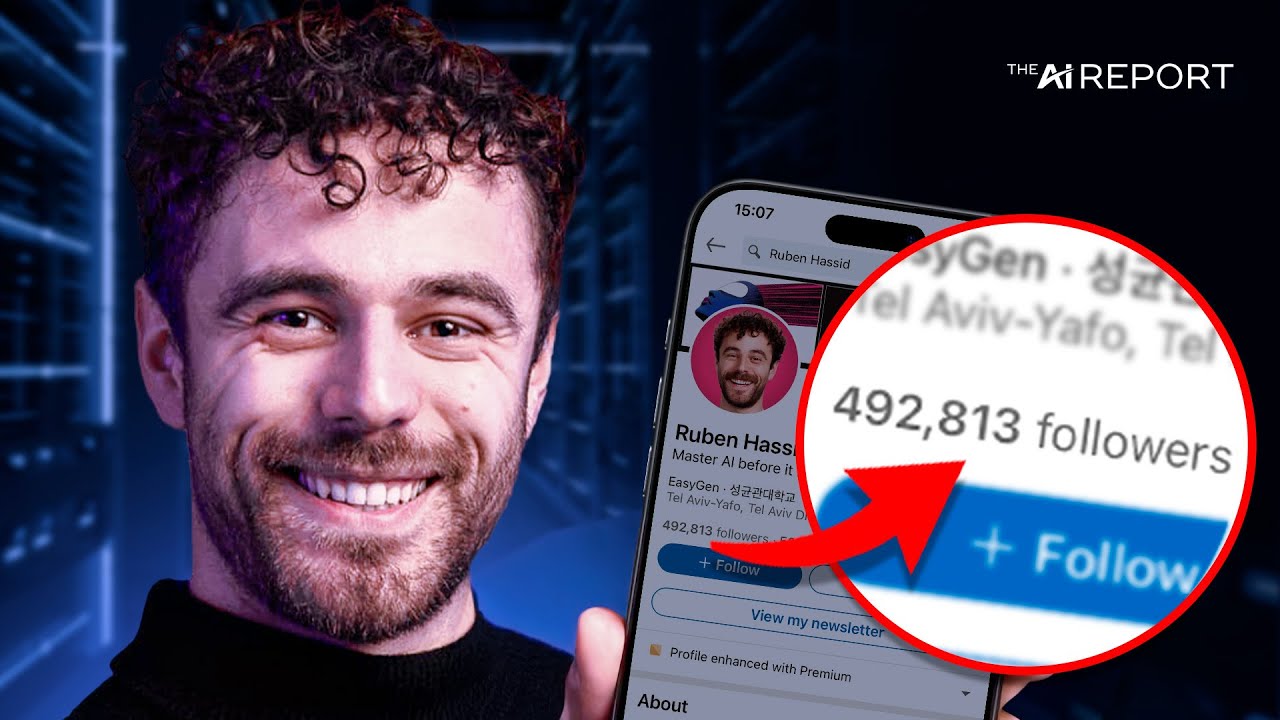

Watch on YouTube · Listen on Spotify or Apple Podcasts
Ruben Hassid, founder of EasyGen, says AI will not replace everyone: it will replace mediocre work, and the winners will be people with taste and experience who use AI to generate more and edit harder. He tells host Liam Lawson how he grew his LinkedIn to 400,000 followers using his own tool, why LinkedIn is the platform professionals should build on, and the one-mission, 30-day method he would use to start again from zero.
Key takeaways
- AI replaces mediocre work, not everyone. Ruben expects one person with more taste and experience, running AI and agents, to produce hundreds of contracts, articles or briefs and replace people whose work is merely okay. (01:08)
- Taste and experience are the differentiator. The best Midjourney artists are creative directors: they generate a thousand images and know which 20 to work on, the same way a photographer picks from a full shoot. (04:13)
- Generate many versions, then edit. Ruben generates 20 or 30 posts on a topic and patches together the best hook, middle and structure. He uses AI to be greater, not lazier. (05:30)
- Start with one tight problem and many solutions. Your mission is one problem to solve. The tighter it is, the more subtopics and solutions you can post about, and repeating yourself is the point. (36:58)
- After 30 days, double down on your best five. Post every day for 30 days in several formats, then remake your five best posts 30 times the next month and drop the rest. (38:29)
- Engagement matters as much as posting. Ruben's question for people who want a community without talking to it: why build one at all? (39:07)
- Map the worst case before a big risk. Before going solo, Ruben opened a spreadsheet, counted his months of runway and asked what would happen if he earned nothing. (47:22)
Will AI replace your job?
AI will replace mediocre work fast, not everyone, says Ruben Hassid. If most of your job is writing okay articles, okay contracts or briefs for designers, he expects you to be replaced, but not by a monster AI that takes all the revenue. It will be one person who can generate hundreds of contracts, articles or briefs and handle agents, because that person has more taste, more experience and higher standards.
He rejects the idea that AI means everyone will now produce good content. The overall level will rise, he says, so what we call mediocre today becomes much better, but it is still mediocre. He also does not buy the claim that no one will work anymore, comparing it with the early 1900s, when about 90% of the US population worked in food and no one could have imagined the jobs that came later.
Ruben adds that the people mastering AI are not the young. In his experience, people in their 30s and 40s, who saw the internet and the phone arrive, are learning as much as they can, while many 15 to 25 year olds use it to avoid schoolwork.
Why do taste and experience matter more with AI?
Ruben Hassid says most people judge AI on a single bad result from one prompt, such as asking for a viral LinkedIn post, and then give up. What they miss is taste and experience. He points to the best Midjourney artists, who are mostly creative directors: like a photographer on a shoot, they generate a thousand images, then pick the 20 worth refining.
He works the same way with EasyGen. Instead of taking one post and publishing it, he generates 20 or 30 posts on the same topic, then picks a hook from one, a middle section from another and patches them together. Humans are better as creators and editors, he says, and that is where they can strategize. Liam Lawson adds that people who learn a process manually first and then bring in AI will pull further ahead of those who skip that step.
Will AI make work more human?
Ruben Hassid's bold statement is that AI will push people to be more human. If two lawyers have the same AI that writes contracts, the first difference between them is attention to detail and precision. If even that is equal, the difference becomes how they handle clients socially, which he says could be the gap between being paid 1x and 10x.
The same goes for content creators: how someone behaves on a podcast or a keynote becomes the reason people follow them. Liam Lawson sees the same pattern elsewhere, from AI sales tools that give salespeople more talk time to AI notetakers that free people to spend more time on calls.
What is EasyGen and how does it work?
EasyGen is a LinkedIn post generator that Ruben Hassid built first for himself. He describes it as a ghostwriter sitting next to you, now used by 38,000 people. It is bootstrapped, and he says it is not just a GPT wrapper but an agentic workflow of several LLMs talking to each other.
You start with a post topic, which can be typed, spoken as a voice note or uploaded as audio, and EasyGen drafts a post. In the live demo, a spoken note about upskilling employees instead of hiring from outside became a full post. Ruben stresses that it is not a one-hit solution: its job is to produce killer variations, and the user is the pilot who regenerates, keeps the good parts and cuts the rest.
His product rule is not to listen to user requests for features he would not use himself. People ask for automation such as AI comments or schedulers that post for you for a week. In his view that does not work, and at worst gets your account banned. Both the EasyGen name and his tagline about mastering AI came from ChatGPT, after he went through hundreds or thousands of generated options.
Why should professionals post on LinkedIn?
Ruben Hassid expects more and more people to become freelancers, a trend he calls the uberization of society, and says good freelancers need a choice of whom to work with. Running ads, writing SEO articles or starting a podcast are hard for most people, so he does not think everyone should become a content creator. They should simply talk more about what they do for a living.
For that, he sees LinkedIn as the only platform that is both non-anonymous and professional first: you can see who someone worked with and who their boss is. His example is his sister, a gastroenterologist working on ultrasound, who hates LinkedIn. His advice to her was to skip SEO blogs, keep going to events, and post once a week on LinkedIn about her mission rather than every day.
How would Ruben Hassid grow on LinkedIn from zero in 2025?
If Ruben Hassid lost his account, he would still start on LinkedIn, because it is text-heavy, educational and not anonymous. He has already rebuilt from zero for others: writing every post for two of his employees with EasyGen, he says, took their accounts from zero to 14 million views and more than 20,000 followers.
His method starts with one problem to solve, which is your mission. The tighter the problem, the better, because even a topic like management of teams contains a hundred subtopics. Then you cover many solutions and repeat yourself. That does not lock you in forever, he says: you can pivot, but go all in when you start.
For the first 30 days, post every day and try several formats and angles. Then take your five best and five worst posts, and spend the next month remaking the best five 30 times in slightly different ways, dropping the other 25. Finally, engage with your community and with other people's content. You cannot want the results of a content creator, he says, but never want to talk to anyone.
How did Ruben Hassid get started?
Ruben Hassid traces his path back to the game Guild Wars, which he played from age seven. He loved theorycrafting, testing combinations of eight skills from thousands, and blogging his builds. He says he learned English to do it, and that within seven years he was the biggest builds creator, under the name Justice.
At 17 he started a techno label that reached millions of views on SoundCloud and YouTube. After seven years he concluded that the DJs were more powerful than the label, because personal brands are more powerful than brands. He moved into ghostwriting in fintech and started writing on his own LinkedIn as part of the deal.
In December 2022 he published a ChatGPT guide that he says reached about a million people in two days. He kept making content about mastering AI, and by March he was reaching more people than his clients. At 26 he decided to go his own way, and six months later he moved to Tel Aviv.
How should you decide whether to take a big career risk?
Ruben Hassid's advice is that most anxiety comes from something you do not understand yet, so open a spreadsheet and work out the worst case. When he went solo, people told him it was not stable. He asked how many months of runway he had, what would happen if he made nothing in that time, and whether finding a job would be hard. With a growing LinkedIn, he judged it would not be. He would give himself four or five months to make any mistake he wanted, then have an honest conversation with himself.
He still uses the same thinking now that he has more than 10 to 15 employees, and finds it freeing. Liam Lawson adds that conviction has to be built internally, from the evidence you find, or you will always be behind.
What legacy does Ruben Hassid want to leave?
Ruben Hassid places himself on a spectrum between the engineers building AI models and people like his mother, who will use AI whether she wants to or not. He is not building models, he says, but he can talk to the engineers and wants to teach everyone else. People should not need to understand neural networks or inference to use AI as a tool.
What satisfies him most is helping people. He mentions a subscriber to his Sunday newsletter, which goes to 45,000 people, who wrote asking for more emails like it. He sees himself as one step in other people's journeys, the way other creators have been steps in his, and describes his mission as helping people share their voice in a world of AI, agents, robots and freelancers who need to stand out.
In his words
"Mediocrity is going to be replaced very fast" (01:08)
"I'm using AI to be greater not to be lazier" (05:58)
"Always double down on the winners" (39:04)
"Personal branding is much more powerful than brands" (44:47)
"Most of the time we're anxious about something we don't comprehend yet" (47:14)
Chapters
00:00 Why AI will replace mediocre work
02:29 The importance of taste and experience in AI content
05:22 How Ruben uses EasyGen to write LinkedIn posts
09:07 Who is actually mastering AI
14:46 AI and the push to be more human
15:42 What is EasyGen?
17:41 Why LinkedIn is the platform to build on
21:26 How EasyGen generates LinkedIn posts
24:05 Turning a voice note into a post
27:16 The name and mission behind EasyGen
33:40 How Ruben would grow on LinkedIn from zero in 2025
37:02 One problem, many solutions and the 30-day method
41:18 From Guild Wars builds to ghostwriting
46:10 Going solo and the worst-case scenario
50:37 Ruben's influence in the AI space
52:21 The legacy Ruben wants to leave
About the guest
Ruben Hassid is the founder of EasyGen, a LinkedIn post generator. He says he grew his own LinkedIn to 400,000 followers using it. Before EasyGen, he ran a techno label for seven years and worked as a ghostwriter in fintech, and in December 2022 he published a ChatGPT guide that he says reached about a million people in two days. Ruben on LinkedIn
About the host
Liam Lawson is CEO of The AI Report and host of The AI Report Podcast. Meet the team
Full transcript
Edited for readability. Quotes above are word for word from the recording.
Ruben Hassid (00:00): [Opening clip] "It's awesome, now everyone's going to do good content thanks to AI," right? No. The general consensus of what's going to be done is going to be better, but because of that, what we call mediocre now is going to become much higher, but it's still going to be mediocre. So that's why I want people to be ahead. If most of your job is writing okay-ish articles, okay contracts as a lawyer, project management, writing briefs to designers, you're going to be replaced really fast. But you're not going to be replaced by a monster AI that will have all the revenues. It's just going to be one guy who can generate hundreds of contracts, hundreds of articles, hundreds of briefs, and handles agents that can just do the job better than you, because he has more taste, more experience, and his standards are just way higher.
Liam Lawson (00:40): Ruben, it's 2025, and I want some more information on this "master AI before it masters you." How important and pertinent is that in 2025?
Ruben Hassid (00:53): It's very much mistaken, I have to say. People understand "master AI before it masters you" as meaning everyone's going to be replaced, so you need to be the first one to have an edge. I think this is not what's going to happen. I think what's going to happen is mediocrity is going to be replaced very fast. It's already happening. If most of your job is writing okay articles, you're going to be replaced really fast. If most of your job is writing okay contracts as a lawyer, you're going to be replaced really fast. If most of your job is just doing some project management and writing briefs to designers, you're going to be replaced really fast.
But you're not going to be replaced by a monster AI that will have all the revenues. It's just going to be one guy who can generate hundreds of contracts, hundreds of articles, hundreds of briefs, and handles agents that can just do the job better than you, because he has more taste, more experience, and his standards are just way higher. So when people say, "Now everyone's going to do good content thanks to AI," I'm like, no, actually. The general consensus of what's going to be done is going to be better, but because of that, what we call mediocre now is going to become much higher, but it's still going to be mediocre. So that's why I want people to be ahead.
Liam Lawson (02:20): Two things you mentioned in there: high standards and taste. Tell me more about the importance of taste.
Ruben Hassid (02:28): Oh yeah. Again, one of the big things where I'm grossly mistaken, but that's okay, it's part of the job. When people know that I have a software like EasyGen that helped me write posts for my LinkedIn (I grew my LinkedIn to 400,000 followers using it, I grew my teams, and I recorded myself doing it every week for 24 weeks using EasyGen), they say it's AI, it's inauthentic, it's not human, it will never work. People confuse using AI with having a bad one-prompt, one-shot result: "Please write a viral post on LinkedIn." Then they're like, this is bad, and they just flush it out. The thing is, they don't put into perspective taste and experience, which is the most important aspect of it.
The easiest way to explain it, and the way I usually do, is the best Midjourney artists. For those who don't know Midjourney, it's the best AI image generator. I know some of the best artists, the ones that get the biggest brand deals and have the most followers on Twitter, because they make crazy generations. You're like, wow, so much emotion. They really capture a brand. They give it an entire vibe that they can reuse consistently. You could ask them why they are better than anyone else, why they mastered it before anyone else. The reason is that most of them, if not all of them, are creative directors. Their taste and experience is already unmatched.
I don't know about you, Liam, but I'm not a creative director. I wish. The difference between us and them is this. If you try to make a one-hit wonder with the best prompt, it's not going to work, because Midjourney cannot create the one-hit perfect image. It doesn't work that way. When you do a photo shoot, you don't do one photo and poof, that's the best. No, you do a thousand of them, if not more, and then you select from taste and experience. It's the same with Midjourney. You and I could do the generations, but the best artists look at the thousand generations and say, these 20 of them, I need to deep dive into them, change a little bit, unzoom, maybe zoom, pan. Now I have new ideas that just got sparked. That's the difference. That's taste and experience, and that's why they mastered it.
So coming back to EasyGen, I'm not using EasyGen as a one-hit solution, and poof, I have my LinkedIn post. No. By the time you try to find a topic, I've written and generated 30 posts on more or less the same topic. I get to see the 20 or 30 posts, and my brain is working really fast now, because humans are much better creators and editors. We love it, like an orchestra, people working for us, because we can strategize. We're like, ooh, that was a good hook, I like that middle part, I can connect them with some patchwork. So I'm using AI to be greater, not to be lazier. The idea is I can do more, not that I can do a quick generation and then I'm done for the day. That's the biggest differentiator.
Liam Lawson (06:14): It's a really interesting time, especially with AI being used by people at college age and high school age, and beyond that as well. What you mentioned is that you need to have that taste and experience first, and one of the best ways to get it is to do this as a manual process first and then integrate AI. Now you've got this entire generation of people just using AI without having the taste and experience, and it's only going to serve to widen that gap. We're already in a space where the market is less competitive than it's ever been, because few people can be bothered to actually learn AI and put in the time to work with it. So if you actually do have some grit and determination, and you're willing to learn it and work with it, you're going to be miles ahead.
Ruben Hassid (07:04): Exactly. Let's look at human history. If you look back 100 years from now, in the early 1900s in the US, 90% of the population was doing more or less food. Either you were producing the food, delivering the food or raising the animals. You were making food, more or less. Actually it's 125 years now. If you go back there and say, "Guys, in about 60, 70 years, less than 1% of you is going to make food," the natural reaction would be, "What? Less than 1%? Right now we are 100 on this acre, and we're going to be one? What are we going to do?" You can't tell that guy about Netflix, the iPhone, going to space, Amazon Prime. He would be like, "What are you talking about?"
So the natural reaction is, "I'm not going to work anymore." I don't believe in that, personally. I think we're very satisfied through what we do for a living. But if you procrastinate and just stick to AI for one-hit solutions, then as I said, the mediocre is going to be of a very high standard, and you're going to be replaced, just because the workforce is competitive. I have taste and experience. If I generate the same stuff as you, I'm going to generate more than you and put them to the test more. And even if AI becomes better, I'll just follow that line, better and better. So this is why I don't believe in that illusion that no one's going to work anymore and it's going to be awesome. I don't think so.
Liam Lawson (09:08): If we hadn't hooked anyone with the title and the thumbnail and your name on this episode, within the first seven minutes we've put enough existential dread into people.
Ruben Hassid (09:19): But look, Liam, I know you're in the same position as me. You have to explain your job to people, including people who don't really care about AI. How old are you, Liam?
Liam Lawson (09:32): I'm 25.
Ruben Hassid (09:32): Okay, I'm 27, and I think you experience that as well. People outside think AI is young. Absolutely not. I can tell you that the people who are mastering AI are more than 30, 35, 40 years old. People who are young, I'm talking 15 to 25, are using it for school because they don't want to do the work. They use it very badly, and they don't really care. They don't like it. It's not vibing with them. It's not authentic. The people in their 30s and 40s, dude, they're crushing it. They're learning as much as possible. They've seen the internet coming, they've seen the phone coming, and they're like, ooh, I'm not missing that. So anytime we have to explain our job, it's always the same: "AI is going to replace us, right?" And I'm always like, wait, it's actually more complex than this.
Liam Lawson (10:28): It's interesting you say that. We've got the newsletter, with 400,000 people on it, and when we first started, our assumption was that the majority of our audience would be 18 to 30. Not the case. Everyone's 30 to 55, because they've seen these cycles come again and again, and then they look at AI and they're like, holy [expletive], this is going to actually change everything, and I need to educate myself.
Ruben Hassid (10:57): They believe in it. When I talk to some 22, 25-year-olds and explain what I'm doing for a living, it's like, hmm, it's kind of [expletive]. They think it's some pre-cooked generation they used for their history class, and that's it. The guy who's 40 is like, wait a second, I was here in the 90s. I know the world before the internet, I've seen it after the internet, and I remember what people used to say about the internet. That was one big thing to be wrong about. And I don't know about you, but if you check the top five companies in the world, the trillions of dollars they have and that they're spending on it, you can bet it's a pretty good direction to master and to leverage.
Follow the money, it never fails: the trends, the money, the technology. That doesn't mean it's about being flashy. I've never promised anything with EasyGen, and you can check my copy. It's never been "the easiest impression ever, one-click AI is going to automate everything and everyone's going to become a content creator." No. Taste and experience is the differentiator right now, and more and more it's going to become the differentiator.
I have this bold statement: AI will actually push us to be more human. Let me give you an example. Let's say you're a lawyer and I'm also a lawyer, both high level, and we both have access to this super AI that makes the contract. We're both Australian lawyers, so we pretty much have access to the same contract. I would say how good you are with details and precision will always make it better. That's the taste and experience. But let's say for some reason we have the same taste and experience. Our difference is going to be how social we are and how we handle the client socially, because they do want to talk to a lawyer. That aspect is going to become why I'm being paid 1x and you're being paid 10x. So it's actually going to push us to be more human. Maybe I'm a content creator, and how I behave in a podcast or on a keynote is going to be the differentiator, because people want to follow Liam and Ruben because they like how they behave, their general vibe, their personality. In a lot of aspects I think it's going to push us to be more social, because that's such a key aspect, and it cannot be replaced.
Even in the movie Her, and that movie predicted 80% of the current world, I'm guessing. Did you know Her is set in 2025? It's happening in 2025.
Liam Lawson (13:52): Really? It only came out, what, five or six years ago? It wasn't that long ago.
Ruben Hassid (13:56): Are you kidding me? Her, I think it was 2012, the Joaquin Phoenix one. 2013. It was 12 years ago, and it happens in 2025. I saw it on Twitter, and I was like, damn, these guys were real. Have you seen the movie? How long since you've seen it? I've seen it again recently.
Liam Lawson (14:17): It's been like three or four years since I've seen it.
Ruben Hassid (14:22): Watch it, I'm serious. You're like, what, it's so close. The OpenAI team have been pretty transparent that they've been heavily inspired by this movie, not copied. When you see the movie again, you're like, damn, that's a pretty foreseeable future, a pretty close one, and you can tell it's going in that direction.
Liam Lawson (14:45): I'm going to watch it again after this. But the point you're making about us being more human, and that being the focus, is something we're seeing across industries as well. If you look at any AI marketing companies that work with agents to do SDR work, the focus is so that the salesperson can have more talk time. Podcasts have never been bigger than they are now, and they're only going to continue to grow. What's the point of an AI notetaker? It's so you can spend more time on calls and don't need to deal with any of that admin after the fact.
Let's hop into EasyGen. From what I understand, EasyGen is a LinkedIn post generator. It's been live for around 10 months, you're at over 38,000 users, and there was a number of 500K. I'm not sure if that's ARR or MRR, but I saw it somewhere.
Ruben Hassid (15:41): It's a bootstrapped company. Look, VCs are chasing me because they're like, damn, this guy has a huge following on LinkedIn, let's do it. And they're right. I'm very bullish on LinkedIn. I hate LinkedIn, I love LinkedIn, both at the same time. It's a very big love and hate relationship. I hate it because they don't care about creators, but I'm guessing this is also why it's so good to be a creator on LinkedIn, and this is why I built EasyGen.
Another trend that's going to happen is what has been coined the uberization of society, meaning everyone is becoming a freelancer that you can hire and fire really fast, because skills move too fast and needs move too fast. I see it from my own company, from other companies, and in why they hire me too. A lot of designers and software engineers, whatever your job is, especially in the tech ecosystem, you kind of need to be a freelancer. And to be a good freelancer, you need to have a choice of whom to work with. To have that choice, you're not going to run ads or make SEO articles. That's probably not going to work. Making a podcast is not an easy task when you're trying to be a full-time freelancer.
So I don't think people should become influencers or content creators per se, but they should definitely talk a little bit more about what they do for a living. I really think so. It will help secure their work as freelancers, because most people are going to be freelancers. And even if they're within a company, it's good to talk about what you do in case that company goes badly and you need to move somewhere else. Again, not as a content creator, but as someone who just talks to other people.
Now, the only platform that is non-anonymous is LinkedIn. You're like, wait, Facebook isn't anonymous, right? Yeah, but you don't see anything on my Facebook. On LinkedIn you can tell who I've been in class with, not just when I was at [name unclear] University in South Korea, but also whom I might know. Liam, you're 25, maybe not, but who's your boss? I can tell who your boss is on LinkedIn. Everything is public: who you're working with. I can DM them. I know where they live. So LinkedIn is the only non-anonymous platform that is professional first, and for that reason, I want to help people get their voice out.
At first I'm concentrating on making the post. Start with the end. Making the post, 80% of it is the caption. I also started to make images. Now I'm going to work backwards. Before making the post, you need a good idea for a post, and I'm already working on the ideation part of it. And before having ideas for posts, I'm also working on the mission that you have, because believe it or not, you need to have a mission. That can be very simple: it's a problem you're trying to solve. You work in HR and you think the world is going too fast, so teams need to be able to upskill instead of hiring from outside. That's a mission. How can we upskill today without making the teams go completely ballistic with too much to do, especially with AI? That's a problem to solve. People struggle to get cold emails opened, or with email deliverability. People do more newsletters now and they have low deliverability. I want to fix that. That's a mission. Then for ideas, you want to solve it in multiple ways, and then I want to create the post.
There's obviously a bunch of competitors in this space, like [names unclear]. I made a free blog comparing all of them. It's right here. The guide to choosing the right AI. Believe it or not, at the end, EasyGen is the best. I'm surprised. But I'm testing three prompts, one shot, with all of the tools, and you see the results. One-shot prompting means you put in one prompt, generate, see the results, and compare. And EasyGen is much better. I know, self-plug right there. But come on. And I'm telling people, go and do the trials, come back to me and tell me if one was better than the other.
"How to get higher deliverability, share multiple solutions." For one good post on LinkedIn, that's too big. I would focus on one solution. Okay, so I'm going to copy that and go to the topic on EasyGen. So this is EasyGen, for everyone. Either you have topic suggestions, because when you come to EasyGen I'm going to ask you some questions to know...
Liam Lawson (21:25): Do you mind explaining what you're doing on a higher level for people who are listening to this on audio only?
Ruben Hassid (21:30): Yeah. So first, EasyGen asks, what do you want to talk about? I built EasyGen as if I'm your ghostwriter next to you, but it's actually doing it with 38,000 people. So the post topic is like the first discussion you have with your ghostwriter: what do you want to talk about? Let's say you've done your research (this is something I want to do inside EasyGen eventually, but not for now) and you know your mission is to get higher deliverability, and you want to make a post about this. The post topic right here is kind of like the prompt, but it's not a prompt. It's not ChatGPT. It's just what you want to talk about. That's why you can make it longer or shorter, and add as much as you want.
Like: I want to make a post about email deliverability and why people must use a dedicated IP address. I made it very simple. You could either write it down, like I just did, and generate, or you can talk to EasyGen. See, I have an entire post now. You might be like, I don't like that. That's fine. You have taste and experience, enjoy it. And now we have another post coming up.
Here I might say, well, it's good and all. I'm going to check how it looks on a phone, but I feel like this is too clunky. I'm going to do this, I'm going to do that. Maybe some of it I don't agree with: "I don't think it's a strategic move, I think it's the only move." Again, up to you. Some part of it I like, keep it. Some part of it I don't like, get rid of it. My thing is that I'm the pilot, and I can generate again and again and again. That's the difference between the guy who's lazy and the guy who's trying to do his best. I'm going to generate 10 times and do patchworks of all of them: the hook, the first two lines, the structure, what am I actually saying. Maybe it's going to give me some ideas, maybe I should talk more about this and that.
So that's the first way of using it. Then the second one, and Liam, I'm going to ask you to be very silent, because you keep talking, it's crazy. The second one is going to be, what did I say before? HR. I want to talk about HR and the fact that in today's age, everything is too fast-paced, and I want people to be able to upskill within their company. I think C-levels spend way too much money trying to hire from the outside and then onboard people, when they should upskill their own employees who are dying to learn more. Especially the ones who are dying to learn more, we should make them thrive within the company. We should give them that chance, because they're probably going to be much better and more motivated than anyone from the outside, and they should be paid more, because God, it's so expensive to hire someone.
Liam Lawson (24:57): And to anyone who's listening, he just spoke that into a voice note, and it came out in the post topic.
Ruben Hassid (25:02): Yeah, that's the whole thing. I like the fact that sometimes you can just talk to it. Damn, it even got the comma: "God, comma, it's too expensive to hire someone." And I could upload audio, so I could upload audio from your own Riverside. And look at this: "I've seen too many companies waste money. Upskill your team instead of hiring from outside." Damn, that's a good one. And again, if you don't like it, that's okay, regenerate it.
Liam Lawson (25:41): You're selling to me right now. You've got me all hyped up. I'm ready to go.
Ruben Hassid (25:47): Regenerate it. It's up to you. A completely different post. It's not up to AI or EasyGen, and I'm not training it that way, to make the best post. EasyGen's role is to make killer variations of posts. I wanted to make it clear: it's not a one-hit solution. It's not going to find the perfect mission and ideas. I'm working on that. But clearly, if you can do this, and I'm writing a lot about how to find your mission and how to find ideas, I even made free GPTs for that, Mission GPT and Topic GPT. You can use Perplexity, Reddit, Twitter, Discord to get ideas. You can use Liam's newsletter if you're into his industry, and translate it into posts that you keep on generating until you have a good sense. Then you get into the flow, patchwork it, and here you have it.
Liam Lawson (26:52): Talk to me about two things I want to sandwich around everything we've just talked about. On one end, I want to ask you about the genesis behind the name and the branding, because that's how you started. And secondly, we've touched on it here, but what is the North Star of EasyGen? Where do you see this in one, two, three, five years?
Ruben Hassid (27:16): Of course. First, something very funny: "Master AI before it masters you" and EasyGen were both found by ChatGPT. But again, how did I use ChatGPT? Was it the perfect prompt? No. I went through a thousand names. I saw this meme the other day that my brother sent me, because I know he's going to have a baby very soon. He's not telling me, but I can tell. The meme was a dad with his newborn son, and the nurse asks the dad what he's going to call the little one, and the dad is typing into ChatGPT. Like, wait, how can I brainstorm without ChatGPT? And that's really how I did it. After hundreds of generations, ChatGPT came up with "Master AI before it obliterates you," and I was like, way too strong.
Liam Lawson (28:20): Yeah, let's pull things back.
Ruben Hassid (28:23): But I liked the symphony, the melody. "Master AI before it masters you" is actually catchy. Same with EasyGen. And actually, here's a bit of the history of EasyGen. At first, EasyGen was not a software open to the public. I didn't build EasyGen so that people could use it. I built EasyGen for myself. I was keeping it for myself. I thought it was a fun project to connect APIs in an agentic workflow. It's not just a GPT wrapper. It's actually multiple LLMs talking to each other, and that's why the generation is so good. I just had so much fun building it, and the better I built it, the more I was reaching people on LinkedIn. Now I'm sitting at probably 200 million views over the past two years, starting from zero.
It's super fun. But then in May of this year, which is when I made it public, I realized, one, that I wanted my team to use it, and it was quite tough to explain to them how I was using it, and it was not easy to generate. And then I wanted other people to use it as well. I don't know why I was gatekeeping it. I thought I should just release it and improve it publicly. But I wanted to do it with one rule and one rule only: I don't listen to users. Users are like, can you do this, can you do that? And I'm like, nope. I'm building it for me, you're using it, that's it. Henry Ford said if he had listened to customers, he would have made faster horses, not cars. And he's right. People want faster horses. For example, they want automation, AI comments, a LinkedIn scheduler that makes the posts for you for a week. That does not work. At a minimum it doesn't work, and at the maximum you're banned and your account is gone. Would I do it for myself? No. So I'm not selling it, I'm not building it, and I'm not pouring any of my brain cells into it.
Back to the mission, that gives you a bit of the mission of EasyGen. I want to give people a voice, because most of them will have to talk on social media. That's what I think is going to be true. Not every day. They don't have to start a podcast or a newsletter. That's another type of person. I don't want to create mini Rubens. I don't think that's actually a thing.
My sister, for example, is a gastroenterologist. She deals with the stomach, she's a doctor. She hates LinkedIn. She can't even pronounce it. French people have a hard time pronouncing LinkedIn. It's a tough word to pronounce. But it turns out she's leading one of the most prominent things in Europe concerning echography. Wait, how do you say that in English? It's what you do when you have a baby.
Liam Lawson (31:42): Ultrasound.
Ruben Hassid (31:42): Ultrasound. You know, the thing when you're pregnant. Don't dare test my French, because we're going nowhere.
Liam Lawson (31:49): Okay, ultrasound it is. Ultrasound is correct.
Ruben Hassid (31:51): Ultrasound is a nice technology, because you don't have to stick something in whatever holes to know what's going on in your stomach. Not a happy moment. Ultrasound is nice: you just do the thing from the outside. And now technology is getting to a point where it's becoming a thing. It's not really an industry, it's an expertise within gastroenterology. So she has to get the word out. How does she do it? She's asking me, "Ruben, how should I do it? Should I do SEO blogs?" Hell no, you're never going to get any results from that. "Should I do events and meet people?" Yes, keep doing that. But eventually everything is interconnected, so you have to get the word out. If it's not her, someone else in the foreseeable future will have to get the word out to connect with professionals.
I don't know any other place than LinkedIn. I don't know any other place that is non-anonymous, worldwide, where you can actually have good organic reach. So don't make a post every day about ultrasound for gastroenterologists, but if one of your missions is that gastroenterologists get trained on it, make a post a week. I can help you with the mission statement, the ideation and the post itself, however you want to make it. You don't want to pay a designer and brief them? That's okay, I can start making some images. In the future, maybe carousels, infographics, maybe videos, if we're talking five years from now. But this is what I see: someone needs to get the word out, and I want to help them.
Liam Lawson (33:40): Awesome. Clearly we're both 110% [expletive] deep in LinkedIn. If you were to start all over again, your 472,000 followers disappear into thin air, some government, the Thai government, says, "Nope, you can't work here, we're taking this," how would you start again in January 2025? Talk to me on a granular level. What methodologies would you employ, how often would you post, and how is that different from how you've grown to where you are today?
Ruben Hassid (34:17): 100%. First, I'd make fewer mistakes. I know more of the how. Have you seen the YouTubers? There's a guy who grew his YouTube account very fast to two million, and then he did a second account and grew it to one million in however many days. It was crazy. But then people started commenting, "You made it public, so that's why you made it again." So he made an account without telling anyone, not even his YouTuber friends. No one knew about it, and it took him more time, like 200 or 300 or 400 days, but he got to a million subscribers again, because he knows how to do it. He has taste and experience, remember.
So I would still go on LinkedIn, because again, I don't know any other platform that can do this. I do have a lot of videos, but LinkedIn is text-heavy. Twitter and Threads are text-heavy too. Sorry to tell people who might say, "Yeah, but videos." No, it's text-heavy. People read most of the posts they consume. It's educational and not anonymous. If anything else were as big as LinkedIn, with a billion users, I'd probably use it.
And I've done it publicly. I can show you, just for the flex. I'm not doing it anymore. It was a nightmare. I love my employees, [name unclear] and Anisha, I would die for them, but when I started their accounts, I said, "Can I just post every day, and I make all of your posts?" They said sure. And every week I would connect, and you can see my tan from that moment. God, I was tanned in my office. And you see one of them was already at 6K. This is week nine. If you go way back in time, to week three, we had less. And I was just going through their accounts and writing posts with EasyGen, and I kept on doing it. Once a week I was writing their whole week of content, actually more than once a week, and I have all of the videos of me doing it with EasyGen.
How would I do it? It's literally two days of posts. If people check my LinkedIn today, it's January 8, I'm literally explaining how we went from zero to 14 million views on LinkedIn. They have more than 20,000 followers. I would do it again. It's quite simple.
One problem to solve, which is your mission. The simpler the problem, the easier for you. And then many solutions, because there are so many things to say about it, way more than you think, and way more subtopics than you think. People come at me and say, "I want to talk about AI, productivity and management of teams." I'm like, are you kidding me? Within management of teams alone you have a hundred topics, if not more, that have subtopics. And productivity for whom? How? So many things to be said. By the simpler the problem, I mean the tighter the better. Then many solutions, and you're going to repeat yourself a lot because you're on a mission. Just like my sister is on a mission with ultrasound for gastroenterologists, you're on that mission. You are that guy, and that's okay. Does it mean you're that guy forever? No, there is no stamp. That's a misconception about personal branding. You can pivot. It's okay. But go all in when you start. So: one problem, the mission, multiple solutions, really go wide, and repeat yourself, because that's the key. You don't know how many times I've repeated myself.
At first, for the first 30 days, try several formats and several angles. At the end of the first 30 days, where you post every day, and it's going to be tough, you analyze the best five and the worst five, and you do the best five 30 times the next month, meaning slightly differently. And yes, it means you ditch the other 25. Do not go back to one and try to make it better. No. Take your most viral one and try to make it again, much better. Always double down on the winners.
Now, the last thing people do wrong that I would not do if I had to start over: engaging. It's just as important, if not more important, in the beginning. I'll say it with a question. If you don't want to comment or engage with any community, whether it's yours, below your own posts, or on other people's content, why do you want to build a community in the first place? Usually people are like, "Because I just want the results." Yes, but you can't be the French president and not want to talk to any citizen ever. Same vibe. You can't want the results of a content creator but never have to talk to anyone ever again, none of your community, no one, ever. I don't think that's how you behave as a human being, really.
Liam Lawson (40:12): Did I hear in there that you're dying to do this series again, but with Liam Lawson's account from zero? I think that's what you said, right?
Ruben Hassid (40:22): Yeah. You have to be my full-time employee, and I'll be a tyrant.
Liam Lawson (40:29): Remember, I've seen that live already. With those abusive Slack messages, I'm just going to delete the app off my phone.
Ruben Hassid (40:35): I literally mentioned people who are on the East Coast, so it's like 2 a.m. for them. No, actually, it's not 2 a.m., it's 7 or 8 a.m. They're going to wake up like, what, yeah, [expletive] Ruben again, ah, [expletive], the tyrant. No, but I almost wanted to hire new people to do it again, and I actually hired two but ended up firing them. We were on good terms. So not only do I know exactly what I would do, but I've done it four times, and two of them are still on my team.
Liam Lawson (41:11): I want to take things back to a human level and jump into Ruben's brain. Before you were massive on LinkedIn, before you were huge in this space, you were doing something else, and at some point you started creating content on LinkedIn. There must have been an inflection point where you realized this isn't just a fad or something you're kind of doing, this is going to be your career. What was that moment for you, and what did it feel like?
Ruben Hassid (41:43): Yeah, 100%. If I go back in time even further, I was a weird kid. Big gamer. A lot of content creators are big gamers, by the way, just saying. So I used to play something you don't know, Guild Wars, which was the competitor of World of Warcraft. I was playing that when I was seven. Guild Wars was an MMORPG. Basically you have a class and a hero, and you have competencies, skills, and you need to build your skills, and then you go outside and kill some monsters. That's how the normal kids would play.
Me, I loved something called theorycrafting. You had to select eight skills to go into the open world and kill monsters, or sometimes fight against real players. And you had to choose those eight skills among thousands of skills. Guild Wars was known for its almost infinite diversity, because you could select two classes, and each of the classes had thousands of skills, and you had to combine them and only choose eight. Because of that, you had blogs, way before Facebook or Reddit, of people sharing their builds, their best eights. I was obsessed with that. I literally learned English for that.
I was going to the training station. This is why my brother thought I was crazy, because I was not playing the game. I was just hitting a punching ball and counting the damage I was making. No Excel file, so I was writing it down on sticky notes. I had sticky notes everywhere. And then I wanted to share it with the world, because I'm still a bit of a mad scientist, still today with AI. I love the fact that I would discover something, make it a recipe and share it with the world. I love that idea. And if you were good enough, people would use your builds as archetypes. It became bigger than you, meaning it's not this guy's archetype, it's the name of the archetype that everyone's using. Within seven years I was the biggest one making builds, under the name Justice, because that was my favorite band at that point. So that was me before: how I learned English, and blogging.
Then at 17 I started a music label, a techno label, and got millions of views on SoundCloud and YouTube. That's the moment I realized, again, [expletive], we can reach millions of people for free as a nobody. But I was doing it for bedroom producers. I was not the DJ, others were the DJs. After seven years, which is very long, I realized that the label was powerful, but the DJs were much more powerful, because personal branding is much more powerful than brands, way more.
So then I started ghostwriting in fintech, which was a different industry, and it exploded. He was already big, and he became even bigger, and I loved that. It was very fun. And by doing so, I started writing on my own LinkedIn as well. It was part of the deal. In December 2022 I was already using ChatGPT a lot, and I made a guide, as the mad scientist kid I was, except it was no longer about a game. It was about ChatGPT, and I reached like a million people in two days. I was like, whoa. And I received tons of messages: could you do this, could you try that? Instead of taking consulting clients, I just made content. I had one problem, mastering AI, which was just prompting ChatGPT and reading the documentation, and loads of solutions, because I was learning, and I kept making content on it again and again. Then in March I became bigger than my clients. I was reaching more people, and I was like, [expletive], I'm 26, maybe I should just do it my own way. And six months after that, I moved to Tel Aviv.
Liam Lawson (46:12): Talk to me about that moment, when you realized you were bigger than the client you were working for and you made the shift into solopreneurship, or entrepreneurship in general. Were you scared?
Ruben Hassid (46:26): Oh yeah. People thought I was crazy at every step of my journey. It's not because I'm special, but I think if you're trying to do something risky, everyone's going to try to prevent you from doing it, because most people won't do it. When I started a label, people said, "You're crazy, why do you do this?" When I started working for Nicholas as a ghostwriter, they said, "It's not a stable job, he could fire you anytime, don't do it." Then I was making tons of money, and I said I'm going to go solo now, and they said, "What do you mean? You made it, this guy loves you, you closed big deals. It's not stable to go solo." And I was like, yeah, so I want to do it.
My advice to other people about taking that decision is that most of the time we're anxious about something we don't comprehend yet. The best way is to sit down, literally open an Excel file and ask, okay, what's the worst-case scenario? How much runway do I have? Three months, four months? What happens after four months if I make zero dollars? I find a job. Would it be hard to find a job? Well, I'm growing my LinkedIn, so my assumption is that it's not going to be hard, and it was already not hard when I was growing my LinkedIn as an employee. So it's going to be a failure, sure, but I have four or five months of runway where I can make any mistake I want. After that I have an honest conversation with myself, I search for a job and go back to doing something else, and that's okay. It never happened.
When I took an office, when I hired employees (now I have more than 10, 15 employees), always the same thinking. What is the worst-case scenario? How many months of runway do you have? Good, 12 months. What happens after 12 months? You're one of the biggest LinkedIn accounts in the world. Okay, I think I could figure it out. I could pay my rent, literally. That kind of discussion. And actually it's quite freeing, because then you're like, okay, that's fine, I can give myself four, five, six months. You probably have the same discussion with yourself, no?
Liam Lawson (48:51): I think part of being, and you are, an extraordinary individual is that you are extra in comparison to the ordinary. So at any point where you take these risks, people are going to look at you as if you're insane. And this speaks to you as well: you mentioned that regardless of what other people were doing, you were spending time in your own lab, developing your own taste. That's where it has to come from. That conviction in what you're doing has to be built internally. It can't come from external sources: "These people are moving in this direction, therefore I should do that as well." At that point you're always going to be the laggard, always behind. So I'm a true believer in that as well. You have to be independent, make your own decisions and be confident in what you do, based on the evidence you've found. If you found ChatGPT is working, and you test a LinkedIn post that gets 2 million views, it doesn't matter what anyone says, because you can see the results. It doesn't matter if anyone else sees it.
Ruben Hassid (49:58): I was bullish, and I knew I didn't want to have the regret of not doing it. Then I just had a hard conversation with myself: okay, we can believe in it for four months, and then we have to be real. For some people it's six months or a year, for some people it's less.
Liam Lawson (50:12): Let's wrap up with one LinkedIn question and one AI question. With everything you're doing, you now have 472,000 followers, and it might have grown since I last looked at your LinkedIn. You are a tastemaker, and with that comes some sense of responsibility. How do you think about your influence in the AI space in general, and how that shifts the market?
Ruben Hassid (50:34): What's funny is that I think it does and it does not. If I went to San Francisco today, to Silicon Valley, people wouldn't really care about me. They'd be like, oh, a content creator, that's fine. I think it's going to be the same with you, Liam, and I don't mean that in a bad way. I just think there are different levels. You have the engineering and model creation level, and I'm not touching that. It's interesting, I love reading about it, I love testing it.
I always say that if there were a spectrum, at one extreme is Andrej Karpathy, one of the architects at OpenAI, and at the other is my mom, who for some reason is going to be in contact with ChatGPT whether or not she wants it. And I say ChatGPT, but I really mean generative AI, and in the future AI agents, and then physical AI with robots. You have this spectrum, and I am here, so close to them. But the thing is, I can talk to Andrej Karpathy, and I want to teach the others how to use it. So this is where I end up: I am worthless and yet very impactful, very influential. I know my worth. I'm not building anything crazy, I'm on top of it. But I want to have the conversation with the people who don't understand anything. I want to have the conversation with my sister, who wants to do ultrasound content. AI is a tool, and I don't think people should have to know about neural networks and inference, for example. I want to know about it, but people don't have to.
Liam Lawson (52:20): That leads me to my last question. With all this being said, you're an AI entrepreneur, and you're talking about the translation of value between the engineers and the general public. How do you think about building a legacy, and what would you like to be remembered for in the AI space in 20 years' time?
Ruben Hassid (52:36): [Expletive], 20 years is going to be crazy. I can tell you that it makes me scared sometimes. I mean, Jensen, the CEO of Nvidia, just made a killer presentation at CES, and when you watch it, you're like, this whole thing accelerates so fast. Can I be cheesy for a moment? Do I have approval? Nice.
It's very satisfying to help people. It's very satisfying, and it's a good common denominator, whether it's you, me or a lawyer. I received these super cute emails the other day. Every Sunday morning I send my blog as a newsletter to 45,000 people, and I received this email for the first time from a person who had probably just signed up. She said, "Please could you send me more emails like this?" Very simple words. I screenshotted it and sent it to my team, and I said, that's what I want. I want that kind of reaction. I want to be part of people's journey.
I think I'm a step. Just like I have many steps from other creators: I have the indie hacker step from [names unclear], whom I love on Twitter. I have the creativity in video making step on Instagram from [name unclear], whom I love. I have Naval, with his one-liners on Twitter, where I'm like, damn. I have obviously bigger inspirations, the Elon Musks of the world, and many others. All of them are not gurus to me. They have faults and good things. But they are steps in my journey, and I'm making those steps kind of like my algorithm, and I hope to be a good step for other people on their journey. I think that journey is being able to share your voice with other people in order to live in this crazy, crazy world of AI, of agents, of robots, and of freelancers who need to stand out. So really, that's the mission. Maybe the legacy. We'll see. 20 years from now I'll be robot man. What do I mean, I'll be a robot? I want to have four arms and do the thing from Spider-Man.
Liam Lawson (55:03): Or just uploaded to some singularity as well. Who knows.
Ruben Hassid (55:06): Yeah, into multiple beings. Damn. I don't think anyone really needs this.
Liam Lawson (55:18): But if people want to get in contact, and what I mean by that is you're obviously huge in this space, so people know who you are, but if people want to find you, speak to you and learn about you, how do they go about doing that?
Ruben Hassid (55:30): LinkedIn. Believe it or not, I have 14,000 connection requests, but I read the notes, and most of them are bad. But if you put a good note, like, "Hey, I listened to you on Liam's podcast, you're so handsome, I love your hair," that's an instant connect. Accept, fast, twice actually. No, if you give a good reason, especially that you heard me on the podcast, it's always a good one. And my blog. I'm also building a Telegram. It's going to be a big part of my journey in 2025, because I want a tighter community with fewer people. I have tons of people on my WhatsApp, like thousands of people, but I want a tighter community on Telegram. So that's going to be a big thing in Q1 2025.
Liam Lawson (56:15): I love it. Ruben, thank you so much for your time. I appreciate it.
Ruben Hassid (56:18): Thank you, Liam. Thank you so much.
Get the five-minute AI briefing
Join 400,000+ business leaders who start their weekday with The AI Report. Subscribe free
