

400,000+ business leaders (and teams at IBM, AWS & Zapier) start their day with The AI Report. 5 minutes. Plain English. No hype.
Human-in-the-Loop AI: When Automation Still Needs People
Where human in the loop AI is still essential for accuracy, compliance, safety, and customer experience, with a simple review model and real examples from operators.
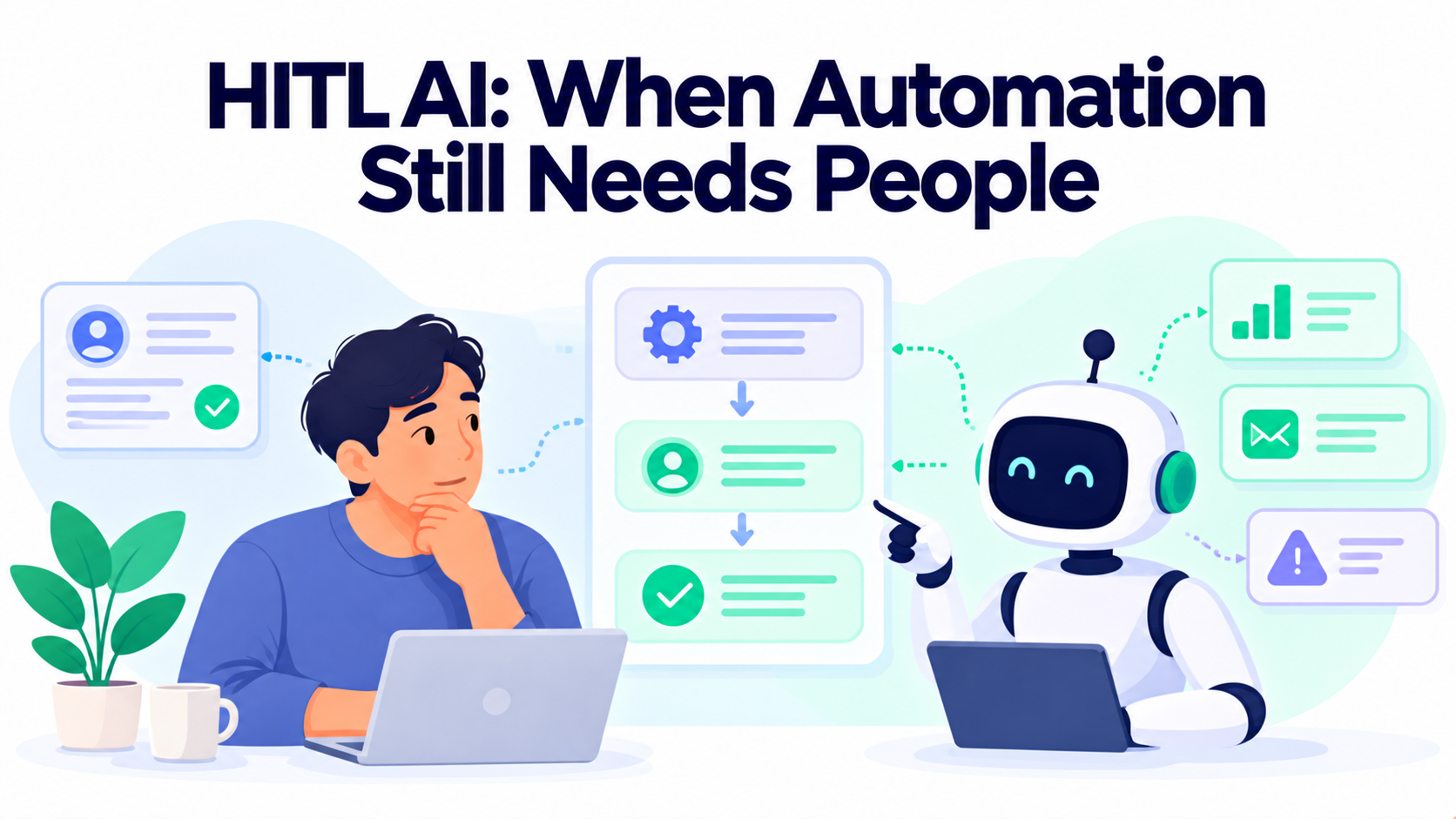

Automation projects often start with a goal of removing people from a process. The better ones end up deciding exactly where people stay. Human in the loop AI means a person reviews, approves, or can override what an automated system does at defined points. The design question is where those points belong, because a reviewer placed everywhere creates a bottleneck and a reviewer placed nowhere creates liability.
Why the model cannot check itself
Dan Klein of Scale Cognition gives the clearest explanation for why review matters. Humans have built-in metacognition, a sense of what they do not know. A base language model has no equivalent. It does not register that it lacks a fact and simply produces its best guess. Klein also notes that older unreliable technologies, from sketchy websites to clumsy machine translation, carried visible tells. Language model output carries none, since a wrong answer reads as polished as a right one. That pushes users toward blind trust or total distrust, and neither extreme serves a business.
Two implications follow. First, a model's stated confidence is a weak basis for deciding what gets reviewed, so route by stakes and by rules instead. Second, Klein warns that chaining models to check one another does not compound accuracy the way people expect. It adds latency and lets errors cascade on exactly the cases that confuse every model in the chain. Automated checks have a role, and a person still needs to own the hard calls.
Accuracy: keep domain experts in the review seat
Brad Axen, who built the Goose agent framework at Block, says his company has dropped Python trivia from interviews but still wants senior domain experts capable of catching an AI's incorrect outputs, not only AI-fluent generalists. The expertise that makes review work is the same expertise AI cannot supply for itself. A junior reviewer who cannot tell a plausible wrong answer from a right one only adds a signature.
Swati Trehan, co-founder of Emma, notes that her system sometimes combines outputs from as many as eight or nine models on harder tasks, including a verification step where one model judges the others. She is also frank that some work, such as writing back into complex enterprise spreadsheets, remains unreliable even for frontier models, which is exactly where a human check earns its place.
At scale, reviewers tire. Aaron of Adobe describes a workflow where an automated validation step checks a batch of 100 generated assets and finds, in her example, that 2 have illegible text, a catch no person could sustain without fatigue. Use machines to screen volume, then send the flagged and the high-stakes items to people.
Compliance: some oversight is required by law
In regulated settings, human oversight is a duty and not a preference. The EU AI Act requires effective human oversight for high-risk systems, and after the Digital Omnibus the main high-risk obligations take effect in December 2027. Courts have also sanctioned lawyers for filing briefs containing AI-fabricated citations, where nobody verified the output. Where a regulator or a judge can ask who checked this, the answer needs to be a named person with authority to stop the process, and a rubber stamp will not hold up.
Rana Gujral of Behavioral Signals draws a related ethical line for systems that read human signals. He separates modulation, using someone's inferred state to support their own goals, from manipulation, bending someone toward another party's goals without awareness. A person should decide where an automated system sits relative to that line.
Safety: permissions and approvals for agents that act
Once an AI system can take actions, safety becomes a matter of what it is allowed to do without asking. An Adobe partnerships executive describes work with NVIDIA on agent governance tooling that adds guardrails against destructive or unintended actions. OneDigital's Mike Sullivan and Vinay Gidwaney build the same idea into how they onboard AI coworkers. Each moves from intern, tested against pass or fail criteria, to apprentice, with guardrails and a human supervisor who is often the subject-matter expert, and only then to full-time. Underperformers get a formal improvement plan and return to the workshop. A named human supervisor with authority is the loop in its simplest form.
Customer experience: humans where judgment and accountability matter
It is tempting to assume empathy is a human monopoly. Sullivan and Gidwaney point to a public comment from Lemonade's CEO that AI claims agents scored higher on delivered empathy than the human agents they replaced in some call-center settings. If that holds, the case for humans in customer-facing work rests less on warmth and more on judgment, exceptions, and accountability. Ian, who leads Adobe Express, describes hospitality customers who need AI-generated marketing to match real property details, with an invented Bahamas bay as the cautionary example. People belong in the loop for cases where a wrong answer is costly, where a customer is escalating, or where a policy exception needs a decision-maker who can be held responsible.
Design review so it does not become theater
Human in the loop AI fails through automation bias, where reviewers defer to the system because it usually looks right. Give reviewers the context to disagree: show the source material next to the output, make rejecting easy, and measure review quality as well as review speed. Remember Axen's point about expertise. The review seat should go to someone who could have done the task.
Keep your oversight model current
As agents gain permissions and regulations take effect, the right review points will move. Subscribe to The AI Report for ongoing coverage of human in the loop AI and how companies are deciding where people stay.
