400,000+ business leaders (and teams at IBM, AWS & Zapier) start their day with The AI Report. 5 minutes. Plain English. No hype.
Jobs Most Likely to be Automated by AI in 2026
Which jobs are most likely to be automated by AI in 2026? A task-by-task look at exposure by function, who is feeling it first, and how to audit your own role.
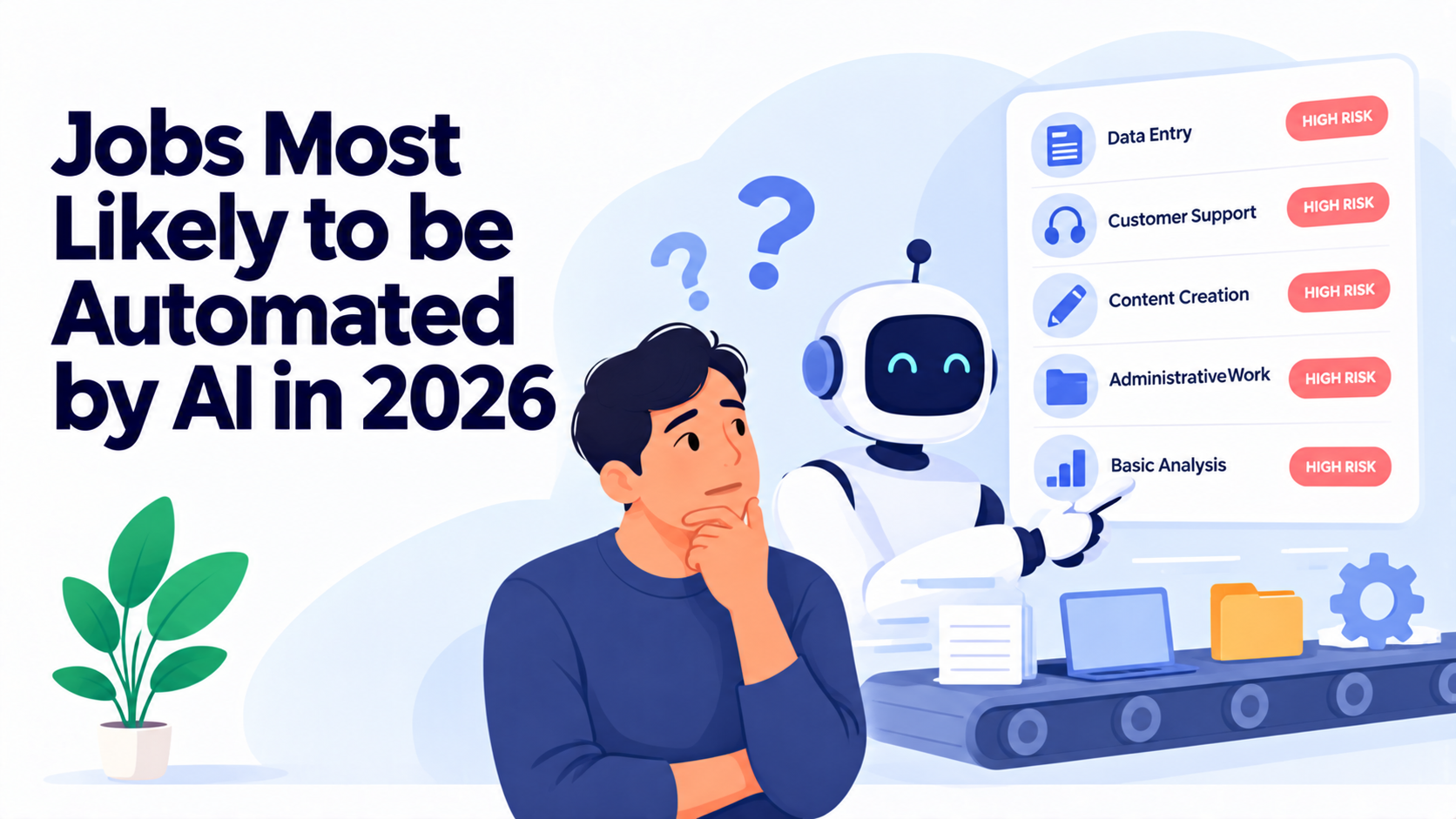

Lists of the jobs most likely to be automated by AI usually rank whole occupations, as though a job were a single block that either survives or disappears. Real jobs are bundles of tasks, and AI takes over pieces of the bundle at different speeds. The more useful question is which tasks inside a role are exposed, and what remains once they are handled.
What the 2026 evidence says about exposure
Anthropic's research on labor market impacts built an exposure measure that counts a task as exposed only when language models could plausibly do it and when it shows up in real, automated work use. By that measure, computer programmers, customer service representatives, and financial analysts rank among the most exposed occupations. Coverage is high across whole families of work: about 94% of tasks in computer and math occupations and 90% in office and administrative ones. Data entry keyers sit nearer 67%, which tells you that even the most routine title still contains work the tools do not yet cover.
The same research found no rise in unemployment among workers in the most exposed occupations. It did find tentative evidence that hiring of workers aged 22 to 25 into those occupations has slowed.
BCG's 2026 analysis points the same way. It argues that most jobs will stay but change substantially, with agentic AI potentially driving high levels of task automation in roughly 43% of jobs. A smaller group, about 12%, falls into what BCG calls divergent roles, where AI substitutes for human tasks and employment effects become uneven, with junior positions hit first. One 2026 tracker of announced layoffs counted 15,341 US job cuts attributed to AI in March, about a quarter of that month's total, while cautioning that AI is still not the largest single explanation for a weak labor market.
The unit that matters is the task
An executive on Adobe's partnerships team relayed a story from NVIDIA CEO Jensen Huang's keynote at Adobe Summit that makes the point well. Predictions said AI reading of scans would eliminate radiologists, yet there are more radiologists today. Reading a scan was never the purpose of the job. Detecting disease was. The same executive describes his own early job, which involved copy-pasting ad tags out of spreadsheets, and says AI removing that work moved him toward the partnership strategy underneath it.
Jason Li, CTO of Laurel, adds a useful twist. Most companies define roles in standard, cookie-cutter bundles because they are easy to manage, and Li argues that granular data on how people actually spend time would reveal specialists hidden inside generic jobs. A role title tells you little about which of its tasks AI will reach.
Swati Trehan, co-founder of Emma, explains why the current wave differs from earlier automation. Rule-based robotic process automation has existed for about twenty years and, in her telling, covers perhaps 10% to 20% of real use cases, since human work varies too much to codify as if-then rules. Language models handle that variation far better. She is equally candid about what is still manual: even frontier models struggle to reliably write back into complex enterprise spreadsheets, because cross-cell relationships and embedded business logic are easy to break. Reading from Excel is largely solved and writing to it is not. Exposure scores capture a moment in time, and they shift with each model release.
Where task exposure is highest right now
Customer and employee support. Trehan notes that most of the natively agentic competitors she sees concentrate on customer support. Her company's flagship customer, Hitachi, uses its assistant for employee support, with more than 50 integrated actions across several backend systems.
Sales research and prospecting. OneDigital's Mike Sullivan and Vinay Gidwaney built an AI coworker named Dex for prospecting and pre-call research, work a rep would otherwise do by hand. The Adobe partnerships executive says company research that once took his team a day or two now happens before a first meeting.
Software work. Brad Axen, who built the Goose agent framework at Block, says his team no longer runs "how well do you know Python" interviews. Candidates now solve problems with full access to AI tools.
Accounting, billing, and time entry. Laurel's product drafts timesheet entries automatically from calendar, email, and meeting activity, work historically done by hand in tenths of an hour. The professional reviews entries instead of building them.
Marketing production. Aaron of Adobe describes content workflows in which numbered steps are assigned to named AI agents or named people, with an automated validation step checking batches of generated assets for problems such as illegible text.
Insurance and other information businesses. Scott Likens, PwC's Chief AI Engineer, calls insurance fundamentally an information business, information and math, and sees its opportunity as the largest of any sector. BCG's examples of exposed insurance tasks are lead qualification, quote generation, and policy comparison, all common entry-level work.
Why early-career roles feel it first
The routine, codified tasks that AI handles best are often the ones assigned to junior staff. That is why BCG expects entry-level pathways to take the first strain, and why hiring data for young workers is where early signals show up. Axen adds a second pressure. His company still wants senior domain experts who can catch an AI's incorrect outputs, which raises the bar for people who have not yet built that depth. Tudor Achim, CEO of Harmonic, says CVs carry almost no predictive signal in his hiring data, which suggests credential filters are weakening as an entry point. The evidence on actual unemployment remains thin, so treat these as early signals and not settled outcomes.
What stays harder to automate
Work that carries accountability or depends on trust holds up better. Aaron predicts that as AI absorbs mechanical work, relationship-building and trust become the differentiator, and she offers a formula for trust: reliability times intimacy times credibility, divided by self-orientation. Ian, who leads Adobe Express, describes hospitality customers who need AI-generated marketing to match the real property, with a Bahamas resort bay that did not exist as his example. Someone has to own that accuracy. Rana Gujral of Behavioral Signals suggests a personal test for any tool: does it make you more capable when you are using it and when you are not.
A quick way to audit your own role
List ten to fifteen tasks you do in a typical month, with a rough share of time for each. Mark which are routine information work with checkable output, since those are the most exposed. Mark which depend on data you control and which depend on judgment or relationships. Then ask what the purpose behind each task is, following the radiology example. Move time toward the purpose-level work and learn to supervise the tasks that automate. Your edge is the expertise that lets you tell when an automated answer is wrong.
Keep tracking exposure as it shifts
Exposure by task changes with every model release and every new deployment. Subscribe to The AI Report for ongoing coverage of which jobs most likely to be automated by AI are actually changing, and how people are adapting.