

400,000+ business leaders (and teams at IBM, AWS & Zapier) start their day with The AI Report. 5 minutes. Plain English. No hype.
Mike Flynn, EY: Controlling AI Agent Costs and ROI
EY's Mike Flynn explains why AI agents break per-seat software budgets, how one query can burn 80,000 tokens, and how to tie AI spend to business value.
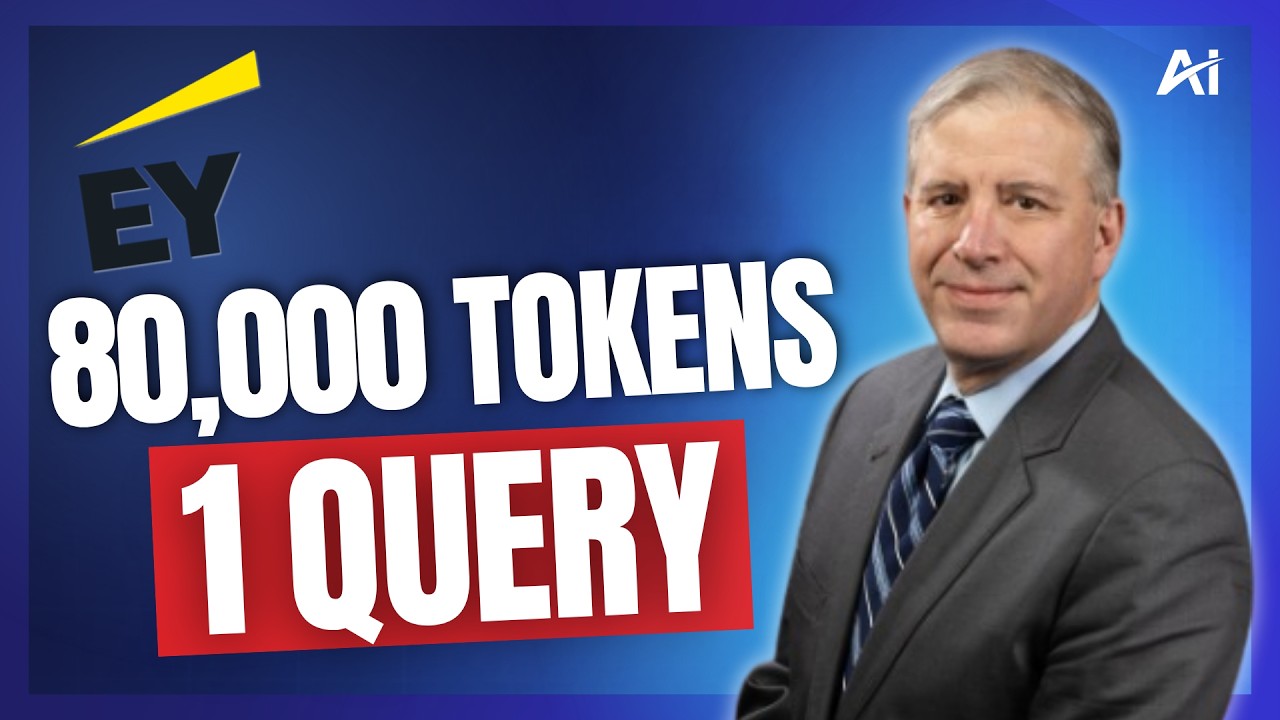

Watch on YouTube · Listen on Spotify or Apple Podcasts
Mike Flynn, a Principal at EY who leads the technology sector for its consulting business, says companies get real ROI from AI when they redesign whole processes to be AI first instead of bolting AI onto workflows built for humans. He tells host Liam Lawson why AI agents break per-seat software budgets, how a simple query can balloon to 80,000 tokens, and how companies can tie AI spend to business value.
Key takeaways
- Design for zero, then add people back. EY's mental model starts by assuming a business process will run without humans, then adds the human touch back where it is still needed. (04:29)
- Per-seat budgets break with AI agents. Runtime usage, not seat licenses, now drives financial exposure, and AI models are bad at predicting what a query will cost before it runs. (10:30)
- Measure cost per completed task. EY's framework adds model, retrieval, tool and API, infrastructure, human review, and retry and rework costs, then weighs them against the cost avoided. (13:18)
- One simple query can cost 80,000 tokens. Tools calling other tools that call other tools are a bad behavior companies now want to remove, along with overusing the best models where a cheaper one would do. (20:52)
- Control AI with a feedback loop. Like a thermostat, a control loop combines policy, telemetry and enforcement, which Mike says means less human input, not more. (25:53)
- Enterprises want seven things from AI vendors. Predictability, quality, risk management, security, value, transparency and flexibility, delivered at enterprise scale. (41:29)
- AI is creating more consulting work, not less. EY is partnering with AI native firms that need its domain expertise, and building out its own forward deployed engineering capability. (46:36)
What is EY's Design for Zero approach to AI?
Mike Flynn says Design for Zero starts with the presumption that a business process will run without human beings, using an AI-first approach, and then adds people back in where the process still needs them. The alternative, applying AI to an existing process that was optimized for humans, is what leads to "trapped work": some steps get automated, but the process is still human-centric with AI bolted on.
He says the shift happened over the last nine to twelve months. Eighteen months ago, many companies were buying point solutions. Executives and boards were unhappy with how much they were investing relative to the ROI, so budgets were pulled back into the executive suite and focused on end-to-end transformations, with business processes redesigned to be AI first and ROI tracked from the start.
Where is AI-first redesign working today?
Mike Flynn says AI-first redesign has the most traction in research and development, where coding agents are being adopted across the value stack. The area clients are now focusing on is G&A: redefining the finance function and integrating AI into sales.
As an example, EY worked with two AI native firms to build a platform called the Future of Sales. An inside sales rep at a software company might manage 400 to 600 small clients today. With an agent that suggests the next best action and pulls together the content for each outreach, that rep can give each client more attention and handle more clients.
Why does AI break per-seat software budgets?
Mike Flynn says AI breaks per-seat budgets because what drives a company's financial exposure is now the runtime usage of AI, not the number of licenses. Companies used to plan software spend annually: a known number of people using a known product. Agents consume tokens in real time, and costs are hard to forecast.
He cites an academic paper from researchers at the University of Michigan, Stanford and MIT, "how coding agents spend your money", which found AI models were not good at predicting how much a prompt would cost before it was submitted. Companies that manage budgets annually now need guardrails and controls that show, in real time, what they are spending, which models they are using and what value they get back.
What does an AI agent really cost?
Mike Flynn says the true cost of an AI agent is its cost per completed task: model cost, retrieval cost, tool and API cost, infrastructure cost, human review cost, and retry and rework cost, weighed against the cost avoided. The retry and rework cost is the one people forget, because AI rarely gets a task done in one pass.
He admits this is a futuristic view: most companies have not reached that level of granularity yet. He compares today to the early days of cloud adoption, when companies received a lump-sum cloud bill with no visibility into where the money went. What fixed cloud spend was more fidelity and clear accountability, and he expects the same for AI. Companies are getting a handle on what they spend; tying it to the value delivered is the harder part.
How can companies control AI agent costs?
Mike Flynn says companies control AI costs by getting down to the job and its outcome, instead of looking at spend at the provider or invoice level, where it is "too aggregated to make a business decision". Even the most sophisticated technology companies track tokens without tying them to the application, workflow or team driving the consumption, because their first goal was adoption.
That is changing. Companies are now optimizing model routing to pick the right model for the right job, cutting out tools that call other tools and turn a relatively simple query into one that takes 80,000 tokens, and avoiding overuse of the best models. The harder question is return. Mike's example is a shoe-shopping feature that checks inventory through AI calls: the goal is to test how often it should check, and whether some of those checks should be a normal API call instead of an AI call.
How do you keep AI agents in check?
Mike Flynn says keeping AI agents in check takes a control loop, not more human oversight. He compares it to a home HVAC system: the condenser just turns on or off, the thermostat holds the setting, and a feedback loop connects them. For AI, that means a policy management system where policies can be written in natural language, telemetry showing whether agents meet those policies, and a control capability to enforce change.
He frames it as four questions: can you see what the agent is doing, can you say what it is for, can you prove it is behaving, and can you keep it true over time? One security company impressed him by taking model choice out of engineers' hands: it installed routing proxies on every engineer's laptop, so it sees all model telemetry centrally and engineers can't route around it.
Why does enterprise AI move slower than personal AI?
Mike Flynn says enterprise AI moves slower because a corporation's job is to align many people on the same way of working, and AI capabilities are changing faster than organizations can redesign their processes. In some cases, by the time a company has planned and executed a change, AI has already moved on.
The first wave of enterprise AI was about adoption: getting tools into people's hands. Now companies want standardization, a single way of doing each thing. Mike says that twelve to eighteen months ago CIOs talked about adoption; now they talk about end-to-end process redesign and AI-first approaches across their G&A functions. He adds that in an EY pulse survey, the majority of executives said they are getting a return on their AI spend, but don't necessarily know how to track it at the right level.
What do enterprises want from AI vendors?
Mike Flynn says enterprises want predictability, quality, risk management, security, value, transparency and flexibility from AI vendors. He doesn't think any single platform delivers all of that at enterprise scale today, which makes it one of the biggest opportunities for startups. He believes enterprise AI adoption is still at a very early stage, even in the technology sector, which is ahead of other sectors.
He also points to data security as the number one concern, and finds private networks that shrink a company's threat footprint compelling as AI tools send more data across the open internet.
Will AI replace consultants?
Mike Flynn says that so far AI is creating more consulting work for EY, not less. AI engineering-first companies need EY's domain expertise and understanding of clients. His work today is roughly 70% advising and 30% deployment, plus managed services where EY runs business processes for clients.
EY is pursuing forward deployed engineering in several ways: an FDE Plus model where partners bring engineers at scale and EY brings domain and client expertise, its own forward deployed engineering pods, help for mid-stage and late-stage startups struggling to scale implementation, and work with SaaS companies pivoting to AI whose customers haven't yet activated licenses they bought. Mike calls consulting "first and foremost a relationship business", built on trust.
What does Mike Flynn look for when hiring?
Mike Flynn looks for two traits when hiring: problem-solving skills, with real excitement about thinking through problems, and initiative. In a flat, matrixed consulting firm, he says, the people who keep leaning forward, helping a senior colleague or jumping on a client's last-minute emergency, are the ones who rise to the top over time. He doesn't see a link between nationality and those traits.
Asked why he does what he does, Mike says he gets bored easily and loves that his job, after more than 20 years, is always different, with problems he didn't know were problems until he was presented with them.
In his words
"So let's start with the presumption that we're going to have a business process that we're gonna run without human beings." (04:29)
"AI is actually very bad at predicting what it's actually gonna cost to run a query." (10:30)
"Like at that point it's too late, it's too aggregated to make a business decision." (20:52)
"I still really believe that we're in like the very early stages of AI adoption." (41:29)
"There's always something different." (55:33)
Chapters
00:00 Introduction and Mike's path from the Air Force to EY and PwC
01:58 What Mike's role at EY looks like today
03:57 Why point solutions create "trapped work"
04:29 From AI experiments to end-to-end transformation
07:47 Where AI-first redesign is working today
10:00 Why AI is breaking the per-seat software model
13:01 The real costs behind running an AI agent
16:00 Measuring AI spend versus business value
18:28 How much work will AI actually take over?
20:52 Why companies need more granular AI cost controls
25:53 Building automated control loops for AI
31:21 Experimenting with enterprise AI tools at scale
36:02 Why enterprise AI adoption moves slower than personal AI
39:37 CIOs shift from adoption to process redesign
41:29 What enterprises want from AI vendors
45:24 Consulting versus AI deployment at EY
46:36 Why AI may create more consulting work, not less
49:00 EY's forward-deployed engineering strategy
52:16 The two qualities Mike looks for when hiring
55:33 Why Mike does what he does
About the guest
Mike Flynn is a Principal at EY, where he leads the technology sector for EY's consulting business. He started his career as a communications officer in the Air Force, where he worked on the launch of Flight Four of the Milstar military communications satellite. He joined EY in 2003 and spent about a decade in financial services, then worked at AlixPartners and spent about nine years at PwC before returning to EY. Mike on LinkedIn · EY
About the host
Liam Lawson is CEO of The AI Report and host of The AI Report Podcast. Meet the team
Full transcript
Edited for readability. Quotes above are word for word from the recording.
Liam Lawson (00:00): All right, Mike, welcome to the podcast.
Mike Flynn (00:03): Hey Liam, it's great to be here.
Liam Lawson (00:05): I want a bit of an introduction. From what I understand, you started as a comms officer in the Air Force, spent almost a decade at EY, another nine at PwC, and now you've recently come back to EY. I'm curious, what made you come back, and what does this version of EY look like compared to when you first joined?
Mike Flynn (00:36): Sure. I started my career as a communications officer in the Air Force. I had the opportunity to work on the launch of Flight Four of the Milstar satellite, which is a military communications satellite, and it was a very unique early opportunity in my career. When I got out of the Air Force, I went into consulting. I started at EY in 2003, focused on the financial services sector, so I spent about a decade working in financial services at EY. I then left to go to another consulting firm called AlixPartners, and then ultimately to PwC, where I was for, as you said, about nine years. I came back to EY, candidly, for a great opportunity to lead their technology sector for our consulting business, which is the role I'm in now. Considering everything that's going on across the technology sector, it's a phenomenal place to be.
Liam Lawson (01:40): There's loads happening. Very interesting time to jump back into it. Say you're sitting down for dinner with someone you've never met, and they ask what your job is at EY right now. What do you tell them? What actually sits on your desk on a Monday morning?
Mike Flynn (01:58): It's all about serving clients and helping them with a wide variety of problems. Within the technology sector, we're helping companies with everything from helping data center operators think about how they get their company off the ground. If you think about the new spend going into the data center business, you have companies that are essentially getting started from scratch, with capital to go out and stand up data centers, and we're helping them end to end with how to do that. That's one area. Another project could be helping a CIO think about what their AI strategy should be, not just for G&A, but also for their research and development costs. A lot of my clients are actually incorporating AI into the products they sell, so they have a unique need: it's not just how we think about AI in the way we run our business, but also in the way we deliver a product to our clients. It could also be a large transformation of a finance function, or an ERP implementation. It really spans a lot of what I would call episodic events that companies go through, which usually relate to transforming their organization, building a capability, potentially spinning out part of a business or acquiring another one. That's the area my remit focuses on.
Liam Lawson (03:57): A few things you mentioned there: end-to-end, and transforming an entire business. When I was doing my research on you beforehand, something you've described is the idea of trapped work. When people take on new AI projects, they focus on one thing specifically rather than overhauling the whole business. Out of the clients you interact with, when they're taking on an AI project, how many are thinking holistically about the whole business, and how many are thinking about a specific problem?
Mike Flynn (04:29): If we go back, let's call it 18 months ago, a lot of companies were thinking about point solutions to solve business problems, and that led to trapped work. Over the last eighteen months, a couple of things happened. One, executives and boards were unhappy with the amount they were investing relative to the ROI they were seeing come back. So over, let's call it, the last nine to twelve months, budgets got squeezed back into the executive suite. Instead of being pushed out for people to experiment, the executive suite said, let's actually focus on end-to-end transformations, think about where we're spending money and have executive-level responsibility for how it's being spent. So what you've seen over the last 12 months is a focus on how we take end-to-end business processes, redesign them to be AI first, and then apply AI so we can actually see and track the ROI coming out of the investments we're making.
One of the mental models we use a lot with our clients when thinking about business transformation and applying AI is the concept of design for zero. Let's start with the presumption that we're going to have a business process we run without human beings, with an AI-first approach. Then let's start adding human beings and that human touch back into the process, because quite frankly, most business processes still require humans to be part of what's happening. The mental model of saying we have an existing process and we're going to apply AI to it is what I see leading to trapped work.
Mike Flynn (06:44): What's happening is we have a process that was optimized for humans, and we're now applying AI on top of it. We're able to take some steps out or automate some steps, but at the end of the day, it's still a process designed with a human-centric approach first, with AI applied to it. Whereas if you start with the mental model of design for zero, you think about what you can get AI to do, and then you're essentially adding people back. That's how you move from a human-centric approach with AI bolted on to an AI-centric approach, where humans are managing the process, monitoring the process, or are still an integrated part of it.
Liam Lawson (07:28): Where have you seen Design for Zero be most successful?
Mike Flynn (07:33): In terms of different processes?
Liam Lawson (07:36): Yeah, a specific project. You're taking on a client, you're using this design for zero mindset. Where have you actually seen it come to fruition?
Mike Flynn (07:47): By far, where you have the most traction in terms of changing the way business processes happen is in R&D. The adoption that's happened there with coding agents, using AI to fully integrate across the value stack, is probably where you have the most traction. What I think is interesting, and where we're seeing a lot of clients focus, is the G&A side of their business. How do they redefine their finance function? How do they integrate AI into their sales function to drive a different outcome? As an example, we've worked with a couple of other companies to build a platform called the Future of Sales, which rethinks enterprise sales, inside sales and really any part of the B2B sales process. That's inherently a human-to-human interaction, but there are still a lot of ways to incorporate AI to make it more effective.
Imagine you're a salesperson and you're being told your next best action: whether you should reach out to a client, how you should reach out, what information that client might think is most important. Then you have an agent that helps you pull together all of the content you want to use. If you're an inside sales agent at a software company, today you might be managing 400 to 600 small clients with relatively few touch points each. Now imagine that content is created for you and your agent is essentially your sales guide, telling you your next best action. One, you can increase the amount of touch you give your clients, and two, you can increase the number of clients you can effectively handle.
Liam Lawson (10:00): What I'm curious about is the shift. We used to work on a per-seat model, and within the past twelve to eighteen months we've moved to a usage model. I think the average cost per AI interaction has gone from four cents to around a dollar twenty, a thirty times increase, because we've moved from chatbots to agents. How has that changed the economics of how we work with AI, and what you've seen in business transformation?
Mike Flynn (10:30): Absolutely. I think everybody started really focusing on tokens and token cost in, I want to say, April of this year. There was this massive focus. But the shift has been happening for quite a while. Historically, companies bought and managed budgets on a per-seat basis. You have a piece of software and a number of people who need to use it, so you know your costs and can plan for them periodically. It's an annual spend. With AI and the amount of consumption that's driving things, everything is switching. You might still have a per-seat license in some cases, but what's actually driving your financial exposure is the runtime usage of AI.
A couple of things are problematic with that. Number one, AI is actually very bad at predicting what it's going to cost to run a query. There was a paper out of the University of Michigan, Stanford and MIT called How Coding Agents Spend Your Money, analyzing and predicting token consumption in agentic coding tasks. It's an academic paper, a great read, and I found it very interesting. What it found is that AI models weren't great at predicting how much a query would cost: if you asked a model to tell you how much a prompt was going to cost before you submitted it, it wasn't very good at that. So companies are now being forced to manage in real time what they've historically managed on an annualized basis. Where we see companies shifting how they think about cost is: how can we put guardrails and controls in place that give us a real-time view of what we're spending,
Mike Flynn (12:50): what value we're getting out of it, what models we're using and where we're using them, and how can we take a more holistic approach to that?
Liam Lawson (13:01): I was reading beforehand that you published a framework around the seven categories of true agent costs. Can you cover them? What actually goes into how much an agent is going to cost a business?
Mike Flynn (13:18): We have a framework covering everything from your runtime cost, your infrastructure, your human in the loop, the retrieval cost of the information coming back, and any tool and API costs. Then there's a retry and rework cost that people don't necessarily think about, because AI is not necessarily one to one. So we have this cost per completed task, which is model cost, retrieval cost, tool and API cost, infrastructure cost, human review cost, and retry and rework cost. You think about that relative to the avoided cost, or the automation credit. That's a framework we've been working on with companies. I'll tell you right now, it's a futuristic view. I actually know most companies haven't gotten to that level of granularity. But I do think a completed task metric, which lets you calculate the benefit an agent gives you relative to the cost going in, is where we're going to move to.
To draw a corollary for where I think we are: with finance operations in the AI space, we're in something like the early days of cloud adoption, when people were getting a cloud bill and saying, we don't really have visibility into where things are going. What changed with cloud costs, and I think it's correlated to what's happening with AI cost, is that people needed more fidelity to make decisions, and then fidelity and accountability across the organization at the right level of detail, so there's a person responsible for making each decision. If you're getting your AI bill every month as a lump sum of how many tokens you used, without visibility into which parts of the organization are using it or the benefits they're getting,
Mike Flynn (15:43): you can't really start to manage it effectively. So this cost per completed task framework is a way, I think, for corporations to start driving visibility and accountability into their spend.
Liam Lawson (16:00): Have you seen that in action yet? If you've brought that framework into an organization, how true to your prediction has the result been?
Mike Flynn (16:08): As I said, I think it's futuristic right now. We're talking with organizations about implementing it. What I will tell you is that the same kind of concept, which we call an autonomous continuous control framework, is how in the past I've helped companies, and done it myself, manage their cloud spend and drive it to accountability.
Mike Flynn (16:38): There are two parts to this. One is what you're spending, and two is whether you can track and tie it to value being delivered. Companies right now are getting their hands on what they're spending. Tying it to value delivered is the harder part, and that's where the challenge is. It means you need to understand, per AI workflow, what the business value is. Not the number of tokens spent or the cost, but the actual business value coming out of the process you're running.
Liam Lawson (17:17): I think we're just moving through stages. I've been running this newsletter for three years, so we've seen a million organizations and advertisers come through, and a lot of them were just in the experimentation process. Some got it right, some got it really wrong. I think it was Uber that gave Claude Code to all their engineers, and they ran through their yearly budget by April. They had a leaderboard for engineers to spend more tokens. They were actually incentivized to spend more tokens without it being tied to any real business value. I'm curious about your intuition. When AI first came around, there was this promise to lots of business owners and organizations that it could do everything and run everything. Now that you're in the weeds, modeling this as a cost per completed task, what do you think the breakdown will be between AI taking over business processes and humans still being in the loop?
Mike Flynn (18:28): Without a doubt, we're going to continue to see AI take over more and more business processes. On intuition, there are so many variables that go into this. The cost of AI continues to come down on an individual token basis, and at the same time, for a lot of different reasons, companies are spending more and more on AI. But I think a lot of those are short-term problems. You have all of these vendors adding consumption costs to software, whether you use it directly or through a SaaS platform that's incorporating AI. So individual economic costs are coming down and total cost of ownership is going up. And companies have also gotten extremely good at dealing with labor and labor arbitrage. At a certain point, in specific job functions, companies are asking, do I need more AI, or should I just bring in humans? Because from a cost and value perspective, a human is actually better than AI for a specific job. I think we're starting to have those debates right now.
My personal view is that we're still a long way away. I'm not smart enough to predict what AI is going to do, but there's still so much opportunity, and I feel we're still so close to the beginning of this journey in terms of what it's going to be able to do, specifically on the enterprise adoption side. I think companies are just out of the starting blocks in terms of what it's really going to do to transform their organizations.
Liam Lawson (20:27): Let me steelman your argument for a second. All of the costs are constantly fluctuating: token usage, data centers, cloud providers, the physical components. Is it even possible to provide an accurate model of what this is going to cost per business function?
Mike Flynn (20:52): I absolutely think it is. It's a matter of getting it down to the actual job and the outcome. One mistake companies make is dealing with things at too high a level: at the provider or invoice level. At that point it's too late, it's too aggregated to make a business decision. Second, they're tracking tokens, but not necessarily tying them to the application, the workflow or the team driving the consumption. And by the way, these are some of the most sophisticated companies out there from an AI perspective. The technology companies I'm talking about are, I think, ahead of their peers in a lot of other sectors, and yet they're still struggling to get to the right level of granularity. Part of that, Liam, as in the example you just gave, is that they were focused on driving adoption, not on cost control and value.
That's changing. Now they're thinking about how to optimize things like model routing, picking the right model for the right job. How do we get rid of bad behaviors, like tools calling other tools calling other tools, turning a relatively simple query into something that takes 80,000 tokens? And how do we avoid overusing some of the best models out there? That's what's happening on the cost side. The question is how you tie jobs to business value. That's where the challenge is going to be: the return on the investment. I think firms will figure out how to get their investment under control, with the right processes and the right routing in place to manage costs. The question is how to tie it to business outcomes. Let me give an example of where companies are today and where I think they'll get to.
Mike Flynn (23:09): [Take a company] that's got different features in its product that it's rolled out to customers, and those features take AI calls to deliver. Let's pretend ACME is helping you buy shoes, Liam. It checks the inventory of whether shoes are available in your size at a store, responds and gives you three options to pick from. The number of times it checks your location to determine which stores are closer, the number of times it uses AI to determine what shoes you have, and the other system calls it uses to determine whether they're in stock,
Mike Flynn (24:18): the actual number of times those things are being done drives the cost of delivering your software, or an outcome, to your customer. If right now I can only define my AI usage at the product level, saying this application has this many system calls and this many queries going out, that doesn't give me a lot of granularity. Versus being able to say, let's A/B test and optimize the right number of checks to drive value for our clients. Should I be calling an MCP server to check inventory and find out whether it's the right color and the right shoe six times, or every six seconds, every three seconds, every half a second? What's the right trade-off for the customer? And quite frankly, should I even be making an AI call versus just a normal API call? That's the level of granularity we're eventually going to get to in how companies tie their investments to the actual returns they're getting.
Liam Lawson (25:42): To get to that stage of granularity, do we just need a lot of human input? Someone literally looking at every decision and every call and saying, that makes sense, or that doesn't?
Mike Flynn (25:53): I actually think it's less human input. We talked about the control loop a second ago, and I haven't really described it, so let me take a second on how I think firms are thinking about this. Imagine an HVAC system in your house. You have a condenser that doesn't really have any brains; it just turns on or off depending on whether you're too hot or too cold. You have a thermostat, which is where you set what you want. And you have a feedback loop: once you get to a certain temperature, the thermostat turns off the condenser. Our perspective on where firms are going to go as they think about token cost is similar. You have a policy management system where you define policy and what you want to do, and that can be in natural language, because it's going to be interpreted as well. You have telemetry giving you continuous feedback on whether what your agents are doing meets your policy. And then you have a control capability that lets you enforce and manage change. Those things together make a control loop.
So I actually think it's less human input. It's more about defining and setting policy, and then having the ability to manage and enforce that policy in real time going forward. The way we think about it is four questions. Can you see what's happening, what the agent is doing? Can you say what it's for, its stated purpose and how it's supposed to be doing its job? Can you prove that it's behaving? And most importantly, can you keep it true over time? Do you have continuous evidence that
Mike Flynn (28:12): it stays true over time? That capability is where we see a control plane coming into the overall ability to manage and monitor AI at an enterprise level.
Liam Lawson (28:27): I'm curious about your perspective as a consultancy coming in. We're talking about token consumption and modeling ROI, but I'm curious about the peripherals. When you work with an organization, what other things are organizations doing right when they approach AI? You mentioned being model agnostic, for example. Have you seen companies run local models? Outside of policy and mapping things to ROI, what are companies doing right when it comes to deploying and using AI?
Mike Flynn (29:03): One of the neatest things I've seen recently relates to model routing and the potential surface area most organizations have, especially engineering organizations, where on the R&D side there's usually a tremendous amount of fluidity and flexibility around what tools people use. A security company that I think got this right has taken model routing and model decision-making out of the hands of its engineers. It has installed routing proxies on all of its engineers' laptops, so when they execute a prompt or define a skill that needs to be executed, which model gets chosen is driven literally at the laptop level and routed and managed that way. So they have complete visibility of which models are being used, and they see all of this telemetry centrally: across their engineering function, which models are being used, how prompts are being routed, what jobs are being executed. And they can track that across their overall R&D function.
I think they've gotten that right. Other firms have started thinking about it, but a lot of times it's an external model gateway that isn't necessarily enforceable, especially with engineers who can go around it. What I found very interesting is that this was tied to their laptops, so there wasn't really a way of going around it.
Liam Lawson (30:52): I want to know how your personal experimentation, your personal R&D, feeds into the advice you give as a consultancy. To give sage advice, you have to experiment with different tools and use cases yourself. So you, Mike Flynn, what tools have you had your hands on? What agents have you played with? Grokbot yet? How much of your time is experimentation before the advice?
Mike Flynn (31:21): A lot of experimentation with a lot of different tools: everything from the frontier models to tools being embedded into what I would call G&A platforms, the Oracles, the SAPs, the Salesforces and so on. Candidly, where I've been spending a lot of time right now is the concept of content generation I mentioned earlier. Both on the sales side and in what we do, handling content generation at an enterprise level with enterprise consistency is a challenge we've been trying to solve, both with a couple of our partners and internally. To pick an example, we have a finance transformation message about where we see the future of finance going. How do you take a large consulting organization and deliver key themes, messages, proposals and presentations to clients, and do all of that consistently, giving people the flexibility they need to respond to their individual clients, while making sure you can roll it all out at scale? That's where I've been spending a decent amount of my time from an experimentation perspective.
Liam Lawson (32:57): Just to clarify: it's taking all of that raw data and making sure the materials you present, whether on socials, in presentations or anywhere else, are on brand as well as correct.
Mike Flynn (33:10): On brand and correct, but also reflecting our view of how finance is being transformed. There are a lot of tools where you can give them a bunch of presentations, say this is the EY brand, and generate a web page, a Canva presentation, a PDF document or an email. That's one thing. It's another to make sure we have, think of it almost as a control pack of content: what does finance transformation mean to us? How are we thinking about straight-through operations processes? What does management on top of that finance function look like? How do we think FP&A and record to report are going to change? And then to be able to say we want all of our finance practitioners globally to have a consistent message about how we think about that transformation, and know that when proposals and presentations get created, they all conform to that overall message. And then don't just do that for one solution. Do it for all of the different solutions and capabilities EY offers.
Liam Lawson (34:26): I understand. It's ensuring communication between every part of the company and having that be consistent across internal and external presentations. I spoke with Krishna Lund, the CEO of Templify, and there are a bunch of different model layers whose entire business model is exactly this: ensuring consistency across these materials.
Mike Flynn (34:51): There's Templify, there's Replit, there's Canva, there's Microsoft. There are a bunch of tools doing that. To the point we've been talking about, from my perspective it's a little bit of a tool problem. I think that's part of it. But it's more about the process and the business support processes you need to put around driving this consistency at scale. The key word is at scale. What AI has done is make it very simple to do that once. The question is how you do it across everything you're doing, and that also requires the organizational change that goes along with it.
Liam Lawson (35:34): I want to understand how often the messaging and goals change. As a company, you have a thesis on how you look at things, and each individual component has its own thesis, and you're talking about how they intersect. I imagine that changes through different cycles of technology, and how you approach the world changes too. Has that sped up recently with AI?
Mike Flynn (36:02): If you had asked me in, I don't know, 2020, I wouldn't have said we had a lot of speed in the amount of change in technology. I think it would have been difficult, if not impossible, five or six years ago to predict the speed of change we have now. So the answer is yes, it's absolutely sped up, and you see that in the speed of announcements coming out.
What I think is a bit of a disconnect for a lot of people is the benefit they're getting from AI in their personal lives versus the benefit being driven in an enterprise. If you think fundamentally about the purpose of a corporation, it's to align lots of people to work on the same types of tasks to get an outcome, so you have consistency in the way you want to do things. The first wave of this was to drive adoption: getting tools into people's hands so they could try to incorporate AI into the way they did their work. What you ended up with was maybe the automation of capabilities, but from a lot of different people's points of view. What you're seeing now is companies saying, no, there's going to be a single way we do something. Maybe we get ideas from a lot of places, but at the end of the day, the idea is driving standardization of change. That's where I think the disconnect is, with people questioning whether there's enough ROI coming out of organizations.
Mike Flynn (38:01): We have a pulse survey we send out, and the majority of executives we survey say they're absolutely getting a return on their spend. They just don't necessarily know how to track it at the right level. But the disconnect is that you have personal AI transforming people's lives at a significant speed, and a delay on the enterprise level. They're just slower. So to your question about speed, part of what's happening is that because there's so much change in what the capabilities are, it's actually moving faster than a lot of organizations can react. An organization has to take some time to think about a process, plan what it wants to change and start executing on it. And in some cases, by the time it gets to the end, AI capabilities have already moved.
Liam Lawson (38:54): To make sure I'm formulating this correctly: so far it's been a bottom-up approach. We've given individual employees access to tools and said, go and improve your life, make your job easier. Humans are probably to some degree inherently selfish; their incentive is to make their lives easier and probably make more money. You're marking the next stage as a top-down approach, with some layer of standardization across everything, which will drive more organizational change, some level of standards and greater ROI, because we're mapping everything to business processes.
Mike Flynn (39:31): Exactly. That's exactly right.
Liam Lawson (39:34): How far off are we?
Mike Flynn (39:37): I think companies are absolutely starting to do that today. Look at every CIO conversation I have and how they're thinking about their AI strategy. This has shifted, I think, since 12 to 18 months ago. Back then, CIOs were talking about adoption: how do I get people to start thinking about this? Now they're thinking about how to take their business functions, and let's take R&D off the table for now and look at the G&A side, and start driving end-to-end process redesign and AI-first approaches across those functions.
Liam Lawson (40:19): I want to take you outside business functions for a second and think macro. I was having a conversation with Cillian Kieran, who runs a company called Ethyca, which does AI governance. They work with a bunch of the Fortune 500s, and we were discussing where the opportunity lies for entrepreneurs and businesses in general over the next five or ten years. Right now a lot of these foundation models are consuming SaaS. There was this whole idea of the SaaSpocalypse six to twelve months ago, where technology companies were getting swallowed up by the foundation models because they could build the technology faster. Where are you seeing the opportunity for new businesses or entrepreneurs? Should they be focusing on the model layer, on harnesses, or on businesses completely outside technology that use the benefits of AI? Where do you see the next areas for growth?
Mike Flynn (41:29): One of the biggest areas for growth comes back to driving enterprise adoption and what enterprises want. They want predictability, quality, risk management, security, value and transparency. Sorry, I forgot flexibility; they also want flexibility. If you're a startup that can deliver those capabilities at scale, I think that's a really exciting place, because right now there isn't a single platform that can give you all of that at enterprise scale with the level of transparency firms are looking for. As I said earlier, I still really believe we're in the very early stages of AI adoption. The technology sector is farther along than other sectors, and even it is still struggling with how to drive value, AI use and AI benefits across organizations. If I think about what's keeping that from happening, it's those points I made: quality, risk, value, security, transparency, flexibility, and being able to give all of that to an enterprise at scale and make it easy. I think there's a ton of opportunity there.
Liam Lawson (43:08): In the conversation I had yesterday with Cillian, they developed a foundational standard, kind of like an MCP for data security, and they released it open source, and now a bunch of organizations use it. I've also spoken to a bunch of organizations working on the transparency part. I had a conversation with one of the lead engineers from Block, Jack Dorsey's company, and they're building something called Buzz, which gives you more transparency and visibility. I think that's one of the most crucial components, even with personal technology. Even with your Claude workflow or anything else, you can't see what's happening. You don't know when it's calling a tool. You have no idea what's going on.
Mike Flynn (43:58): That transparency piece I completely agree with. I was listening to some of your previous podcasts, and you had a guest on talking about private networks. I found that a very compelling point of view as well. You mentioned data, and I think data security is the number one driver of concern and value moving forward: firms want to protect their data. To your point about the expanding risk profile from a security perspective, as you use more and more of these tools, data is flowing across the open internet. Then you have the ability to create a private network to keep all of that in and shrink your threat footprint. I found that very compelling as another area of future opportunity.
Liam Lawson (44:57): I'm excited for the future episode we recorded yesterday to release. I think you'll find it very valuable. This might be a silly question: how much of your consulting work is consulting versus deploying the technology itself? Are you purely there to advise, or is part of your work actually deploying and integrating the technology within the companies you work with?
Mike Flynn (45:24): I would say it's probably 70% advise and 30% deployment, and then if I add in manage, we also do a lot where we actually run business processes for companies as a managed service. But I'd break it down in that 70-30 range in terms of advising versus implementing. That's at a very macro level. Where we're doing more on the implementation side is helping clients define the art of the possible and then think about their rollout strategy.
Liam Lawson (46:10): Theoretically, will that split switch in the next five or ten years? Everything you've described so far is building the technology for transparency, trust and governance, looking at this at a granular level with a feedback loop. You're trying to build a system that can be implemented with less human oversight. So theoretically, you'd have less consulting work and more implementation.
Mike Flynn (46:36): That's a great question, and one I haven't actually thought about: is it going to switch that drastically? First of all, five to ten years: like I mentioned, if I look back five years, I wouldn't have predicted where we are now, so I don't think I'm a great prognosticator. What we are seeing, though, is that a lot has been published about AI being essentially the death of consulting, driving consulting out of business. And yet, at least up to this point, what we're seeing is that it's actually driving more opportunity for us. We're partnering with AI engineering-first companies that need our domain expertise and our deep understanding of our clients to drive benefit. So right now we're seeing a ton of synergistic opportunities with AI native firms. As I mentioned, our Future of Sales work is with two AI native firms, and we complement each other. We all bring a different skill set: one is an expert in content generation, the other is a database and AI-powered capability, and we bring the perspective on how to transform sales organizations. Those three things together are very powerful. So I don't know what five to ten years looks like. Honestly, it feels like an eternity. But all indicators I see right now are that it's going to drive more opportunity in consulting, not less.
Liam Lawson (48:28): A trend I'm noticing is the use of forward deployed engineers. Palantir is probably the biggest example: really heavy on people who are deeply technical and can also do consulting work. Is that something you're thinking about? Are you hiring more people in that lane, with deep technical expertise but also the human component, able to translate that value?
Mike Flynn (49:00): Absolutely. We're doing all of the above. We're partnering with other companies in what we call FDE Plus, or Forward Deployed Engineer Plus, where they bring engineering people at scale and we bring people with domain, business and client expertise at scale. We're also hiring and building out our own forward deployed engineering capability to go and deliver outcomes with pods at clients. We're also in conversations with mid-stage and late-stage startups that have a very successful product but need more help driving adoption and implementation, because they're struggling to scale getting it up and running at their clients and making sure it works correctly.
And we're working with companies that are more like historic SaaS companies pivoting to AI, which have sold licenses and capabilities to clients that clients haven't yet turned on and activated. There's a concern that those clients won't renew because they're not getting the value. We're helping release that value by going in as forward deployed engineers, which is a bit of a loaded term depending on who's using it. Let's call them highly technical resources who also understand the business, going in to help clients get value out of software they've already purchased. So we're seeing it from all of those places.
Liam Lawson (50:48): As you mentioned, trust is obviously a huge thing, and it's something we notice too. Part of our business is training: we do enterprise training with organizations across the States, such as SHRM, Fisher Phillips and Mertz. The biggest thing we notice is that it's not about access to technology. It's the fear of actually working with it. Most people essentially need to be handheld. They need someone to say, it's going to be okay, we're going to figure this out together. That's such a massive component of it.
Mike Flynn (51:26): I completely agree with you. At the end of the day, it's also why this is first and foremost a relationship business. That relationship and that trust are what start any other conversation we're going to have.
Liam Lawson (51:43): I have one question on hiring and one personal question to finish. Most of our audience are senior operators and executives, but this one is for people coming out of college or even in their teens. Who do you get most excited about hiring right now? What skills, qualities and experience make you think a person is an absolute no-brainer?
Mike Flynn (52:16): I get asked a version of this question a lot, and I come back to two traits I think are critical. They're probably critical in a lot of industries, but I've definitely seen them make people successful over time. Number one is problem-solving skills and being excited about thinking through problems. The second, especially at the junior level you mentioned, is initiative. I can't stress it enough. In consulting you have a relatively flat and matrixed organization, with a lot of opportunities to participate in things that aren't part of your everyday structure: helping a senior person think through a problem, working on a proposal, or helping a client with a last-minute emergency. Some people are always leaning forward and focused on that. Others are happy to do what they want to do, but aren't necessarily always taking the initiative and leaning forward. Over any time horizon, the people constantly taking the initiative are the ones who end up rising to the top. I could come up with a lot more, but those are two very simple things: being excited about problem solving, and leaning forward and taking the initiative.
Liam Lawson (53:56): I'm assuming you primarily work with people from the US in terms of internal staff?
Mike Flynn (54:06): I've held global roles as well, so I've worked across the world.
Liam Lawson (54:11): This may be something you can't answer, but have you noticed any cultural or demographic differences in people's attitudes that align with those traits?
Mike Flynn (54:30): I don't know that I would say that's true. I've worked with Europeans and with people across Asia and Australia, and I don't know that there's necessarily a correlation between nationality and those capabilities. I think you could find them anywhere.
Liam Lawson (54:53): I want to finish with one last personal question. I ask every one of my guests the same question. The only context I'll give you is that everyone takes it in a different direction: some people talk about work, some about family, some about purpose. It's completely up to you, and I'd encourage you to take five to ten seconds to really think about it before answering. Mike Flynn, why do you do what you do?
Mike Flynn (55:33): I do what I do because I think I get bored easily, if I were doing something repetitious. Candidly, what I love about my job, and I've been doing it for 20-plus years now, is that it's always different. There's always something different. You get to look at and think through problems that you didn't even think were problems before you were presented with them. That constant challenge is what's kept me in the same industry doing the same thing for the last twenty-plus years, and why I love it.
Liam Lawson (56:19): Awesome. Two things, Mike. One, thank you so much for your time. I really appreciate you taking an hour out of your day to speak to me. And two, if people want to find out more about who you are and what you're doing, how do they go about doing that?
Mike Flynn (56:34): Probably the easiest thing is to connect with me on LinkedIn. I got your invitation earlier today, so I know we're connected now. And for what we're doing more broadly at EY, check out ey.com. There's a ton of information. We're putting out a lot of points of view on the topics we've been talking about, both sector specific and broader across different organizations. I'd love to hear from people on LinkedIn.
Liam Lawson (57:07): Awesome. Thank you so much for your time.
Mike Flynn (57:11): All right, thank you.
Get the five-minute AI briefing
Join 400,000+ business leaders who start their weekday with The AI Report. Subscribe free
