

400,000+ business leaders (and teams at IBM, AWS & Zapier) start their day with The AI Report. 5 minutes. Plain English. No hype.
Nia Samady, Salesforce: AI Agents and 70%+ Case Deflection
Salesforce VP Nia Samady explains why AI agent projects stall, how forward deployed engineers help, and where service teams see 70%+ case deflection.

Watch on YouTube · Listen on Spotify or Apple Podcasts
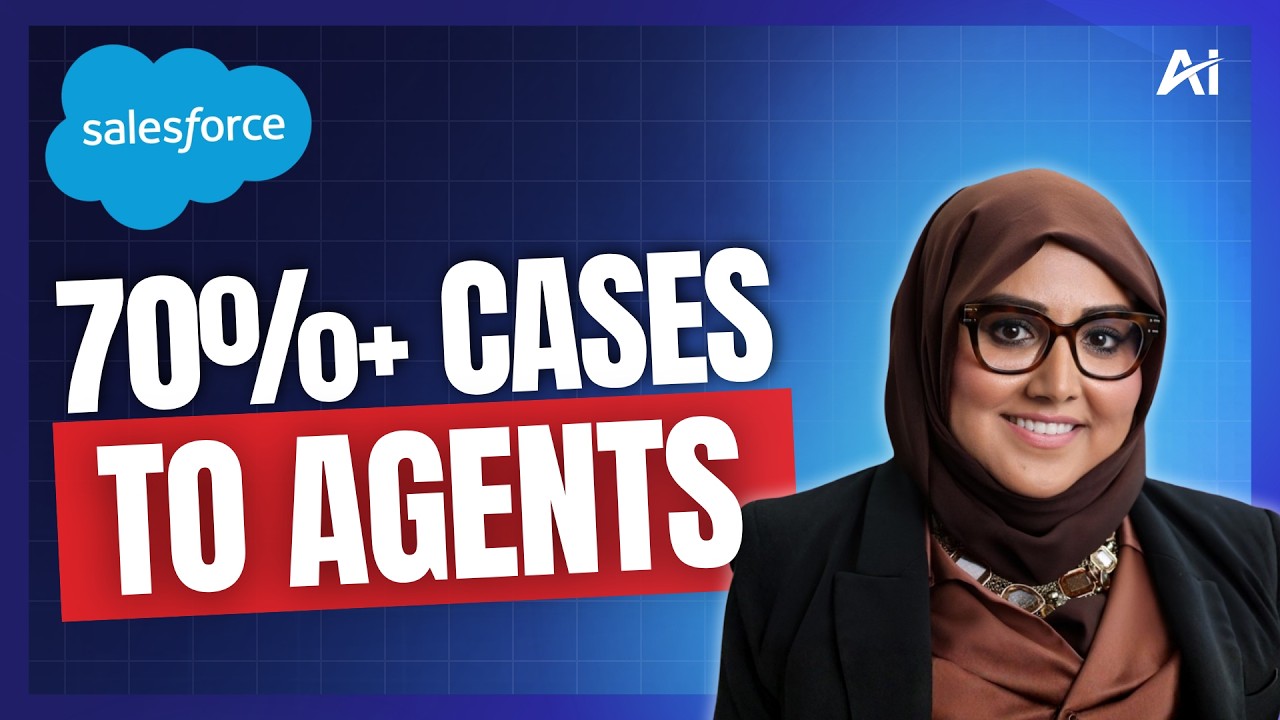
Nia Samady, VP of Global Partner Success at Salesforce, says AI agent projects succeed when forward deployed engineers join a deal early and the customer's data is ready before the build starts. Recorded at Dreamforce 2026, she tells host Kyle Mair where agents already pay off, including service teams seeing case deflection of more than 70%, and why regulated industries such as health and financial services are the real test.
Key takeaways
- 84 partner firms in Salesforce's FDE network. Salesforce launched its Forward Deployed Engineering (FDE) Partner Network in March 2026. Partners get Salesforce's technical resources, the same training as internal teams and a verified practitioner stamp. (05:30)
- Data readiness is the usual sticking point. Processes, data readiness and customer readiness were the recurring problems as releases sped up. (05:30)
- Engineers now join before the deal closes. Forward deployed engineers often appear in pre-sales to ask what business problem the customer is solving and to assess the data. (07:46)
- Service teams see 70%+ case deflection. The biggest returns so far come from service use cases, with a human in the loop and much of the work done by the agent. (10:17)
- Regulated industries are the litmus test. Partners are showing results in health and financial services, where policy, legal processes and guardrails matter most. (10:17)
- Claudeforce puts Salesforce inside Claude. It is a plugin in the top layer of AIforce, Salesforce's approach to reaching customers in the interfaces they already use. (03:05)
- A new wave of "AI native" partners. Just as the cloud era produced born-in-the-cloud partners, Nia now sees AI native partners appearing in the Salesforce ecosystem. (11:47)
What does Claudeforce change for Salesforce customers?
Claudeforce lets Salesforce customers work with their Salesforce data inside Claude, according to Nia Samady. At the Dreamforce 2026 keynote, Marc Benioff described AIforce in four layers. Nia explains that Claudeforce sits in the top layer, alongside Slackforce and Salesforce cowork: the interfaces where people actually work.
The idea is choice: instead of asking customers to come to Salesforce, Salesforce goes to them, in whatever interface they already use. In the early release, Nia's team sees partners reporting that customers are updating opportunity data from inside Claude, and asking how to get more users working that way.
Why do AI agent projects stall?
AI agent projects most often stall on processes, data readiness and customer readiness, says Nia Samady. Part of the problem is speed: Salesforce releases that once came monthly now arrive every few weeks.
Salesforce's response was the FDE Partner Network, launched in March 2026. Forward deployed engineering is an industry term inspired by Palantir. The 84 partner firms in the network, of all sizes, go through the same training as Salesforce's internal teams and get access to its technical resources.
The biggest change is timing. Forward deployed engineers now often join in pre-sales, when the customer is still defining what it wants to do and which business problem it is solving. That lets them assess the data early, which Nia calls the foundation of Salesforce's "four-layer cake". As she puts it, "it's not about a handoff, it's an interlock."
Where are AI agents delivering ROI today?
Customer service is where AI agents deliver the clearest ROI today. Nia Samady says service use cases are seeing case deflection "upwards of seventy plus percent", with knowledge workers and agents working together and a human kept in the loop.
The second area is regulated industries. Partners working in health and financial services are showing what the platform can do where policy, legal processes and guardrails are critical. Kyle calls it a litmus test: if it works in heavily regulated industries, anyone can do it. Nia agrees.
What is an AI native partner?
Nia Samady uses "AI native" for a new wave of Salesforce partners, which she compares to the "born in the cloud" partners that grew up around Salesforce's SaaS model. She also calls them AI forward partners. They are appearing more often in the Salesforce ecosystem, especially around AIforce and headless deployments.
How is AI changing who Salesforce hires?
Salesforce is looking for new graduates who blend technical skills with business acumen, says Nia Samady, especially for its builder teams. Salesforce now has a builder organization, with builder teams across its fifteen or sixteen sales operating units. A builder team can include solution engineers, forward deployed engineers and AI research specialists.
Inside that organization there is real interest in new graduates, both from computer engineering and from non-technical backgrounds such as design. What matters is a balance of technical skill and business acumen. Nia's advice for technical graduates is to learn the business side early: follow the industry, keep up with AI research and understand how sellers and go-to-market teams think. She also recommends networking through podcasts and local events.
How do you keep up with AI without burning out?
Nia Samady's advice for keeping up with AI is to pace yourself and focus on applying what you learn rather than rehearsing it. Salesforce relies on internal enablement and field readiness to keep each role current on how AI applies to it, and she suggests asking how each change applies to your own role.
On her own career, from college hire to VP over 22 years, she credits both mentors and sponsors: leaders who vouched for her work and spoke for her in rooms she was not in. She also tells the story of meeting Marc Benioff and his dog Koa in an elevator on the day of her interview, before she knew who he was.
What will be obvious to partners by Dreamforce 2027?
By Dreamforce 2027, Nia Samady expects partners to have customer stories built on AIforce across all of its interfaces. She describes the platform's trust and governance as "the plumbing" every house needs.
In her words
"Fast forward twenty-two years, twenty-two years later, and for the first time in a very long time, I'm getting those feelings back." (00:36)
"It's not a matter of months or years, it is truly weeks, days, hours." (05:30)
"It's not about a handoff, it's an interlock." (07:46)
"I definitely believe in both mentorship and sponsorship." (20:24)
"I think the key is learning, always just being curious, being inquisitive, and learning." (20:24)
Chapters
00:00 Introduction and Nia's 22 years at Salesforce
00:26 What Nia didn't see coming in the agentic era
01:21 From the Dreamforce keynote to partner success
02:52 Claudeforce and the Anthropic partnership
04:15 Early signals from customers using Salesforce in Claude
05:05 How forward deployed engineers support Agentforce delivery
07:36 What forward deployed engineers look at first
09:08 Why partners value early engagement
09:53 Where AI is delivering ROI today
11:32 The rise of AI native partners
12:32 Marc Benioff, the beginner's mind and a chance elevator ride
14:58 How hiring has changed for new grads and builders
16:59 How technical grads can build business skills
18:35 How Salesforce keeps employees ahead of AI
20:09 Mentorship, sponsorship and career growth
21:20 What will be obvious to partners by Dreamforce 2027
About the guest
Nia Samady is VP of Global Partner Success at Salesforce, where she has worked for 22 years. She joined as a college graduate on a QA and developer support team and now leads a technical team that works alongside Salesforce's consulting partners, from global system integrators such as Accenture and Deloitte to regional firms, across the full customer lifecycle. Nia on LinkedIn · Salesforce
About the host
Kyle Mair is Director of Partnerships at The AI Report. Meet the team
Full transcript
Edited for readability. Quotes above are word for word from the recording.
Kyle Mair (00:00): Hi Nia. Welcome to the podcast. Really excited to have you. You've been at Salesforce for 22 years, from a college graduate all the way through to VP of Global Partner Success.
Nia Samady: That's right. Thank you for inviting me.
Kyle Mair (00:26): What version of partner success in this agentic era did you not see coming when you first started?
Nia Samady (00:36): When I first joined Salesforce, in those early days, I was part of a QA support and developer support team, supporting our API versions one and two, and even, for the non-techies out there, XML-RPC. It was the first time I saw a major transformation like that. I had done all this academic work, and now I was seeing it in the applied world. Fast forward twenty-two years, and for the first time in a very long time, I'm getting those feelings back. I could never have seen this AI era evolution happen so quickly.
Kyle Mair (01:21): At the keynote yesterday, Marc announced a lot of features, such as AIforce and Claudeforce. What does that mean inside your job, from the keynote to actual success with partners?
Nia Samady (01:38): In partner success, my team is focused on how we work alongside our partners. These are mostly our consulting partners: the global system integrators, the Accentures and Deloittes of the world, but also regional system integrators that cover mid-market and commercial. We work alongside these partners across the customer lifecycle, from pre-sales, before a deal closes, all the way through post-sales.
Hearing Marc talk about AIforce and all of the innovation that's happening is super exciting, because I have a team of technical folks who wake up every day and work with our partners to enable them: the latest go-to-market messaging and value propositions, but also, from a technical perspective, what all of this means and how our partners can take it and deliver it to our customers. We are now going to take AIforce and Claudeforce and work with our partners across the globe to see that come to life for our customers.
Kyle Mair (02:52): I want to stay on the Anthropic partnership, because it's clearly changing a lot for customers. How has it changed the conversations you're having with partners, and what does it mean for their success?
Nia Samady (03:05): Claudeforce and the Anthropic partnership really touch the top layer. Marc talked about the four layers. In the top layer of AIforce you have Slackforce, the interface many customers are accustomed to from Slack, and of course Salesforce cowork. Then there are other interfaces, Claudeforce being one of them, that give customers tremendous choice.
Our partnership around Claudeforce is exactly that. It's a headless approach, now branded as AIforce, that takes Salesforce to customers where they are, in many different interfaces. It's a plugin, so if you're already working inside Claude, you have the opportunity to start working with all of your Salesforce there. It's a phenomenal interface example, and there are many more coming.
Kyle Mair (04:15): Marc mentioned this has been with customers on early release for a couple of months. Are there tangible ROI or success stories from the early stages?
Nia Samady (04:27): My team is a technical team, so what we're starting to see is partners coming to us and saying customers are making changes to opportunity data and doing all of this work in the interface, and asking how they can get more users working there. That's where my team comes in: helping partners in this pilot see that users are already in that interface, and how it interacts and engages with Salesforce. That's where we're at right now.
Kyle Mair (05:05): When an Agentforce project stalls or something goes wrong, what is usually the main culprit? Is it a skills gap, the architecture, the initial planning?
Nia Samady (05:30): That's a great question. This AI world is moving so quickly. It's not a matter of months or years, it is truly weeks, days, hours. With Agentforce and a lot of the AI delivery work, earlier this year we launched a network called the FDE Partner Network. FDE stands for forward deployed engineering. It's not a term Salesforce created. It's an industry term, inspired by Palantir, which was the first to share what a forward deployed engineering motion looks like.
We launched the program in March, and we have 84 partner firms in this network globally, of all sizes. Those partners get access to our technical resources. They've gone through the same training as our internal teams, earned their certifications and received our verified practitioner acknowledgement.
What we saw, as our releases sped up from monthly to every few weeks, was that processes, data readiness and customer readiness, making sure the data is the king and queen, were the recurring areas. We also saw that the expertise needed more applied AI work. So through our FDE network and with our partners, we looked at which AI tools they should bring in when deploying Agentforce and these headless solutions. That's what we saw recurring, and we tackled it through our FDE Partner Network.
Kyle Mair (07:36): Are the forward deployed engineers mainly focused on data when they first diagnose an issue?
Nia Samady (07:46): Yes, but there are ands. They are definitely looking at the data. Customer readiness is so critical. What I love about the forward deployed engineering motion is that they come in so early in the customer engagement. Often we're even seeing them in the pre-sales motions, when there's the customer checklist: what exactly do you want to do, and what business problem are you trying to solve? Having the forward deployed engineers come in that early, looking at the data assessment, matters because it's not about a handoff, it's an interlock. In this world of AI, things move so quickly. The more the FDE understands early on about the customer's outcomes, the business landscape and the data readiness, the better.
Kyle Mair: Because data's not the fun part, it's not the glamorous part, but the agent needs all of those things.
Nia Samady: That's right. In our four-layer cake, it's the foundation. That's what's so exciting: these FDEs come in really early and then stay as they get involved in the deployment work.
Kyle Mair (09:08): Is that feedback you've received from partners, that they like having forward deployed engineers there from the start?
Nia Samady (09:20): Absolutely. What we've heard from partners is that our focus on this motion has been really rewarding, because we're going into it together in a unified way. It's also what customers demand. Customers are looking for that early engagement, and our partners bring the domain and industry expertise. That's a magic part of the formula. Bringing them in early, and partners having access to work with us in a unified way, is so critical.
Kyle Mair (09:53): Are there industries or use cases where you've seen the greatest leaps in ROI as AI has improved over the past six months?
Nia Samady (10:17): Definitely in the service industry. That's where we're seeing case deflection upwards of seventy-plus percent, real ROI impact. Service use cases: the knowledge worker, the human plus the agent. You have the human in the loop, but so much of the work is happening with the agent. That's a use case where we're seeing a lot of impact.
Also, when our partners are working in regulated industries, they're using the power of our platform and helping customers see what can be done in a regulated industry, where policy, legal processes and guardrails are so critical. We're starting to see some really great things happening in health and financial services. Partners are doing a lot of great work there.
Kyle Mair (11:20): That's an awesome litmus test. If it works in these heavily regulated industries, anyone can do it.
Nia Samady (11:26): Anyone can do it, that's right.
Kyle Mair (11:32): You work with partners like Accenture, Deloitte, PwC and a long list beyond that. Are you seeing partners successfully integrate AI this year who weren't showing up last year?
Nia Samady (11:47): Absolutely. Years ago we used to call them born-in-the-cloud partnerships: because of Salesforce and our cloud SaaS model, very Salesforce-native partners started coming in. I haven't coined this term, but I call them AI native partnerships, AI forward partnerships. We're definitely seeing a lot more of these springing up in our ecosystem, especially around AIforce and headless. They're doing pretty cool things.
Kyle Mair (12:32): Marc Benioff talks about the beginner's mind and achieving it through meditation. Is there something you instill in yourself or your team to create that ethos?
Nia Samady (12:51): I love that question, because it makes me a little nostalgic. Twenty-two years ago, on the day I interviewed, I was leaving the building where the first Salesforce offices were. I got in the elevator, and it was Marc with his dog, Koa. I didn't know it was Marc Benioff at the time. The dog came and sniffed my leg, and I petted him. Later, when I got the job, I learned that was Marc Benioff's dog.
I learned about Marc, read Behind the Cloud and became part of the culture, and I felt my personal values aligned so much with the values of the company and Marc's mantra around the beginner's mind. That's why I've been here for 22 years: the innovation, the culture, and that mindset of having the beginner's mind and the energy. There's always so much good and fun to be had when you're working on amazing things that drive so much impact. I pass that on to my teams and align with it on a personal level as well.
Kyle Mair (14:25): Is there a personal meditation practice you follow?
Nia Samady (14:29): I'm a person of faith, of the Islamic faith, so my personal meditation is my prayer. That's very important to me. Here at Salesforce, through our employee groups, we have space for prayer in all of our locations, meditation rooms but also space for prayer. It allows us to bring our authentic selves to work and have the space to do that.
Kyle Mair (14:58): On hiring for your team, has anything changed since you joined as a college hire?
Nia Samady (15:23): Two things stand out. The concept of builders is really picking up across the industry. Here at Salesforce we have a builder org. Across our fifteen or sixteen sales operating units we have builder teams, and builder teams can include solution engineers, FDEs and AI research specialist teams. As part of the builder org, there's real interest in new grads: new grads with computer engineering backgrounds, but also new grads with non-technical backgrounds, maybe design experience. You need both the technical skills and the business acumen, blended. Not in a unicorn sense, you just need that balance.
For quite some time across the industry it's been all technical or all business. So we're looking at new grads that way, and I see it in our partner ecosystem too, where new grads are coming into the FDE and builder profile. And forward deployed engineering is very different from when I started, or even ten years ago.
Kyle Mair (16:59): Any advice for someone coming out of college who is more technical, on how to get business experience quickly and stand out?
Nia Samady (17:14): I was a technical person and had to pick up the business side of the house. I was thinking about everything in a binary mindset. A lot of it is keeping up to date with what's happening across the industry. There's so much AI research. Keep up with the business aspects too: understand the seller and go-to-market persona content. A lot of technical folks think it's okay to just focus on the technical, but that's something I would really encourage people to get ahead of.
Kyle Mair (18:00): We're here at Dreamforce, and one of the big benefits is networking with amazing people. Is that something to dedicate a lot of time to?
Nia Samady (18:12): Networking is major. And now, with your digital footprint, you can listen to podcasts and get to know who's who. Show up at local events and start building that connection.
Kyle Mair (18:35): A lot of our readers are both nervous and excited about how fast AI is moving, and they want to stay ahead of the curve. What framework does Salesforce have internally to keep employees at the top of the curve?
Nia Samady (18:52): Our internal enablement and field readiness are an important part of that: keeping folks in all of our different roles up to date on how AI and the knowledge apply to their specific roles. Our employee success team is doing a great job. The reality is that the pace is going really fast, but you also have to pace yourself. That's the beauty of all of this: you can learn, you can apply, and you don't have to feel so rushed.
The fundamental is understanding and being able to apply it, less so regurgitating and rehearsing it. If people can do that and ask how it applies to their role and how they should be thinking about it, that's the enablement our internal team is doing so well.
Kyle Mair (20:09): Moving from college grad to VP, did you take the initiative yourself, or were there teams at Salesforce pushing you forward?
Nia Samady (20:24): I definitely believe in both mentorship and sponsorship. Mentors are amazing, and I have so many of them. But sponsorship was key to my career progression: leaders inside the company who vouched for your work and spoke on your behalf when you weren't in those rooms. As a new grad, and early in your career, you also have to sit down and ask yourself what you want to do and where you want to learn. I think the key is learning, always being curious and inquisitive. That's how you build your confidence and see where your interests lie, and mentorship and sponsorship help propel that.
Kyle Mair (21:20): One final question. If we sit down at Dreamforce 2027, your twenty-third, what will seem obvious to partners about AI that isn't obvious today?
Nia Samady (21:39): Honestly, it's the power of what's been shared here around AIforce and the interfaces, powered by the Salesforce platform, which is grounded in trust and governance. I call it the plumbing: you need the plumbing in the house. By next year I want to see all those incredible customer stories come to life across all of the interfaces and the power of our platform. There's so much more to do, and I can already see customers thinking about the ways this will show up for them.
Kyle Mair (22:33): I hope we can talk about those success stories next year. I really appreciate your time.
Nia Samady (22:37): It's been a pleasure. Thank you so much.
Get the five-minute AI briefing
Join 400,000+ business leaders who start their weekday with The AI Report. Subscribe free
