

400,000+ business leaders (and teams at IBM, AWS & Zapier) start their day with The AI Report. 5 minutes. Plain English. No hype.
Rana Gujral, Behavioral Signals: What Your Voice Reveals
Rana Gujral, former CEO of Behavioral Signals, explains how voice AI reads 75 to 100 behavioral dimensions and why the EU banned emotion AI at work.
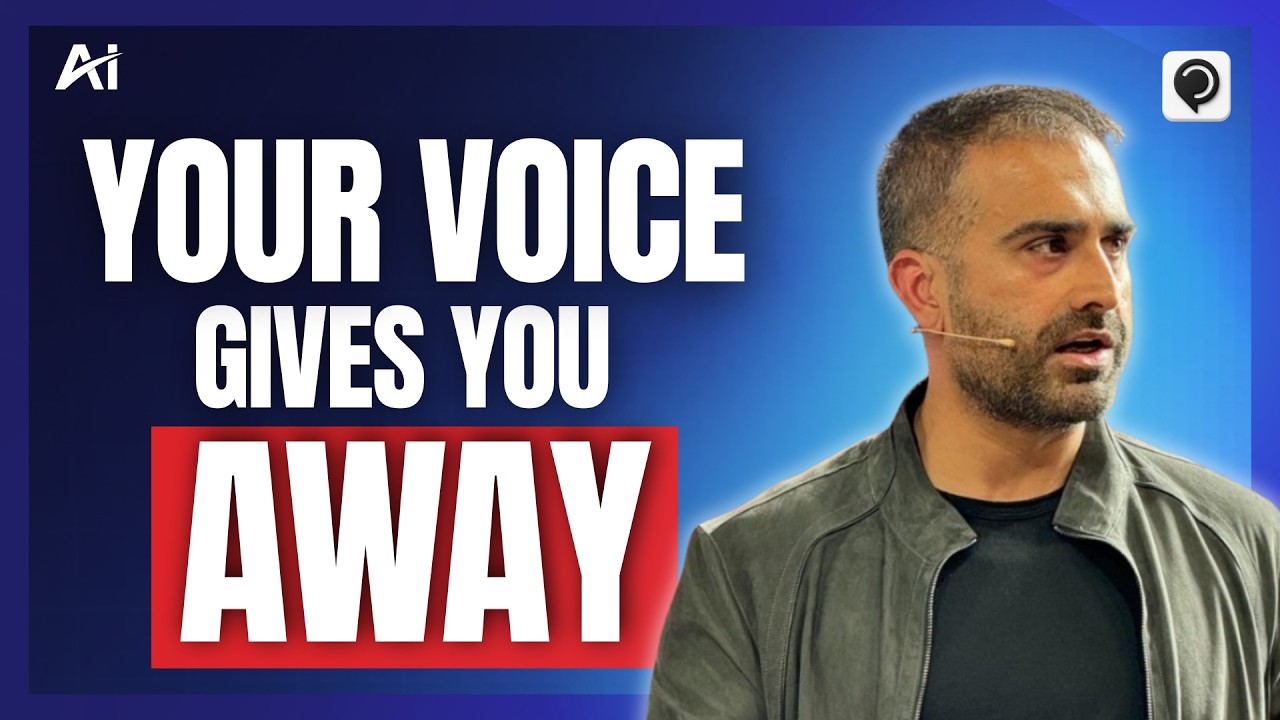

Watch on YouTube · Listen on Spotify or Apple Podcasts
Rana Gujral, former CEO of Behavioral Signals and author of The AI Instinct, says the words in a conversation are the least interesting part: intent, trust and stress live in how something is said. He tells host Liam Lawson how voice AI maps 75 to 100 behavioral dimensions, why he leans closer to the EU's ban on emotion AI at work than many in his industry, and why he thinks AI is missing an axis he calls Artificial General Experience.
Key takeaways
- Voice is a behavioral signal, not a language signal. Behavioral Signals bet that the paralinguistic layer, the how rather than the what, tells you whether a customer is about to churn or whether a caller is who they claim to be. (00:39)
- 75 to 100 dimensions, none directly observable. The system works in a probability space across emotion, behavior and cognitive state, inferring hidden states from changes such as trembles, cadence and micro pauses. (03:30)
- Behavioral mapping as a deepfake defense. Synthetic voices can now fool a mother into thinking her daughter is calling. Rana argues behavior over time is much harder to replicate than surface biometrics. (00:39)
- Matching callers to compatible agents. Every person's conversational signature is unique, and matching call center customers to agents with compatible signatures has a "massive impact on the KPIs". (08:14)
- Suppressed stress sounds flat, not loud. Under masked stress the larynx tightens and pitch range narrows while energy stays high. High energy plus flat pitch is the signature of someone holding it together. (22:12)
- Who benefits decides the ethics. Rana's rule: be very careful if the person measured is not the main beneficiary, and if they cannot say no without consequence, do not do it. (26:21)
- The AI access gap is geopolitical. Rana argues a two-year head start on frontier models becomes a generational gap, because each discovery builds the next better tool. (56:49)
What can voice AI detect that words miss?
Rana Gujral says voice AI can read intent, emotion, hesitation, trust and perception, none of which appear in a transcript. When you call your mother and she says she is fine, you know within half a second whether she is, because you are reading pauses, pitch and breathing, not the dictionary meaning of the word.
Behavioral Signals models that layer across roughly 75 to 100 dimensions. Rana describes three stacked layers: basic emotions such as anger, joy and fear; dimensional axes such as arousal and valence; and a behavioral and cognitive layer covering intent, trust, stress, deception and engagement. None of it is measured directly. The system infers the most likely internal state from observable changes in the voice, and because a single moment can mislead, it looks at the trajectory across a conversation.
He adds that voice carries a surprising amount of physiological information, including heart rate variability, respiration and muscle tension, which makes it a non-invasive sensor that works over a phone line or Zoom.
How does Behavioral Signals measure conversational compatibility?
Rana Gujral says compatibility shows up as entrainment: two speakers whose pitch contours mirror, speaking rates converge and energy rises and falls together. Incompatible pairs show asymmetric turn-taking, with one person consistently slower to respond and interruptions going mostly one way.
Behavioral Signals turned this into a call center product. It extracts each caller's behavioral signature in real time and routes them to an agent whose signature is compatible for the KPI that matters in that setting. Rana says the match works regardless of topic, or even whether the two people like each other.
What are the most common unconscious vocal tells?
Rana Gujral points to two. The first is the hesitation signature: a slight rise in pitch before a pause, a small intake of breath and a softer start to the next word. He says people do it when deciding whether to tell the truth or the polished version, and executives do it when asked something they did not prepare for.
The second is pitch compression. People expect stress to sound loud, but suppressed stress tightens the laryngeal muscles and narrows the range of pitch, so the voice sounds steady and almost rehearsed while volume and pace stay up. The mismatch between high energy and flat pitch is the giveaway.
How did studying voice change the way Rana Gujral talks?
Rana Gujral says eight years of studying voice made him slow down, because he learned that a fast reply often signals you were formulating rather than listening. Listening back to his own calls, he noticed his pitch climbed and his phrases shortened when he was nervous, and he now manages those tells by breathing lower and letting sentences finish. He compares reading rooms on this "second channel" to being a sommelier at a dinner party: the upside is empathy, the downside is that he is a more deliberate version of himself than he was in 2018.
Why did the EU ban emotion AI in the workplace?
Rana Gujral says the EU AI Act's Article 5 drew a line around workplaces and schools because they are coercive environments, where people cannot really consent when the boss is asking. He calls that the right instinct and says that on the workplace he leans closer to the EU than many of his industry peers.
His framework separates modulation from manipulation. Modulation uses what a system knows about your state to support your own goals, such as a coach telling a call center agent that a customer sounds frustrated. Manipulation uses it to bend you towards someone else's goals without your awareness. Same technology, different ethics. He worries most about consumer apps, where every frictionless agree button leads to what he calls "consent drift".
What is Artificial General Experience (AGE)?
Rana Gujral defines Artificial General Experience as the missing axis in AI: a system's relationship to time, consequence and being wrong. He argues the industry is fixated on one question, when AGI arrives, and is measuring the wrong thing.
Large language models, he says, do a narrow slice of what humans do with language, but not the part that remembers being wrong and updates. His proposal is to treat the LLM as one module inside a larger agent, alongside a world model, a memory system that reconsolidates rather than just stores, a valuation layer, an attention controller, a self-model and a verifier that catches hallucinations. In humans, he says, the meaning of an event changes over a lifetime through valence mapping, narrative integration and causal reattribution, and no current model does any of the three.
Where does augmentation end and replacement begin?
Rana Gujral says the line is who is still doing the deciding. Augmentation extends your capacity to choose and replacement removes the choosing. GPS is his example: it helps you get somewhere, but years of use can weaken your spatial reasoning because it removes the practice.
His tests are whether a tool makes you more capable when you are not using it, whether you can step away and still be yourself, and whether you are becoming "more myself" or less. He warns that the market pushes towards replacement because it is stickier and easier to monetize, so augmentation has to be chosen deliberately.
Is AI creating a new kind of inequality?
Rana Gujral says the real story of every technology has been inequality, and AI will follow that pattern unless people are deliberate. He worries that a small group will get AI that genuinely enlarges them while everyone else gets a consumer-grade version that is mostly replacement dressed up as augmentation.
Liam points out that access to frontier models already differs between countries. Rana agrees that the divide is now geopolitical and compounding, and says there is no international framework for what he calls cognitive access, only trade and arms control frameworks.
What is The AI Instinct about?
Rana Gujral says The AI Instinct grew from noticing that he had stopped using AI like a calculator and started using it inside his own thinking. The book asks what using these systems does to us over time, and introduces AGE and hybrid cognition. He wants readers to swap the question "AGI, when?" for a different one: who they are becoming alongside AI. He also wants them to come away with more agency and less awe.
In his words
"We don't make high stakes judgment from text, we make them from voice, from presence" (00:39)
"So my personal rule is simple: if the person being measured isn't the primary beneficiary of the measurement, you should be very, very careful." (26:21)
"I'm trying to figure out what amplifies humans without erasing them." (38:14)
"The market will always push towards replacement because replacement is stickier, more monetizable, more habit forming." (43:17)
"The question is whether we become wise." (1:02:08)
Chapters
00:00 Introduction
00:09 The contrarian bet: voice as a behavioral signal, not a language signal
02:51 Mapping 75 to 100 dimensions of emotion, intent, and cognitive state
06:07 Commercial uses beyond law enforcement: marketing, call centers, fraud detection
10:35 The science of compatibility and conversational entrainment
13:35 Beyond voice: body language, physiology, and why voice is the primary channel
16:42 How 8 years of studying voice changed Rana's own communication
19:32 The unconscious vocal tells everyone gives off
23:40 Pitch compression: the real signature of suppressed stress
23:53 The ethics of emotion AI: EU AI Act, modulation vs manipulation
27:08 Why Rana wrote The AI Instinct
30:04 Artificial General Experience (AGE) and what LLMs are missing
33:59 How lived experience dynamically updates memory and meaning
38:04 Why the goal isn't to build machines that are more human
40:50 Augmentation vs replacement: where the line gets drawn
43:55 Purpose, meaning, and the risk of frictionless cognition
51:23 What we should be teaching the next generation
56:01 The geopolitical inequality of AI access
59:11 What Rana hopes readers take from The AI Instinct
1:02:32 Where to find Rana and the book
About the guest
Rana Gujral is the former CEO of Behavioral Signals, which models emotion, intent and behavior from the human voice and applies it to deepfake detection and call center matching. He is the author of The AI Instinct, with forewords by Kai-Fu Lee and Joscha Bach. Rana on LinkedIn · ranagujral.com
About the host
Liam Lawson is CEO of The AI Report and host of The AI Report Podcast. Meet the team
Full transcript
Edited for readability. Quotes above are word for word from the recording.
Liam Lawson (00:00): Rana, welcome to the podcast.
Rana Gujral (00:04): Thanks, Liam. It's a real pleasure to be here. Thanks for inviting me.
Liam Lawson (00:09): There's a lot I want to discuss today. I want to get into the book that's coming out later this year, but first I want to get into what you've been involved in since at least 2018. Looking at your background and at Behavioral Signals: at the point you joined the team, what was the bet you were placing on voice that the rest of the AI world was missing?
Rana Gujral (00:39): Honestly, when I joined Behavioral Signals, the bet was pretty contrarian for the time. Everyone in AI was obsessed with the words: transcription, NLP, what was being said. The whole industry was pouring resources into making machines understand language as text. Our bet was that words are actually the least interesting part of a conversation. Think about it. When you call your mom and she says, "I'm fine," you know in about half a second whether she's actually fine. You're not parsing the dictionary definition of fine. You're reading the micro pauses, the pitch variation, the throat resonance, the slight jitter in frequency that comes from emotion or breathing. That's where the real signal lives: intent, emotion, hesitation, trust, perception. None of that is in the transcript.
So the wager was that if you can model the paralinguistic layer, the how rather than the what, you unlock a completely different class of decisions. Not what did the customer say, but is this customer about to churn? Not what are the words on this call, but is the person on the other end who they claim to be?
What made it feel like the right bet was that it's closer to how humans work. We don't make high-stakes judgments from text. We make them from voice, from presence, from tiny things we started to call behavioral signatures, which are really hard to fake. The interesting thing is that the bet aged well in ways I didn't fully anticipate back in 2018 or 2019. The deepfake problem we're solving right now, synthetic voices that have gotten good enough to fool a mother into thinking her own daughter is calling: that's exactly the world where behavioral mapping matters most. Surface biometrics get patched, and behavior over time is much harder to replicate. So the short answer is that we bet voice was a behavioral signal, not a language signal, and that turned out to be a relatively durable framing.
Liam Lawson (02:51): I want to dive into this a little more. From what I understand, you've managed to map 75 different dimensions. Is that correct?
Rana Gujral (03:01): Yes, 75 to 100.
Liam Lawson (03:03): 75 to 100. I'm curious about the range of emotions they represent, and the intent, trust and cognitive state you can actually decipher. How do you know what maps to what? And are there internal states that aren't directly observable?
Rana Gujral (03:30): The 75 to 100 range is roughly the dimensional space we operate across: emotion, behavior and cognitive state. It's important to say up front that those aren't 75 cleanly separated buckets. It's more like a probability space. At any given moment, a speaker is some weighted mixture across many of these dimensions. The way I think about it, and this goes back to the affective computing tradition, is that you have a few layers stacked on top of each other.
The bottom layer is the basic emotional categories, the classics: anger, joy, fear, sadness, disgust, surprise and so on, the things Plutchik and Ekman cataloged decades ago. Those map pretty cleanly to vocal signatures: tense voice, elevated pitch, breath patterns, energy contours. Above that you have the dimensional axes: arousal, from calm to excited; valence, from negative to positive; and a third that's something like control or attention. Almost any state you care about can be located somewhere in that space. Then the layer that's the most commercially interesting, and frankly the hardest, is the behavioral and cognitive layer. Think about intent, trust, stress, duress, deception, engagement, hesitation. These aren't really emotions exactly. They're inferences about what someone is about to do, or whether what they're saying lines up with their internal state.
To your question about what's directly observable: none of it is directly observable. That's the key thing. We never measure the emotion itself. What we measure is what the field calls sentic modulation, observable functions of a hidden state. The voice trembles, the cadence shifts, the micro pause lengthens, and we infer backwards from those signals to the most likely internal state. So when I say we detect trust or intent, what I really mean is that we're measuring observations of motor system behavior that correspond, with high probability, to an underlying state. It's always probabilistic, which is why temporal modeling matters so much. A single window can lie. A trajectory across a conversation is much harder to fake, and that's where the real signal lives.
Liam Lawson (06:07): You mentioned the commercial opportunities. When the audience hears something like this, they'll immediately think of police using it as a lie detector in interrogations. Expand their mindset. What other commercial opportunities and customers do you work with?
Rana Gujral (06:29): Law enforcement is the obvious one people jump to, and it's real. Companies like Converus, with EyeDetect+, are being used by US and international agencies for screening officer candidates and for internal investigations. We operate in that space to some extent. We have a very specialized deepfake detection capability that we apply to various private and public sector use cases. As I mentioned, we use behavioral mapping to detect deepfakes, which is a new approach, and also a future-proof one.
The verticals that surprise people are the fun ones. Marketing and media is huge. There are a lot of use cases outside of what we do. Affectiva, which came out of the MIT Media Lab and was then acquired by Smart Eye, has been working with agencies like Kantar and MarketCast to measure emotional engagement in ads and movie trailers. There's a lot of data there. There's a great case study with a major action film franchise, where tracking surprise and engagement moments helped them optimize which clips went into which geographic markets, at what length and in what category, and campaign performance jumped quite significantly. It's not magic. It's just the first time you can measure what an audience actually feels, not what they say on a survey afterwards. Automotive is another one, and education. On the enterprise side, which is where we also play, there are call centers, financial services and fraud detection.
Rana Gujral (08:14): One of the things we ended up doing was building a very specialized solution for the call center, or CCaaS, market. We extract what we call the behavioral signature, tapping into the 75 to 100 attributes I talked about earlier, and put it in a vector file that we call a behavioral profile or conversational signature. We realized these signatures are unique to every person. Your signature is unique to you and mine is unique to me. And because they're unique, there's an aspect of compatibility nobody had thought about. That compatibility plays a direct role in natural rapport and in our ability to have a nice, clicky, flowy conversation. Conversely, if the signatures are incompatible, we're going to struggle to have a good dialogue. That's irrespective of what we're talking about, or even whether we like each other. We could be arguing, but the flow is so good and there's a natural underlying rapport. Or you could be making small talk, but if the signatures are incompatible, you just struggle to talk to each other.
We see this every day. You call a call center, somebody picks up, and you think, no, not you. I'm going to put the phone down and go through the process again and hope I get somebody else. You just know it. What we've built is a solution that avoids that situation. It extracts the signatures in real time behind the scenes, does the matchmaking behind the scenes, and connects you to an agent, on an inbound or outbound call, whose signature is highly compatible with yours for the particular use case or KPI being focused on. The goal is to match you with somebody you'll have a natural, flowy conversation with, and we see a massive impact on the KPIs just by doing that.
Liam Lawson (10:35): Break compatibility down for me more. I was just at a conference in Florida this past week. With some people it naturally feels amazing. We know when to pause and when to speak. There's a natural rapport. With other people, it feels like so much effort. How much of that can we measure? What are the signatures of compatibility? And is there anything there that's unspoken?
Rana Gujral (11:08): Compatibility is one of those things that feels mystical until you start measuring it, and then it turns out to be surprisingly tractable. What we mostly look for is something called entrainment: the degree to which two speakers start to synchronize across multiple channels. Their pitch contours start to mirror, their speaking rates converge, the energy in their voices rises and falls together. Even breath patterns begin to align over the course of a conversation. When two people click, you can literally see it in the signal. The waveforms start to dance together.
The flip side is just as measurable. When two people are incompatible, you see what we call asymmetric turn-taking. One person's latency before responding is consistently longer. Interruptions go in one direction more than the other. The prosodic mirroring just doesn't happen. One person stays flat while the other modulates, or they modulate in opposite directions. It feels effortful because neurologically it is. Your system is working harder to bridge a gap that isn't closing.
Now, your question about the unspoken: this is where it gets interesting. A lot of compatibility lives in micro timing that neither speaker is consciously aware of. The gap between when you stop talking and I start. Whether I take a breath in sync with yours. Whether my backchannel cues, the "mm"s and "yeah"s, land on the beat or off it. None of that is in anyone's conscious control. It's pure System 1, but it's the substrate of what we experience as chemistry. There's even a layer beneath that, something closer to what Clynes called a sentic form: the shape of an emotional gesture in time. When two people are compatible, those shapes tend to be congruent. The arc of your enthusiasm matches the arc of mine. When they're not, the shapes collide. So compatibility is measurable, chemistry is mostly measurable, and the mystery shrinks the closer you look at it, which I find more romantic, not less.
Liam Lawson (13:35): Right now you're measuring voice. But another component is body language, smell, sight, touch, whatever you feel when you're physically present. How much of that is physiological, like heart rate? Is that something you look into, or do you cap it at voice? How much can we do with voice?
Rana Gujral (14:04): Voice is our primary channel, and honestly, you can do more with it than people expect. The human voice carries an extraordinary amount of physiological information. When you speak, you're not just transmitting words. You're transmitting heart rate variability through micro tremors in vocal fold vibration. You're transmitting respiration through phrase length and breath placement. You're transmitting muscle tension through what we call jitter and shimmer in the signal. Stress hormones change the viscosity of the mucus in your vocal tract, which changes the timbre. All of that is in the audio. You just need the models to extract it. So in a real sense, voice is already a multi-physiological sensor. It's a remote proxy for things you'd otherwise need a wearable or a polygraph to measure: heart rate, breathing, autonomic arousal, cognitive load. And we infer all of it from just a microphone.
But to your bigger point, yes, the richer picture comes from fusion. If you add facial microexpressions, posture, gaze and gesture, you get more bandwidth. If you add what affective computing researchers have explored for decades, skin conductance, pulse, pupil dilation, temperature, you get even more. Picard wrote about this back in the nineties: the idea of affective wearables. A jacket that senses posture, a ring that reads your pulse, sneakers that catch the lift in your walk. The vision was that the body is constantly broadcasting, and if you're willing to listen on enough channels, you can build a remarkably accurate picture of the internal state. So we could go there. The technology exists. But voice has a unique advantage: it's non-invasive.
It works over a phone line, over Zoom, through a car speaker. You don't have to wear anything or opt in to a sensor, and that makes it scalable in ways wearables aren't, at least not yet. So we made a deliberate bet: go deep on voice, extract every drop of signal it carries, and treat it as a universal sensor. If the world eventually wears more devices, fusion gets easier. But even alone, voice is far from capped. We're still finding new dimensions in it every year.
Liam Lawson (16:42): People who wear these measurement devices tend to change their behavior as a result. I wear an Oura ring to measure my heart rate variability, and I change my behavior.
Rana Gujral (16:52): Same.
Liam Lawson: You've been studying communication and voice for eight years. How has your own communication and voice changed as a result?
Rana Gujral (17:10): That's a really honest question, and the answer is yes, in ways I didn't expect and don't always love. The first thing that changed is that I became aware of my own latency, the gap between when someone finishes a thought and when I respond. I used to jump in fast, and I valued that. It felt like engagement. But once you start studying turn-taking and see how often a quick response signals that you were formulating, not listening, you can't unsee it. So I've slowed down a bit. I leave more space, sometimes too much, honestly.
The second thing is pitch. Years into this work, I caught myself listening back to recordings of my own calls and noticing that when I got nervous, my pitch would climb and my phrase length would shorten: classic markers of arousal. Once you know your own tells, you start managing them. Not faking, just modulating: breathing lower, letting sentences finish. It's a kind of self-regulation that came directly from staring at other people's signals all day.
The third thing, and the one I'm most ambivalent about, is that I read rooms differently now. When I'm talking with someone, part of me is always listening on the second channel: the jitter, the shimmer, the micro pauses, the lilt and the absence of it. It's like being a sommelier at a dinner party. You can't just enjoy the wine anymore. There's a professional ear that won't switch off. The upside is empathy. I can catch things earlier. When someone says they're fine and they're not, I usually know, and I can decide whether to honor the surface answer or gently go underneath it.
Rana Gujral (19:13): The downside is exactly what you named with the Oura ring. The observer changes the observed. I'm a slightly more deliberate, slightly more performed version of myself than I was in 2018. I hope that's a better version, but it's definitely not an unselfconscious one.
Liam Lawson (19:32): You mentioned the dinner party, and constantly measuring on this second channel. You must have built up a wealth of understanding of how we communicate as humans. What are some of the common unconscious tells? What have you noticed in pitch, tone and timbre that the general public is unaware of?
Rana Gujral (20:08): There are a handful that come up so consistently I almost can't unhear them now. Once you know them, you start noticing them in every conversation, every meeting, every podcast. The first, and probably the most universal, is what I'd call the hesitation signature. It's not just pausing. There's a very specific cluster: a slight rise in pitch right before the pause, a micro intake of breath, and then a softer onset on the next word. People do this when they're deciding whether to tell you the truth or the polished version. The conscious mind hasn't caught up yet, but the vocal tract has already started hedging. You hear it in executives all the time when they're asked something they didn't prepare for. The second one is pitch compression under stress. When someone...
Liam Lawson (21:06): Sorry to interrupt. Can you give me an example?
Rana Gujral (21:17): Sure, let me give you a concrete one. It's the one that still rattles me when I think about it. A mother gets a phone call. The voice on the other end is her daughter, panicked, sobbing, saying she's in trouble and needs money. And the mother hears her daughter, not someone who sounds like her daughter: the cadence, the breathing, the little catch in the voice. That's an example of how it can play out when somebody is trying to fake it, in a deepfake situation. But the models can look at the same cues and detect whether it's real or fake in that scenario.
Liam Lawson (22:03): And the second example you were about to go into was pitch compression?
Rana Gujral (22:12): Yes, pitch compression. Here's what I find genuinely interesting about it. We tend to think of stress as something loud. Someone raises their voice, they get agitated, you can hear it. That's the obvious version. But the version that actually matters, the version that's diagnostic, is the opposite. It's when someone is suppressing. What happens physiologically is that when you're under cognitive or emotional load and trying to mask it, your laryngeal muscles tighten. Not dramatically, just enough. That tightening reduces the range of pitch variation your voice can naturally produce. So instead of the normal melodic contour we all have when we're relaxed, where pitch moves up and down across a sentence in a very fluid way, you get a narrower band. The voice sounds steady, composed, almost rehearsed.
The giveaway is the mismatch, because the energy is still there. The volume is up, the pace is normal, sometimes even a little fast, but the pitch isn't moving the way it should. That's the contradiction. High energy plus flat pitch: that's the signature of someone holding it together.
Liam Lawson (23:40): I'm curious how you approach this on a moral level. In my research, I saw that Article 5 in the EU prohibits AI systems that infer people's emotions in workplaces. But this is being used by the US government and others. Where do you sit on this? If you can infer and understand all these emotions, you can also manipulate. Where is the line for you?
Rana Gujral (24:21): This is the question I sit with the most, honestly. The EU AI Act's Article 5, which you mentioned, drew a line specifically around workplaces and schools, because those are coercive environments. You can't really consent when your boss is the one asking. I actually think that's the right instinct. I might quibble with some of the implementation, but it's in the right direction.
Here's how I think about the line. There's a distinction I keep coming back to in my own writing, between modulation and manipulation. Modulation is when a system uses what it knows about you or your state to support your own goals. Think of a call center coach that whispers to an agent: the customer sounds frustrated, slow down, show empathy. That's a tool for the human in the loop. Manipulation is when the system uses what it knows about your state of mind to bend you towards someone else's goals without your awareness. Same technology, completely different ethical posture.
When we deploy in defense, fraud or crisis negotiation, the consent architecture is explicit. Operators know, and that's non-negotiable. Subjects in many contexts are told. And the output goes to a human decision maker, not directly into a behavioral nudge. Where I sometimes get worried is the consumer side: emotionally aware systems running in the background of social platforms, dating apps, retail and so on. That's where you get what I call consent drift. Every agree button is frictionless. Pretty soon saying yes becomes reflexive rather than deliberative, and the system learns your triggers faster than you learn its methods.
Rana Gujral (26:21): Those are the things I worry about. On the workplace specifically, I lean closer to the EU than a lot of my industry peers. The asymmetry of power matters. An employee can't meaningfully refuse. Even if the tech is accurate and well intentioned, the deployment context corrupts it. So my personal rule is simple: if the person being measured isn't the primary beneficiary of the measurement, you should be very, very careful. And if they can't say no without consequence, you probably shouldn't be doing it at all. The capability is morally neutral. The coupling, who's pointing it at whom and why, is where the ethics actually live.
Liam Lawson (27:08): I want to move on to the book that's coming out in the next couple of months. Can you give us an introduction to why you started writing it in the first place? What prompted you?
Rana Gujral (27:27): Honestly, the book started as a private itch, not a book project. I was deep in building AI systems every day, and at the same time I was reading big-idea books on computation, cognition and the nature of reality. I kept noticing a gap between the conversation happening in the AI world and the conversation I thought we should be having. The AI world was, and still is, obsessed with one question: AGI, when? When does the machine get smart enough? Every panel, every podcast, every research roadmap, same question. I started to feel we were measuring the wrong axis entirely.
What pushed me over the edge was self-observation. I noticed I'd stopped using AI the way I used a calculator. I was using it the way I used my own mind: to draft thoughts, test arguments, frame decisions. It had slipped inside the loop of my own attention and judgment. Once I saw that in myself, I started seeing it everywhere: in how kids were learning, how my team was deciding, how strangers were forming beliefs. The question that hit me was, what does using these systems do to us over time? Not in the instant, over time. Are we building better instincts, or a convincing stream of outputs that feel like thinking without actually being thinking? That's when I realized intelligence isn't the whole story. Experience, the relationship to time, to consequence, to being wrong and updating, is the missing dimension.
Rana Gujral (29:22): That became artificial general experience, AGE for short, which is one of the central ideas in the book. I wrote it because I felt we were sleepwalking into something. Not towards some apocalyptic machine takeover, but towards outsourced judgment and engineered instinct. I wanted to put a stake in the ground for a different framing. Not us versus them, but hybrid minds: intelligence and experience expanding together, deliberately. The book is my attempt to make that fork visible while we still have a choice about which path to take.
Liam Lawson (30:04): It's something I think about a lot. My last two guests were someone from harmonic.fun, a mathematical superintelligence company, and the VP of AI at Prolific, a data collection company. What I'm coming to terms with is that LLMs as we know them are fundamentally prediction machines. They're not grounding anything in truth or in experience. They're just predicting the next token that sounds most viable. So your idea of artificial general experience speaks to me, because it grounds this in something. Break it down for me. What is experience? How do we thread experience into how LLMs exist today, and fuse them together?
Rana Gujral (31:00): You've put your finger on exactly the thing that pushed me to write the book. LLMs are prediction machines. They generate plausible next tokens. What's wild is that this turned out to be a much bigger deal than we expected, because a lot of human language also operates that way. There's a thread in the research, and Barenholtz makes this argument really sharply, that meaning in language doesn't come from pointing at the world. It comes from the internal topology of tokens relating to other tokens. So the model isn't faking what we do. It's doing a version of what we do, just a narrow slice of it. I don't think a lot of people understand that.
The problem is that the slice is the language slice, the narrative cortex. It's not the part of you that remembers what it felt like to be wrong, that flinches before touching a hot stove, that updates its priors because last Tuesday's decision blew up in your face. That's experience, and that's the missing axis. So how do you thread it in? My view is that you stop treating the LLM as the whole mind. You treat it as one module, the language and narrative module, inside a larger agent. Then you add things that give the system a relationship to time and consequence. A world model, so it has a picture of what's actually out there and what's about to happen. A memory system that doesn't just store but reconsolidates: memory as transformation, not storage. The system has to become different after it's wrong. I think that's really important. A valuation layer that maps outcomes to felt weight.
Rana Gujral (33:05): An attention controller. A self-model that tracks the agent across time, so there's ownership and accountability. And a verifier, so when the language module hallucinates, something else catches it. The fusion piece is the part I get most excited about. It's not LLMs versus world models versus humans. It's a hybrid stack where the language layer talks to the experience layer, and over time the agent accumulates judgment, not just outputs. That's the bridge from AGI to AGE. Intelligence gives you raw competence. Experience gives you relevance, perspective and continuity. Until we measure both side by side, we're answering the wrong question, in my opinion.
Liam Lawson (33:59): Let me try to make this very real for the audience. Imagine I go through something bad when I'm 12. It's very upsetting at the time and builds a lot of trauma. Then at 18 or 19, I use that same experience to fuel some ambition. At 28, maybe I've worked through it enough that it takes on a different meaning, and at 45 it becomes something entirely different. My life experience and context are updating that meaning dynamically over time, and that's what's missing from these models: they can't dynamically update their context and memory based on experience. From first principles, how do you define how that context gets updated? For me as a human it just happens. These things take on new meaning, but I don't know how.
Rana Gujral (35:16): You've just described the single hardest problem in this entire space, and better than most of the technical literature does. What you're pointing at isn't memory. It's reconsolidation: memory as transformation. The same event, the same raw data, takes on a completely different meaning at 12, at 19, at 28, at 45. The event didn't change. You did. The meaning the event carries changed because your relationship to it changed. Here's how I think about the mechanism from first principles. There are really three things happening at once in a human that no current model does. The first is valence mapping.
At 12, that event is tagged with a very specific emotional weight: pain, shame, fear, whatever it is. As you accumulate new experiences, your evaluation system, the thing that decides how much something hurts or how much it matters, gets retrained. So the same memory gets rescored against a new baseline. At 19, with ambition layered on top, that pain becomes fuel, because the evaluation function has shifted. The second is narrative integration. You have a self-model, a running story of who you are across time, and every new chapter forces a rewrite of the earlier ones. The 28-year-old isn't just remembering the 12-year-old. The 28-year-old is authoring a version of the 12-year-old that fits the arc. That's not distortion. That's how continuity works.
Rana Gujral (37:08): The third, and I think the most underrated, is causal reattribution. At 12, you thought the event happened to you. At 45, you understand the chain of causes around it. It's the same data point, now embedded in a much richer world model, so its meaning shifts because its position in the causal graph shifts. Put it together, and what's missing in current systems is all three. The models store; they don't reconsolidate. They have weights, not a self. They don't have a valuation layer that drifts with lived consequence. That's exactly why I keep saying intelligence isn't enough. You need a system that becomes different after it's wrong. That's the experience axis, and that's what we're missing.
Liam Lawson (38:04): What's the goal here? Are we trying to model these machines after humans? Is that the end product?
Rana Gujral (38:14): No. I think that's actually the trap a lot of the field falls into. If the goal is to build a synthetic human, we've already failed, because we'll spend decades trying to replicate something biology already does beautifully, cheaply and at scale. There are 8 billion humans. We don't need synthetic ones. The goal, at least the way I frame it, is to build something that's genuinely a third thing: not human, not machine, but a fused intelligence that behaves like its own category. The human brings what the human is uniquely good at: value grounding, emotional relevance, causal intuition, embodiment, the lived sense of stakes. The machine brings what it's uniquely good at: scale, memory, simulation, pattern extraction across spaces no individual could ever hold in their head.
When you lock those together into a continuous cognitive loop, where perception, inference and intention move freely across the organic and artificial layers, you get an emergent decision-making agent that neither side could be alone. So I'm not trying to model machines after humans. I'm trying to figure out what amplifies humans without erasing them. That's a very different design problem.
Here's the part I keep coming back to. There's a long tradition, going back to philosophers like Andy Clark, of pointing out that human cognition has always been hybrid. Language is a tool. Writing is a tool. A notebook is part of our memory processes. Culture is a cognitive process. We've already extended ourselves through the technical world. What's happening now just makes that boundary more literal, more dynamic, more real time.
Rana Gujral (40:12): The risk isn't that we build machines that are too human. The risk is that we redesign the human experience too aggressively in pursuit of comfort or efficiency, and accidentally strip out the friction and depth that made human cognition worth amplifying in the first place. So replication isn't the goal. The goal is continuation. The question I keep asking is, what do we want to become? The answer to that should drive the engineering, not the other way around.
Liam Lawson (40:50): What do we want to become? Maybe I'm just pessimistic and cynical, but my brain goes to this: we build something that takes the best parts of humans and the best parts of machines, and then we become second tier, because we've built something functionally better than us.
Rana Gujral (41:15): The way I draw that line is by asking who's still doing the deciding at the end. Augmentation extends your capacity to choose. Replacement removes the choosing. Those sound similar, but they diverge fast in practice. Take a tool like GPS. On the surface, it's pure augmentation. It helps you get somewhere. But if you use it every day for 10 years, something happens to your spatial reasoning. You stop building cognitive maps. You stop noticing landmarks. The tool didn't replace your navigation, but your navigation atrophied because the tool removed the practice. So the honest framing isn't augmentation versus replacement as a binary. It's a slope, and what slides you down the slope is the loss of practice.
That's the test I use. Does the system make me more capable when I'm using it, and also when I'm not? Or does it only work when I'm plugged in? A calculator made us all faster at arithmetic, but most adults can't do long division in their head anymore. We traded capacity for convenience. Was that worth it? For arithmetic, probably. But the same trade for judgment, for moral reasoning, for emotional attunement to another person, is a much scarier exchange, and I think that's what's happening right now.
The other piece I think about is reversibility. Augmentation should be something you can step away from and still be yourself. Replacement is when stepping away leaves a hole. When the process becomes load-bearing for your identity or your competence, you've crossed the line, and you may not even notice when it happened. So in the hybrid cognition framing I work in, the goal is coupling that enlarges agency rather than absorbing it. The system holds information for you, but you still build meaning. It offers options, but you still own the weighing. It catches your blind spots, but it doesn't choose your values.
Rana Gujral (43:17): Here's the uncomfortable part. This isn't really just an engineering question. It's a discipline question. The market will always push towards replacement, because replacement is stickier, more monetizable, more habit forming. Augmentation requires the user to keep showing up as a participant. That's the version worth fighting for, but it doesn't build itself. You have to choose to build it.
Liam Lawson (43:55): Let me try to thread a few ideas together. You said humans need to do hard things: we need purpose and meaning, and to get them we need to do difficult things. I'm finding it hard to see where augmentation starts and finishes in relation to that. There are global studies of happiness during World War II versus now, and people were happier on those scales during the war and in the fifties and sixties, when life was more difficult, because they had purpose and meaning. I think mental health is probably at its worst ever, because life has been easier than ever. The second place my brain goes is Neuralink. A common idea is learning a new language: you put a chip in your brain and suddenly you know Spanish. I learned Spanish at a Spanish school in Guatemala. I spent months learning and speaking it, and that built my self-esteem, purpose and meaning over time. If I just put a chip in my brain and suddenly knew Spanish, it wouldn't fundamentally contribute to who I am. So I don't know where augmentation is right and where it's wrong.
[The connection dropped briefly here, and Liam repeated the question.]
Rana Gujral (47:53): Let me push this into a place we haven't gone yet. We've talked about cognition and we've talked about emotion, but there's a third dimension that I think is where this question gets decided in the next decade, and that's the spiritual, or identity, layer. For most of human history, the mind carried an aura of mystery. The idea of a soul lived in our capacity to choose, to wrestle with meaning, to console another human being. That was sacred ground. Hybrid systems are now stepping onto that ground. They reason with us. They console us, sometimes, honestly, more effectively than the humans around us can in a given moment. That's where the augmentation and replacement question stops being technical and becomes existential. Here's the line I draw on that layer: augmentation deepens your relationship to meaning, and replacement outsources it. Those are not the same thing, even when the output looks identical.
Let me give you a concrete example from my own life. A few weeks ago I was wrestling with a problem, and I used an AI as a sounding board, back and forth, real dialogue. At some point the model offered an angle I hadn't considered, and something clicked. A lock turned, a door opened. Here's the important part: it didn't solve the problem. I had the epiphany. But the collaboration created the conditions for me to see something I couldn't see alone. That's augmentation. My interior life just got bigger.
Rana Gujral (49:46): The replacement version of the same interaction is when you stop having epiphanies and start collecting answers. When you stop asking "what do I think?" and start asking "what should I think?" The mechanics look the same. The trajectory of the self is entirely opposite. So the way I test it now, beyond agency and practice, is this: am I becoming more myself through this coupling, or less? Am I more recognizable to the people who love me, or less? If hybrid cognition is going to mean anything good, it has to leave more of you in the room, not less. The goal was never frictionless. The goal was to be more fully human inside a wider landscape.
And the bigger point is that the coupling is already happening. It started back in the day with notebooks, then calculators, and now LLMs. We're using them for everything from small, mundane things like crafting a response to more complex things like thinking. I have to solve a problem: can I just think in silence, or do I need to interact with an LLM? It's about being a bit more perceptive and aware of the direction we're going in.
Liam Lawson (51:23): I love the way you phrase that: is this making me more myself or taking me further away? And with your loved ones, are you showing up as more yourself or less? I think about this a lot. I don't think many people in modern society know who they are, or are very in touch with who they are as individuals. Any step towards people knowing who they are, what they want, what their purpose and morality are and how they feel about things is a step in the right direction. And I see what you mean by augmentation now. Sorry to bring it back to Spanish, but one kind of chip would just make me know Spanish. Another could let me ask questions in real time while I'm learning: why does this mean this? Why does this mean that? And I'd arrive at the epiphany faster through that augmentation. I still own the epiphany. I'm still exercising that reasoning ability.
Last week I was at SHRM 2026, the biggest human resources convention, down in Florida, and a big part of the conversation was education: what do we teach the next generation? Are you arriving at the same conclusion, that we should be teaching rationality and reasoning? What's the most important skill or attribute to hone going forward?
Rana Gujral (53:09): Those are important things. Let me come at this one more time from an angle we haven't touched yet, which is the societal layer. I've talked about the individual line, the emotional line and the meaning line. But there's a collective version of this question that I think matters more, and almost nobody is asking it. When we debate augmentation versus replacement, we tend to picture one person and one system, a user and a tool. But the real story of every technology in human history has not been existential failure. It's been inequality. That's the pattern, and hybrid cognition is going to follow it unless we get deliberate.
So the societal line I want to draw is this. Augmentation is when the cognitive extension is broadly accessible and lifts the floor. Replacement is when access concentrates and the gap between the enhanced and the unenhanced becomes the defining fracture of the century. That's not a metaphor. If only a narrow slice of people get access to genuine cognitive partnership, real augmentation, while everyone else gets a thinner, consumer-grade version that nudges them and harvests their attention, you don't have a society with AI in it. You have two different species of human experience living side by side.
Rana Gujral (54:52): I'll be blunt. The consumer-grade version is mostly replacement dressed up as augmentation. It answers for you, decides for you, optimizes you. The premium version, the one a small group of people will buy or build, is the one that actually enlarges the person using it. That's the inequality I worry about. Not the robots, but the asymmetry of who gets to become more capable. So I now think about the line as a design responsibility, not just a personal one. If you're building these systems, the question isn't only whether this augments the individual. It's whether it augments a person in a way that's distributable, and whether it works at scale without collapsing into the manipulation we talked about earlier. Personal discipline matters, but the architectural choices we're making right now will decide whether augmentation is a human inheritance or a luxury good. I think that's a real line.
Liam Lawson (56:01): It already exists. As of when we're recording, the 22nd of June, Mythos, which Anthropic had released, was supposed to be available to the general public and moving to token-based pricing today. Right now, only parts of the US government can use it. They've outlawed it in other countries. The UK asked for a carve-out and they said no. So this inequality is already happening, not in the way people think, between the elites and everyone else within one country, but between nations. It exists right now.
Rana Gujral (56:49): You're absolutely right, and I think this is one of the most under-discussed dimensions of the whole AI conversation. The inequality story we keep telling is a domestic one: rich versus poor inside a country. But the actual frontier of the divide right now is geopolitical. Which passport you hold determines which cognitive tools you have access to. What makes this version of inequality particularly hard is that it compounds. If one nation's research community, defense apparatus, medical system and legal infrastructure all get to work with a frontier model two years before another nation does, that's not a two-year gap. It's a generational gap in capability, because everything downstream accelerates. The discoveries made with the better tool become the foundation for the next better tool. The countries on the wrong side of the carve-out aren't just behind. They're being lapped, and the gap widens with every cycle.
The other piece I'd add is that export controls and national security carve-outs are being framed as safety measures, and some of them are genuinely safety measures. I'm not naive about that. There are legitimate concerns about who's holding what capability. But safety language is also doing real work as economic strategy. In practice, the line between "we're protecting the world" and "we're protecting our advantage" is very blurry, and the countries on the receiving end read that blur just fine. What concerns me most is that we don't have any meaningful international framework for this. We have trade frameworks and arms control frameworks, but we don't really have a cognitive access framework. Without one, the default is that the most powerful nations decide who gets to think with what tools. That's a kind of soft sovereignty over other people's minds that I don't think we've fully grappled with yet. So yes, definitely a big question.
Liam Lawson (59:11): I want to bring things back to the book to finish. When you're writing, you go through a long process of editing, getting the right information in, asking the right questions. What difference do you want to make between the reader who starts the book and the one who finishes it? How should they change? What difference are you hoping to make in their mindset?
Rana Gujral (59:53): The honest answer is that I'm not trying to convert anyone to a position. I'm trying to change the question they walk around with. When most people pick up a book on AI right now, they're carrying one question: AGI, when? When does the machine catch up, surpass us, replace us? That's the frame, and I think it's quietly making us passive. We're sitting in the audience waiting for the curtain to rise on some future event. What I want is for the reader to close the book carrying a completely different question. Not when does AI arrive, but who am I becoming alongside it? That's the shift from spectator to participant, from prediction to responsibility.
If I do my job, three things change. First, they stop thinking of AI as a thing outside them and start noticing the ways it's already inside the loops of attention and judgment. That awareness alone is powerful. You can't be deliberate about something you can't see. Second, they get a vocabulary they didn't have before: AGE, hybrid cognition, the experience axis. Not because the labels matter, but because once you can name something, you can argue with it, resist it, design for it. Right now most people don't have language for what's happening to them, so they default to the language the industry hands them. I want them to leave with their own.
The third, and the one I care about most, is that I want them to feel a little more agency and a little less awe. The technology is extraordinary, obviously, but it's not destiny. It's a set of choices being made by people, including the reader: how they parent, how they lead, how they learn, how they vote, how they build. Those choices are the actual road ahead. So the change I'm hoping for isn't a position shift.
Rana Gujral (1:02:08): It's a posture shift, from watching the future to building it. The question isn't whether AI becomes intelligent. It already is. We know the answer. The question is whether we become wise. If the reader closes the book feeling that wisdom is their job, not the machine's, I've done what I came to do.
Liam Lawson (1:02:32): I think there's no better place to finish than that. Rana, two things. First, thank you for your time. I've loved this conversation. Second, if people want to find out more about you, what you do and the book, where should they go?
Rana Gujral (1:02:53): Thank you. I really enjoyed the conversation as well. The fastest and best place is my website. It's my first and last name dot com, ranagujral.com, and there's more detail about the book and the ideas in it there. Or you can go directly to ranagujral.com/book. The book is called The AI Instinct. I actually have a sample copy here. You can find out what people are saying about the book and the ideas in it. I was very fortunate to have people like Kai-Fu Lee and Joscha Bach support it and write forewords explaining why these ideas matter, and you can read those forewords on the website too. So just go to ranagujral.com or ranagujral.com/book, or Google the book, The AI Instinct. I would also very much welcome engagement. If you're working on an interesting project, have an interesting idea or want to talk to me about something, reach out. Emails from the website come directly to me, and I would love to talk.
Liam Lawson (1:04:17): Rana, thank you so much.
Rana Gujral (1:04:19): Thank you.
Get the five-minute AI briefing
Join 400,000+ business leaders who start their weekday with The AI Report. Subscribe free
