

400,000+ business leaders (and teams at IBM, AWS & Zapier) start their day with The AI Report. 5 minutes. Plain English. No hype.
Vinay Gidwaney & Mike Sullivan, OneDigital: AI as Talent
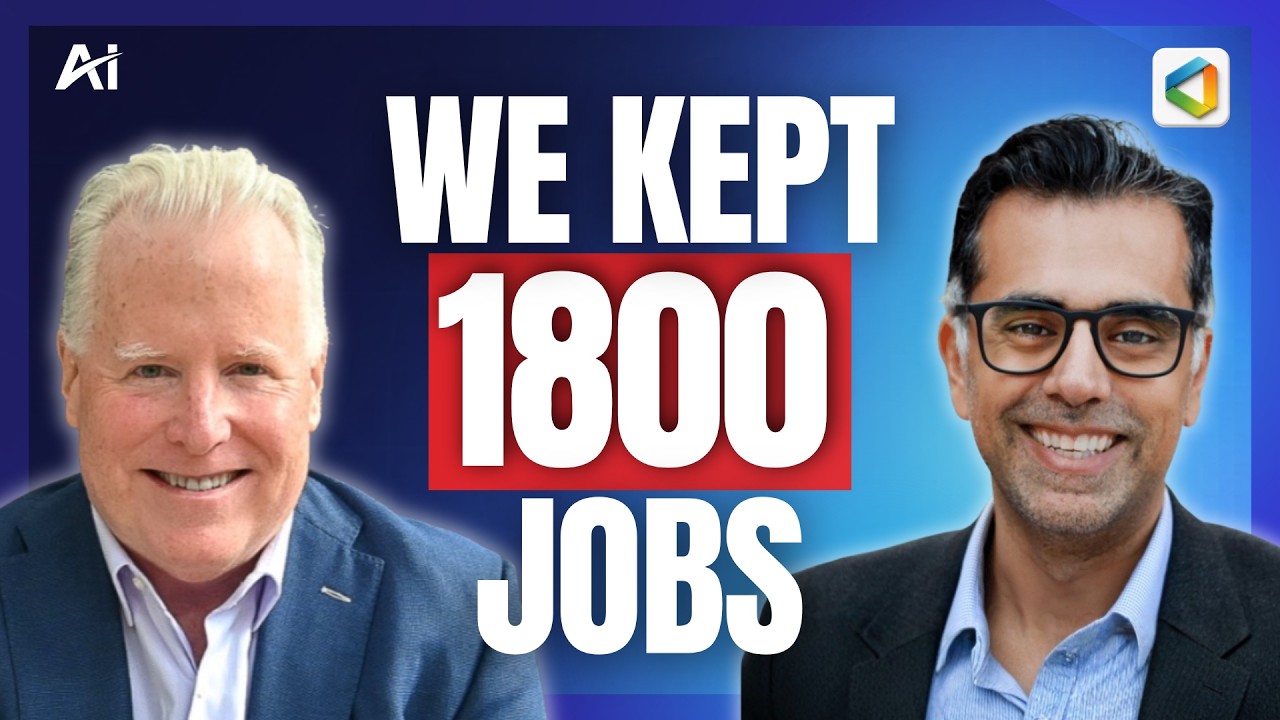
OneDigital's Vinay Gidwaney and Mike Sullivan explain why they hire AI like talent after an AI model showed 1,800 of their 6,000 jobs were at risk.

Watch on YouTube · Listen on Spotify or Apple Podcasts
Vinay Gidwaney, Chief Product Officer, and Mike Sullivan, Co-Founder and Chief Growth Officer of OneDigital, argue that AI transformation is about talent and leadership, not technology. They tell host Liam Lawson how a model Mike built overnight showed 1,800 of OneDigital's 6,000 jobs at risk, and why the company chose to hire AI coworkers like employees and amplify its people instead of cutting them.
Key takeaways
- Treat AI as talent, not technology. Vinay says rolling out AI like a CRM is bound to fail, because it is a general-purpose technology. OneDigital thinks in terms of human talent and AI talent. (02:44)
- Augmenting thinking beat automating tasks. An early attempt to have AI fill out 500-line RFP spreadsheets struggled. Helping people think problems through delivered far more value. (07:19)
- Manager usage doubles team usage. When a OneDigital manager actively uses AI coworkers, their team's usage doubles, regardless of team size or type. (11:45)
- A disruption calculator showed 1,800 jobs at risk. Mike built it overnight in Claude and Replit from 14 outside data points. It showed OneDigital would need to cut a third of its 6,000 people if it did not change. (18:10)
- AI coworkers go through a hiring pipeline. Each starts with a job description, moves from intern to apprentice to full-time under a human supervisor, and can be put on a performance improvement plan. (24:02)
- 1,600 consultants use Ben every day. Ben, an AI coworker trained by one of OneDigital's top client managers, has handled hundreds of thousands of conversations in about 18 months. (27:39)
- Own your intelligence layer. OneDigital stays LLM-agnostic and keeps its intelligence layer separate from any one model or harness, because metering and access can change overnight. (31:30)
Why does OneDigital treat AI as talent, not technology?
Vinay Gidwaney says AI has to be thought of as talent because it is a general-purpose technology, so approaching it like a CRM adoption will fail. OneDigital is not trying to compete on chips or models, where trillions of dollars are already being spent. What matters to the company is what it does with AI, and the closest analogy it found was hiring.
Mike Sullivan explains why the stakes are high for OneDigital. It is a 6,000-person advice business that has thrived on knowing more than its clients, and that asymmetry of information is going away. The company has spent two and a half years reshaping what its people do, and Mike estimates AI adoption inside the company at 80% to 90%.
Why did automating tasks fail where augmenting thinking worked?
Vinay Gidwaney says OneDigital's early focus on automation did not work. Its test case was RFPs: clients and prospects send 500-line spreadsheets, and the team tried to have AI answer them. It was hard to get the answers really good with the models of the time.
What worked better was helping people with cognitive tasks: moving from "do this for me" to "help me think this through better". Mike adds that the company started with a "10x group" of top performers after reading Ethan Mollick's book Co-Intelligence, and recommends pairing a technology leader with a non-technology leader to drive adoption.
How do leaders drive AI adoption?
Vinay Gidwaney says AI is a very personal technology, so no leader can drive AI transformation without transforming themselves first. OneDigital's data shows that when a manager actively uses AI coworkers, their team's usage doubles. Vinay tells staff that the value is not the answer AI gives but the thinking it causes, and that their lived experience is what makes the collaboration valuable.
Mike Sullivan describes being "the hammer". About two months before the recording, he began scheduling calls with senior leaders who had not yet had their own breakthrough moment, sharing his screen and showing them new ways of thinking about their business. He says the change now cascades from the C-suite down.
What did OneDigital's disruption calculator show?
Mike Sullivan says his disruption calculator showed OneDigital would need to eliminate 1,800 of its 6,000 jobs if it did not change what it does. He built it between 8 p.m. and 6 a.m., starting in Claude and then building software in Replit, using 14 data points on AI and employment from firms including the World Economic Forum and McKinsey. The result put OneDigital in the riskiest quadrant.
He sent it to Vinay the next day with a clear message: this is not happening to us. He also notes that investors were once shown a plan to grow from a $1.6 billion company with 6,000 people to a $3 billion company with 10,000 to 12,000 people, and says that staffing path "is not going to happen" now.
How does OneDigital hire AI coworkers?
Vinay Gidwaney says OneDigital hires AI the way it hires people, run by an internal staffing team with recruiters and onboarders. Every coworker starts with a job description, written exactly like one for a job board. A general-purpose coworker called Ace is cloned and given that description, then moves through three stages.
As an intern it is tested against criteria. As an apprentice it gets best practices, guardrails and a personality, plus a human supervisor, usually the subject matter expert the company most wishes it could clone. Once it meets all the criteria it is hired into full-time availability. Coworkers whose quality slips go on a performance improvement plan and back through apprenticeship. OneDigital separates AI into three categories: coworkers that help people think, builders that produce assets, and agents that carry out tasks. It started with coworkers and is only beginning on agents, the reverse of most companies.
What is Ben, OneDigital's AI coworker?
Mike Sullivan says Ben is an AI coworker that 1,600 benefits consultants interact with every day. One of OneDigital's most talented client managers left her role to become Ben's full-time manager, so that what was in her head could get into Ben's. About 18 months in, Ben has had hundreds of thousands of conversations, and Mike says that if you are not talking to Ben before you talk to your client, you are not doing your job.
How is OneDigital's AI stack built?
Vinay Gidwaney says OneDigital separates the LLM layer, the intelligence layer and the harness layer. It is LLM-agnostic, routing work to whichever model fits the task and cost. The intelligence layer, made of playbooks, skills and system prompts, mostly RAG-based, is kept separate so it is not tied to any one model or harness. One harness is Cassidy, a chatbot platform from a partner, but coworkers such as Ben also power internal applications, including an analytics tool for reducing healthcare costs.
What is the risk of metered AI?
Vinay Gidwaney says recent metering and access shocks turned AI cost into a risk and ownership issue. Companies are integrating systems they do not control, and someone else can limit how much intelligence they get. He describes doing work with a newly released model that he could no longer do once access was withdrawn.
The real question, he says, is where the intelligence of your company is going to live. His warning for companies that cut staff: "You got rid of all the smart people in your company, and now all the smart intelligence is being rented back to you". Mike says OneDigital plans to measure "workforce intelligence", the combined intelligence of humans and digital talent, against token spend.
How should companies measure AI success?
Vinay Gidwaney says what you measure shapes behavior: count tokens and people burn tokens, count hours saved and people cut corners. OneDigital built its program around two promises, the gift of time and better insights. Its people say burnout and lack of time with clients are their biggest problems, so the company measures what people do with the time they get back, such as spending more time with clients and delivering better insights.
Which skills should humans keep?
Vinay Gidwaney says leaders should split the work in each work center into irreducible skills, which cannot be broken into steps, and reducible skills, which can. That shows what AI should do and what people should do. But the line keeps moving: he cites a recent claim from the CEO of Lemonade that its AI claims agents delivered more empathy than its human staff.
Mike Sullivan adds that some jobs, such as preparing spreadsheets for a lead consultant, will change, and that OneDigital has to get much better at reskilling and redeploying people. Vinay argues it makes no sense to let go of a committed employee whose brain you could train for higher-level work.
What does "see the faces" mean for OneDigital?
Mike Sullivan says HR sees faces while finance may see headcount, so the C-suite has to set the tone. OneDigital calls its standard the humanity test. He argues that if AI drives employment down dramatically, there will be no one left to buy the products, and that companies should innovate rather than extract. He wants tens of thousands of employers to take a pro-people approach.
What is the book Workforce Intelligence about?
Vinay Gidwaney says Workforce Intelligence, released August 25, is both a playbook and a call to action for HR leaders. OneDigital serves 100,000 employers, many of them small businesses, and the book shares the company's actual job descriptions and hiring process for AI coworkers. Vinay argues that HR, not technologists, should lead companies through AI transformation, because HR cares about people.
In their words
"So if you approach your AI implementation like you're approaching your CRM adoption, it's going to fail." Vinay Gidwaney (02:44)
"We see faces, not headcount. It's not about margin." Mike Sullivan (18:10)
"Why would you get rid of a brain that you already have that's committed to your organization" Vinay Gidwaney (54:45)
"You got rid of all the smart people in your company, and now all the smart intelligence is being rented back to you" Vinay Gidwaney (1:11:10)
"I don't want to live in a world where AI is more important than my neighbor." Mike Sullivan (1:14:20)
Chapters
00:00 Introduction
00:41 The thesis: AI transformation is about talent and leadership, not technology
02:44 Why treating AI adoption like a CRM rollout fails
04:29 Pitching VCs a "Workday for AI agents," and why it flopped
07:19 Why automating tasks failed, and augmenting human thinking won
11:20 The stat that changed everything: manager AI usage doubles team usage
15:04 Mike's personal epiphany and the "Claude" nickname from his family
18:10 Building an overnight "disruption calculator" with Claude and Replit
19:56 The result: a model showing 1,800 of 6,000 jobs at risk if nothing changes
21:11 Coworkers, builders, and agents: OneDigital's three-part AI framework
24:02 The AI hiring pipeline: job descriptions, interns, and apprenticeships
27:39 Meet Ben: the AI coworker now used by 1,600 benefits consultants daily
31:10 What's actually deployed: an LLM-agnostic stack with a separate intelligence layer
35:38 The metering and access risk: the Fable/White House security scare
39:56 Measuring "workforce intelligence": blending human and AI capability
50:07 Irreducible vs. reducible skills, and the Lemonade insurance AI-empathy example
53:38 The reskilling problem, and why human judgment stays irreplaceable
56:30 "Faces vs. headcount" and the company's internal "humanity test"
1:07:08 The origin of their book, Workforce Intelligence (out August 25th)
1:11:10 The risk of "renting back" your own intelligence after cutting your best people
About the guests
Vinay Gidwaney is Chief Product Officer of OneDigital, where his team runs the company's AI coworker program. He previously did neuroscience research, and has worked across software, neuroscience and medicine. Vinay on LinkedIn
Mike Sullivan is Co-Founder and Chief Growth Officer of OneDigital, which he helped start in 2000. He runs a 35-person M&A team. Mike on LinkedIn
OneDigital is a 6,000-person, PE-backed benefits, HR and wealth consultancy serving about 100,000 employers. Vinay and Mike are co-authors of Workforce Intelligence. OneDigital
About the host
Liam Lawson is CEO of The AI Report and host of The AI Report Podcast. Meet the team
Full transcript
Edited for readability. Quotes above are word for word from the recording.
Liam Lawson (00:00): All right, Mike, Vinay: my first time having two people on the podcast at once. We've got a bit of a round table of experts, not including myself, so welcome to the podcast.
Mike Sullivan (00:10): Thank you very much.
Vinay Gidwaney (00:12): Thank you, Liam.
Liam Lawson: I'm excited to jump into today's conversation. Some good framing is the thesis we're talking about. From what I understand, your core argument is that AI transformation is fundamentally about talent and leadership, not so much about technology. Can you expand on that to begin?
Vinay Gidwaney (00:41): Go ahead, Mike. You first.
Mike Sullivan (00:44): We've been a living experiment, Liam, for the past two and a half years in how you deploy AI in your organization. We're 6,000 people in an advice-giving business, which basically means we've thrived on asymmetry of information. We know things our clients don't know, and we can advise them on what to do. That has allowed us to build a company and a revenue stream, and it's been really good for a long time. All of a sudden, the asymmetry of information is going away. AI is going to be able to do things that weren't possible in the past.
So we've come to the realization that we have to harness AI differently than we've ever thought about anything before. We need to get all of our people moving in a different direction. We have to make decisions about what work gets done by AI and what work gets done by humans. And we need to move fast. Vinay and I have been on this journey through the end of 2025 and throughout 2026, basically saying we need to reshape what 6,000 people do and get everybody rowing in the same direction. We're two and a half years deep in this AI journey, and it's been amazing. But it's more recently that we've realized we can do things for our clients we never thought possible. So we're very much focused on amplifying our people, then amplifying our firm, and doing amazing things for our clients. It's been a journey to get here. Vinay, I don't know if you think about it differently.
Vinay Gidwaney (02:44): No, I think that's absolutely correct, Mike. What I'd add, Liam, is that there was a key insight early in our AI journey that has shaped how we think about everything. It was that AI has to be thought of as talent, not technology. A lot of people are in the camp that says it's about chips, data centers and large language models. They live in a very technology-oriented frame of reference around AI.
We're clearly not doing that. Part of the reason is that trillions of dollars, quite literally, are being spent on companies and technology to do amazing things there. We're not going to reinvent or change any of that. What we do with it is what matters most to us. And in that camp, most people start to think about AI as a technology adoption issue. The problem with that framing is that AI isn't like any other technology. It is by definition a general-purpose technology. So if you approach your AI implementation like you're approaching your CRM adoption, it's going to fail, because it's not like adopting a CRM. The closest analogy we could find, the way to think about it in its most expansive opportunity, was to think of it as talent. We have human talent and we have AI talent. If we start from that premise, adoption takes a completely different form.
Liam Lawson (04:29): I want to know how you arrived at that conclusion. When ChatGPT first came out a couple of years ago, everyone was playing with it, thinking maybe we'll give this to our employees. To get on the right path, you have to take a lot of wrong ones. In getting to this mindset of AI as talent, AI as a coworker, what wrong decisions did you make?
Vinay Gidwaney (04:58): That's a good question. It makes me think of a story about when I started thinking about AI that way. I was at a conference at Stanford watching somebody speak. I don't recall who it was. But in the breakouts, I went up to a friend I've known for many years who was thinking about doing a startup, and I said, I have a great idea for a business. We should build the Workday of AI agents, because people are going to need to manage all these agents the same way they manage people. This was two or three years ago, before any of this conversation. He said that was interesting, let's go talk to some VCs. We were at a conference at Stanford, so the whole courtyard was full of VCs I could test the idea on. I've done a lot of VC pitches, so I wasn't nervous about burning a bridge. I went up to a bunch of them and said we should build a Workday for AI agents. Out of maybe seven or eight conversations, all but one said, that's the dumbest thing, don't do that. Go figure out how to get large language models working properly. You're talking about things way beyond that. And one guy said, that's interesting, email me about it. I emailed him, and of course he never responded.
That was the sign for me that maybe I was onto something, because I thought we were talking about AI the wrong way. Now, of course, there are two or three unicorn companies working on a Workday for AI agents. But a few years ago it was relatively novel. So we took that path really early on. We ran a bunch of experiments internally, and one of the things that failed was our initial focus on automation. We looked at everything people were doing.
Vinay Gidwaney (07:19): People were filling out RFPs manually every time. More and more, a client or prospect puts out an RFP and we have to fill out a 500-line spreadsheet. Why do that manually? Obviously AI should just do it: read the question, go into our corpus, fill out the answer, and we're done. What we realized is that it's really hard to replace a human in that. It's really hard to get those answers really, really good, and this was two years ago, with the models back then. What we realized was that there was a lot more value in augmenting human thinking and helping people with cognitive tasks than in automation. So instead of "do this for me," it was "help me think this through better." We found a lot more value in the latter than the former. A lot of people stay in the former and don't realize that the true potential, from what we've seen, is helping people think very differently.
Mike Sullivan (08:33): I'd add, Liam, that about two and a half years ago, Vinay sent me Ethan Mollick's book, Co-Intelligence. He posits that you're looking at anywhere from 20% to 80% productivity gains for your teams. One thing I'd recommend any company do early on is pair up a technology leader with a non-technology leader. Come at it with a dual lens. It can't be about one or the other. It has to be about both, and you have to be able to drive it forward credibly inside the organization. We had 10 or 15 top performers in the company read the book, and we pulled together a 10x group. If we can empower the 10x crowd, people who are generally ten times more effective than the average employee, let's see where we can go. Even with the models from years ago, we began to see huge possibilities to amplify talent. We almost backed into this: get the most talented people first and see how much of their time you can free up to be more effective with clients and prospects.
That was a catalyst for everything that followed. But probably one of the most serendipitous things early on was having a co-founder of the company and a chief product officer attached at the hip in this process. I've learned so much. It was Vinay's job to make sure what we were setting up was set up the right way, and honestly, it was my job to be the hammer in the company: saying we're doing this because we have to, and beating that drum early in the process. Today we probably have 80% to 90% adoption of AI inside the company. We've gotten to the point where we're going to change what we do, not just amplify our people. We're going to amplify the firm. It's exciting, but it has taken a lot of getting buy-in along the way, and more than anything, saying: don't be afraid for your job. We're doing everything possible to make sure you keep your job. But the quid pro quo is that you've got to get moving with us. That's where we're at.
Liam Lawson (11:20): The fundamental concept you've arrived at is that you're not replacing people through automation, because you found that doesn't work. You're teaching people to think on a larger scale and be more effective. When you were first implementing AI, was that what you were pushing, and what pushback did you see?
Vinay Gidwaney (11:45): We started to frame it in pretty simple terms. The interesting thing about AI, and I'll share a stat, is that it's a very personal technology. You can't think about AI adoption and AI transformation without having adopted it and transformed yourself. No leader can. We'll get into how our AI coworkers work, but we found that if a manager in the company, and at 6,000 people we have a lot of people managers, uses AI coworkers actively, their team's usage doubles. It was night and day. It didn't matter whether the team was internal or external, big or small. It always came down to leadership adoption. If the leader had transformed themselves in their own work, it immediately resulted in transformation among their employees. That was a hunch, and now, after a lot of data collection, the data shows it's definitely the case. What we remind people is that the transformation you go through personally is the transformation your team will go through.
The transformation I went through personally, when I started using ChatGPT way back when, was that at first I used it as a transactional vending machine. I'd go in, get what I needed and pop out and continue with my day. Then you start to realize you can collaborate with AI, go back and forth with it. I'm a curious person who got lazy over time, got a life, had a family and responsibilities. I used to be the kid who would go research something just because I was interested in it. Pre-AI, if I was interested in something, I'd think, I wonder how that works, and just let the spark go, because who has the time? Now when I want to know how something works, I'll just ask ChatGPT or Claude or whatever.
Vinay Gidwaney (14:05): Then you start to realize you can collaborate with AI. What I tell people is that it's not the answer AI gives you, it's the thinking it causes within you. It's that collaboration that's the magic. Anybody can get the same answer. Everybody now has access to the same quality of answers. That's a loaded statement, because of different models and closed-door models, but generally everybody has access to the same power of AI. So what's the value you bring to the table? It's your lived experience. It's what you can do with the AI that makes the difference. Getting people to realize they were an essential part of the equation, that this wasn't about them being replaced but about how they collaborate with AI, which truly makes them valuable: that was the key thing we had to keep telling people. And it only came out of your personal experience with it.
Mike Sullivan (15:04): I had that moment, Liam. I'm so deep in it now that my wife and daughter actually call me Claude from time to time when I won't let something go. I'm not wildly excited about that nickname. But I had this moment where I'd always come to Vinay and say, I'm hung up on something, help me get to the next level. Over the past two years, I've been the guy in the company who wants to understand our value proposition and how we talk to clients. When you're a spatial thinker and all of a sudden you have an unlimited ability to reach beyond anywhere you used to go, it's tough to shut it down. We could do this, we could reshape that. Being continually presented with possibilities you've never thought of is absolutely intoxicating, and then you have to decide how to prioritize it all.
Once you activate your team, and I run an M&A team of 35 people, it cascades through the entire organization. But to Vinay's point, about two months ago we took a step back and asked which senior leaders in the company haven't had that "holy smokes, this changes everything" moment yet. I started calling them and setting up calls. I'd say, let me show you what I would do. I'd share my screen, talk about their business, and present new ways of thinking about it. They were using the vending machine: ask a question, get something back, move on, and say it's so much better than Google. And I'd say, no, that's not what we're talking about. That's where I was the hammer. I'd say, you not having that moment yet is no longer an option for us as a company. So we went through the senior leadership team, and I'd say that across the board, everybody is there now. It's cascading from the C-suite down, and that makes all the difference in the world. It's why we're where we are as a company right now.
Liam Lawson (17:26): I'm wondering if you've noticed an acceleration in this. I describe these moments as epiphanies. You're using it, you do something, and you think, that would have taken me $10,000 and three different experts last year, and I've just done it by myself. And it's accelerated for me. Using ChatGPT two years ago, I was okay with it. I've run this newsletter for three years now. In the past six months to a year, what I can do with agents and what I can build has accelerated so much, and so have the moments of amazement. Have you seen the same?
Mike Sullivan (18:10): Vinay chuckles about this, because he knows exactly what I'm going to say. I had this under-the-skin concern about jobs. Where is employment going? We're in a knowledge-based business, and it's going to come knocking on knowledge-based companies first. I was well underway with my core use of Claude, primarily, and then Vinay set me up with a Replit account. Replit builds software. I was most concerned about the conventional wisdom, and I ended up with 14 major data points from the World Economic Forum, McKinsey and others, 14 different firms, on the impact of AI on employment in knowledge-based businesses. I spent from 8 o'clock one evening until 6 o'clock in the morning building this disruption calculator. I started in Claude, spent half the time there, then went to Replit.
Over a cup of coffee in the morning, I had that moment. What materialized was a four-quadrant risk analysis view with OneDigital blinking red in the upper right quadrant, which is not the quadrant you want to be in. It basically said that if you don't change what you do, you should expect to eliminate 1,800 jobs based on the conventional wisdom. 6,000 people cut by a third if we don't evolve what we do. I sent it to Vinay the next day and said, dude, this is not happening to us. We see faces, not headcount. It's not about margin. If it does this now, it's going to do it to our firm later. We need to get moving.
Mike Sullivan (20:20): For me, Liam, that was the moment where, one, a history major can actually build software, which is mind-boggling in and of itself. But it was also the moment of realizing that if I activate my mind, I can impact the path we're on and the way other people think about it. That was probably my most profound moment. I couldn't wait to connect with Vinay in the morning and say, we need to move.
Vinay Gidwaney (20:50): I sometimes joke with Mike that AI for a visionary founder like him is like crack cocaine. He's in there every day.
Mike Sullivan (21:03): I'm pretty sure you used to call it a dopamine fix.
Liam Lawson (21:11): I'm curious about the through line. You get to this realization of what's possible, then you actually deploy agents throughout your company, and somehow you don't reduce your employee count. That seems very counterintuitive to the average viewer. Explain that through line for me.
Vinay Gidwaney (21:37): Great question. Let me explain how we translate the statement "AI is talent" into an agent. What does that actually mean? One of the key insights we had early on was to differentiate between what we think of as coworkers, builders and agents. Right now I think of generative AI in a company in those three categories. Is there a fourth or fifth? We'll see. Coworkers are AI that helps you think. That's different from a builder, which is AI that produces an asset of some kind: a piece of software, a document, a presentation. Then there are agents, which carry out a task on your behalf, autonomously or semi-autonomously. Agents are doing things in the background. Maybe a human is in the loop, maybe not.
We started with coworkers, and we're very far along with them. I'll explain why in a second. We're pretty deep into builders, and we're really just starting on agents. Most companies do that in reverse order. They start with agents, that's where most of them have been and continue to be, and in my opinion that's where the ROI hasn't been as clear. The infrastructure you need for agentic AI, the systems you need to plug agents into, the reliable data and reliable actuators to actually make changes, and where you put the humans in the loop: that's a very difficult problem to solve at scale. And it's only valuable to solve when you have it at scale. There's no point in saying, we have 20 people in this 6,000-person company whose work we can automate. It's just 20 people. Why spend the time? It only makes sense across hundreds of people, and if you're doing anything across hundreds of people, you're dealing with very complex processes. So a lot of companies get mired in agentic AI transformation and stuck in the weeds. We started on the coworker side and asked: how do we treat AI as talent, and how do we give people a better way to think?
Vinay Gidwaney (24:02): How do we give them more insights, a brainstorming partner, the collaboration I was talking about? We basically said, let's treat the AI like we're hiring it. My AI coworker team is really an internal staffing team. We have recruiters, onboarders and a normal HR function behind it. We treat each AI we bring into the organization like we're hiring it, so everything starts with a job description. We write a job description for the AI that looks exactly like one you'd post on a job board. The only difference is that you don't need to look for candidates. You can feed that job description into a model and say, meet the needs of this job description.
We have a vanilla coworker we call Ace. He's general purpose. He knows everything about OneDigital but isn't skilled in any particular area. We clone Ace and feed in the job description, and Ace becomes the intern for a particular area. We have a three-stage hiring process. In the intern stage, we throw prompts at it to see how it performs, and it has to pass certain criteria to graduate beyond intern. Just like any other intern: my wife went to Harvard, so I'll say this, it's like a Harvard Business School grad who thinks they know everything but doesn't really know anything yet. You need to give them some experience. Then we graduate them into an apprenticeship, where we start to build out the coworker's resume. We give it best practices and guardrails, and even a bit of a personality. The most important thing we do at that point is assign a human supervisor. The coworker is ready to contribute to the organization in a meaningful way, but it needs to be supervised by a human being. That supervisor is often the subject matter expert, the person you wish you could clone and put into every client relationship or project.
Vinay Gidwaney (26:22): The coworker is the amplification of that person's skill set. The supervisor role is like a full-time role. They need to manage that coworker in perpetuity, because it takes a lot of effort, but the ROI is certainly there. When the coworker meets all the criteria, it gets hired into full-time availability. We have dozens of coworkers that have gone through that hiring process, and many more in the pipeline. We used to fire a lot of interns. We don't do that as much anymore, because the models have gotten better. We take the analogy even further. In some cases we've put a coworker on a PIP, a performance improvement plan, because we found a degradation in its quality, or it was being asked to do things it didn't quite know how to do. So we pull it into a PIP, put it back in the workshop, tinker some more, put it back into apprenticeship, and promote it back to full-time when it's ready. It's a very HR-centric approach, because it helps us think about AI in a mindset that's not about use cases. It's about the fact that I need talent that's able to do something, I'm going to train that talent, and then it's going to work with other talent and amazing things will come out of it. Taking that generalized approach, we've seen some really great successes.
Mike Sullivan (27:39): Liam, here's a real-world example. A big part of our business is that we're a large employee benefits consultant. In the States, we help employers build the benefit packages their employees are eligible for. We're very creative with our names, so the coworker is named Ben. We took probably one of the most talented client managers we have across the entire country, and she came out of that job and became Ben's full-time manager, because we wanted to start with what's in her head and get it into Ben's head. Today, about 18 months later, 1,600 benefits consultants interact with Ben every single day. Ben is the sum total of all the knowledge and best practices, plus continual weekly and daily updates from Shelly on everything Ben needs to know. So we're moving towards uniformity in our solution set. We don't have to worry about whether Mike remembers what to tell a client. If you're not talking to Ben before you talk to your client, you're not doing your job in today's world.
There have now been hundreds of thousands of conversations with Ben. From a talent standpoint, Ben is a super coworker, an almost unlimited repository of information and best practices on being an employee benefits consultant, amplifying everything our people do. More and more, we're creating capacity so that if I were a benefits consultant, I'd spend much less time preparing for client interactions and much more time in front of clients, engaging at a level I never had before. Our talent is being totally enabled by Ben. We'll continue to roll out coworkers, and pound for pound, they're emerging assets inside our organization: talent personified.
Mike Sullivan (29:48): To Vinay's earlier point, I don't know exactly how we backed into some of these decisions. But leading with coworkers, and having thousands of people around the country say, wow, this is really helping me, as opposed to the agentic side, where people ask what work is being automated: that talent-first approach got everyone acclimated, everyone got better, and it was a great place for us to start.
Liam Lawson (30:29): It's funny you mention preparing for calls, spending less time preparing and more time engaging. I have a Claude Cowork setup. When you booked in for the podcast, an agentic function recognized the calendar event, used Perplexity to prepare a research brief, and pinged me that it was ready. So the preparation for this conversation was done the moment you booked the call, and I can spend more time enjoying and engaging in the conversation rather than doing the eight hours of research it might have taken me three years ago.
Liam Lawson (31:10): What I'm really curious about, now that I understand the concept, is what's actually being deployed in a practical sense. Are you using proprietary models? Are you working with Claude or ChatGPT? Are some of these point solutions, like Paradox? What does it look like?
Vinay Gidwaney (31:30): Great question. We didn't have words for this a year or six months ago. The industry is starting to settle on terms now, so I'll use them, but we were playing with these concepts before they were concepts. We differentiate between the LLM layer, the intelligence layer and the harness layer.
First, we're LLM agnostic. That's just the smartest thing to do, because you need to be able to use whatever model makes sense for the task at hand. You also need to manage token usage and the cost of tokens. The last thing you want is to send everything to Opus 4.8 and pay a boatload for things you don't need. Sometimes you send things to Haiku or Opus, and sometimes to Gemini or ChatGPT or whatever other models are available. So being LLM agnostic is the first thing.
Second is the intelligence layer. We were talking about an intelligence layer before the concept of skills, Claude skills and that kind of externalization of the training, so to speak, became commonplace. Take Ben, whom Mike referred to. Another example is a coworker named Dex. Dex is non-denominational, so they're them. Dex knows a lot about prospecting. Dex can research a prospect and look up all their information on LinkedIn and the web, very similar to how you used Perplexity to prepare for this call. What makes Dex work is a set of training: playbooks, skills, lots of system prompts or MD files that define that intelligence layer. The good thing happening in tech right now is that people are starting to define knowledge structures, with open knowledge formats and other things that help people encapsulate the context and knowledge that goes into this intelligence layer. Most of ours is RAG-based, but we're starting to experiment with different formats to supplement how you pass chunks of information into every prompt.
Vinay Gidwaney (33:55): There's a really thick intelligence layer that defines where these centers of intelligence exist and how we train them, and most importantly, it's externalized. We really believe in owning your own intelligence. The last thing you want is your intelligence layer tied to one LLM. That doesn't make sense. We also don't want it tied to one harness. That doesn't make sense either. You want different ways for your intelligence to show up. One of the harnesses we use is from a great partner of ours called Cassidy. Cassidy AI is a chatbot harness. It wraps any LLM, gives you access to all the knowledge capabilities, and makes it very easy to set up what they call an agent and we call a coworker. You can set up workflows, knowledge bases and so on. So we encapsulate the intelligence layer for Ben, Dex and others in Cassidy.
But we also have other harnesses. We have applications we've built and other ways these coworkers can express themselves. It's not just about chatting with them. In some cases they create artifacts. In other cases they're the thinking engine behind an analytics tool we've built that helps a consultant visualize how to drive down healthcare costs, and Ben does all the thinking. So Ben shows up all over our stack, because it's the common, transferable intelligence layer.
Liam Lawson (35:38): I don't have experience in a company of your size and stature. Something I'm seeing a lot in the news, which we're covering in the newsletter, is that for the first time a lot of companies are cutting their AI usage because intelligence is getting more expensive. There was a story two weeks ago about a company that gave its employees unlimited access to Claude and ran up a bill of 500 million, or was it 250 million, dollars.
Vinay Gidwaney (36:05): Yes. Was it Uber or something?
Mike Sullivan (36:11): That would be a bad day.
Liam Lawson (36:19): How does your team think about this? Deploying AI and agents makes sense right now because the graph of productivity gains has been going up. But we're moving towards a model of metered intelligence, and there's a prospect that it gets more expensive. How does that factor into your calculations when you deploy AI?
Vinay Gidwaney (36:45): It's a few things. Two things have happened in the last couple of months that have made every company step back and think hard about this. One is metering, because we're recognizing this stuff is expensive and you have to think hard before you end up with a runaway token budget. The other is access. Take the whole debacle with Fable a couple of weeks ago, with the White House and it being a security threat. Everybody realized that we're spending a lot of effort integrating these AI systems into our companies, and we don't really control them. Somebody can meter them, turn them down and say you don't have access to as much intelligence right now. It's like a power cut. What if we had a blackout? Now you don't have access to AI. How are you going to run your business?
That's not just an uptime issue. What we're starting to see is that there's no defined approach to metering. There are no rules. And then there's access. As soon as Fable came out, I was doing a lot of things in Fable that weren't possible with Opus 4.8. When Fable was gone, I thought, okay, we can't do that now. What if you'd based your entire company on that? I'm pretty sure some startup set itself up after Fable came out and had to shut down a week later because what it did wasn't possible anymore. Imagine that at the scale of an organization like ours. So this is not just a monetary or economic issue. It's a risk issue and an ownership issue. It's about where the true intelligence of your company is going to live. Pre-AI, we had the structures for that. Where did the intelligence live? In your people. How did you hold on to it? You paid them well, you incentivized them, you gave them a reason to come to work and use their intelligence to maximize value for your clients. We don't really understand how to do that in the world of AI.
Vinay Gidwaney (39:07): We don't fully control everything that happens there, and the levers are very different. They're not the same as paying people. So this conversation about metering and access is opening up a bigger issue that we need to think about as companies and responsible corporate citizens: where is the intelligence in my company going to live? How do I gain better understanding and control of it? How do I balance it between human intelligence and artificial intelligence? And very importantly, how do I make sure it becomes an enabler, not an albatross around my neck? A lot of people are going to head in that first direction, because they don't realize what they're doing.
Mike Sullivan (39:56): I'd add something as the non-technology, non-token person on this call. We brought in new investors last year, and we showed five- and eight-year projections of what the company would look like. I remember a visual that said we'd go from a $1.6 billion top-line revenue company with 6,000 people to a $3 billion company with 10,000 or 12,000 people. That is not going to happen. I think part of the issue in the economy is going to be that job growth, because of what AI does, will be fundamentally different from what we were thinking last September. We're not going to staff the same way going forward. Coworkers are going to change the way work gets done. In a very intellectually profound way for our company, Vinay said there needs to be a way to measure and score the growth of our intelligence: the combined intelligence of humans and digital talent. That's something we need to monitor.
And we need to correlate that to token spend. We believe you can measure your workforce intelligence, which will be a blended workforce, and as long as you keep an eye on how it's growing, it needs to grow in line with what you have to spend on compute. It's early in the game. Vinay, I don't know if you think about it differently, but we're very much of the mindset that, for our business, as long as the spend is something we can understand, manage and predict, those are dollars well spent given the impact on the throughput to the client. But it's going to be a tricky thing we'll have to keep figuring out.
Liam Lawson (42:13): It's the famous Peter Drucker quote: what gets measured gets managed. So many people find it hard to know exactly what to measure. Top-line revenue makes sense. But how do I measure productivity, or employee satisfaction? What don't I know that I'm not measuring that does matter? With all the deployments you've done, is there anything the average onlooker wouldn't suspect as a signal of success that you're measuring?
Vinay Gidwaney (42:51): Great question. Maybe I'll answer it through the way we approached people feeling threatened by AI, because how people approach AI and how effectively they use it reflects how you choose to measure it. If you say we're going to measure AI effectiveness by the number of tokens you use, that becomes the incentive. Then you get the token-maxing trend, where people burn through tons of tokens for the fun of it because that's how they're measured. Obviously that's not productive. If you measure by time saved, saying these are the hours we want to save with AI, you'll get a certain type of behavior out of that too. Maybe people cut corners or just stop doing certain things.
When we attached goals and principles to our AI adoption, we struggled for a while, but eventually we settled on two basic ideas, and whenever I talk about AI internally, I mention them all the time. The first is that our AI initiatives are designed to give you the gift of time. If you survey our people, which we do, and ask what the number one issue affecting their happiness at work is, they'll talk about burnout, about not having enough time in the day to spend with their clients. They got into this business because they wanted to help people, whether it's a small business trying to figure out benefits for its employees or an individual trying to retire the way they envision.
Vinay Gidwaney (44:49): They got into this business to spend time with people, and they're not doing that enough. Or they're doing it during the day and doing all their other work at night and on weekends. So the gift of time wasn't about shaving hours off a process. It was a psychological feeling: I now have agency over my time, so I can pursue why I do this work and do more of it. The second idea is to give you better insights. We're in very dynamic fields: health insurance, property insurance, wealth management. You never want to show up in front of a client not knowing what they're going to ask. They're paying you to know the answers. As Mike said, we're in the information asymmetry business. We're supposed to know more than our clients, and the world is changing really quickly. I don't have enough time in the day to keep up. So my AI can help me gain better insights into what my client needs, connect it to what's happening in the world and give me ideas to focus on.
Focusing on those two concepts, the gift of time and better insights, was how we dealt with "is this going to take my job away?" No. This is about giving you time back in your day and making you smarter. But it's also how we measure. What we look for is what people are doing with the time they have back. Are they spending more time with their clients? Are they delivering better insights? Are they showing clients how to reduce healthcare costs even more because we use data more effectively? Those are the things that actually matter, as opposed to what the AI is doing specifically. It's almost the inverse of what you'd expect to measure.
Mike Sullivan (46:55): We've taken a very pro-human approach. When your job is to help people live their best lives, you think about every aspect of the human side. We've gone to our people and said very directly: we expect you to bring the right attitude, the right energy and the right intelligence to the job every single day, and we're going to do everything possible to amplify you in front of clients. But we need you to adopt this technology and, for all intents and purposes, get better at what you were doing, because you have capacity beyond anything any of us would have imagined several years ago. Again, the quid pro quo is: meet us in the middle. Adopt, explore, engage, and dream about the possibilities for our clients. Help us evolve as a company.
We view it this way, Liam: two years from now, we can't be sitting around saying we do what we do today more efficiently. That is not the game. What Vinay and I, and literally hundreds of other people at OneDigital, are doing is redefining the client experience, amplifying our people and using AI in new and interesting ways, and we're going to blow our clients' minds with what we can do for them. It's not about doing what we do today more efficiently. It's about doing things we never thought we'd be able to do for clients. Rather than looking backwards and explaining what happened, we're getting into a position of signaling to them insights created that day, that hour, because AI is driving that signaling and our business intelligence is getting so much better. The possibilities are remarkable, but it's not about standing still and doing things more efficiently.
Liam Lawson (49:17): From my perspective, what you're both touching on is aligning people more closely with purpose. You're not trying to make people more efficient, or turn them into machines. You're trying to connect your employees more closely to the client experience and to the purpose they're delivering. I can only assume that people who feel purpose in their work, some dedication, some personal connection to what they deliver, will want to do more. They'll be more motivated and face less burnout, because they're not doing a job machines are meant to do. They're doing something innately human. Am I on the right track?
Vinay Gidwaney (50:07): Absolutely. Going back to Mike's comment about workforce intelligence, what we're trying to understand is work centers, not necessarily departments like client service or sales, but the places where work happens in your organization, which usually cuts across departments and divisions. If you draw a circle around where a particular type of work happens, you can analyze the irreducible skills: the things humans are uniquely qualified to do that you can't break down into a process or reduce to a series of steps. Versus the reducible skills: the five things you do, with some variation. When you break the work into those two buckets, you start to see what AI should be doing and what humans should be doing. You also realize that when you give people more time to do the things humans should be doing, they're happier, because they're not doing what a machine should be doing.
The very interesting thing, though, is that you hear all the time that humans are better at building trust and empathy, and machines can't do that. I read an interesting quote from the CEO of a company called Lemonade. Lemonade sells home insurance. They have millions of people who buy insurance right from their phone. It's a really unique model. The CEO commented very recently that they had moved a lot of their claims call center to AI, so when you submit a claim, you talk to AI first. You'd think this is where empathy matters. You've probably had the worst day of your life, you've had a flood in your house, you're distraught. They found that the AI agents delivered a higher level of empathy than the humans they employed.
Vinay Gidwaney (52:35): So the concept that only humans can do empathy and AI can't: I think there are about as many people spilling their guts in a therapy session with ChatGPT as with real people. The point is that the boundary between what's appropriate for humans and what's appropriate for AI is moving. It's a moving blob. I think of it like a yin and yang within the work center that's constantly changing. It's going to be very important for leaders to get a pulse on that, to figure out what people should be doing and what AI should be doing, and to keep evolving it based on the opportunities in front of them. Nobody is having that conversation yet, because they think of AI as a hammer to knock some people and processes down. Instead, it's a very fluid partnership between humans and AI that you need to figure out how to set.
Mike Sullivan (53:38): I'd add, Liam, that we're also not naive. Say you're a first-chair consultant with multiple people on your team, and one person's job is to do the research and put together the spreadsheets and financial illustration for the first-chair consultant to take to the client. There's an issue with that person's job and where that work is going to get done in the future. Part of the issue is that we have not been an organization that fundamentally understood how to reskill and redeploy people into new jobs. One thing we're really going to have to ramp up on is how you take someone who is very detail-oriented and task-oriented, who has done a job for the last five years, and say: that work is going to be done by AI, and you're going to be reskilled into this job over here. There's a lot of work that needs to be done.
Vinay Gidwaney (54:45): I think Mike is touching on one of the most important things leaders need to open their eyes to: the value of somebody's brain, their time and their dedication to your mission is incalculable. I did neuroscience research for a couple of years. We would open up a mouse's brain and look in, and the first time I did that, I thought, holy crap, that's a really small brain that can do a lot. Everything going on there seems like pure black magic. We don't fully understand it. What the brain is capable of coming up with and synthesizing is unlimited. It's infinite.
That's the truly valuable part of your company. The question is how to get the human brains in your company doing what human brains are best equipped to do. If you feel that this person is doing a really menial job today, copying and pasting and preparing spreadsheets, and AI will do that, so you don't need them: why would you get rid of a brain you already have, that's committed to your organization, that knows something about what you do as a company, and that you could potentially train to do higher-level things? That human being is far more valuable to you than the job cut you were going to get. That mindset of amplifying humans, not minimizing them, is what we want people to have.
Mike Sullivan (56:30): The other thing I'd add, Liam: Vinay and I talk all the time about whether you see faces or you see headcount. Go talk to the HR department in any company and they see faces. Go talk to finance, and finance might apply a different lens. That's why it's really important that leadership in a firm says the most important thing is that we survive as a company and that AI doesn't replace us in the marketplace. We've made a commitment that we're going to evolve and do amazing things for our clients. There's a lot of sorting out that needs to happen, and our view is that we'll take a people-centric approach, invest in our people and understand how we can do more for clients. There's friction in that process and in what goes on every single day. But I think the C-suite has to set the tone for what kind of company it is. Lately we've been calling it the humanity test.
Everyone beating the drum that AI is just going to eliminate however many jobs in the knowledge-based arena: there are people way smarter than me who apply a lens I don't fully understand to this equation. But at some point, if the hit to employment is dramatic, I don't know who's buying the products once employment has been so reduced that people can't afford them. There's a circular nature to this, and I ultimately think we are betting on a pro-employment deployment of AI, a logical deployment of AI that keeps humans in the game.
Mike Sullivan (58:29): On my bad days, I ask myself whether I even fully understand what's going on here. But I can tell you we're trying hard as an organization to say we're all in on our people and all in on our clients, we're going to move, and we're not going to stand still. These are exciting times, but there's a lot to sort out.
Liam Lawson (58:56): For context, part of our business is enterprise training and LMS development, and we always find the problem isn't access to information. It's people being comfortable with it. What I'm taking from this conversation is that you're more aggressive than other companies with the hand-holding: I'll take your hand and walk you through this from start to finish. The second part is the practicality. A lot of organizations deploy strategy, have a lot of verbiage and talk a lot about it, but never get anyone to the aha moment. The epiphany we spoke about at the start has to come from: here's what we're doing, here's why, here's how it's real for you, here's how you get to the aha moment. When you combine those things, I think that changes everything.
Vinay Gidwaney (59:55): That personal epiphany can't be overstated. It's why adoption is so hard in these companies. You're not rolling out a new CRM and teaching people how to log in, reset a password, create an account and update a deal, while they drone on and say, I already do it differently, so nobody really uses the CRM. That's what most CRM implementations look like. This is about your own personal potential.
Those of us who've crossed over take this for granted, but for a lot of people, AI feels like a dark cloud. It's a looming threat to their livelihood and their family. If you have kids coming out of college right now, you're worried about them. And your company is telling you to use AI, and you think, this is a cloud, how do I survive? When you hold people's hands through it and they realize how expansive AI is, it becomes an enabler. If you give them confidence in the human qualities they add to the equation, it's like, holy crap, this is what I can do now with AI. It's exploded the opportunities I have as an individual to make an impact. When they cross over, it's a different world. In our company, maybe a few thousand have crossed over. My goal is to get to 99% and to have people already there when they join the company. That's the kind of organization we're trying to build.
Liam Lawson (1:01:56): Here's what I think when I hear this. The people who are most effective with AI are original, practice metacognition, think rationally and solve problems. So my question is: does everyone have the same capacity to think that way and be enabled by AI? Or are some people better or worse at it because of innate traits?
Mike Sullivan (1:02:31): As someone who was affectionately called an AI vampire the other day, again by my loving family...
Liam Lawson (1:02:41): Claude the AI vampire.
Mike Sullivan (1:02:43): I just can't turn it off. I remember distinctly, when we started our 10x program years ago, a really, really successful sales advisor called me up and asked, how do you figure out what questions to ask AI? And I said, I don't understand. What do you mean? I couldn't process it. We were on totally different sides of the ledger. But part of me thinks we've lived in a world where, in so many jobs, the more structured and process-oriented your thinking was, the more jobs it could be applied to.
Mike Sullivan (1:03:36): I have partners in the C-suite, and the line I always use is that there are people who think like an Excel spreadsheet, and I'm like a Word document. I think spatially. I put puzzle pieces together on the strategy board. This is an unbelievable opportunity for a guy like me to expand my capability. We started OneDigital in 2000, and I was already well into a career, so I'm no spring chicken when it comes to this stuff. But it's amazing what it's done in terms of activation. And yet there are people I sit with for whom it just doesn't click.
I think we're going to have to figure out the role of the culture you're starting with as an organization. We're a bunch of huggers, hands-on people who see the faces, know the names and make the impact. That culture is a big part of the DNA of the firm, and it's playing out in our AI deployment strategy. I think where you start from culturally as a firm probably has a huge impact on where this goes and how. Months ago we stepped back and said we have to take our learnings out into the world, so other people see that this is doable and there's a how-to. If we can get more people heading in the direction of pro-employment, pro-jobs, amplification of people. Because all you hear now is layoffs, what Square is doing and what Meta is doing, and you wonder if that's the tip of the iceberg. We said, let's beat the other drum: there's an alternative.
Mike Sullivan (1:05:39): I'm hoping we're right. I think we're well on our way as a company, but we need tens of thousands more employers, if not hundreds of thousands, saying the starting point is pro-people, pro-amplification. Let's get moving and innovate, not extract. We'll see how it plays out.
Liam Lawson (1:06:01): I think it's the most needed narrative. My job has been to consume AI media for the past three years, and there's such a cognitive dissonance between tech CEOs and everyday reality. They'll go on a podcast for an hour and a half and talk about the bottom line and their efficiency gains, and 99% of the people watching are thinking, what's going to happen to me? It never gets addressed. The answer is always something vague about the Industrial Revolution. It's the standard answer for every one of them.
Vinay Gidwaney (1:06:37): I'm sick of hearing that.
Liam Lawson (1:06:41): You've given us nothing. You haven't brought any candor to the conversation. So this level of honesty and an opposite perspective are really needed. Thread that through for me. You have Workforce Intelligence releasing on August 25th. Take me from when it was the seed of an idea to the finished product it is now.
Mike Sullivan (1:07:08): Way faster than you would imagine.
Vinay Gidwaney (1:07:08): It came out of the conversations Mike and I were having about the transformation happening to our own workforce. It also came from a deep desire: OneDigital serves 100,000 employers in the country, and a lot of them are small businesses. Small businesses are people just trying to make it every day, trying to grow their business, serve their customers and do what they're meant to do. AI is going to come in like a wrecking ball for a lot of businesses. We knew we had to go through that transformation ourselves to be in a position to share what we learned with our clients and help them through the transition.
What became immediately clear was that they needed, first, a playbook. So we took a lot of our own understanding and our own playbooks and put them in the book. This is actually how we hire a coworker. This is the actual job description we use. This is the actual process we go through. That way somebody has a playbook they can get going with right away. We also wanted a call to action for HR leaders to run this transformation. As Mike said, what finance sees is numbers on a sheet. What HR sees are faces. When I think about the tremendous transformation we need to go through as a society, I ask who should lead us through it on the ground. Do you really want the tech bros leading us through this? Or the people in your HR department who care about people because that's their job? They got into HR because they care about making sure people succeed every day, enjoy their work and maximize their potential as human beings. I want that person in my company telling us how we should be using AI. So the book is really that call to action, and it gives HR the language to be successful.
Mike Sullivan (1:09:34): I think every firm has an opportunity to reimagine what it does. We're literally reimagining what we can do for our clients. Two weeks ago, Vinay and I did our first presentation to others on the leadership team about the ability to create agents that read narratives and let us signal things to clients in advance, in real time, that we never thought we could deliver. It's all about using AI in new ways at a consulting level. We really do believe there's a linear aspect: amplify your people and you will amplify your firm. Extract, hollow out headcount, and it's just a matter of time before AI gets to everything you do. Vinay and I and the rest of the leadership team, including my partner Adam, who co-founded the company, see the faces every single day. We're a PE-backed firm, so we sit down with investors and tell them how we feel. If everyone is sitting there thinking we could really expand margin by doing this, you have to ask what it looks like 12, 24, 36 months out when every company out there is extracting margin and laying people off.
Vinay Gidwaney (1:11:10): And worse yet, they've extracted margin and handed the keys to the organization, the intelligence layer, over to AI companies that meter it back to them. That's a double whammy. You got rid of all the smart people in your company, and now all the smart intelligence is being rented back to you, and your landlord can ratchet up the rates whenever they want. That's not a good situation for any company.
Mike Sullivan (1:11:37): What we ultimately said, Liam, is that there's an ocean of people who aren't sure what to do, waiting for some greater clarity on how this will play out and hoping for the best. Meanwhile, millions of workers have morale at all-time lows and are nervous about the future. We collectively, as a species, need to push back, strongly, with an alternative lens on how this plays out. Without getting into politics, I have this image of Elon Musk in Washington on a stage with a chainsaw, cutting jobs at USAID and the Education Department, and on the other side, now being a trillionaire. There's a middle ground between those two things where we can find amazing levels of innovation and support everything we need to keep people in the game. But sitting on the sidelines hoping for clarity won't work. Everyone has to get a glove, get in the game and understand what their firm is going to do differently. If we can be one small drumbeat saying see the faces, and move your company in a direction that does more for the clients you serve, we'll end up in a better spot.
Liam Lawson (1:13:32): You may have answered the last question I was going to ask anyway. The through line I'm drawing: you're private equity backed, I think the most recent round was 7 billion, Stone Point and CPP, correct me if I'm wrong. And you're releasing a book that actively helps people run their businesses better. The cynic inside me, maybe because I'm from the UK, asks why you would help other businesses perform better. But the last question I always ask people on this podcast is: why do you do what you do? Keeping all that framing in mind, for each of you personally, why do you do what you do?
Mike Sullivan (1:14:20): Vinay and I have talked about this. I have three young adult children who have to find their way in this world. I'm not worried about what it's going to do to my wife and me, but I see the faces. Vinay and I were recently talking to a political operative, asking, can you help us build a movement? Could we actually build a "see the faces" movement? And honestly, Liam, I don't want to live in a world where AI is more important than my neighbor. I can't even get my head around why everyone doesn't feel that way. When someone asks me, do you know what this is going to do to EBITDA? I say, do you know what it's going to do to your neighbor? What's more important to you? How much is enough? That's why: because I see not just the faces of the people at OneDigital, but my kids. I'm about to be a grandfather for the first time. If you don't see the faces, you're sitting in the wrong seat doing the wrong thing. That's my take on it.
Vinay Gidwaney (1:15:37): My answer would be very similar. I have four younger kids, from a high schooler down to a one-year-old, so I get to see firsthand how a young person's life evolves with AI, as an AI native, not just a digital native. When I look back at my career, there's been a central through line: the role humans have with technology. The interface between technology and people has always been a big interest of mine, whether in software, neuroscience or medicine. We are at the precipice of a potentially unhealthy relationship between people and technology for the first time in our species. Maybe the nuclear age was the last time, but that was at a country and state level. This is at an individual level. The relationship we each have with technology is about to change dramatically. The reason we do this work every day is that we care about the faces, the people on the receiving end of this change. I'm a technologist. I spend a lot of time understanding and building technology, but I don't care about the technology. I care about the people.
Liam Lawson (1:17:06): Both great answers. First, thank you both for your time. This has been really insightful, and it's been awesome to have you both on. Second, if people want to find out more about who you are, what you do or the book, where should they go?
Mike Sullivan (1:17:26): Sounds great. We appreciate it, Liam. It's early in the game for us in terms of beating the drum, but hopefully lots of people listening to your podcast see the faces and want to learn more about what we're up to. We're open for business when it comes to that.
Vinay Gidwaney (1:17:41): The book is called Workforce Intelligence. Find it on your favorite website, and also at onedigital.com.
Liam Lawson (1:17:51): Awesome. Thank you both.
Mike Sullivan (1:17:53): Thanks a million. Thanks, Liam.
Vinay Gidwaney (1:17:53): Thank you.
Get the five-minute AI briefing
Join 400,000+ business leaders who start their weekday with The AI Report. Subscribe free
