

400,000+ business leaders (and teams at IBM, AWS & Zapier) start their day with The AI Report. 5 minutes. Plain English. No hype.
Yasmeen Ahmad, Google Cloud: Dark Data, AI Agents and ROI
Google Cloud's Yasmeen Ahmad on why 80 to 90% of enterprise data is dark, how a semantic layer makes AI agents accurate, and why governance adds speed.
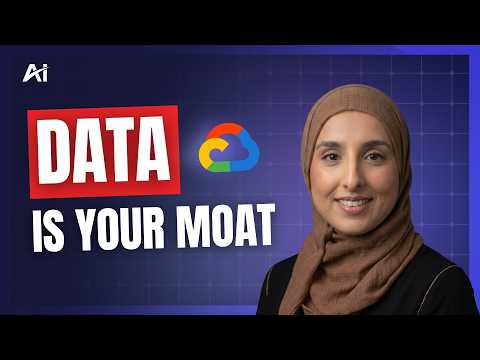

Watch on YouTube · Listen on Spotify or Apple Podcasts
Yasmeen Ahmad, Managing Director of Product Management for Data & AI Cloud at Google Cloud, says enterprise AI only pays off when powerful models are connected to a company's own data and to the business context around it. She tells host Liam Lawson why 80 to 90% of enterprise data is unstructured "dark data" that Gen AI can now unlock, why AI agents need continuous evaluation instead of one-off unit tests, and why good governance works like brakes that let you take a bend at 150 miles per hour.
Key takeaways
- 80 to 90% of enterprise data is dark. Most enterprise data is unstructured, such as documents, PDFs, images and video, and analysts rarely touched it. Gen AI models like Gemini can now analyze it alongside structured data. (10:19)
- Clean data is only half the accuracy. Yasmeen says 50% of the accuracy of AI-ready data comes from good clean data and the other 50% from knowledge and semantics: the business context human analysts carry around. (12:59)
- From 50 agents to 2,000. A Google Cloud customer that appeared on stage a couple of weeks before the recording went from 50 agents to 700 and then 2,000, because autonomous agents do not need a human prompting them. (20:41)
- Agents need continuous evaluation. A one-time unit test gate does not work for agents that keep reasoning, and a 1% error in the first step of a multi-step task compounds into a bad answer. (22:07)
- 50% of Google's code is written by AI. Google's CEO said on a recent earnings report that 50% of its code is now written by AI, with a 10% efficiency gain in engineering. Honeywell reports 30% team efficiency using Google's data agents. (25:46)
- Start with the most painful manual work. Successful pilots run from the ground up on a specific problem. One legal tech customer cut manual workflows by 80% by automating legal document analysis in BigQuery. (27:42)
- Governance is the brakes that let you go faster. Context, semantics and guardrails let AI operate at speed with trust and accuracy, and Yasmeen expects that context layer to be the bigger unlock in the next six months. (36:57)
Why is most enterprise data called dark data?
Yasmeen Ahmad says 80 to 90% of the data enterprises hold is unstructured, and most of it has never been analyzed, which is why it is called dark data. Data analysts and data scientists traditionally worked with structured data in tables with neat rows and columns. Documents, PDFs, images and video were so hard to analyze that many teams did not even store them.
Gen AI models like Gemini change that. They are powerful on unstructured data and can combine it with structured data. Her example is a manufacturing line: instead of only reading the numbers a sensor picks up, a company can analyze images and video of the line alongside the sensor data to understand what is really happening and how to optimize it.
She also explains why a company's own data matters even more in the enterprise. A generic model trained on the internet can answer public questions, but it cannot answer unique questions about your business, because it has never been trained on your proprietary data. Enterprises have to ground models in that data, and use it to evaluate how accurate the models are.
What does BigQuery do, and why does the semantic layer matter?
BigQuery is Google Cloud's flagship data platform, where structured and unstructured data come together and organizations run analysis with AI models on top of it, says Yasmeen Ahmad. She describes it as highly scalable, running billions of queries per second.
A powerful engine on clean data is only half the job. In her view, 50% of the accuracy of AI-ready data comes from good clean data and the other 50% from knowledge and semantics. A human analyst looking into failing machines, for example, talks to the inspection team to learn that a code on page 10 of a PDF means a failed inspection, then connects that to structured machine data. She calls this "invisible work", and it has never been captured in the data platform.
Google is now bringing that work into BigQuery through a semantic and knowledge layer that stores business definitions: what the business means by a new customer or by revenue, how it calculates them and what it classifies as a failure. When an AI agent accesses the data, it accesses that knowledge at the same time, so it can make sense of the data and analyze it accurately.
How are enterprises scaling to thousands of AI agents?
Yasmeen Ahmad says enterprises are moving from agents that wait for a prompt to autonomous agents that take action, such as placing an order or rerouting things in a supply chain, or driving marketing campaigns when a customer shows a propensity to buy. Google calls this intent-driven agentic AI: instead of telling an agent each step, you give it an outcome, and models like Gemini 3 use multi-step reasoning to work out the steps.
Because no human has to sit and prompt each agent, the numbers grow quickly. A customer that joined Google on stage a couple of weeks before the recording went from 50 agents to 700, and now 2,000. Organizations are applying agents across finance, HR, legal and supply chain to do things that were not possible before.
How should companies evaluate AI agents?
AI agents need continuous evaluation, not the unit tests used for traditional software, says Yasmeen Ahmad. Many customers try to test agents the way they built software: write the tests, and publish once the software passes. That does not work for agents built on models that keep reasoning and responding to new inputs once they are out in the wild.
Continuous evaluation tracks how an agent's behavior and actions change over time and whether it stays within the trust boundary. It also has to look inside the task: if an agent takes five steps and the first has a 1% error, that error compounds into a bad answer by the end. She says evals are becoming a whole discipline, with eval roles and teams appearing as customers reach thousands of agents. When an agent fails, the cause often comes back to missing business context and semantics.
What signals show a company is ready for AI?
Yasmeen Ahmad says success comes from pilots that start from the ground up on a specific business problem, not from a top-down master plan. She points first to Google: its CEO said on a recent earnings report that 50% of Google's code is now written by AI, and its engineering teams see a 10% efficiency gain. Outside Google, Honeywell says it sees 30% efficiency in its teams by using Google's data agents.
Her customer examples are specific. An Indian digital supply chain company saw a four times improvement in its sourcing team's efficiency by applying Gen AI to sourcing. A legal tech customer uses BigQuery to automate legal document analysis and has cut its manual workflows by 80%, with a human still in the loop. Her advice is to find the most painful, manual journeys in your enterprise, or the work you skip because analyzing a thousand documents is too hard, and apply Gen AI there.
Why do 95% of AI pilots produce zero ROI?
Liam cites an MIT study finding that 95% of AI pilots produce zero measurable ROI, with a big difference between companies that go it alone and those that take on a partner such as Google. Yasmeen Ahmad's explanation is the pace of change. The biggest complaint she has heard from customers for a year or more is "Google, you're innovating too fast". Models get incremental updates every two weeks, and inside Google teams are told that if something did not work with AI three months ago, they should try again now.
A partner helps by doing the synthesis. Google's DeepMind research teams follow exactly how the models are improving, and Google sees use cases across customers, industries and research areas such as life sciences. That lets it bring customers what matters from the last two weeks of progress, so they do not have to read a hundred papers. She mentions the blog of a thousand customer use cases Google published last year, and notes that companies often build on examples from other industries.
How does governance make AI faster?
Yasmeen Ahmad says governance in the AI era is not the "Department of No" that locks systems down. Her analogy: it is not about applying brakes to stop the car, but brakes that let you confidently drive 150 miles per hour into a bend and know you are still in control.
In practice, AI governance means giving models context, semantics and a real-time catalog as a safety net, so they give precise answers instead of making things up. She lists three jobs: making sure the model only uses the data it should, without leaking sensitive PII; grounding the model in business data so it answers accurately; and giving it personalization and context so each person gets answers that fit their department. She expects that semantic and context layer, rather than more powerful models, to be the bigger unlock for organizations in the next six months, because everybody has access to the same models.
Which companies are best placed to win with AI?
Yasmeen Ahmad says culture, not budget, decides who wins with AI. In the past, the largest companies moved fastest because they had deep pockets for technology and infrastructure. Now everybody has access to the same powerful technology, from a three-person startup to the largest enterprise, so it comes down to mindset and culture. She sees companies of equal size where one moves 10 times faster and tries 10 times more things than the other.
Because AI changes how workflows and processes work, change management and a growth mindset matter. She has also seen founders and product leaders come back to lead their companies, bringing a founder mentality that rethinks products around the customer need instead of bolting AI onto existing ones.
Why does Yasmeen Ahmad do what she does?
Yasmeen Ahmad believes AI is a fundamental step change in human history, comparable to the internet, and that people will look back on life before and after Gen AI. She calls it a privilege to be at Google, one of the companies at the bleeding edge of the technology, and to play a part in defining what that future looks like.
In her words
"I describe what the human analyst does as a lot of invisible work." (14:50)
"So we can't test agents like we've done software in the past. Agents need continuous evaluation." (22:07)
"Even if you tried something three months ago and it didn't work with AI, you should try again now." (31:58)
"It's not about applying brakes on the car so that you halt the car and stop it from moving ahead. It's applying brakes so that you can confidently drive 150 miles per hour into a bend and know that you're still going to be in control." (36:57)
"I actually don't think it's about the size of company or how deep your pockets are." (42:03)
Chapters
00:00 Introduction and welcome
00:50 Being Scottish in Silicon Valley and the power of community
03:13 The career thread: curiosity, pivots and getting outside your comfort zone
06:20 What makes data fascinating: the hidden stories inside numbers
07:48 Why data is the lifeblood of enterprise AI
10:19 80 to 90% of enterprise data is dark and untouched
12:59 What BigQuery actually does, explained simply
14:50 The invisible work: knowledge layers and business semantics
17:38 The agentic AI moment: agents that think, plan and execute
20:41 From 50 to 2,000 autonomous agents inside enterprises
22:07 Why you can't evaluate AI agents like traditional software
25:46 Signals of AI readiness: Google's 50% AI-written code and Honeywell's 30% efficiency gains
30:21 Why 95% of AI pilots produce zero ROI
35:37 Governance as a speed accelerator, not a brake
39:53 Who's best poised to win: culture over budget
45:59 Why do you do what you do?
About the guest
Yasmeen Ahmad is Managing Director of Product Management for Data & AI Cloud at Google Cloud. She grew up in Dundee, Scotland, studied computer science and then did a PhD in life sciences, applying her computer science skills to proteomics and genomics. She later consulted with retailers, financial services firms, telcos and manufacturing companies, and took a finance course at Harvard. Yasmeen on LinkedIn · Google Cloud
About the host
Liam Lawson is CEO of The AI Report and host of The AI Report Podcast. Meet the team
Full transcript
Edited for readability. Quotes above are word for word from the recording.
Liam Lawson (00:01): Yasmeen, welcome to the podcast.
Yasmeen Ahmad (00:04): Thank you, Liam. It's a pleasure to join you.
Liam Lawson (00:08): I want to address the elephant in the room. We are both obviously Scottish, and we're going to try to rein it in for the conversation and be understandable. We'll do our best. Before we jump into everything you're doing with Google, everything to do with governance, security, data and agents, I want to ask a bit of a funky question. You've been in Silicon Valley, I think you said, around seven or eight years now. Is there anything about being Scottish, about the mindset or the upbringing, that informs your success in a different way from your peers?
Yasmeen Ahmad (00:50): That's a great question. Growing up in Scotland was such an amazing experience. You are on an island and there's so much community around. I grew up in a small city called Dundee. So much community. You grow up in this vibrant culture. I studied computer science and life sciences in Scotland, and it pushed me to think about different industries and domains. The fact that the UK is an island creates a sense of community: you're learning from others and building these connections.
When I moved to the US, frankly, the US is massive. You could almost fit all of Europe inside it. It felt like this massive explosion of space and time, and the scale at which you're able to do things in the US felt massive. But as I held on more to the roots, the skills I learned in Scotland, having studied and lived there and built the communities I was part of, I could take those skills and apply them in this really big world that otherwise felt super scary. So now, in my day-to-day at Google, those communities and building relationships are so important. You begin to learn it's a small world once you start to build those connections, whether with other communities and teams at Google or outside of Google. That's what I really hold on to.
Liam Lawson (02:43): I love that ability to make connections and friendships and really build that. I feel that being Scottish as well. I think it's something we're very good at, a cultural thing that comes easily to us. I'm fascinated by your journey, from starting with projects like Pet Tracker, to running your own consultancy, to studying at Harvard, to your current role as Managing Director of Product Management for Data and AI Cloud at Google Cloud. That was a big one, but I got it out there. What's the thread that runs through all of those things for you?
Yasmeen Ahmad (03:26): Curiosity. Throughout my journey I've taken lots of pivots and turns, but getting myself outside of my comfort zone has always been about curiosity, about learning different domains and different spaces. When I did the Harvard thing, I did a course in finance, which was completely outside of the work I'd been doing. But I could see how connected the world of finance was as I progressed in my career, and applying that, I got into strategy. Each of those journeys was about curiosity, pivoting and getting outside my comfort zone.
I think it started right from my university days. I studied computer science, but then went and did a PhD in life sciences. I hadn't taken biology or done the traditional science part of it, but I felt I'd learned skills in computer science that I could apply in the proteomics and genomics space to help biologists. Throughout my career I've recognized those pivots, where I've taken the skills I'd built and said, I want to go try to use them in a different domain. Continuously learning and being able to explore those domains has been the most fun thing for me.
Liam Lawson (06:00): So much of your background and your career has centered around data. What is it about data that interests you so much? Why are you so deep in it as a subject area?
Yasmeen Ahmad (06:20): Data has been around forever, from the basic spreadsheet to the biggest, most complex data platform systems I've seen, with hundreds of petabytes of data. What super interests me is that at its core, data is super simple. It's numbers, it's characters. But the stories you can pull out of data, that's where I love to get in and understand what it really means. In my early days I consulted with retailers, financial services, telcos and manufacturing companies. What I was super passionate about was that data can look super simple, but it hides all of these unique stories, insights and intelligence. That's what originally got me into the data science space: the opportunity to explore and tell stories with data.
Liam Lawson (07:22): I love that. I want to use that background to frame our conversation today. When we talk about enterprise AI, I want every listener to have the same foundation. When you hear the word data in the context of AI, what does it actually mean? And why does the quality of that data determine whether AI succeeds for an enterprise or not?
Yasmeen Ahmad (07:48): Data, in some ways, is the lifeblood of these amazingly powerful new Gen AI models. When Gen AI first came on the scene, with AI models like Gemini, data was all about how these models had been trained. They're so powerful because they understand the internet of data, and you can ask any question and the model can synthesize really powerful answers.
But in an enterprise context, I think data plays an even more significant role. A generic model like Gemini, trained on the internet of data, can answer any public question, but it can't answer unique questions about your business, because it's never been trained on your business. Your business's data is proprietary. It's typically locked away and access controlled in systems. So organizations that want to use Gen AI to unlock new use cases, be it for customers or supply chain, have to connect these powerful models to their business data. A number of techniques have evolved for grounding a model in your business data so it can answer questions about your business accurately and in a trustworthy way.
Beyond grounding, enterprise data has a really important role in evaluating models and their accuracy. You need your enterprise data supporting this new space of evals. Without AI and data truly coming together, I don't believe an enterprise or business can get the value out of these AI models for enterprise use cases.
Liam Lawson (09:48): I want to break this down into first principles and very simple steps. There's the human querying the data, there's the translation layer, and then there's the foundation. Let's talk about the foundation first. When you see these enterprise AI organizations, what does their data usually look like? Is it structured, is it unstructured, is it ready for AI? What does it look like to be AI ready in terms of your data foundation?
Yasmeen Ahmad (10:19): Great question, and maybe one of the top questions I hear from customers: I need an AI ready data foundation, so what do I need to do? Traditionally, the data analyst or data scientist largely worked with structured data, data that's nicely described in tables. Imagine your sheets: columns, rows, very neat and tidy. Gen AI has blown the doors open on the data you can work on. Yes, it can work with structured data, but more importantly these AI models are super powerful on unstructured data like documents, PDF files, images and video. That's data that analysts and data scientists often didn't even store, because analyzing images or video was just super hard.
When we look at enterprises, 80 to 90% of the data they have is unstructured. Now we suddenly have this amazingly powerful tool, Gen AI models like Gemini, that can unlock that 80 to 90% of what's been dark data. We call it dark because nobody's ever touched it or thought about analyzing it. With these models, you can bring together your structured and unstructured data and get to much more useful, insightful analysis. You're not just looking at your manufacturing supply chain in terms of the numerical readings a sensor picked up. You can look at image and video analysis of the manufacturing pipeline and augment it with the sensor data to understand what's really happening on the line, how to optimize it and how to get better. All data, structured and unstructured, is now coming together for these organizations.
Liam Lawson (12:30): When I was doing my research beforehand, this was a world that's entirely new to me. I'm not a data scientist and I'm not technical myself. Something that comes up all the time is BigQuery, and BigQuery Knowledge Engine, and I don't fully understand it. For someone who doesn't live in this world, what is BigQuery doing at its core, and why is it important?
Yasmeen Ahmad (12:59): Linking to the previous question about AI ready data foundations, at its core BigQuery is our flagship data platform. It's where all of that structured and unstructured data comes together, what we call multimodal data: structured, unstructured, images, videos and PDFs. BigQuery as an engine lets organizations run analysis with AI models on top of that data. It's super powerful and highly scalable, running billions of queries per second, doing amazing work on this data foundation.
But AI ready isn't just putting a really amazing engine on top of data and saying go. When we think about AI ready data, 50% of the accuracy comes from having really good, clean data, with all of that data organized and put together. The other 50% comes from what we call knowledge and semantics.
To make that concrete, think about how a human analyst or data scientist works today. They might be looking at inspection reports for machines that are failing quality checks, and they will connect all of that data together. How do I know there's actually a failure on this machine? They go and speak to the team that does the inspection reports and work out that on page 10 of a PDF there's a code, and that code means it failed an inspection. Then they connect that with the machine data, the nice structured data about what the machine is, how long it's been in production and when it had its last maintenance check. The human analyst is using a lot of context from what they understand about the business. They're speaking to colleagues and learning how the data comes together and what it means. Then they put together an analysis and come back with a report that says, for example, 50% of our machines are failing because of this error, and this is what we should do to avoid these failures in the future.
I describe what the human analyst does as a lot of invisible work: speaking to colleagues, learning about the business, understanding how machines work and how to analyze the data based on how the inspection reports are done. That invisible work has never been captured in the data platform. Traditionally, a data platform like BigQuery would just store the good, clean data, and the human analyst would do all this invisible work and then work with BigQuery on that data.
Now, with AI and autonomous agents, we're bringing more of the invisible work the human analyst did outside the system into the system. Inside BigQuery it's no longer just about clean data and a powerful engine. We support all the clean multimodal, structured and unstructured data, but we're also bringing in semantics and a knowledge layer. That layer captures the business context and the business definitions. What does the business mean when it says new customer, or revenue? How does it calculate these things? What does it classify as a failure? Those are all definitions we can store in the knowledge and semantic layer.
Yasmeen Ahmad (16:55): That knowledge layer then works alongside the data. When an AI or an agent accesses the data, it also accesses the knowledge and semantics at the same time, so the powerful AI model can make sense of the data and do accurate analysis. This is where Google is evolving our data cloud to meet the agentic moment of this AI moment we're in. We have to evolve our data platforms beyond the traditional platforms humans used, think about how an AI operates, and capture inside the platform some of the invisible work humans were doing.
Liam Lawson (17:38): I think agents are the word of the moment. Yesterday Anthropic released Claude Dispatch, and I've been using it. I was talking to my phone and getting Claude to work on my computer and go and do things. Perplexity released Computer, and they're releasing Personal Computer. Obviously OpenClaw is a massive thing right now as well. I'm really impressed by what exists already. I've been playing around with it personally and running it in my business, and I'm about to buy a Mac mini so I can run things while I'm elsewhere. I'm really impressed as a consumer. Are you impressed on the enterprise side? How impressive are agents right now?
Yasmeen Ahmad (18:26): Super impressed, both from a consumer perspective, personally using all the advancements that are coming out so rapidly, and because those advancements apply equally in the enterprise or business context. We're moving beyond agents where you sit prompting the model, asking questions and getting answers, to an autonomous space where agents can go and take action. They can run a search in a browser for you. Beyond that, for an enterprise, they can take action in your supply chain: place an order, reroute things. They can drive marketing campaigns for you automatically, based on a customer who's come in and is showing a propensity to buy.
This leap from an agent waiting for you to prompt it to autonomous workflows is creating a massive opportunity for enterprises. We're calling it intent-driven agentic AI. You don't have to tell the agents to do single steps. You give them an outcome you want to achieve: a more optimized supply chain, more marketing touch points. With the power of Gemini 3, these models can now do really advanced multi-step reasoning to meet that outcome. A model might decide there are three steps to get to the outcome, or five. The model can determine those steps because of its powerful reasoning capability.
That applies in the enterprise context, where we're seeing organizations move beyond building one or 10 or 100 agents. We had a customer on stage with us just a couple of weeks ago.
Yasmeen Ahmad (20:41): They said they rapidly went from 50 agents to 700 agents, and now 2,000 agents. You can go from human scale to agent scale, thousands of agents, because it's not a human sitting and prompting these agents. They're working autonomously. Organizations are looking at these agents across finance, HR, legal and supply chain to do things that frankly weren't possible before without that autonomous capability.
Liam Lawson (21:17): In my own experience yesterday, I spoke to my phone and said I needed some documents sent. It found some notes in Granola, then an email thread, then a Slack conversation, then went into the files on my computer, drafted the email and pinged me when it was ready. But with any agentic system I use, I'm still evaluating at the end of the day. I don't trust them enough to hit send automatically all the time. I want to check. So I want to talk about evaluations. It seems we're still at the stage of a human in the loop, or, as I think you've described it, a human on the loop. What do evaluations look like right now? Are they good enough? What does a solution look like?
Yasmeen Ahmad (22:07): Great question. I've seen many customers trying to evaluate agents the way they've built traditional software. With traditional software, you write the unit tests and check that the software passes all of them. If it passes, great, you can publish the software and put it out into the market.
Agents are different, and this is why I've spoken before about the human on the loop. Agents are built on these Gen AI models that are super powerful, constantly reasoning and learning over time based on the reasoning they're doing and the inputs they're seeing. So writing a set of unit tests as an evaluation gate, and saying that if it passes this gate the software is ready, doesn't really work in the agentic world. So we can't test agents like we've done software in the past. Agents need continuous evaluation. Once you put them out into the wild, and an agent continues to reason and learn from the environment it's reasoning in, we need continuous evaluation to look at how the agent's behavior is changing over time. How are the actions it's driving changing? Is this still what we expect? Is it still within the trust boundary we need?
That's especially important because these agents are doing multi-step reasoning. If an autonomous agent is doing five steps and the first step has a glitch, a 1% error, that error compounds over the multiple steps of reasoning, and the agent gets to a really bad answer by the end. So it's not just evaluating what the agent did at the end. It's also understanding and evaluating the reasoning steps, and where errors might be creeping in as the agent gets to work.
Yasmeen Ahmad (24:08): This is why evals are not just a simple case of creating a unit test and being done. It's becoming a whole discipline. We're seeing eval roles and teams evolve as customers get to thousands of agents. They're asking how they make sure they're continuously monitoring, with the observability to understand the operations of these agents and continuously tweak them. And if an agent is failing, a lot of the time it comes back to the context I spoke about before. Maybe it doesn't have the right business context and semantics. How do I add that into the system so the agent understands the operation and performs as I expect?
Liam Lawson (25:05): It's really interesting. I want to make this more real and tangible for people. Part of our business is enterprise training and AI implementation for organizations. That's what we do. And what we really find, in taking a project from pilot to production, is that a lot of the time it's a cultural thing. From your perspective, when you walk into a large organization, what signals are you looking for that they're AI ready, beyond just the technical part?
Yasmeen Ahmad (25:46): That's a great question. Let me start by reflecting on Google and our internal adoption of Gen AI. Our CEO mentioned on a recent earnings report that 50% of our code is now written by AI. We're seeing a 10% efficiency gain in our engineering orgs because of the use of AI. That's internal to Google. Externally, we have customers like Honeywell saying that by using our data agents, they're seeing 30% efficiency in their teams. So we're already seeing organizations adopting agents and talking about productivity, efficiency and automating code generation.
When it comes to the signal I look for, many organizations are already unlocking those use cases. It's not about having a master plan high up that says our organization is going to adopt AI and here are the four steps to follow. Because this is such a new technology and it's evolving so fast, a lot of the innovation is coming from the ground up. I've spoken to multiple customers this week, and often the same question comes up: where do we even get started? Where we're seeing success is where customers choose pilots and run them from the ground up. They figure out there's an opportunity in their business, and if they can get moving on it, they can prove out how to apply this technology to that use case in their real-world context.
Yasmeen Ahmad (27:42): To take a couple of customer examples, an Indian digital supply chain company saw a four times improvement in their sourcing team's efficiency. That was because they got very specific: I want to look at my supply chain platform and how we are doing sourcing, so let's apply Gen AI in this context. Then they could rapidly drive new agents and new techniques at that specific problem. It's by really honing in on a specific area of the business, understanding what's very manual or cumbersome today, or often what is just impossible because it's so human driven, and asking how to apply agentic thinking to do it differently.
We also had a legal customer working with their legal team. I pick on that use case because we've seen use cases in HR and legal teams, and those have traditionally been very human, manual work. If you were doing document reviews, it was a human sitting and reading all of those documents or contracts. Today, by applying agents, those customers are able to process those multimodal, unstructured documents. The customer I was thinking of is in the legal tech space, and they're now using BigQuery to automate legal document analysis. They're cutting down their manual workflows by 80%, because it no longer relies on a human reading line by line through these legal briefs in copious detail. They can use AI to cut through the noise, analyze those legal documents and pinpoint information, and then, yes, the human still comes into the loop, but much more efficiently.
Yasmeen Ahmad (29:44): So my recommendation to customers is always to go and find those really painful journeys in your enterprise today. Find the moments where you're doing things that are super manual or super laborious, or where you're not doing something at all because the barrier to analyzing a thousand documents is just too high. This is where Gen AI is a new kind of tool that we've never had in our toolbox before.
Liam Lawson (30:21): It's funny hearing you describe the problem, because there are such parallels between individuals and enterprises. When I speak to family and friends, they ask, how do I use AI, where do I start? I give them the same advice: start with one problem and go from there. And seemingly it's the same for enterprises. Something I want to tap into: I was reading an MIT study beforehand saying that 95% of AI pilots produce zero measurable ROI. But one clear distinction they made is that there's a very big difference between companies that try to approach these projects by themselves and companies that take on a partner, such as Google. Why do you think there's such a difference in the results? Is it just a case of not having the blinders on?
Yasmeen Ahmad (31:22): Yeah, that's an interesting study. When I talk to my customers, one of the challenges they call out continuously is that this space is evolving so fast. The biggest complaint I've heard from my customers over probably the last year or longer is, Google, you're innovating too fast. We can't keep up. That feeling is very common across lots of customers, individuals and teams I speak to.
Yasmeen Ahmad (31:58): Even internally at Google, if I look at the pace at which the market is evolving, every day there are new papers, new research, new findings and new products being launched. It's really hard for organizations to keep up with that and understand what's the latest. In fact, within our teams at Google, we've instituted this idea that even if you tried something three months ago and it didn't work with AI, you should try again now, because every two weeks there are incremental updates to the models and they're taking leaps and bounds forward.
So where I think the partnership piece is probably working to customers' benefit on ROI is this. An individual customer isn't necessarily living and breathing AI model building every day. If they partner with Google, our DeepMind research teams are knee deep in understanding exactly how the models are working, how they're innovating every day, what the enhancements are and what that might unlock. We're trying all of these use cases across the globe with different customers. We're also deeply embedded in the research space. We've been looking at gaming, life sciences and different domains to see how these models unlock transformational shifts, in cancer research for example, in areas traditional tools just couldn't touch.
The benefit of Google is that we can do that because we have the deep research teams, we're in the business of building these models, and we have the global reach to see and apply these models in different contexts. If I'm in the shoes of a CEO or a leader at one of my customers, I can imagine it's really hard to stay up to speed. So having a trusted partner like Google means you've got a partner helping to synthesize all of the advancements that are happening, never mind in six months, but in the last two weeks, and bringing that to you in a context relevant way. You don't have to read the hundred papers to work out what's most important and relevant.
Last year we published a blog of a thousand customer use cases, and people were blown away, because at that point people were still asking whether there was ROI, whether there was value. Because we can look across the landscape, we can pull together where the nuggets of success are and how organizations can build on them. A lot of the time, organizations are building on examples from other industries. It doesn't have to be their own industry, because this area is so new. They're looking for ideas and inspiration from across industries and domains.
Liam Lawson (35:10): That customer pain point really resonates, saying, I literally can't keep up with how fast you're innovating. Our entire company relies on providing the news, with a newsletter and a podcast, and we struggle to keep up. It's advancing at a ridiculous rate. Over the past two and a half years of us doing this, AI has come a long way, and especially within the past three months everything's been advancing so quickly that I've been messaging family, friends and my brother on WhatsApp saying, you have to get on this, you can't afford not to be in this space right now.
I want to finish with a segment on governance. When people hear that word, they think red tape, they think bureaucracy, they think it's going to slow them down. I know you think about it differently, more as an accelerator. Talk to me about how governance makes you move faster, not slower.
Yasmeen Ahmad (36:30): I think part of the challenge, Liam, is the word governance. In the traditional world, when anybody said governance, that was the Department of No. We've got to go figure out the governance, which basically meant we can't do it, we're going to lock the system down and nobody's going to have access, or it's going to be limited access. In the legacy way, governance was more the trust and compliance team locking things down.
Yasmeen Ahmad (36:57): Governance in the AI era means something completely different. These models are super powerful and they're off to the races. It's not about applying brakes on the car so that you halt the car and stop it from moving ahead. It's applying brakes so that you can confidently drive 150 miles per hour into a bend and know that you're still going to be in control.
Governance, when it comes to AI, is about giving these models the additional context, the semantics, the real-time catalog. We call it the real-time catalog for AI: as AI operates, it's got that safety net. That's a mindset shift from how people have thought about governance historically. As organizations look at the governance challenge around models, a lot of it comes back to building the context layer, the semantic layer, so these models can operate with trust and accuracy and have guardrails so they don't hallucinate, so the model doesn't make things up in the enterprise context. These models are generating amazing imagery and videos, but in an enterprise context, if I'm asking about revenue, sales and failure rates, I expect a very precise answer.
Yasmeen Ahmad (38:40): So governance in the AI space is taking on the role of making sure, first, that in an enterprise context the model is only inferencing over the data it should be, and that sensitive PII information is not being accidentally leaked through the models. Second, that the model is grounding itself in business data so it answers more accurately and precisely. And third, that the model has access to personalization and context information, so it can give you, Liam, the answers you're looking for, which might be different from mine, because I'm in a different department with a different context.
If I think about the biggest unlock in the next six months, the models are really powerful, and I'm sure they will continue to grow and get more powerful. But the bigger unlock for organizations is going to be that semantic and context piece. Whether you're a startup or a large enterprise, everybody has access to these powerful models. So what makes you differentiated in how you use them? It's the business context and governance you bring to the model to help it operate at speed, in thousands of autonomous agents, but with trust and accuracy.
Liam Lawson (39:53): Let me ask you this. If that's the biggest unlock moving forward, who do you think is best poised to succeed with it? Is it a particular industry? Are you looking at the founder, or the way a company is set up? Who's actually going to adopt this? What would your prediction be?
Yasmeen Ahmad (40:15): Historically, especially in large data technologies, the largest companies were often able to move faster because they had deep pockets to invest in and buy technology, and even to make the infrastructure investments. In the cloud, and now with AI, if I think about the Google stack, AI is everywhere across it and everybody has access. In some ways there's a level playing field, whether you're a three-person startup or the largest enterprise in the world. Everybody has access to this powerful technology. You don't need massive deep pockets to make upfront investments to embrace it.
With that level playing field, I really do think it comes down to the mindset and culture within the company to drive innovation and adoption. You'll see equal-sized companies where one is able to move 10 times faster and try 10 times more things than another company of the same size and scale. What we're seeing is that it comes down to a company's internal culture: how they set it up to try things out, to innovate and to do things in a different way. It also comes down to a lot of change management, because we're talking about completely changing the way workflows and processes have traditionally worked within companies. How resilient your culture is plays a lot into it. How much is your culture going to fight that change to processes and workflows, versus being built on a growth mindset that says, let's adopt this, because we can do better for our customers and move faster?
Yasmeen Ahmad (42:03): So I actually don't think it's about the size of company or how deep your pockets are. I think it's the leadership, the tone they set, the culture of the company and their willingness, with a growth mindset, to adopt new technology that makes the big difference.
Liam Lawson (42:28): We started this conversation by talking about your skills and qualities, and I want to loop back there to finish. This mindset of growth and openness to change is a crucial part of succeeding over the next three to six months and the coming years. That cultural aspect is so important, and the majority of the time it comes down to an individual: the founder or the CEO usually sets the tone. So what skills or qualities do you think are really important for that individual? What kind of people are going to succeed moving forward?
Yasmeen Ahmad (43:14): If I reflect on the industry, we've seen a number of companies make CEO changes and leadership changes. I've seen a lot of founders come back to take the helm of their companies, and often those leaders are product leaders, not necessarily sales leaders or CRO or CFO types. We've seen a resurgence of product leaders and founders driving their companies, because of the mindset they bring: innovation and thinking differently. How do I build a product that disrupts the market? How do I find an opportunity within the market?
We talk a lot about business needs and customer CUJs. What's the actual customer need we're solving for? Now that we've got an amazing new technology, this really powerful Gemini model, maybe there's a different way to solve that customer problem than we've thought about for the last decade. That requires a founder-type mentality, where you're not looking at optimizing your business or your existing products and bolting AI onto them. You're fundamentally rethinking your products and saying there may be a completely different way to solve the problem that we never imagined before, because we didn't have the tools. So I do feel there's a certain founder mentality, for product companies, in coming back to that product leadership, because of the skills those individuals bring to the table.
Liam Lawson (45:05): I think it speaks to what you said at the start of the conversation. The thread through everything for you was curiosity. I think curiosity and creativity are more important than ever. It's why I do this, and it's why I love the podcast the most. When AI can build anything for you, your imagination is the limiting factor. I've heard a similar sentiment from other C-suite execs on the podcast. I want to finish with one last question that I ask all of my guests. Take it however you want. I'd encourage you to take five to 10 seconds before answering, and I refuse to give any further context, okay?
Yasmeen Ahmad (45:55): Okay.
Liam Lawson (45:59): Why do you do what you do?
Yasmeen Ahmad (46:08): That is a deep question, Liam. Why do I do what I do? Beyond what we spoke about with my career journey, I find it fascinating to be in these different domains, unlocking use cases with customers. But at the core of it, I believe AI represents a fundamental step change in human history. We'll look back at this moment and say this technology really changed the game across many different industries, in how humans think about work, and even how we put meaning to life and work.
I equate the moment we're in right now to a shift like the internet. You can think about life before the internet and life after it, and there's a radical difference in how the internet as a technology changed every aspect of human life: how we work, how we think, how we communicate, how we socialize as communities. I think AI has that potential. To me, it's a privilege to be at this point in my career, at Google, one of the companies at the bleeding edge of innovating this technology, and to be part of that shift and of defining what that future looks like for humans. I know that feels quite grandiose, but I don't think you get many opportunities in your life to be part of such a pivotal shift.
Yasmeen Ahmad (48:00): I really believe now is one of those moments. So waking up every day, yes, things are crazy. Yes, it's hectic. Yes, it's hard to keep up. But for me it's about whatever small part I can play in defining what that future looks like. I really do believe we'll look back and say there was life before Gen AI and life after Gen AI, and the difference in the impact it has for humans will be stark.
Liam Lawson (48:32): It's an amazing answer. Yasmeen, thank you for your time, taking an hour out of your day. I'm glad we made this happen. If people want to learn more about you and what you do, how do they get in contact?
Yasmeen Ahmad (48:51): Of course. I am at Google Cloud, and we're always happy to hear from customers and anybody looking to explore the technologies, so please reach out. Personally, I'm on LinkedIn, so please drop me a note. I'm always happy to engage and talk about what's happening in the space.
Liam Lawson (49:17): Awesome. Yasmeen, thank you so much for your time.
Yasmeen Ahmad (49:20): Of course. Thank you, Liam.
Get the five-minute AI briefing
Join 400,000+ business leaders who start their weekday with The AI Report. Subscribe free
