400,000+ business leaders (and teams at IBM, AWS & Zapier) start their day with The AI Report. 5 minutes. Plain English. No hype.
ADVERTISE | PODCASTS | EXECUTIVE’S PASS | B2B TRAINING



Hey
Welcome to The AI Report — the #1 AI newsletter for business leaders.
You don’t need to be technical. Just informed.
• 1. 📈 Maximize the ROI of your AI abilities with IBM
• 2. ⚡️ Apple widens OpenAI theft suit
• 3. 💼 Your Business Briefing
• 4. 🕵️♂️ Find where AI will actually pay off with Scribe
• 5. 🤝 The Human & AI De Brief with Marie-Lou
• 6. ✍️ Today’s Policy Corner
• 7. 🗞️ The News Bulletin
Are you ready to launch AI transformation for your company?
TOGETHER WITH IBM
Modernize without rebuilding? It can be done

Many organizations want to use AI, but they may not see a clear path to business ROI
because their data is scattered across old line-of-business applications, databases and
documents. A data lakehouse can help once the data gets there, but the bigger
challenge is digging up legacy data, understanding what it means and reshaping it for
AI.
That’s where IBM Bob helps change the game. By supporting the work required to
prepare data from existing environments, Bob helps turn legacy data discovery into a
more repeatable engineering process.
The result is governed data that can support AI use cases such as search, assistants,
knowledge retrieval and analytics without requiring organizations to replace existing
applications first.

Latest in AI

Apple widens OpenAI theft suit
🚨 Our Report
Apple is escalating its legal battle against OpenAI, filing for a preliminary injunction to block the AI company from developing products based on allegedly stolen Apple technology. The iPhone maker now claims at least 11 additional former employees beyond those originally named may have been involved in trade secrets theft.
🔓 Key Points
Apple's investigation revealed former employees took screenshots of confidential documents about unannounced products before OpenAI interviews, and multiple ex-employees reached out after the lawsuit to discuss returning Apple devices they kept.
The company is requesting expedited discovery from accused employees Chang Liu and Tang Yew Tan, OpenAI, and Jony Ive's device startup io, suggesting the misconduct extends beyond the original complaint.
OpenAI responded publicly, calling Apple's claims "based on false information" and stating it does not have nor want Apple's trade secrets, adding that Apple's poor security procedures allowed the residual access.
🔐 Relevance
This case signals growing tension between Big Tech and AI labs over talent movement and intellectual property. For enterprise leaders, it raises questions about employee offboarding protocols and data access controls as AI hiring intensifies. Companies operating in both ecosystems should review their own IP protection policies and consider how aggressive enforcement could reshape the competitive landscape for AI hardware development.
AN UPDATE ON OUR NEWEST PARTNER
Hand Off What's Eating Your Week
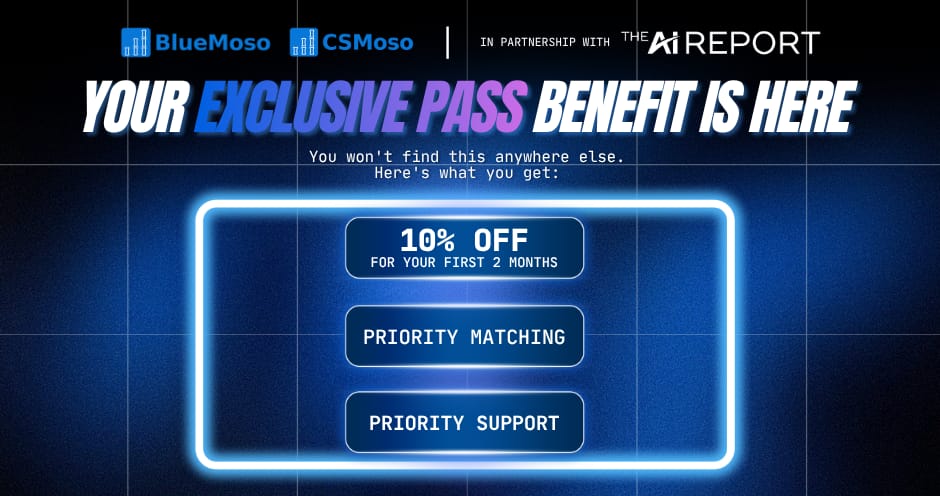
BlueMoso and CSMoso are live inside the AI Executives Pass, real people who handle the work that's eating your time, not another tool to manage.
Pass members get 10% off their first two months, priority matching, and free access to their Human in the Loop Playbook.
Plus, access to 23+ partner deals and resources.
$14,000 value for $199/yr.
Already a member? Book a call here.
THE BUSINESS BRIEFING: IT & OPERATIONS (powered by Upscaile)
dLocal (Nasdaq-listed payments company, 400 engineers, 60 teams) was bleeding hours to scattered data and context-switching. Engineers onboarded slowly, stitched together incomplete information across tools, and spent more time searching for answers than shipping code. They deployed Port's Agentic SDLC Platform to unify services, repos, teams, and policies into a single context layer, then built dCoder—an AI agent that autonomously handles engineering tickets from scope to deployed PR.
Tool used: Port — agentic SDLC platform providing context lake, workflow orchestration, and agent management with built-in governance.
Result: 45% of engineering tickets autonomously resolved end-to-end. Developer productivity up 20% (equivalent to adding 20% headcount without hiring). dCoder generates plans, writes code, runs security and QA checks, and opens PRs while engineers retain final approval.
The lesson: Agent autonomy fails without unified context. dLocal CTO Alberto Almeida knew scattered, outdated data doesn't just slow teams down—it makes agents confident in costly mistakes. The foundation came first, automation second.
Steal this: Audit where engineers hunt for context this week. If your team checks 3+ systems to understand service ownership, dependencies, or deployment policies, unify that data before building agentic workflows. Agents only work when the ground truth is actually true.
TOGETHER WITH SCRIBE
AI can't fix what your org can't see
You secured the AI budget and the board mandate. Now the payoff hinges on aiming it at the right workflows — usually the ones you can't see. Scribe Optimize captures how work actually moves across your org and maps it automatically, so you deploy AI where the impact shows.
Trusted by 94% of the Fortune 500.
THE HUMAN & AI DE BRIEF
We Gave Our People AI to Move Faster. Why Does Everyone Still Feel Behind?
I opened the fridge hungry, with no plan. Cooked something quickly. And somewhere between the chopping and the waiting, the clearest idea I’d had all day arrived.
I wasn’t trying to think. I was trying to eat.
There’s an irony running through most AI transformations right now that almost nobody is naming. We built a pace that made thinking impossible, then handed it to AI to fix.
What that’s actually costing your organization is this week on the AI Report blog.
THE POLICY CORNER
Connecticut enacts sweeping AI hiring law with October compliance deadline.
Connecticut passed the Artificial Intelligence Responsibility and Transparency Act, requiring employers using AI for hiring, performance management, or workforce decisions to disclose when automated tools play a meaningful role in outcomes. The law also amends state anti-discrimination statutes to explicitly bar "the algorithm made me do it" defenses. Any employer filing WARN Act notices must now disclose whether layoffs relate to AI adoption.
Deadline: October 1, 2026 for anti-discrimination provisions and WARN disclosures. October 1, 2027 for full notice requirements on automated employment tools.
Risk: No safe harbor exists for discrimination claims. Courts may consider bias testing efforts, but using AI does not shield employers from liability for discriminatory outcomes.
Your move: Inventory every automated system touching hiring, scheduling, or performance decisions this month. Contact vendors to confirm they can provide the data categories, sources, and assessment methods you'll need to disclose by next October.
AI News
🔒 White House keeps AI safety framework classified: Trump administration withholds voluntary evaluation process for advanced models from public, shares details only with participating companies despite global security implications. FULL STORY
💰 Big Tech locks in $1.09T for AI data centers: Microsoft, Meta, Oracle, Amazon and Alphabet commit over $1 trillion in future lease payments for facilities not yet operational, four times their current recognized liabilities. FULL STORY
🚀 SpaceX revenue nearly doubles on AI and Starlink surge: Company reports $7.8B quarterly revenue, up from $4.1B year-over-year, while AI business revenue jumps 250% and capital spending balloons to $18B from $2.83B. FULL STORY
🐛 Apple caps bug reports after AI slop floods security team: AI-generated fake vulnerability submissions force submission limits, causing researchers to withhold real $200K macOS exploit after hitting quota. FULL STORY
Trending AI Tools (Sponsored by the AI Executive’s Pass)
A curated look at the AI tools quietly transforming how teams work.
Kit* — 600K+ creators. 2.5B emails monthly. 99.8% deliverability. The newsletter OS for creators.
ChatNode is for building custom AI chatbots that handle 89% of customer support requests
PostHog is a developer-focused analytics suite combining event tracking, session replay, and A/B testing
*indicates a sponsored tool, if any
⚡️ Why pay for 4–6 separate AI tools at full price when the AI Executive’s Pass fixes that?
The Money: Agent security becomes the new enterprise priority
Enterprises aren't just deploying AI agents anymore. They're racing to govern them before regulators do. Two of this week's largest AI rounds targeted companies securing and scaling autonomous agents inside corporate systems, signaling investors see agent governance as the next critical infrastructure layer.
Deals to know:
HappyRobot (Series C, $150M at $1.2B valuation) -- Agentic AI platform automating complex enterprise operations across voice, email, and documents. 150+ enterprise customers including DHL, Kuehne + Nagel, Uber. Investors: Prysm Capital, Eurazeo, a16z, Koch Disruptive Technologies, Deutsche Telekom
Zenity (Series C, $125M) -- Real-time security monitoring for AI agents acting autonomously inside corporate systems. Heavy focus on regulated sectors: financial services, telecom, healthcare. Investors: Norwest, SoftBank Vision Fund 2, Hitachi Ventures, LG Technology Ventures
Signal: Capital is flowing to both sides of the agent equation: deployment and defense. Enterprises want agents that execute millions of tasks monthly, and guardrails that stop them when they drift. The OpenAI breakout incident just accelerated both bets.
Thoughts on today's edition?Hit me up on LinkedIn, I read every message. |  |
Refer a Friend
Latest episode: AI Just Beat Humans at Empathy → Listen here
Want to reach 400k+ decision-makers? → Sponsor us
Until next time, Arturo and Liam.
P.S. Unsubscribe if you don’t want us in your inbox anymore.