400,000+ business leaders (and teams at IBM, AWS & Zapier) start their day with The AI Report. 5 minutes. Plain English. No hype.
ADVERTISE • PODCASTS • ENTERPRISE TRAINING


Hey
Welcome to The AI Report — the #1 AI newsletter for business leaders.
We believe you don’t need to be technical. Just informed.
Inside: real-world use cases and Partner Perspectives you won’t find anywhere else:
• 1. 🦾 Build your AI advantage with IBM
• 2. 📢 OpenAI announces Pentagon deal
• 3. 💼 Your Business Briefing
• 4. 💻 Get rid of your personal data from Google with Incogni
• 5. ✍️ Today’s Policy Corner
• 6. 🗞️ The News Bulletin
Want to reach 400k+ AI-focused business leaders?
TOGETHER WITH IBM

How leaders can build their AI advantage in a sovereign-by-design world
For executives, digital sovereignty is about who truly controls the intelligence behind their business — their data, their models, and their operations. Dive deeper into why sovereignty is becoming a top C-suite priority and how IBM can help your organization.
In this paper, you’ll learn how to:
Identify sovereignty risks across your data, cloud, and AI stack
Implement controls that maintain operational independence
Strengthen resilience with hybrid, open, sovereign-ready architectures
Latest in AI
OpenAI announces Pentagon deal
🚨 Our Report
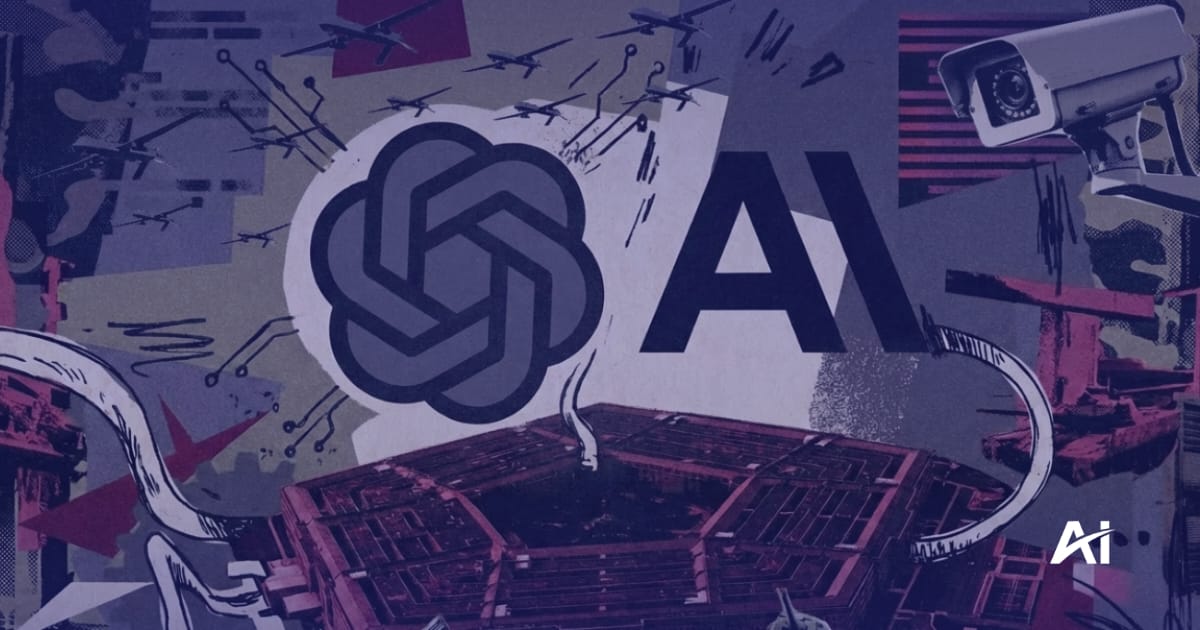
OpenAI has reached an agreement with the Pentagon to deploy its advanced AI systems in classified environments, marking a shift after months of hesitation. At the same time, it developed what it calls stronger safeguards than any previous classified AI deployment. The deal includes technical and contractual protections that OpenAI requested the government extend to all AI companies, including Anthropic, which previously walked away from talks over safety concerns.
🔓 Key Points
OpenAI maintains three firm red lines: no mass domestic surveillance, no directing autonomous weapons systems, and no high-stakes automated decisions like social credit systems—enforced through cloud-only deployment, retained control over safety systems, and cleared personnel oversight.
The contract explicitly prohibits the use of OpenAI models for autonomous weapons where human control is required by law or policy, and limits intelligence activities to foreign targets under strict Fourth Amendment, FISA, and Executive Order 12333 compliance.
OpenAI says it refused to remove technical safeguards to boost performance on national security tasks and deployed cleared forward engineers and safety researchers to monitor compliance, contrasting its approach with labs that reduced guardrails and relied primarily on usage policies.
🔐 Relevance
This sets a precedent for how frontier labs negotiate government contracts while maintaining safety standards. OpenAI's public framing positions cloud-based deployment and retained safety controls as enforceable alternatives to edge deployment or "guardrails-off" models. Companies building AI governance frameworks will watch whether this model becomes standard for classified work or if agencies push back on technical restrictions that limit operational flexibility.
The AI Report Podcast
Stanford Class Recording: How to Master AI Prompting for Creative Filmmaking (Upscaile)
THE BUSINESS BRIEFING: SALES
LILT (AI translation platform, enterprise accounts) was burning 20-30% of rep time on manual prospecting: building lists, researching accounts, and toggling between Sales Navigator, enrichment tools, and Salesloft. Their ADR and AE pods needed better account mapping and multi-channel execution, but tool sprawl was costing money and meetings came almost entirely from cold calls.
Tool used: Amplemarket — unified sales intelligence platform with AI sequencing, signal-based triggers, and social integration.
Result: 56% cost reduction by consolidating legacy tools. 35% of qualified meetings now attributed to Amplemarket. Reps reclaimed 20-30% of their week. Cold call dominance (70-80% of meetings) shifted to balanced multi-channel (55-60% calls, rest from email and social). 3-month payback period.
The lesson: Tool consolidation only works when you replace workflows, not just swap logins. LILT didn't just buy Amplemarket; they rebuilt their prospecting motion around signal-based triggers and AI-assisted sequences that reps actually use.
Steal this: Audit how much time your reps spend switching tools this week. If it's over 15%, you have a consolidation opportunity, not a training problem.
TOGETHER WITH INCOGNI
Unknown number calling? It’s not random…
The BBC caught scam call center workers on hidden cameras as they laughed at the people they were tricking. One worker bragged about making $250k from victims.
The disturbing truth?
Scammers don’t pick phone numbers at random. They buy your data from brokers. Once your data is out there, it’s not just calls. It’s phishing, impersonation, and identity theft.
That’s why we recommend Incogni: They delete your info from the web, monitor and follow up automatically, and continue to erase data as new risks appear.
Try Incogni here and get 55% off your subscription with code AIREPORT
THE POLICY CORNER
Data protection authorities across four continents published a joint statement targeting AI image generation systems that produce nonconsensual intimate imagery. The declaration puts companies like xAI (Grok) and social platforms integrating AI generation tools on notice: creating deepfake content featuring real individuals without consent violates existing privacy laws. Authorities in Canada, the UK, and Hong Kong have already opened formal probes into X and xAI following circulation of millions of AI-generated sexualized images.
Deadline: In effect now across 61 jurisdictions including EU, UK, Canada, Australia, and Hong Kong.
Your move: If your product includes AI image generation, audit whether user-uploaded photos can be processed without explicit consent. Review terms of service and content moderation policies; privacy regulators are coordinating intelligence sharing on compliance failures.
AI News
Microsoft leaks Copilot Canvas, an AI-powered whiteboard: Internal screenshots reveal a freeform workspace with live AI image generation, streaming responses, and enterprise data integration. FULL STORY
Enterprise software spending jumps 15% to $1.4T in 2026: Gartner's latest report credits AI adoption for the surge, with Microsoft 365 commercial cloud revenue up 17% and Azure climbing 39% year over year. FULL STORY
Cognizant partners with Google Cloud to scale agentic AI: The IT services giant will deploy Gemini Enterprise and Google Workspace through specialized centers of excellence to optimize enterprise workflows globally. FULL STORY
NVIDIA leads coalition to build AI-native 6G networks: BT Group, Deutsche Telekom, T-Mobile, and nine other telecom leaders commit to open, software-defined wireless platforms designed for billions of autonomous machines. FULL STORY
Trending AI Tools (sponsored by our tools database)
A curated look at the AI tools quietly transforming how teams work.
Chatnode is for building custom, advanced AI chatbots that enhance customer support and user engagement ⭐️⭐️⭐️⭐️⭐️ (Product Hunt)
Starizon AI is an AI agent for web data scraping and automation
Whisper is OpenAI's speech recognition model for multilingual transcription and translation
The Money: Infrastructure giants bet on open AI stacks
Two of this week's largest AI deals share a common thread: both are backing modular, non-proprietary infrastructure. As enterprises resist vendor lock-in, capital is flowing to platforms that promise interoperability and choice over closed ecosystems.
Deals to know:
Amazon (Equity + Cloud, $50B): Invests $15B now and commits $35B more in OpenAI, tied to $100B AWS cloud expansion over eight years. OpenAI commits 2 gigawatts of Trainium capacity. Investors: SoftBank, Nvidia also in for $30B each.
AMD (Equity + R&D, $250M): $150M equity investment in Nutanix plus $100M for joint engineering. Building open AI platform on AMD Instinct GPUs and EPYC CPUs with Nutanix orchestration, targeting late 2026 launch. Investors: Strategic only.
Signal: Proprietary AI stacks are losing leverage. Investors backing platforms that let enterprises swap models, silicon, and orchestration layers without re-architecting, betting openness wins enterprise wallets through 2027.
Refer a Friend
Latest episode: How to Master AI Prompting for Creative Filmmaking → Listen here
Want to reach 400k+ decision-makers? → Sponsor us
Until next time, Martin, Arturo, and Liam.
P.S. Unsubscribe if you don’t want us in your inbox anymore.