400,000+ business leaders (and teams at IBM, AWS & Zapier) start their day with The AI Report. 5 minutes. Plain English. No hype.
AI Training by Department: What Should Each Team Learn?
A practical breakdown of AI training by department, covering the skills and workflows marketing, sales, HR, finance, operations, IT, & leadership actually need.
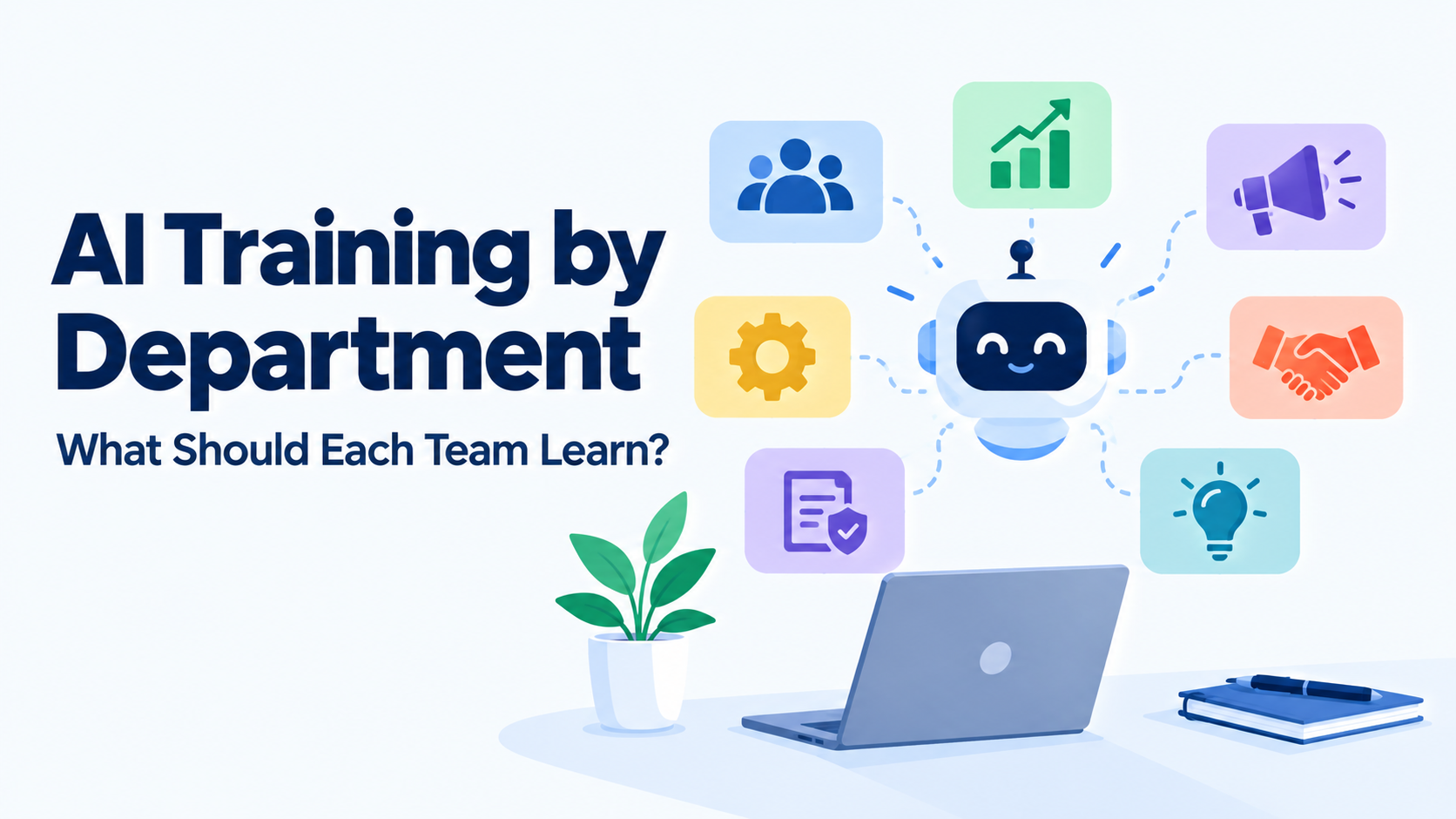

One-size-fits-all AI training is one of the fastest ways to waste a training budget. A generic session on "how to use ChatGPT" might raise general awareness, but it doesn't tell a finance analyst which numbers still need human verification, or tell a sales rep which parts of their pipeline are actually worth automating. Real AI training by department means matching the curriculum to the specific tasks, risks, and tools each team already works with, rather than teaching the same session seven times to seven different audiences.
Here's a practical map of what each function actually needs, and why the differences matter more than they might seem.
Start with the split that matters most: fluency vs. engineering
Before breaking training down by department, one distinction should shape the whole plan. Most employees need AI fluency training: how to prompt well, evaluate an AI tool's output, and decide what to delegate to AI versus keep human-only. A much smaller group, engineers and technical staff building AI-powered products, needs AI engineering training instead, covering things like retrieval systems, agent design, and evaluation pipelines. Conflating these two into one curriculum was a common mistake in earlier AI training efforts, and it's part of why a lot of that training didn't stick. Once that split is clear, AI training by department becomes much easier to design well, since each function below falls almost entirely into the fluency camp, with the partial exception of IT.
Marketing: content velocity and campaign judgment
Marketing teams are typically the earliest and heaviest AI adopters, so training here should move past basic content generation quickly. The core skills worth building are prompt quality for on-brand content, using AI for campaign planning and audience research, and evaluating AI-generated creative for accuracy and tone before it goes out. As more marketing functions move toward AI agents handling routine tasks like customer follow-up and proposal drafting, training also needs to cover where a human review step stays mandatory, since brand and messaging mistakes are public and hard to walk back.
Sales: pipeline judgment over pipeline automation
Sales training under an AI training by department framework should center on lead scoring, AI-assisted deal support, and using AI to prepare for calls and objections, not on replacing the relationship-building parts of the job. The skill that separates strong from weak sales AI adoption is judgment: knowing which leads an AI score can be trusted on and which need a human gut check, and using AI-generated account research as a starting point for a conversation rather than a script to read from.
HR: sensitive data and fairness, not just efficiency
HR sits in an unusual spot. The function is expected to lead AI training for the rest of the company while also adopting AI itself for recruiting efficiency, policy drafting, and employee communication. HR-specific training needs to go further than general fluency and cover privacy, fairness, and bias specifically, since HR teams routinely work with sensitive personal data and decisions that carry legal weight, like hiring and performance evaluation. HR professionals increasingly rank training itself as a top priority this year, which reflects a broader shift: many organizations now see training as a more sustainable way to close AI skill gaps than trying to hire specialized talent in a tight market.
Finance: verification as the core skill
Finance is the department where AI training by department should lean hardest into caution rather than speed. AI is genuinely useful here for budget commentary, variance narratives, cash-flow explanations, and drafting management reports, but finance is also one of the areas where an AI-generated explanation can sound completely convincing while resting on an incorrect assumption. Training should explicitly frame AI as an assistant for drafting and structuring, never an authority on the final number, and should build in a habit of independently verifying any calculation, forecast, or financial conclusion before it's used for a decision.
Operations: workflow mapping before tool rollout
Operations teams benefit most from AI training that starts with process mapping rather than tool tutorials. The useful skill here is identifying which repetitive, high-volume steps in a workflow are strong automation candidates, and which involve enough judgment or exception-handling that a human needs to stay in the loop. Training that jumps straight to "here's how to use this automation tool" without that mapping step tends to produce automations that look impressive in a demo but don't hold up against real operational edge cases.
IT: the closest thing to a hybrid curriculum
IT is the one function that typically needs a blend of fluency and technical training. Most IT staff need the same AI fluency baseline as other departments for their own day-to-day work, but a subset, particularly anyone supporting AI tool rollouts, integrations, or security review, needs deeper technical training covering things like agent permissions, data governance, and how the AI tools other departments are adopting actually handle information. IT training under an AI training by department plan should also cover a governance role: IT is often the team best positioned to see across departments and flag when tools are being adopted independently in ways that create security or integration risk.
Leadership: strategy and adoption, not hands-on tool use
Executives and managers generally don't need the same hands-on prompting practice as their teams. What they need is strategic AI training focused on adoption planning, governance, and how to interpret ROI reporting from the functions below them. Leadership training that's too technical misses the point, and leadership training that's purely inspirational without addressing governance and risk tends to produce enthusiastic sponsorship without the guardrails that keep department-level adoption safe.
Build a shared foundation, then branch
The most effective approach to AI training by department isn't seven completely separate curricula built in isolation. It's a shared fluency foundation, covering prompting basics, output evaluation, and delegation judgment, that every employee gets, followed by a department-specific layer covering the tools, risks, and workflows unique to that function. Sharing AI success stories across departments also matters more than most training plans account for: a workflow that works well in one function often adapts cleanly to another, and building shared AI infrastructure where possible avoids the cost and integration headaches of every department adopting tools independently.
Keep your training plan current
The specific tools and skills that belong in AI training by department are shifting quickly as new capabilities and new risks emerge across every function. Subscribe to The AI Report for ongoing coverage of how organizations are training their teams and what's actually working department by department, so your curriculum stays current as the landscape keeps moving.