400,000+ business leaders (and teams at IBM, AWS & Zapier) start their day with The AI Report. 5 minutes. Plain English. No hype.
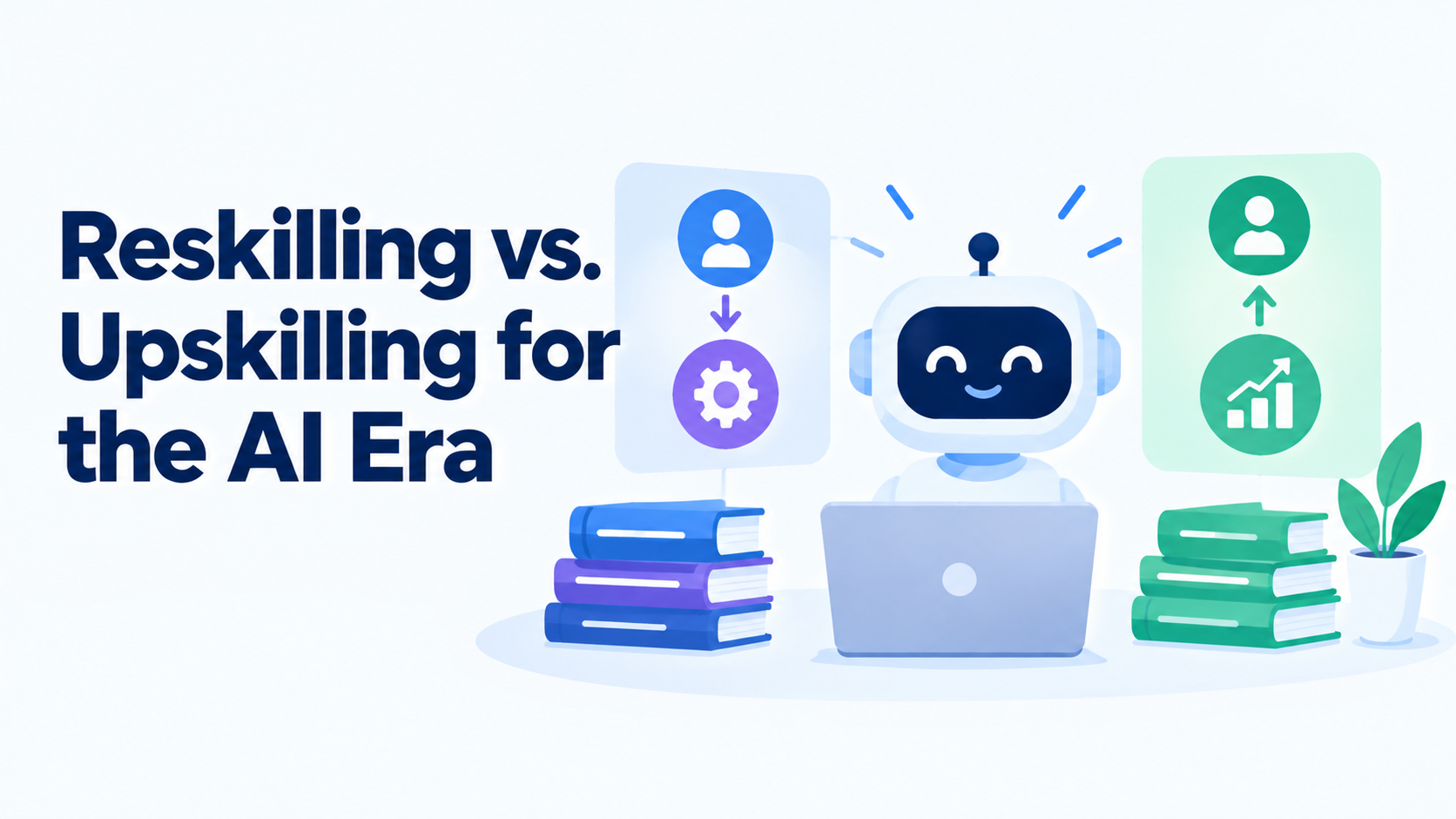
Reskilling vs. Upskilling for the AI Era
A practical look at reskilling vs. upskilling for the AI era, drawing on real company decisions from PwC, Laurel, monday.com, and UserTesting.

Ask most AI leaders whether their workforce needs deeper training in existing skills or a genuine rebuild into new ones, and you'll get a confident-sounding answer. Michael Domanic, Head of AI at UserTesting, gives a more honest one. Asked directly whether AI will take people's jobs, his answer is explicitly "we don't know," which he frames as both the bad news and the good news, an argument for treating the uncertainty honestly instead of defaulting to a reassuring or alarmist talking point. He also pushes back directly on a comparison other AI leaders lean on constantly: the Industrial Revolution. He points out that period played out over roughly 80 genuinely painful years for the people living through it, and argues leaders should stop using it as a comforting analogy for how AI-driven job disruption will actually go.
That honesty is a better starting point for reskilling vs. upskilling than most frameworks offer, because the real answer depends heavily on what a specific role is actually for, not on a general industry prediction.
Upskill toward the purpose of the job, not the task
The clearest framing for this distinction came from a story an Adobe partnerships executive relayed from NVIDIA CEO Jensen Huang's keynote at the same conference. Huang used radiology as a case study: despite predictions that AI-assisted scan reading would eliminate radiologist jobs, there are actually more radiologists today, because reading a scan was never the actual purpose of the role. The purpose was disease detection. AI took over the mechanical task and elevated people toward the higher-purpose work underneath it.
This is the cleanest test available for reskilling vs. upskilling at the role level. If AI is automating the mechanical task sitting on top of a role, the answer is usually upskilling, deepening a person's ability to do the higher-purpose work the mechanical task was always in service of. The same executive applied this to his own career, noting his early job literally involved copy-pasting ad tags from spreadsheets, work AI now handles, freeing him for the actual partnership strategy underneath it. Reskilling becomes the answer only when there's no higher-purpose layer left to move into, when the entire function was the mechanical task itself.
Use real data to find out who's actually in their zone of genius
Jason Li, CTO of the legal and accounting timekeeping company Laurel, offered a genuinely data-driven way to make this call rather than guessing. Laurel's product generates granular data on what knowledge workers actually spend their time on, and Li argues most companies default to standardized, cookie-cutter role definitions purely because they're easier to manage at scale, not because they're optimal. With real time and outcome data, an organization might discover that one person is an exceptional lead-generation specialist buried inside a standard mixed role, and should be freed to focus entirely on that strength rather than continuing to split their time.
That's upskilling in its purest form: not training someone in something new, but using real data to let them go deeper into what they're already best at, once AI has cleared away the parts of the role that were diluting their time. The same data, used differently, is also how you'd identify a genuine reskilling case, someone whose current role has largely disappeared into automation with no adjacent strength to build on, which is a very different conversation than someone whose role just needs to shed its lower-value tasks.
Watch for the group that needs deliberate reskilling investment
Scott Likens, PwC's Chief AI Engineer, has a useful way of identifying exactly where this decision gets hardest inside a real organization. He describes AI adoption splitting into three groups: leadership at the top, largely bought in already, digitally native junior staff at the bottom, adopting AI on their own without much prompting, and a "frozen middle" of established, skilled employees with ten to twenty years of experience. This middle group is the hardest to move, not because they lack capability, but because they're already comfortable and successful with their existing methods.
This is precisely the group where the reskilling vs. upskilling question needs the most deliberate answer, rather than an assumption that enthusiasm at the top and bottom will eventually carry them along. For most of the frozen middle, the honest answer is upskilling: their domain expertise is exactly what makes an AI tool trustworthy rather than dangerous, and the goal should be layering AI fluency onto expertise that already works, not asking them to abandon it.
Reskilling in practice often looks like a change in self-positioning, not a change in skill set
Roy Mann, CEO of monday.com, described a concrete internal story worth sitting with. A developer on his own team was initially terrified watching an AI agent implement and deploy UI fixes faster than he could read the change requests. Within a week, the same employee shifted from feeling he was competing with the agent to feeling he now operated it. Mann attributes this shift explicitly to a change in how the employee positioned himself relative to the process, not to any change in the underlying technology.
This matters because a lot of what gets labeled "reskilling" in these situations isn't actually a new technical skill at all. It's a psychological and role shift, from doing the task to directing and supervising the tool that now does it. Training programs that treat this purely as a technical skills gap, more prompting practice, more tool tutorials, can miss the real barrier, which is often about identity and role rather than raw capability.
What actually predicts who adapts well
Tudor Achim, CEO of the formal-math AI company Harmonic, offered a genuinely contrarian data point on this. He states directly that CVs now carry almost zero predictive signal for hiring decisions at Harmonic, and that early production-relevant programming experience, meaning people who were coding from a young age, is one of the only detectable positive correlates they've found with strong performance. Separately, Domanic at UserTesting made an anecdotal but consistent observation of his own: employees who already have creative hobbies outside work, painting, music, woodworking, tend to be the fastest internal adopters of AI tools, offered explicitly as a personal pattern rather than a validated study finding.
Neither of these is a rigorous predictor on its own, but together they suggest something worth building into a reskilling vs. upskilling decision: comfort with open-ended, self-directed problem-solving, whether from early coding experience or a creative hobby, seems to matter more than formal credentials when predicting who adapts fastest. That's a more useful signal for identifying who to invest deeper upskilling in than tenure or job title alone.
Sequence the investment instead of doing it all at once
Domanic also laid out a three-phase roadmap for where UserTesting is headed next, which doubles as a useful sequencing model for any reskilling vs. upskilling plan: continued tool adoption first, then connecting institutional knowledge to AI, and only after that, orchestrating agents into actual business workflows. The mistake many companies make is trying to jump straight to the third phase, full workflow automation, before the first two are solid. Upskilling generally belongs in phase one and two, building fluency and connecting AI to what your best people already know. Reskilling becomes necessary mainly once phase three genuinely restructures a role, not before.
Keep learning from what's actually happening inside these companies
The honest answer to reskilling vs. upskilling is rarely a clean rule. It's a case-by-case judgment call that real operators are still actively working out. Subscribe to The AI Report for ongoing, firsthand coverage of how companies are actually making these calls, straight from the people making them.