

400,000+ business leaders (and teams at IBM, AWS & Zapier) start their day with The AI Report. 5 minutes. Plain English. No hype.
Aaron Mitchell Finegold, Adobe: AI Agents, Trust and Brand
Adobe's Aaron Mitchell Finegold on why generative AI without guardrails erodes brand integrity, how agents earn trust, and why work may mean fewer screens.
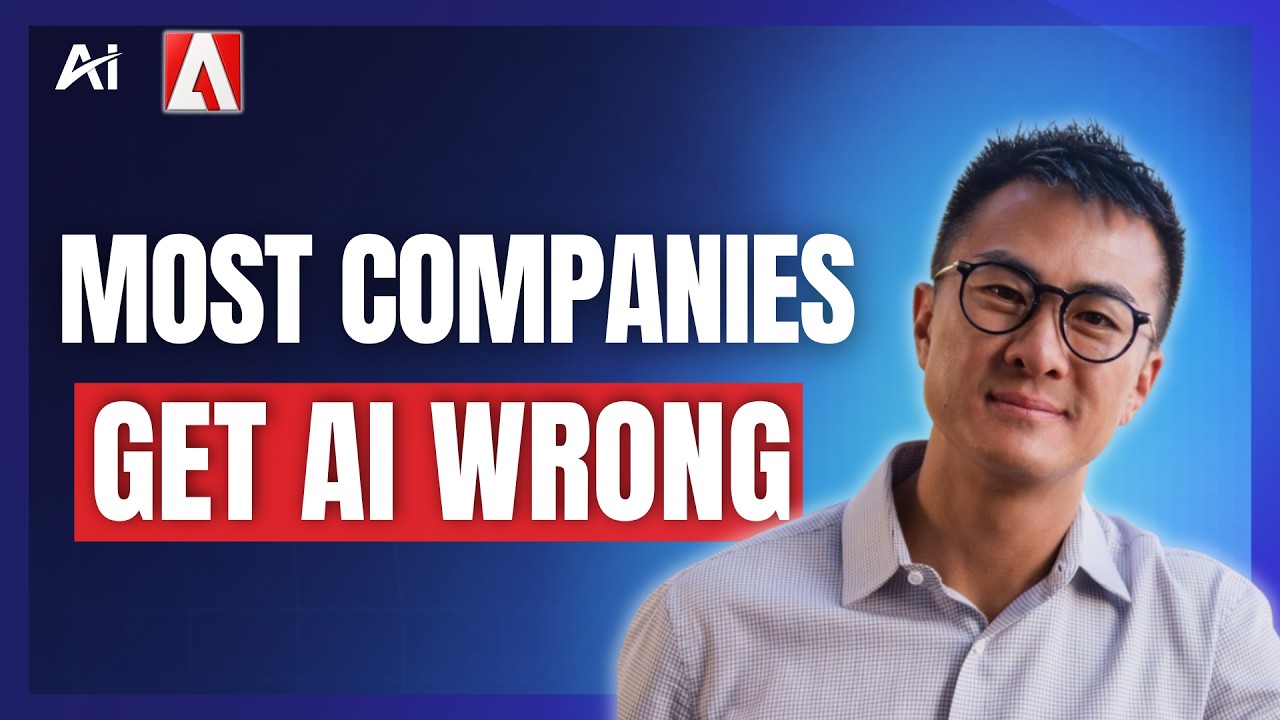

Watch on YouTube · Listen on Spotify or Apple Podcasts
Aaron Mitchell Finegold, Head of Product Marketing at Adobe, says generative AI used without guardrails erodes brand integrity, and that each enterprise should decide which work goes to AI agents and which needs human judgment. Recorded at Adobe Summit, he tells host Liam Lawson how Adobe Brand Intelligence turns a brand's tribal knowledge into something agents can act on, and why he expects the future of work to involve less interaction with machines, not more.
Key takeaways
- Generative without guardrails leads to negative ROI. Applied selectively and judiciously in pockets, generative AI can unlock scale. When anyone on the creative team can use any model, it erodes quality and brand integrity. (04:54)
- Humans and agents now share one workflow. In Adobe's agentic content supply chain, each step from the creative brief to the activated asset can be assigned to an agent, such as the Firefly Creative Production agent, or to a named team member. (06:01)
- Mission-criticality decides who does the work. The choice depends on which work an enterprise feels needs human discernment, judgment and accountability, and on how much tolerance the enterprise has. (07:38)
- Brand knowledge is learned from decision traces. Adobe Brand Intelligence trains on creative feedback, rejections, reviews and approvals, in some cases 800,000 annual annotations, rather than relying only on static PDF guidelines. (09:43)
- Taking a brand somewhere new stays human. A shift in tone, voice or brand personality is a decision only a human can make. The intelligence layer captures what the brand is and has been. (11:05)
- Agents earn trust by showing up consistently. Once agents have got 99 or 100 of the last 100 tasks right, organizations will let them do more autonomously. (13:52)
- Curiosity plus discernment is the winning combination. Aaron looks for hands-on curiosity about new AI capabilities, paired with the discernment to protect a brand built over decades. (19:58)
What does a varied career bring to AI product marketing?
Aaron Mitchell Finegold says his untraditional path gave him the breadth the role needs. Having been a global chief marketing officer at an executive search firm, he knows his customers' pains around attribution, journey optimization and content at scale, including how frustrating it is when going from brief to content activated in the channel takes four months. McKinsey taught him frameworks, structured thinking and a hypothesis-led approach, and working with product and engineering at LinkedIn showed him how software moves from idea to shipped product.
His hands-on AI experience started at that search firm, whose ambition was to be the world's first AI native executive search firm, with a tech and ML team building LLMs fine-tuned for the executive talent domain. At Adobe, his team and business unit now run AI demo days every month. It is two hours out of the month, but it creates a self-reinforcing incentive: people learn the latest capabilities, build something and show it, with leadership on the call to recognize them.
Why does generative AI without guardrails hurt brands?
The biggest misconception Aaron Mitchell Finegold sees is that generative AI is the answer to everything. Sophisticated enterprises are realizing that generative AI applied selectively and judiciously in pockets can be immensely helpful and unlock scale.
The problem comes when it is too democratized. If anybody in the creative team can access any model, he says, the result is eroded quality and brand integrity, and ultimately negative ROI.
What is an agentic content supply chain?
An agentic content supply chain is a content workflow where each step can be handed to either a human or an AI agent, explains Aaron Mitchell Finegold. The workflow runs from the marketing or creative brief to final assets being activated in channel, stored in the DAM and tracked with analytics, with every step in between.
On a Monday morning, he says, that looks like a screen listing steps one through nine, with a column for each step and a column for who does it: the workflow optimization agent, the Firefly Creative Production agent, or a team member. He calls that ability to assign work across multiple agents the first step in orchestration and agent management, and a really big leap forward.
When should a task go to an AI agent instead of a human?
Aaron Mitchell Finegold says the decider is each enterprise's preference for which work requires a human level of discernment, judgment and accountability, and which it is happy to make agentic. Adobe gives customers options: mostly acceleration with some automation in pockets, or a lot of work running fully autonomously.
The technology allows for both. Where a company lands depends on how mission-critical the task is and what tolerance the enterprise has.
How does Adobe Brand Intelligence capture brand knowledge?
Adobe Brand Intelligence codifies the tribal knowledge, subjectivity and judgment that usually live in the heads of a few people, normally chief brand officers or executive creative directors, says Aaron Mitchell Finegold. It uses specialized computer vision models governed by a reasoning engine, so agents can act on a human's behalf with that brand knowledge informing what they do. Adobe views this as foundational for all agentic marketing.
One of the most important training inputs is what Adobe calls decision traces: creative feedback, rejections, reviews and approvals, plus the commentary captured alongside them. When a creative director says an asset is factually on brand but spiritually not something the company could put out, and explains why, the system learns from it. After seeing, in some cases, 800,000 annual annotations, it understands how a brand exists in practice, not just how it appears in 200, 400 or 800 pages of static PDF guidelines.
Where does AI stop and human creativity start?
Intelligent risk-taking stays with people, says Aaron Mitchell Finegold. Moving a brand in a new direction, whether a subtle move or a major shift in tone, voice, creative expression or personality, is a decision humans should be making and, for the foreseeable future, will be making.
What the intelligence layer does well is capture the decision logic and pattern recognition up to now: what the brand is and has been. Taking it somewhere new is something only a human can decide.
Why might the future of work mean less time with machines?
Aaron Mitchell Finegold imagines the future of work involving a lot less interaction with machines. If a machine truly understands his objectives, context and day, it can take care of the busy work autonomously and free him to focus on human relationships, trust and intimacy, which he says machines will never be able to replace.
He pictures less time with a screen or even a voice agent and more time with people, building the trusted relationships that are the foundation of business. When the means of production are democratized and many companies can bring the same offering to market at the same speed, he argues, trust and relationships become the differentiating factor.
How do AI agents earn trust?
Aaron Mitchell Finegold offers two definitions of trust. One is showing up consistently over time. The other is a formula: reliability times intimacy times credibility, all over a denominator of self-orientation. A zero in any numerator factor breaks it, and as self-orientation grows, trust shrinks. For humans, he says, self-orientation is paramount: you have to believe the other person has your interests at heart.
For agents, consistency matters most. People will let systems do more autonomously once they have got 99 or maybe 100 of the last 100 tasks right. Deterministic software earned trust easily because people knew exactly what would appear on screen. Agentic capabilities are more autonomous and so less deterministic, which means a higher hurdle to clear. He suggests the numerator of his equation, reliability, credibility and intimacy, may be one way to evaluate how trustworthy an agent is.
How do you make generative AI workflows reliable?
Asked by Liam how Adobe makes sure its outputs are always reliable for customers, Aaron Mitchell Finegold says it depends on the workflow. Deterministic workflows are easy to trust because the relationship between input and output is well understood. Workflows with probabilistic steps, such as generated video or images, object compositing or gen expand, are less predictable.
That is where Brand Intelligence comes in. Its validate skill is available as a node in the Firefly Creative Production experience, so a workflow with generative steps, for example one that turns a single asset into 100, can end with an agent checking every output. A human reviewing 100 assets would fatigue and get distracted; the agent won't. It might find 98% are perfect and two have a problem, such as text that is not legible because the color contrast is too low, and send them back to be fixed. That, he says, is how you reach reliability and, as a lagging indicator, trust with enterprise customers.
What personality traits thrive in AI-driven work?
Aaron Mitchell Finegold names two traits. The first is immense curiosity: staying up to date not just with AI news but with how to use these tools. Building skills from folders of Markdown files, applying them to your own context and watching agentic capabilities run, make mistakes and get corrected is, he says, a far better teacher than reading about the theory.
The second, in the enterprise, is discernment. Many capabilities are coming online, but teams also have a brand to steward, in some cases a blue-chip brand more than 100 years old, and they are responsible for making sure its equity is not eroded by off-brand content. Curiosity and experimentation paired with an understanding of the enterprise bar, he says, will make someone extremely successful.
In his words
"generative without guardrails, generative when it's just anybody in the creative team having access to any model is gonna actually erode and degrade quality and brand integrity, which is ultimately gonna result in negative ROI." (04:54)
"those are decisions that humans should be making and for the foreseeable future, humans will be making." (11:05)
"I actually imagine the future of work being a lot less interaction with machines." (12:33)
"in a world where the means of production are democratized, and a lot of companies can get the same product or the same offering to market at the same speed, trust and relationships are gonna be the differentiating factor." (12:33)
"A human will take a long time to look at 100 assets and they'll fatigue and they'll get distracted. The agent won't." (17:08)
Chapters
00:00 Intro and Aaron's background
03:01 Hands-on experience building with AI
04:41 The biggest misconception about generative AI
05:38 What an agentic content supply chain looks like
07:30 When should AI agents replace humans?
08:40 How Adobe's Brand Intelligence works
10:44 Where AI starts and human creativity ends
12:09 Aaron's vision for the future of work
13:41 What trust means for humans and AI agents
16:34 Reliability, AI systems and enterprise adoption
19:34 The personality traits that will thrive in the AI era
21:38 Wrap-up
About the guest
Aaron Mitchell Finegold is Head of Product Marketing at Adobe, working at the intersection of enterprise AI, agentic workflows and brand intelligence. Before Adobe he was global chief marketing officer at an executive search firm that set out to be the world's first AI native executive search firm, and his earlier career includes McKinsey and LinkedIn, where he worked closely with product and engineering. Aaron on LinkedIn
About the host
Liam Lawson is CEO of The AI Report and host of The AI Report Podcast. Meet the team
Full transcript
Edited for readability. Quotes above are word for word from the recording.
The episode opens with short clips from the conversation.
Aaron Mitchell Finegold (00:00): There are all of these traditional offline businesses who will have AI native versions of themselves start to pop up now and be successful, because they are able to handle both revenue-generating activities and more operational activities in an AI native...
Liam Lawson (00:14): I've been hearing a lot about you talking about the agentic content supply chain. For someone who hasn't heard that term before, what does it actually look like?
Aaron Mitchell Finegold (00:23): We now have the ability to assign steps in that workflow to either human or agentic collaborators. Generative without guardrails is going to actually erode and degrade quality and brand integrity, which is ultimately going to result in negative...
Liam Lawson (00:38): If I have the option between an agent and a human, I know the agent's going to get it perfect every time. Why would I ever choose human?
Aaron Mitchell Finegold (00:43): I actually imagine the future of work being a lot less interaction with machines. And the reason I say that is because...
The interview begins.
Liam Lawson (00:57): Aaron, welcome to the podcast.
Aaron Mitchell Finegold: Great to be here. Thanks for having me.
Liam Lawson (01:01): I did my research on you beforehand, and I'm curious about you as an individual. You've done McKinsey strategy, LinkedIn product, working in LLM development and now enterprise AI marketing. It's a pretty varied path. What does someone who's done all of that bring to a product marketing role that's not normally there?
Aaron Mitchell Finegold (01:20): I'm so glad you asked. I am untraditional, I suppose, as a profile for this role, but I really do think all of my experiences led me to having the exact breadth of experience I need to be successful in it. Specifically, having been a global chief marketing officer at an executive search firm prior to this gives me a lot of empathy for my customers. I know the pains they're going through around attribution, journey optimization and content at scale. I understand how frustrating it can be to go from brief to content activated in the channel, and that takes four months. So I'm deeply familiar with a lot of the challenges. I've solved a lot of them, and even the ones I haven't solved, I have a great deal of understanding for what they're going through.
I think McKinsey taught me frameworks, structured thinking and a hypothesis-led approach. I'm very grateful, because it provides the backbone and the structure for everything I think and do. At LinkedIn, I worked closely with product and engineering, as you said, and that gave me a very good understanding of how software is developed, how things move from idea to being shipped, and what it means to really apply a quality bar and a customer-centric lens to product development.
Liam Lawson (03:01): I'm really curious about your hands-on experience with AI. I know when you were at Kingsley Gate, you were building LLMs, or very close to that. And you're orchestrating these multi-agent workflows now. So for you as an individual, what does hands-on experience look like?
Aaron Mitchell Finegold (03:17): For me, one of the things that drew me to Kingsley Gate was that company's ambition to be the world's first AI native executive search firm. The proximity to the tech and ML team there, who were, as you said, building LLMs fine-tuned for the talent domain, and the executive talent domain specifically, was really interesting. And then, of course, as the CMO, I was figuring out how to tell that story.
I've applied a lot of that learning to what I do today, not just from the functional lens of knowing what a marketer goes through, but in understanding what it means to be successful in the world of AI. We've implemented a lot of things within my team and within our broader business unit. For example, we now have AI demo days every month. It is a very small act, two hours out of the month, but it creates a self-reinforcing incentive system where people are encouraged to learn about the latest capabilities, build something and then show it in the demo. We have leadership on the call, so people get recognition for having done that. It's one of those small things that is a component of being successful in this ever-changing AI landscape.
Liam Lawson (04:41): When you're translating what AI can do, there must be a lot of conversations where you have to repeat yourself, and common threads where you have to explain how AI works. What do you think people fundamentally don't get?
Aaron Mitchell Finegold (04:54): The number one thing I'm seeing is that certain people think generative is the answer to everything. What really sophisticated, smart enterprises are starting to realize is that generative, when applied selectively and judiciously in pockets, can be immensely helpful and can really help unlock scale. But generative when it's too democratized, generative without guardrails, generative when it's just anybody in the creative team having access to any model, is going to actually erode and degrade quality and brand integrity, which is ultimately going to result in negative ROI.
Liam Lawson (05:38): I've been hearing a lot about you talking about the agentic content supply chain: multiple agents being orchestrated. For someone who hasn't heard that term before, what does it actually look like on a Monday morning, when someone sits down, wants to look at their brand assets and is working with agents?
Aaron Mitchell Finegold (06:01): There are two things we've recently introduced that help make the idea of the agentic content supply chain real. There are more than two, but I'm going to talk about two because they're very pragmatic and potentially easier to understand. The first is in a content supply chain workflow that starts with the marketing brief or the creative brief and ends with final assets being activated in channel, stored in the DAM and marked as activated, with analytics coming back, and all the steps in between. My colleague Ravi spoke about this in my session on the agentic content supply chain on Monday. We now have the ability to assign steps in that workflow to either human or agentic collaborators.
So, as you asked, what does it look like on Monday morning? That is what it looks like. You can literally see a screen that says these are steps one through nine. The next column is what the step is. The last column is who you want to do it. Do you want this to be the workflow optimization agent, the Firefly Creative Production agent, or your team member, Maggie? That ability to assign work across multiple agents, which is the first step in orchestration and agent management, is, I think, a really big leap forward.
Liam Lawson (07:30): What is the decider here? If I have the option between an agent and a human, I know the agent's going to get it perfect every time. Why would I ever choose a human?
Aaron Mitchell Finegold (07:38): There are a lot of tasks that should be agentic-led and a lot that should be human-led. The decider is essentially that enterprise's preference for what work requires a human level of discernment, judgment and accountability, versus other things the organization is very happy to have be agentic. One of the things I have believed for a long time at Adobe, and that I'm seeing more and more people say here at Summit, is that we give our customers options. You can have things that are mostly acceleration and a little productivity gain, with maybe automation in pockets, or you can be on the other end of the spectrum and have a lot of things running fully autonomously. The technology allows for both, and it really is a matter of how mission-critical the task is and what tolerance the enterprise has.
Before we move on: I mentioned the one thing, which is assigning tasks. The other thing I want to touch on is that, as we said earlier today, for the content supply chain to become agentic, it needs access to deep enterprise context and brand intelligence. We've now made that real. With our Adobe Brand Intelligence product, which just went GA on Monday, we've taken all of that tribal knowledge, all the subjectivity and all the judgment that usually lives in the heads of a few people, normally chief brand officers or executive creative directors, and found a way to codify it in an ontological understanding, using specialized computer vision models governed by a reasoning engine. That allows agents not only to take action on a human's behalf, but to have that action be deeply informed by brand intelligence, which we view as foundational for all agentic marketing.
Liam Lawson (09:34): Explain that on a first-principles basis for me. You have that person with all this knowledge and 30 years of experience. How are you actually capturing that data?
Aaron Mitchell Finegold (09:43): We train this intelligence layer on a number of different artifacts, and maybe one of the most important is what we call decision traces: all of the creative feedback, rejections, reviews and approvals, and all the commentary captured alongside them. Whenever creative directors say this asset is nominally on brand, it's factually on brand, but spiritually it's not something we could ever put out to market, and here's why, our system learns from that. It pieces together patterns, much like a human does, across many different surfaces and touchpoints to say: now that I've seen, in some cases, 800,000 annual annotations, I understand how this living, breathing brand actually exists in practice, not just how it shows up in the 200, 400 or 800 pages of static PDF guidelines.
Liam Lawson (10:44): I think that works in two buckets. The bucket we're speaking about now is 90% of the work: making sure that what goes out is on brand, perfect and stylistically on brand. But when you think about great marketers, they usually do things that haven't been done before. So where does AI start and finish?
Aaron Mitchell Finegold (11:05): That is a great question. What we acknowledge is the exact craft of intelligent risk-taking, of pushing the brand in a new direction. Say you have a Super Bowl spot, though actually many of our enterprise customers would never advertise on the Super Bowl. Say you have any opportunity to move the brand, to your exact point, in a new direction: to move the creative expression or the brand personality somewhere different, whether it's a subtle move or something really major, such as a shift in tone and voice. Those are decisions that humans should be making, and for the foreseeable future, humans will be making. What the intelligence layer is able to do so well is capture all of the decision logic and pattern recognition leading up to the current point in time, which says this is what the brand is and has been. But moving it in a new direction is something only a human can decide.
Liam Lawson (12:09): I want to get personal for a second. I think about the future of work a lot and what I want it to look like. I love conversation. I love that we're sitting down and talking right now. Podcasting is part of my job. My version of the future of work is that I come down, speak to a laptop and things happen. What do you imagine the future of work looking like in an enterprise context?
Aaron Mitchell Finegold (12:33): I actually imagine the future of work being a lot less interaction with machines. The reason I say that is because if a machine truly understands my objectives, my context and my day, it can take a lot of action autonomously on my behalf, taking care of a lot of the busy work, or even the semi-busy work, and allowing me to focus on human relationships: trust and intimacy, things that machines will never be able to replace. So I can imagine a world in which a lot less of my day is spent interacting with a screen or even a voice agent, and much more of my day is spent with humans, maybe with no machines around, getting to know people and building those trusted relationships, because those relationships are the foundation of business. In a world where the means of production are democratized, and a lot of companies can get the same product or offering to market at the same speed, trust and relationships are going to be the differentiating factor.
Liam Lawson (13:41): I want to stop on that word, trust. It's a bit of a vague question, but what does trust mean in the context of humans? What does it mean in the context of agents? And how is that different?
Aaron Mitchell Finegold (13:52): I've heard many different definitions of trust. One that is somewhat basic, but easy to understand, is the idea of showing up consistently over time. Another is that trust is reliability times intimacy times credibility, all over a denominator of self-orientation, if I've got that right. The factors in the numerator are all multiplicative, so if you have a zero in any of them, it doesn't work. And as the denominator grows, the overall quotient shrinks. I think both feel relevant. For humans, that idea of self-orientation is paramount: when I'm talking to you, I have to have some belief that you care about me and have my interests at heart, at least more than 0%.
For agents, the first definition, showing up consistently over time, is a lot of how we're going to start to say these systems can do more autonomously. We knew they were always capable, but we're going to allow them to do more autonomously because they've shown us they've gotten 99, or maybe even 100, out of the last 100 tasks correct. Now suddenly we feel comfortable. With deterministic software, we've come to expect that when we take a certain action, drag and drop or typing, we know exactly what's going to appear on the screen. So it was very easy in the early days of software to get comfortable with that level of trust. Agentic capabilities are a lot more autonomous, and so by definition they're less deterministic. We are going to have a higher hurdle to clear.
But once we've seen that pattern of repeated reliability, maybe for agents you think about the numerator in my trust equation: reliability, credibility and intimacy. Intimacy is how well you know me and my context. Credibility is how well you can actually access intelligence and expertise. And reliability is how often you make an error versus get things right. If you think just about the numerator, and I've evolved my answer a little as I was speaking, that equation feels to me like one way we might evaluate the level of trustworthiness for agents.
Liam Lawson (16:34): Reliability is something that's on my mind a lot. I use Claude, and I'm automating things through skills and workflows. That all works perfectly, and then their systems get overloaded, my AI is dumbed down, and it feels like the goalposts are changing a lot. In your experience, what are you actually using on the back end? Is it a proprietary model, or are you step-functioning to different models? How do you make sure that when a customer comes to you, you're always reliable in your outputs?
Aaron Mitchell Finegold (17:08): That goes back to exactly what we were saying: different enterprises are going to want to use different capabilities. Some workflows are deterministic by nature, both the authoring of the workflow and the specific nodes. Those workflows are very easy to trust, quote unquote, because the relationship between the input and the output is very well understood.
Then there are others where more probabilistic elements are introduced, whether that's generated video, generated image, object compositing, gen expand, outpainting, whatever it may be. These workflows are a little more questionable, in that you don't know exactly what the output will be. If you run a workflow where you take one asset and create 100, and there was a generative element in there, you don't know exactly what is going to show up in the final output. That's where brand intelligence starts to play a role, and where having the validate skill from Brand Intelligence available as a node in the Firefly Creative Production experience is so helpful. Now I can say: this is my workflow, there are 12 steps, and some of them maybe have generative components. Maybe there's a resize with gen expand, and later the creation of a new background. I would love for that validate node, which draws on deep brand comprehension from Brand Intelligence, to look at 100 assets. A human will take a long time to look at 100 assets, and they'll fatigue and get distracted. The agent won't.
So that node looks at the 100 assets and says: of these, 98% are perfect, but two have problems. That's because what you've generated is a little unpredictable. As you know, you can use the same prompt multiple times and get different results. So an agentic capability that can look at that and say, in this case the text is not legible in this area because the color contrast is too low, we're going to go back and fix it, is immensely valuable. That's how you get to that level of reliability and, hopefully, as a lagging indicator, trust with enterprise customers.
Liam Lawson (19:34): One of the through lines of our conversation is that work is changing a lot compared to five years ago, 10 years ago, even three years ago when ChatGPT was first released. I'm constantly interested in what kind of people are most set up for success. In your experience working with customers and with people at Adobe, what personality traits are most in tune with this new version of work?
Aaron Mitchell Finegold (19:58): That is a great question. The first is immense curiosity and a desire to learn and absorb all of the changes going on, and to stay as up to date as possible, not just with the latest news, but with how to actually use and implement these things. You talked about skills: creating folders with Markdown files, applying those to your individual context, letting those agentic capabilities run, make mistakes, correcting them and seeing them in action is going to be an immensely better teacher than endlessly hearing or reading about the theory.
In the enterprise context, the other trait I would say is immensely important is discernment. A lot of things are coming online, and we can apply a lot of them, but we also have a brand to steward and protect. In some cases it's a blue-chip, 100-plus-year-old brand. We are responsible for ensuring that the equity and value injected into this brand over decades doesn't get eroded because we allowed content that is antithetical to the brand personality, message and expression we want to put into the market. So I think pairing curiosity, continuous learning and experimentation with a real understanding of what the enterprise bar is, those two things together, will make someone extremely successful.
Liam Lawson (21:38): Aaron, thank you for your time. Appreciate it.
Get the five-minute AI briefing
Join 400,000+ business leaders who start their weekday with The AI Report. Subscribe free
