400,000+ business leaders (and teams at IBM, AWS & Zapier) start their day with The AI Report. 5 minutes. Plain English. No hype.
ADVERTISE | PODCASTS | LAUNCH GUIDE | B2B TRAINING


Hey
Welcome to The AI Report — the #1 AI newsletter for business leaders.
You don’t need to be technical. Just informed.
• 1. 🤖 Learn how to replace dashboards with AI Agents from Cube
• 2. ⚡️ DeepMind exposes AI web traps
• 3. 💼 Your Business Briefing
• 4. 📕 Build AI capability with the Leaders Launch Guide
• 5. ✍️ Today’s Policy Corner
• 6. 🗞️ The News Bulletin
Are you ready to launch AI transformation for your company?
TOGETHER WITH CUBE

Learn How Brex, Patagonia, and Jobber Are Replacing Dashboards with AI Agents
AI agents can now autonomously build data models, answer questions, create reports, and dashboards.
At the Agentic Analytics Summit, data leaders from Brex, Patagonia, Jobber, and Cube share exactly how they're building AI-native analytics in production: what worked, what broke, and what they'd do differently.
You'll hear how:
Brex built an AI financial analyst that answers questions in seconds, not days
Patagonia is modernizing analytics inside a mission-driven organization
Cube is using the semantic layer to eliminate AI hallucinations
This isn't theory. These are practitioners shipping real products to real users. The summit is virtual and free.
Latest in AI

DeepMind exposes AI web traps
🚨 Our Report
Google DeepMind has published a systematic framework called "AI Agent Traps" that catalogs how ordinary web content can be weaponized to mislead, control, or exploit autonomous AI agents. The research identifies six classes of attacks and argues that the open internet should be treated as a hostile surface by default.
🔓 Key Points
The framework covers six trap categories, including hidden instructions in HTML, bot-detection content that serves agent-specific payloads, and behavioral-control sequences that can trigger purchases or unwanted API calls.
Attacks can also poison retrieval stores used in RAG pipelines, meaning false data gets treated as ground truth in future sessions, creating persistent skew in agent behavior.
The researchers note that model-level defenses like prompt filtering don't fully address the threat, because agents cannot rely on human-visible rendering to detect malicious elements buried in machine-readable content.
🔐 Relevance
For teams deploying browsing or tool-using agents, this research reframes the threat model entirely. DeepMind recommends treating the web as adversarial by default and redesigning agent architectures to minimize trust in unauthenticated content. Practical mitigations include content provenance checks, sandboxed tool invocation, memory integrity audits, and human review gates for irreversible actions. The paper shifts attention from model internals to the agent environment as the primary risk vector.
The AI Report Podcast
90% of Enterprise Data Is "Dark" — Here's How Google Unlocks It | Yasmeen Ahmad
THE BUSINESS BRIEFING: MARKETING (powered by Upscaile)
Ashley Stewart (mid-market plus-size fashion retailer) was burning ad dollars with rising costs and flat sales. Imprecise targeting and stale creatives drove up acquisition costs while engagement dropped. They implemented Performance Max campaigns with AI-powered bidding, automated creative refresh cycles, and full UTM attribution tracking.
Tool used: Google Performance Max — AI-driven campaign optimization across Search, Display, YouTube, and Shopping with automated bidding and creative rotation.
Result: 400% increase in ROAS. Cost per conversion dropped $2.94. Generated 13,800+ additional purchase events and $1.16M in incremental revenue within 12 months.
The lesson: AI bidding only performs when attribution is clean and creatives stay fresh. Ashley Stewart spent upfront time fixing UTM tracking and building a creative refresh schedule before letting automation run.
Steal this: Audit your UTM parameters this week. Fix broken or inconsistent tracking codes, then set a 14-day creative refresh calendar before turning on automated bidding.
📘 Move from AI consumer to AI operator
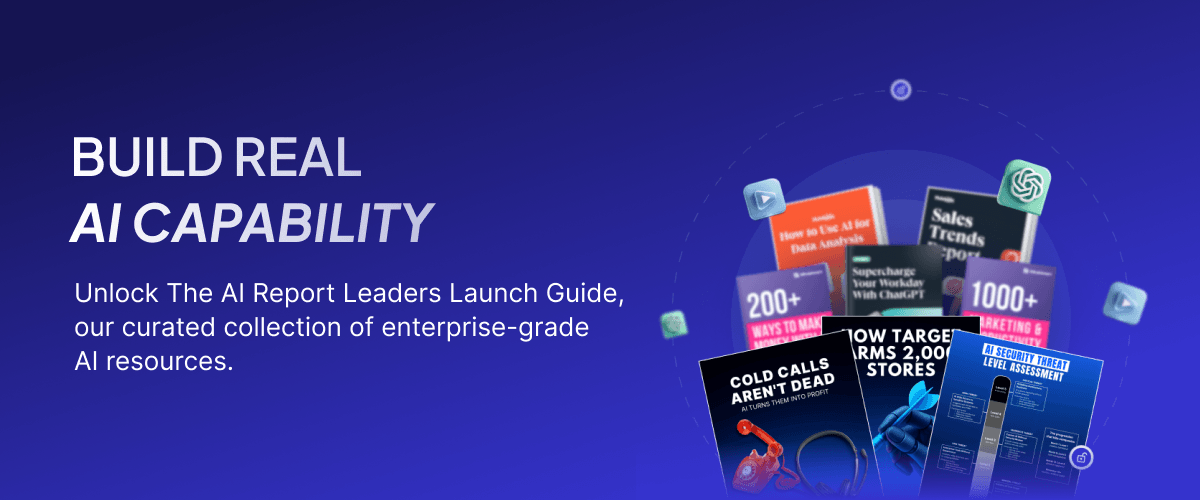
Get the AI Leaders Launch Guide, including:
• 16-lesson implementation guide
• HubSpot AI playbooks
• AI tools quick-start
• 5 custom GPTs
THE POLICY CORNER
OpenAI must provide Canada's AI Safety Institute full access to all model protocols and safety systems following a February incident in which a ChatGPT user banned for concerning interactions evaded the ban with a second account before committing a mass shooting. AI Minister Evan Solomon confirmed the institute is reviewing OpenAI's systems and preparing a report. The order applies to any AI company operating in Canada whose models can be accessed by Canadian users.
Deadline: In effect now. Formal report and compliance framework expected within 60 days.
Your move: If your company operates AI models accessible in Canada, audit your account suspension systems this week, verify users can't create duplicate accounts and confirm you have protocols to escalate high-risk behavior to law enforcement.
AI News
🏆 PwC study reveals AI value concentration: Just 20% of organizations capture 74% of AI-driven economic value, with top performers 2.6x more likely to reinvent business models and 7.2x better at financial performance. FULL STORY
🤖 Meta develops AI clone of Mark Zuckerberg: Digital version trained on CEO's tone, mannerisms and company strategy to help 79,000 employees "feel more connected" and get internal information faster. FULL STORY
🌾 USDA sponsors Grok for government deployment: Agriculture Department becomes first agency to push xAI's chatbot through FedRAMP security reviews for data analysis, research and operational efficiency despite ongoing safety concerns. FULL STORY
☁️ Cloudflare integrates GPT-5.4 into Agent Cloud: Partnership enables enterprises to deploy OpenAI-powered AI agents for customer support, system updates and reporting at edge locations with global scalability. FULL STORY
Trending AI Tools (The Full 2026 Tool Stack PDF Included Here)
A curated look at the AI tools quietly transforming how teams work.
Alumni Ventures: co-invest in AI, Deep Tech & Quantum with top-tier VCs.
JenAI Chat is an ad-free Android AI chat app with voice interaction and educational tools
Prefixbox is an AI-driven search and discovery platform for enterprise retailers
⚡️ Looking for the exact AI tools our team uses to run The AI Report?
We just launched the 2026 AI Tool Stack…
The Money: Infrastructure bets trump model builders
Three of the past week's largest AI deals targeted the compute layer and chip design, not LLMs. As hyperscalers lock in multi-year capacity at investment-grade terms and RISC-V challengers secure $400M rounds, capital is signaling that AI's next bottleneck isn't intelligence, it's infrastructure.
Deals to know:
SiFive (Series G, $400M) -- RISC-V chip designer building AI data center CPUs to replace power-hungry legacy architectures. Valued at $3.65B. Investors: Atreides Management, NVIDIA, Apollo Global Management, T. Rowe Price
CoreWeave (Multiple facilities, $12B+ in debt/equity) -- GPU cloud provider closed $21B Meta commitment (2027–2032), $3.5B convertible notes, and $8.5B delayed draw term loan at investment-grade. Investors: undisclosed high-yield and convertible debt buyers
Signal: Smart money betting AI's constraint shifts from model capability to physical compute capacity. Companies solving power efficiency and capital-intensive infrastructure will command premium valuations and investment-grade financing through 2028.
Thoughts on today's edition?Hit me up on LinkedIn, I read every message. |  |
Refer a Friend
Latest episode: 90% of Enterprise Data Is "Dark" → Listen here
Want to reach 400k+ decision-makers? → Sponsor us
Until next time, Arturo and Liam.
P.S. Unsubscribe if you don’t want us in your inbox anymore.