400,000+ business leaders (and teams at IBM, AWS & Zapier) start their day with The AI Report. 5 minutes. Plain English. No hype.
How Managers Can Lead AI Adoption Without Employee Resistance
A practical guide to leading AI adoption in the workplace without triggering resistance, drawing on real rollouts at OneDigital, Adobe, PwC, and monday.com.
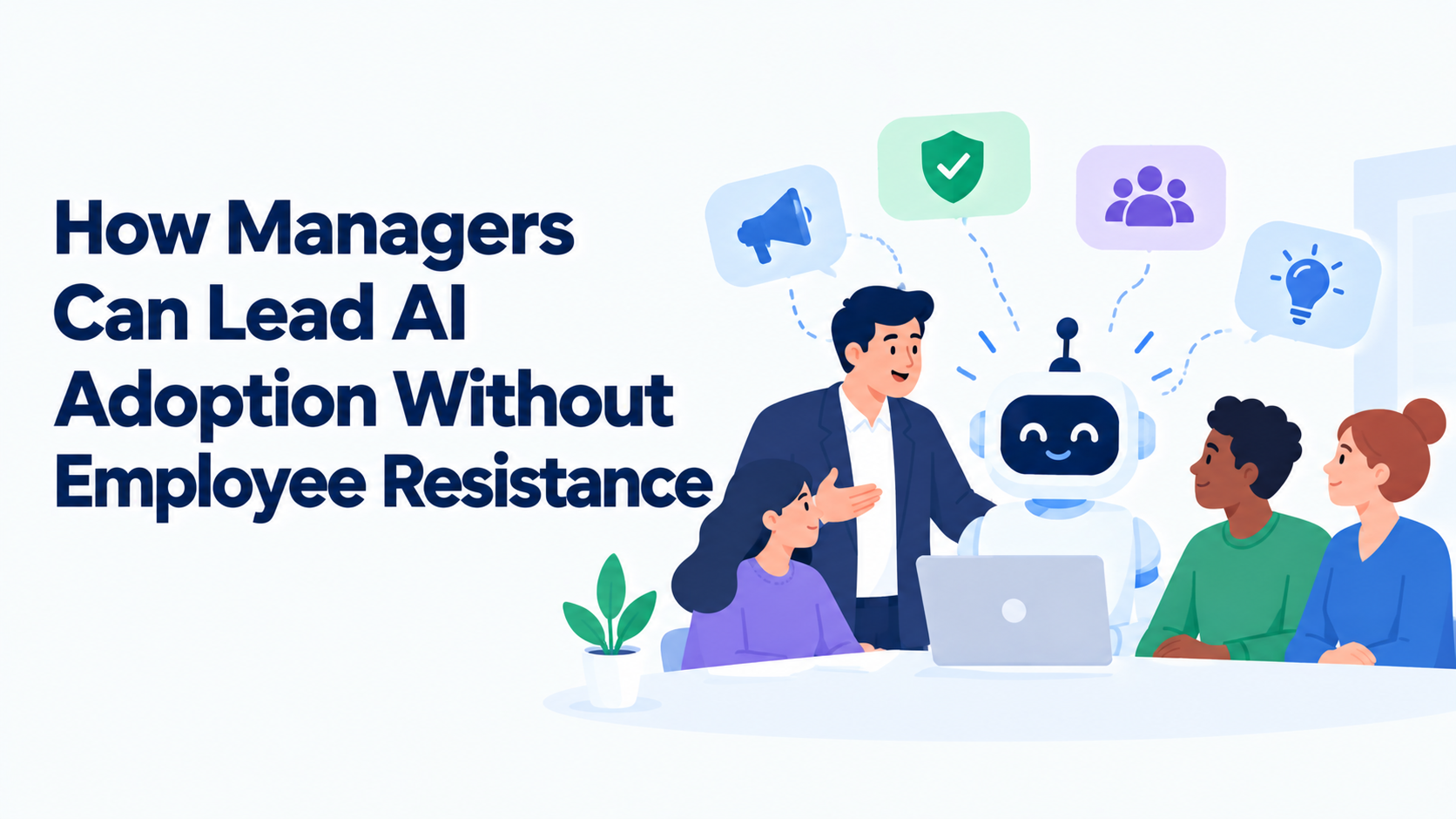

Most resistance to AI adoption in the workplace doesn't come from employees rejecting the technology outright. It comes from how the rollout gets communicated, whether people get to experiment safely before being judged on results, and whether the framing sounds like a threat to their job or an investment in it. A handful of operators who've actually run these rollouts have specific, tested answers for each of those pressure points.
Frame the objection correctly before you try to answer it
Scott Likens, PwC's Chief AI Engineer, has a direct way of handling the most common form of resistance he hears from clients: concern about hallucination risk as a reason to slow down or avoid adoption. His pushback is blunt: "people hallucinate too." His point isn't that hallucination doesn't matter. It's that treating it as a uniquely disqualifying flaw in AI, when humans make comparable errors constantly, usually signals the real objection is something else. He argues the more productive question for a manager to ask a resistant team isn't "what could go wrong," but "what do you want changed." That reframe moves the conversation from abstract risk to a concrete, ownable outcome, which is a much easier conversation for an employee to engage with honestly.
Likens also names the group inside most organizations where this resistance concentrates: a "frozen middle" of established, skilled employees with ten to twenty years of experience, sitting between leadership at the top, who are usually already bought in, and digitally native junior staff at the bottom, who tend to adopt AI on their own without much prompting. The frozen middle isn't resistant because they lack capability. They're resistant because they're already comfortable and successful with methods that work, which means AI adoption in the workplace needs a different pitch for this group specifically, one built around their existing expertise rather than around replacing it.
Model the behavior yourself before asking your team to
OneDigital's Mike Sullivan and Vinay Gidwaney have a concrete internal data point worth building directly into a manager's own rollout plan: teams whose managers actively use AI themselves see their own AI usage roughly double, compared to teams where a manager mandates adoption without visibly using the tools. That single finding is why they run their own rollout leadership-first rather than bottom-up. If a manager wants to reduce resistance to AI adoption in the workplace, the most direct lever isn't a training session. It's using the tools visibly and often enough that the team can see it isn't being asked of them from a distance.
They also frame the language around adoption deliberately to avoid triggering the fear that drives resistance in the first place. Rather than measuring or messaging success around token usage or hours saved, both of which can read as thinly veiled headcount justifications, they anchor their internal communication around two qualitative ideas: the gift of time back, and better insights. It's a small distinction, but it changes what the rollout sounds like to the person receiving it, an investment in their day rather than a countdown to their replacement.
Give people a low-stakes way to experiment before judging results
An enterprise marketing team at Adobe runs a specific ritual worth adapting directly: monthly "AI demo days," a deliberately small, two-hour recurring session where employees are incentivized to learn a new AI capability, build something with it, and present it live to leadership for recognition. It works because it separates experimentation from evaluation. Nobody's building a demo to be judged on production output. They're building it to learn, in public, with a built-in reward for trying.
Michael Domanic, Head of AI at UserTesting, ran a related but distinct model at a larger scale. Rather than a top-down curriculum, UserTesting put minimal guardrails on who could build a custom GPT, and adoption spread mainly through hackathons where subject-matter experts built tools for their own workflows live and then showed peers directly. Over 600 custom GPTs got built across an roughly 800-person company within a single month during the early rollout, driven almost entirely by peer demonstration rather than mandate. For a manager trying to reduce resistance, the shared lesson from both examples is the same: give people room to build something small and low-stakes for themselves first, and let visible peer results do the persuading, rather than leading with a mandate.
Redesign the workflow around how people actually think, not just what the tool can do
Ian, VP of Adobe Express, offered a useful caution against a common mistake in workflow redesign: assuming a fully conversational, AI-only interface is the end state everyone should be pushed toward. He argues the current conversational creative interface is a first version, not a finished design, because people cognitively process decisions differently. Some need to see rendered visual options before they can refine a direction, citing his own wife needing to see actual renders during a home renovation because she couldn't describe her preferences verbally in advance. Others are precise and language-oriented and prefer direct prompting from the start.
The resistance-reduction lesson here applies directly to workflow redesign as part of AI adoption in the workplace: forcing every employee into a single new interface or process, regardless of how they naturally think through a problem, creates friction that looks like resistance to the technology but is actually a mismatch with how a specific person works best. A redesigned workflow that offers both a conversational path and a more direct, hands-on path tends to meet less resistance than one that assumes everyone wants the same interaction style.
Build trust through a real stake in the outcome, not just a training session
Swati Trehan, co-founder of the AI automation company Emma, described a rollout example from their enterprise customer Hitachi that goes further than most training programs attempt. Rather than simply deploying an AI assistant for employee support and calling it done, Hitachi ran a company-wide vote, across roughly 300,000 employees, to name their internal AI assistant "Skye" and deliberately shape its conversational personality. That's a genuine change-management move, not a marketing gesture. Giving employees an actual say in what the tool becomes, even something as small as its name and tone, gives them a stake in its success rather than a rollout that simply happens to them.
Expect the trust shift to take longer than the skill shift
Roy Mann, CEO of monday.com, shared an internal story that illustrates why resistance often outlasts the actual learning curve. A developer on his own team was initially terrified watching an AI agent implement and deploy UI fixes faster than he could read the change requests. Within a week, the same employee shifted from feeling he was competing with the agent to feeling he now operated it. Mann attributes the shift specifically to a change in how the employee positioned himself relative to the process, not to any change in the technology itself over that week.
For a manager, the practical takeaway is patience with a specific kind of resistance: the technical skill to use a new tool often comes quickly, but the psychological shift, from feeling replaced by a tool to feeling like its operator, tends to take longer and needs to be actively supported rather than assumed to happen automatically once training is complete.
Keep learning from how real managers are handling this
The specific tactics that actually reduce resistance to AI adoption in the workplace are still being worked out in real time by the people running these rollouts. Subscribe to The AI Report for ongoing, firsthand coverage of how managers are actually leading this shift, straight from the people doing it.