

400,000+ business leaders (and teams at IBM, AWS & Zapier) start their day with The AI Report. 5 minutes. Plain English. No hype.
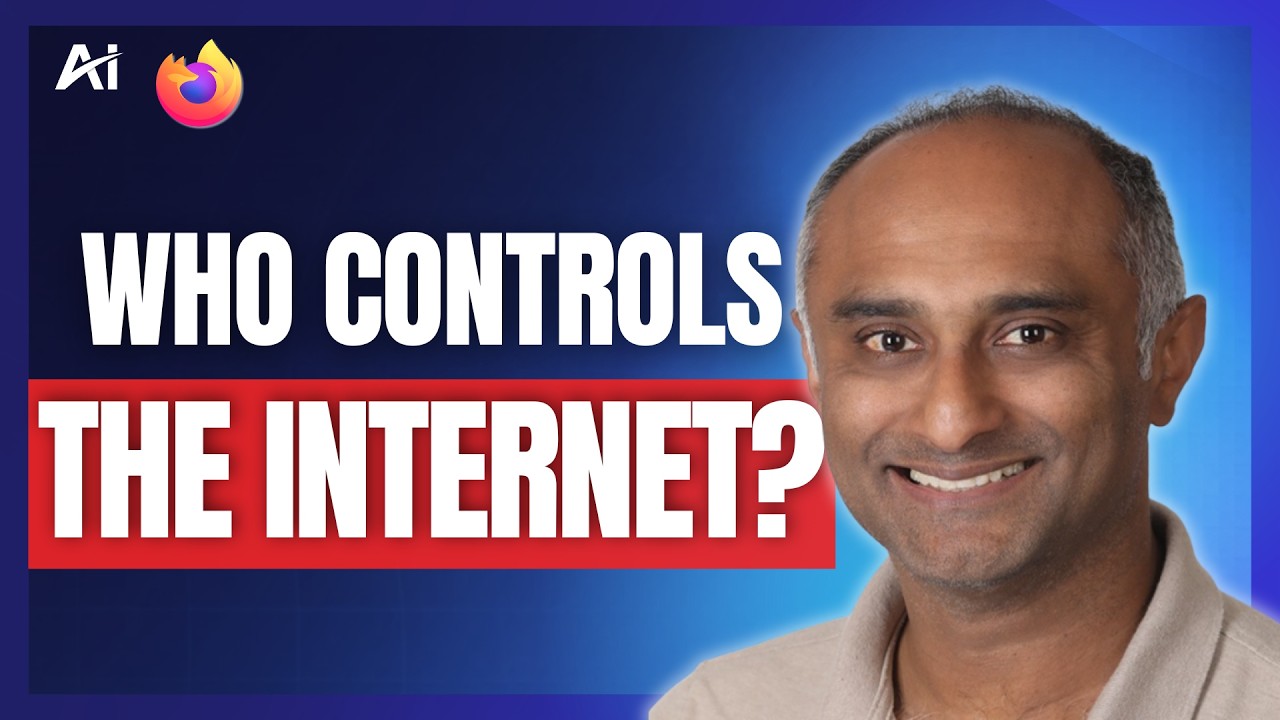
Ajit Varma, Firefox: AI Browsers, Model Choice and Privacy
Head of Firefox Ajit Varma on keeping AI opt-in in the browser, letting users pick any model, and why he believes open systems will win over time.

Watch on YouTube · Listen on Spotify or Apple Podcasts
Ajit Varma, Head of Firefox, says the AI era makes an open, competitive internet more important: browsers should keep AI optional and let people pick any model, instead of tying them to one company's assistant. He tells host Liam Lawson why Firefox is "not an AI company", how it wants to make privacy something users can feel, and why he believes open systems will win over time.
Key takeaways
- Every AI feature is opt-in. Many people want AI and many do not, so Firefox forces nothing on users. Its AI controls work as a kill switch that hides AI entirely while letting people add back features such as translations. (08:34)
- Pick your model, or bring your own. Smart Windows offers three model choices, from fast to balanced to more powerful, powered by models that can include open source models like Qwen, Google models or OpenAI models. Power users can point it at any model, including a local one. (08:34)
- Firefox is a browser company, not an AI company. For rival browser makers, AI adoption ranks higher in their hierarchy of needs than the browser, so AI is forced in and tied to their own model: ChatGPT in OpenAI's browser, Gemini in Chrome, Copilot in Edge. (06:15)
- Shareable "flavors" of Firefox. Firefox planned to look at letting anyone share their browser setup as a single link, so people can follow an influencer's or a company's setup instead of working through hundreds of settings. (12:50)
- Privacy has to be felt. Ajit says Firefox is the most private browser but, like Signal, does a poor job explaining it. The fix is simpler messaging and product cues, such as telling users nobody can see their browser history, not even Firefox. (28:07)
- Competition keeps AI cheap. With hyperscalers estimated to spend $750 billion on infrastructure this year, Ajit says intense competition is what keeps AI commoditized, and he advises using several AIs rather than going all in on one. (45:20)
- Open systems win over time. Consolidation in steel, oil and railroads 120 to 130 years ago was broken open by regulation. Today Firefox is doing well in Europe, where preventing consolidation and digital sovereignty are priorities. (21:51)
What is Firefox's mission, and why does the browser engine matter?
Ajit Varma says Firefox exists to build the best browser in order to preserve an open internet: one built on open standards that nobody controls. Firefox runs on its own engine, Gecko, while Google's and Microsoft's browsers are built on Chromium and Apple's Safari on WebKit. Open web standards mean there are no gatekeepers deciding how people reach the billions of others online. Mobile platforms are different: Android and iOS each set their own standards, and that entrenchment lets the app stores charge access fees and commissions.
The engine renders everything inside the frame of a web page, which is what makes rich web apps possible. Ajit traces this back to Netscape and the early Firefox years, when Internet Explorer had stagnated and Gecko's rich features helped make apps like Google Maps and Gmail possible. The work is not finished. New standards aim to let web apps compete with downloaded apps on speed and performance, and newer protocols such as MCP raise the question of websites built for agents as well as humans. Firefox is pushing for these to be open standards, so people can switch to any AI they want.
How does Firefox handle AI in the browser?
Firefox keeps every AI feature opt-in, says Ajit Varma, because many users want AI and many do not, whether over its functionality or over societal and environmental concerns. He argues Firefox can do this because it is "not an AI company", while for rival browser makers AI adoption ranks higher in their hierarchy of needs than the browser itself. That is why OpenAI's browser was built around ChatGPT, and why Gemini is tied to Chrome and Copilot to Edge.
Firefox started small, with features such as Shake to Summarize on mobile, link previews and suggested names for tab groups, plus translations, which many people do not think of as AI. Before launching its larger Smart Windows feature, Firefox built AI controls: a kill switch that hides AI entirely while letting users add back features such as translations.
Smart Windows opens with a choice of model. There are three options, from fast to balanced to more powerful, each powered in the background by a different model, which can include open source models like Qwen, Google models or OpenAI models. Power users can point it at any model they want, including a more private local model. Ajit says he does not think any other browser offers that kind of flexibility.
Why should people be able to choose their AI model?
Ajit Varma says model choice is about more than reliability: every model has its own personality, tone and biases, and if everyone asked the same model the same question and got the same answer, the world would be a boring place. Liam Lawson raises the risk of building a business on a single model that then suffers an outage, and Ajit agrees. Firefox has experimented with letting people adjust the temperature setting of its open source models, from super creative to super conservative, though it has not shipped that yet. Ajit can imagine a future where people fine-tune AI themselves.
How can Firefox get past the power of defaults?
Ajit Varma says most people never ask themselves which browser to use. They simply use the one they have, with no equivalent of the Coke-or-Pepsi moment in a grocery store. One answer Firefox planned to explore later in the year is making it easy to share a "flavor" of Firefox: a set of settings for privacy, gaming or AI, packaged as a single link. A company such as Anthropic could create its own flavor instead of building a separate browser, and influencers or passionate users could share theirs with their audiences, so people get a tailored browser without going through hundreds of settings.
Voice is also on the table, starting on mobile. On desktop, Ajit says muscle memory is strong. When Firefox removed the address bar in favor of a single entry bar in Smart Windows, many users found it too much of a change, so any voice features will add to the interface rather than replace it.
Why did Ajit Varma join Mozilla?
Ajit Varma joined Mozilla because Firefox combines scale with individual impact. He has alternated between big tech, startups and founding his own company, and says big companies offer scale with little individual impact, while startups offer the reverse. Around 3 billion people use a browser every day, he says, and at Firefox he can help make the internet better for them.
He also believes the open web needs protecting. Facebook, Google and OpenAI's ChatGPT all started as websites and succeeded because no gatekeeper stood in front of them, whereas crypto apps were not allowed on app stores. He calls duopolies the worst outcome, because they look like competition without really being competition, and points to Mastercard and Visa, and Apple and Google, as examples. Because Firefox is not motivated by shareholders or by maximizing profits, he says it can stay mission driven.
Will open systems win as AI consolidates?
Ajit Varma believes open systems will win over time, even though tech is consolidating. He compares today with consolidation in steelmaking, oil and railroads 120 to 130 years ago, which government regulation broke open by forcing standards and openness. Today Firefox is doing well in Europe, where there is a push to prevent consolidation and digital sovereignty is a growing concern.
Open source still underpins a lot, he says, from Linux and SQL to coding and development tools, but there are only a handful of consumer examples. Its branding problem is really a convenience problem: open source products often lack the profit margins to be the easiest option. Firefox's aim is to remove the trade-off, so users get a browser as good and as fast as any other while supporting one that matches their values.
What is "felt privacy"?
Felt privacy, as Ajit Varma describes it, is the set of cues in a product that help people understand how private it really is. He says Firefox is the most private browser but, much like Signal, does not do a good job explaining it. At WhatsApp he saw that most people think Telegram is the most private messenger because of features like secret chats, even though Signal is the most private.
Firefox's private browsing disables third-party trackers and uses enhanced tracking protection, yet Chrome's Incognito mode, which shows none of the caveats, can seem more private to users. Firefox has launched a VPN and email masking, and plans simpler messaging such as: nobody can see your browser history, not even Firefox. Visual cues, like a window that burns away when it is closed, can make a browser feel more private without changing anything. Ajit wants people to be able to trust Firefox's commitments without learning technical terms, knowing that because it is open source they can verify them.
What do people really want from technology?
People want convenience and want technology to go into the background, says Ajit Varma. They have a job to get done, and products help most when they make that job simple. He calls it a fallacy that more features make things easier, and warns against getting in users' way with steps, such as account sign-ups, that serve an internal metric rather than the user.
He is wary of AI that creates work: people spending more effort setting up agents than the task itself would take, and AI-generated documents that sound good but do not connect. If an agent sends far more emails, someone still has to read them, and in coding the bottleneck has moved from writing code to reviewing it. The hope, he says, is that AI reaches the point where agents can handle that review without a human.
How does Ajit Varma use AI?
Ajit Varma uses AI mostly to get started: generating ideas and getting past the writer's block problem, then editing the results with his own intuition. He used vibe coding to build a site for his wife's small business in about 20 minutes, work he says would have taken a lot of effort five years ago. AI also removes some of the context switching that makes coding hard for managers, which he says brings him back to the craft. He wants a world with fewer managers and more builders and creators.
Can AI make the economy fairer?
Ajit Varma says AI has to be built for humanity rather than for maximizing corporate profits. His hope is that AI takes on the work people do not want to do, so a chef who opens a restaurant can cook while AI agents handle brand strategy, marketing and taxes. As a startup founder he spent his time on leases, fundraising and hiring instead of engineering, and he believes AI could let hundreds and thousands of people run their own companies.
The risk is consolidation. Hyperscalers are estimated to spend $750 billion on infrastructure this year, and at some point that has to be paid for. He points to ride hailing and streaming as markets that became more expensive once a few players owned them. Intense competition between Anthropic, OpenAI, Google, Microsoft, Meta and others is what keeps AI commoditized. Without it, the value of replaced human labor could accrue to a few companies and create a handful of trillionaires. His advice is to experiment with all the AIs rather than going all in on one.
He thinks things may get worse before they get better, but expects Firefox's focus on choice, including not preferring its own LLM, to matter more as rivals show what they optimize for. A new CMO, he says, is bringing ideas Firefox has not tried before.
Why does Ajit Varma do what he does?
Ajit Varma says he got into technology to make people's lives better, and for him that means freedom: anyone who works hard should be able to create the life they want, without being held back by nepotism, inheritance or the power of governments and companies. He sees Firefox, and every job he has had, as part of creating a level playing field. He also describes Firefox as a community product, built together and "owned by everyone".
In his words
"We are not an AI company. We are a browser company." (06:15)
"Duopolies make it seem like there's competition, but there's really not" (19:29)
"Open systems will win over time because that's what users ultimately want." (21:51)
"You don't need to compromise on quality in order to do that." (25:13)
"It's not owned by anyone. It's owned by everyone." (55:26)
Chapters
00:00 Intro and the mission behind Firefox
02:09 Browser engines and why they matter
04:48 AI, browsers and the future of the web
05:58 Why Firefox takes a different approach to AI
11:15 User choice, AI models and customization
16:40 Why Ajit joined Mozilla
21:13 AI competition, consolidation and the future of tech
25:07 Does open source have a branding problem?
28:07 Privacy, customization and Firefox users
34:26 Product design, simplicity and consumer behavior
39:40 How Ajit uses AI personally
41:53 AI, entrepreneurship and the future of work
53:07 Why do you do what you do?
About the guest
Ajit Varma is Head of Firefox at Mozilla, where he works at the intersection of AI, privacy, open source software and the future of the internet. He has worked in product at Meta, including WhatsApp, as well as Google and Uber, and has also founded his own company and worked in startups. Ajit on LinkedIn · Firefox
About the host
Liam Lawson is CEO of The AI Report and host of The AI Report Podcast. Meet the team
Full transcript
Edited for readability. Quotes above are word for word from the recording.
Liam Lawson (00:00): All right, Ajit, welcome to the podcast.
Ajit Varma (00:03): Hi, nice to meet you, and thanks for having me on.
Liam Lawson (00:07): It's an absolute pleasure. I want to start off broad. Firefox is one of those major browsers that's not controlled by Apple, Google or Microsoft. For someone who maybe hasn't thought about Firefox in a couple of years, how do you describe what Firefox is today?
Ajit Varma (00:29): Our mission is that we're building the best browser in order to preserve an open internet. An open internet means an internet that's not controlled by anybody. It's built on open standards. Any developer can build to those standards, and anyone can build a browser or a browser engine that can render and meet those standards.
Our engine is called Gecko. A lot of the competitors are built on Chromium, which is what Microsoft and Google are built on, and Apple's Safari is built on something called WebKit. People often don't really think about what a browser engine is. But the reason it's so important is that these open standards make sure there aren't gatekeepers that define how you can access and connect with all the other billions of people in the world.
Most platforms aren't like that. It's very special. If you look at mobile, another mobile operating system is almost impossible to create today, because Android has all its own standards, iOS has all its own standards, and developers are not going to invest so much money to build for another platform. So you have this entrenchment, and that allows things like the stores to create gateways and charge access fees and commissions.
That's why the open internet is such an important thing for us. That's the mission of Firefox and why we were created: to make sure there aren't gatekeepers and that we preserve access to this great resource called the internet.
Liam Lawson (02:09): I love the mission. I want to understand more about the engine. When people think about browsers, Safari and Chrome work because they work, and Firefox works because it works. Explain how the engine intersects with the browser, how they work together and what that actually means.
Ajit Varma (02:29): You can think of the engine as everything that's inside the frame. Say you type a URL into your address bar and go to Google Docs. Within that frame, the engine is rendering the code that Google Docs, or Maps, or anyone else has built. The browser also encompasses things around that frame: split tabs, vertical tabs, looking at your history, saving your passwords, a VPN, which we recently launched. The engine is what makes more powerful sites and web apps possible.
I'll rewind a little bit of history. Firefox is originally based on a company called Netscape, which was one of the first successful browsers. It was acquired and then spun off into an open source project, which is the genesis of Firefox. Around that time you saw a stagnation in development of the browser engine. People who remember the Web 1.0 days will remember static sites: here's some context, you tap a link and you get some more context.
Rich apps were really not possible. Internet Explorer had stagnated because Microsoft didn't really have an incentive to create a better internet. It moved most of its people off the browser onto other projects, because it wanted people to install applications, which helps the operating system. So Firefox, with the Gecko engine, started building all these rich features, and that's what made apps like Google Maps and Gmail possible. People don't think about it today, but the ability to drag a map, have things render and have JavaScript power it all became possible.
People sometimes ask, isn't it all done? What is there left to build? But surprisingly, there are so many standards that are continuously being pushed, and some of the exciting ones we're building are about how you create richer and richer applications that
Ajit Varma (04:48): feel faster and are more powerful. Ultimately the hope is that all web apps can compete with any natively downloaded app in performance and speed, and there's still a lot of progress to be made in the richness of applications. A lot of our development in the engine is about making that better.
Then we get into the new, interesting stuff. With the shift to AI, people want to interact with the internet in different ways, so you get new protocols. One is called MCP, which is basically about whether people are going to build websites that are not just for humans but also for agents. These are all new standards that are coming up, and a big thing we're pushing is to ensure they are open standards, versus consolidating on the preferences of any of the big OSs. You can see a lot of them pushing their own AI standards, whereas we are very much pushing open standards, so that you can switch to any AI you want.
Liam Lawson (05:58): I'm curious about that. From what I understand, when someone uses Firefox, they have the choice to use whatever AI model they want when they're searching. Explain a little more about that from the user experience perspective.
Ajit Varma (06:15): We're very early in understanding how people want to use AI within a browser. There have been a lot of attempts, but nothing has really stuck with users yet. It's a lot of experiments. Within Firefox, we understand that there are a lot of people who want AI, and a lot of people who don't want AI at all. That can be for a variety of reasons: they don't like the functionality, or they're worried about societal or environmental concerns about AI.
That's one of the benefits we have at Firefox: we are not an AI company. We are a browser company. For a lot of the other browser companies, when you look at what I call their hierarchy of needs, their AI adoption and success is probably a higher need than their browser success. So you see a lot of forced integration of AI, tied to their own AI. When OpenAI launched a browser, guess what? It was all built on ChatGPT, it was very integrated, and you couldn't really do anything else. You see this with Gemini and Chrome, and with Copilot and Edge.
Our position is that nothing is forced on users at all. Any of the AI features that are coming are an opt-in experience: you have to take an affirmative action to enable them. We've also been starting small. On mobile we have something called Shake to Summarize, which lets you summarize a page. We have link previews, and productivity features like looking at your tab groups and suggesting names. There are also features people may not even think of as AI, like translations. A lot of people say, I love translations, but I hate AI. Most translations are AI driven now. So we want people to be able to pick and choose whichever features they're interested in.
The longer-term thing we have is something called Smart Windows, and I'll talk a little about that. But the sequencing we did was this.
Ajit Varma (08:34): Before launching Smart Windows, we built something called AI controls. This is almost what we call a kill switch. If somebody doesn't want to be upsold and doesn't want to see AI at all, they can turn on the kill switch, add back anything they want, like translations, and then we won't show anything else. But the future is very likely that AI will have such a big, positive, transformative impact that many people are going to want these powerful features. It's really important to understand what the trade-off is, and often the trade-off is that you're giving data to a model to get this context and this power.
Smart Windows is basically an icon in the upper right. You tap on it, it comes up, and the first screen asks what model you want to use. Today we are giving three model choices, from fast to more powerful to a balanced approach. Each has a different model powering it in the background. That could be open source models like Qwen, Google models or OpenAI models. We're trying to obfuscate that a little, because a lot of people don't understand the difference between Gemini and ChatGPT.
But for power users, we're making it possible to point to any model they want. If they have a local model, and they understand it may be less powerful and less up to date but much more private, they can point to that local model. That choice is one of the big differentiators in Smart Windows and the new features we're building: you can bring any model you want with you, or change it at any time, which is pretty different. I don't think any other browser offers that kind of flexibility.
Liam Lawson (10:41): At a baseline level, being model agnostic is just smart. It's pretty much non-negotiable. A lot of our business is training organizations, and if you've used Claude recently, you've seen all of the outages and hallucinations. It's like, OK, I've built my entire workflow and my entire business on this model, and now I can't use it. So if I'm using a browser that only uses one model, and one day it has an outage, my entire business falls apart. What am I supposed to do?
Ajit Varma (11:15): Exactly. There's also a big question of what personality, what tone and what biases you expect from an AI model, and the reality is that it's probably going to change. If everyone asked the same AI model the same question and it gave back the same answer, it would be a very boring world, because everyone would see the same thing. So it's about choice and user agency, where you can say, I want this model to be really creative. We have been experimenting with whether to let people toggle the temperature setting on our open source models, to make them super creative or super conservative. We haven't got there yet, because I don't think a lot of people understand that level. But in the future you could imagine a world where people are very familiar with it and can fine-tune the AI themselves.
Liam Lawson (12:20): Something that comes to mind: my general thesis is that the majority of people are lazy. They want one browser. They want an iPhone with iCloud Keychain. I can't be bothered even filling in my password anymore. So how do you make this selection, this choice, this customization so good from a product standpoint that people want to do it, and aren't going to be lazy?
Ajit Varma (12:50): We're very familiar with the power of defaults. I think the reason Firefox is most challenged is these patterns, and the fact that people don't really ask themselves what browser they should use. They just use what they have. Even with other commoditized products, like soda, there's a moment in the grocery store where you have to choose Coke or Pepsi. So a lot of what we're thinking about within Firefox is not just building the best browser, but how to let people understand what these trade-offs are.
One of the projects I'm excited about, which we're going to look at later this year, is whether we can make it super easy to share your flavor of Firefox and the way you've set it up. Say I'm really passionate about privacy: I can toggle all the settings to maximize privacy. If I'm passionate about gaming, can I change the memory usage and make the new tab page more gaming focused? I think of AI the same way. If I were a company, say Anthropic, I wouldn't need to build a separate browser. I could make the Anthropic flavor of the Firefox browser, create a link and share it with other people.
An individual may not want to look through hundreds of settings. But if we can make it easy for an influencer, or someone who does care, and there are a lot of these passionate people, to share with their followers or audience, that could help the balance: there are thousands of flavors of browser, but not everyone has to think about the settings. They can easily look to someone to find the best flavor of Firefox for them.
Liam Lawson (15:01): How do you feel about making that experience conversational? One of my favorite things from recent months of AI usage is using Wispr Flow to talk to Claude, Perplexity and whoever else, and just being able to speak to my computer. That's my ideal version of work. Where does that fit into this conversation?
Ajit Varma (15:20): We are looking at this, and we're actively working on it, primarily on mobile to start. There are a lot of voice APIs we're looking at. It just feels like a more natural experience, and everyone brings up Star Trek: you just talk to your device and it does things.
Ajit Varma (15:48): On desktop, we're definitely very open to it. One thing we've seen is that people have so much muscle memory in how they use it. When we launched Smart Windows, we said, let's be more aggressive, and we removed the address bar and put in a single entry bar. For a lot of people, crossing the chasm becomes real: this is too much of a change. So now we're looking at what to bring back. If we add voice, it will definitely be additive rather than replacing the interface. It's great for a lot of things like accessibility, and it feels more natural for a lot of people. So we're definitely looking at it for mobile, and then we'll look at desktop depending on how engaging it is.
Liam Lawson (16:40): I'm very curious what it's like to work inside Mozilla. From what I understand, you have a background in product at Meta, Google, Uber and a bunch more, and you started at Deloitte, correct? All these experiences have been at private organizations, and then you come into Mozilla. What sparked that change?
Ajit Varma (17:08): In my career I've alternated between big tech, founding my own company and working in startups, and what has always motivated me is having the biggest individual impact I can. I look at individual impact as two things: the scale of the problem you're trying to solve, and your own individual impact on it. It's hard to find both. If you work at a big organization like Google, the scale is huge, but if you weren't there, someone else would be. It's a big company with lots of checks and balances, and it's hard to say any individual matters that much.
A startup is the flip side. You have a lot of individual impact, but most of the time you don't have the scale, because not many products touch millions, hundreds of millions or billions of people. Firefox is a great opportunity for me personally because it has both. On scale, I think 3 billion people use a browser every day. And on individual impact, it's what I can do to make the internet better and have a positive impact on people's lives.
As for why Firefox matters so much, I think people assume the way the world is today is the way it will look in the future. Some of the things we take for granted don't stay that way unless we work really hard to preserve them. For me, a very meritocratic, democratized society, where everyone has access to information and everyone who works hard can be successful, requires a very distributed system without gatekeepers and controllers. Many of the successful companies today, whether it's Facebook, OpenAI's ChatGPT or Google, all started off
Ajit Varma (19:29): as a website. They were able to succeed because there wasn't a gatekeeper in front of them. They could create a great product, and anyone in the world could discover it and start using it. Take crypto as an example: crypto apps weren't allowed on app stores. So if there were only apps in the future, you wouldn't have anything innovative or new. I don't think you would have had things like ChatGPT, because they would have been controlled by the operating system. So long term, the internet has to be free, it has to be open, and it can't be controlled by anyone. That's really what motivates me.
It's important for Firefox to be successful and make sure there is competition, so that even if the market share isn't there, it really is a check and balance against any one company controlling the internet. To be honest, I think duopolies are the worst, because duopolies make it seem like there's competition, but there's really not. You can see convergence of all the policies if you look at Mastercard and Visa, or Apple and Google.
That's really why I'm here. I hope that over time the best browser wins, and the foundation and structure of Firefox mean we're not motivated by shareholders or by maximizing profits. We are motivated in a mission-driven way.
Liam Lawson (21:13): What do you think about the current ecosystem? I love this idea of an independent ecosystem with checks and balances. But I follow the news: Amazon is investing in Anthropic, Meta with Google and so on, there's 30 billion going to Oracle, which goes back the other way, which is going into the Pentagon. Everyone's investing in each other, and the web of interconnections gets so vast and complex that I've just gone, I give up. You talked about the idea that things can change. What do you think about where we are right now?
Ajit Varma (21:51): Unfortunately, I do think we're at a point in time where things are consolidating more and more, and the past has shown examples of this. I'm more familiar with America, but 120 or 130 years ago you saw consolidation in steelmaking, the oil industry and railroads, and the most valuable companies were in those areas. Today railroads are commoditized and power is commoditized, but you could imagine a world where all the value is extracted by the power company or the telco. The reason it isn't is that government regulation came in and forced standards and openness.
Today, where we see a lot of the competition in tech, and where Firefox is doing well, is Europe, because Europe wants to make sure there isn't this consolidation. From a global perspective, a lot of people are talking about digital sovereignty: how do you make sure countries aren't relying on companies that are perhaps controlled or strongly influenced by governments that may be antagonistic in a way they weren't in the past.
It is a challenging, hard thing, but that's what's exciting about it. If you gave something an unlimited amount of time and space, I can't imagine why it wouldn't be an open source product and platform, because the incremental cost to produce another browser or installation is so low. So I definitely believe open source will win over time. Open systems will win over time because that's what users ultimately want.
Liam Lawson (23:59): Where else is open source winning, outside of browsers?
Ajit Varma (24:04): There are still open source systems that are powerful, like Linux, but there's a long way to go. There are a lot of things people may take for granted. A lot of web standards are open, and there are things like SQL. There are a lot of standards built by IBM many years ago that they contributed back, in a different era when companies were contributing a lot back. But I don't think most people think about open source. It's hard to think of a lot of examples: a lot of coding tools, development tools and engineering-centric things. On the consumer side, there's more of a handful of examples.
Liam Lawson (25:07): You're a big product guy. Does open source suffer from a branding problem?
Ajit Varma (25:13): One of the points you made earlier is that people want convenience, whatever is easier. Often, because the profit margins may not be there for open source, it may not be the most convenient, and that's where people will pay for something because it's easy. It's very reasonable to take the easy solution. That's where at Firefox we're trying to make it so there's no trade-off. This browser is as good as any other browser and as fast as any other browser. There are no trade-offs you have to make in order to support something that adheres to your values. It's beneficial to have the inspectability and the ability to verify anything by being open source, but ultimately you don't need to compromise on quality in order to do that.
Liam Lawson (27:26): There's a difference between your user base and Safari's or Chrome's. It's people who care more about security and more about customization. You mentioned the idea of influencers translating the value of using Firefox. Have you seen any demographic or psychographic shift in the people coming onto your platform recently?
Ajit Varma (28:07): You definitely called out the strengths of Firefox. Privacy and customization are the things that really drive people to Firefox. Those are often more power-user features. For a lot of people who care about privacy, it's hard to understand what that even means. So a lot of our focus is how to make privacy more felt and more understandable. Features we've launched include VPN and email masking, and we'll have a lot coming over the next few months to say that Firefox cannot see your browser history at all. That's not true of Chrome. That's not true of Safari. Talking about it from an encryption perspective is hard for people to understand, so how do we change the messaging to: nobody can see your browser history, not even Firefox? We're trying to make that simple.
This is where I take a lot of cues from my own background. Before this, I spent a lot of time at WhatsApp, where privacy was really important. An interesting thing I saw was that most people think Telegram is the most private and don't even understand Signal's privacy, even though Signal is definitely the most private, unless you're techie. Why is that? Telegram has things like ephemeral messaging and secret chats. None of these are really there by default, but people see secret chats and think, that feels really private. So I'd say we are the most private browser, but we don't do a good job explaining it. That's why I compare us to Signal. How do we get better at showing all the things we're doing to increase privacy, and help users see that?
On the customization side, the reason I'm excited about the sharing feature later in the year is that customization takes effort.
Ajit Varma (30:09): So how do we make it one link: I take it, I download it, and I have the flavor of the browser I want? These are things we hope will help spread the word about Firefox. But you definitely see a convergence: very techie power users who care a lot are on Firefox, and a lot of the more casual internet users stick with the operating system's browser of choice, whatever that may be.
Liam Lawson (30:48): A word you've used a lot throughout this conversation is "feel". You gave the example of secret chats, but beyond just copying words, how does someone feel privacy?
Ajit Varma (31:04): There are a lot of cues that happen as you naturally use the product. One example is private browsing mode. A lot of people think, I want this session to be more private, let me go into private mode. There are a lot of caveats to private browsing. Your ISP can still see what you're doing. If you log into a site like Yahoo, you've logged in, so it can tie your sessions together. And there are things you can add on top, depending on what you want, like a VPN. Historically, we'd load it up and put in all the caveats, because we wanted to make sure the user really understood what's going on.
Our private browsing mode is much more private than Chrome Incognito. We disable third-party trackers, we have enhanced tracking protection, we do all these things. But if you show someone the two side by side, Chrome doesn't put any of the caveats. It just says it's really private, and people think that's way more private because it's telling them so. We don't want to throw up a modal listing all these things, because in a weird way it scares people.
So to me, felt privacy is: do you have a super dark screen? When you close the window, does it burn? That's what Brave does. None of this changes anything. The privacy could even be less, but when someone closes the window and sees the screen burn up, it feels more private.
Ajit Varma (33:00): Felt privacy is the idea that, because we are the most private and we're doing all these things, what are the cues in the product that make it more accessible for people to understand? People who care a lot can go into all the details and compare the private modes: what login means, what sync means, what end-to-end encryption means. But the average person shouldn't need to know all this terminology and these technical concepts. They should just be able to say, this is a commitment this browser makes, I trust this company, I can verify it, it's open source, I know exactly what's happening. That's not true for any other browser: you don't know what's going on. Technical people understand this, and the question is how we make it possible for everyone to understand.
Liam Lawson (33:54): Where does sound fit into this?
Ajit Varma (33:59): What do you mean by sound?
Liam Lawson (34:01): Say I enter that incognito window, the most private version of it, and there's a little sound like a keypad unlocking. Is that something you've played with?
Ajit Varma (34:12): We have not thought about that, but it's a good idea. I've not actually thought of that before, but we can definitely look into it.
Liam Lawson (34:26): If you need a part-time product marketing brain on the project, let me know. You have this ability to experiment, and you've spent so much time on product. I'm curious where consumers are smart and where we're dumb.
Ajit Varma (34:53): I'd say everyone is just different in what they're optimizing for. People want convenience at the end of the day. They want the technology to go into the background. I don't think most people think, I need to use this technology. They have some job they need to complete, whether it's productivity tasks or entertainment, and technology is a way to make it easier. So with products, the question is how you actually make it easy. One fallacy with a lot of products is assuming that more features make it easier for people to do things. A lot of times simplicity is what's important. A lot of what we focused on at WhatsApp, and focus on at Firefox, is that simple is a pretty powerful value proposition. It's not getting in the way of people completing tasks because I have some KPI, like getting more adoption for account creation, so I put account signups everywhere. The user doesn't care about accounts. What does an account help them do?
On the flip side, I see a lot of cases where people spend so much effort in order to be lazy. With agentic behavior, I see a lot of cases where it would be so simple to just do the task instead of spending so much work getting an agent to do it for you. I know people running 10 agents at once, and I wonder whether we got any benefit from that or not. I don't know. It's interesting to see people trying new things, and we'll see what works and what doesn't.
Ajit Varma (37:12): A lot of this comes down to the fact that people want to do the things they enjoy in life. I don't think people want to spend all their time learning new things and doing complex things in order to do work. So the goal of product people, and people building things, is to make things simple and accessible.
Liam Lawson (37:34): Aren't really, really good agents the best example of simplicity? If I can just tell an agent to go and book me a doctor's appointment and a dentist's appointment and sort my mail, and it goes and does it, that would make my life ideal.
Ajit Varma (37:45): Yes, and that's definitely the hope in AI: you get to the point where the agents are good enough, and the rate of improvement is incredible. But the flip side is all the AI slop being created. I won't call anyone out, but I read many documents that are so long. I read them, I read them again, I don't quite understand what's going on, and after three or four times I think this was 90% generated by AI, because things don't connect. I've just wasted my time, because it sounds good,
Ajit Varma (38:43): and I wonder what I'm missing, and then it just doesn't quite make sense. So is it actually productive to create hundreds of these things? If I have an AI agent that's much better at sending emails, someone has to read all those emails. Did you actually make the world more productive or efficient if you're just producing so much low-quality content that someone else has to sort through? You see this with coding: the bottleneck isn't code creation now, it's code review. Someone has to review the code. But the hope is that AI gets to the point where it doesn't need review by a human: one bot talks to another bot and makes people's lives better. Someone sends me an email, my agent reviews it, and the agents talk to each other.
Liam Lawson (39:40): Where does your personal AI use start and finish?
Ajit Varma (39:47): I use AI a lot for inception and idea creation. From a work perspective, I have an idea, and I use AI to come up with even more ideas. If I want to experiment with a piece of code, I let AI start. AI has been really effective at what you might call the writer's block problem, where to start. Then I think, these are great ideas, let me edit. In a lot of ways people become more like editors, working on intuition: there are all these options, so what does my intuition tell me is the best thing to prioritize?
Liam Lawson (40:39): Taste, right? Taste is becoming the valuable commodity here.
Ajit Varma (40:44): Exactly, and a lot of experimentation. For instance, my wife has a small business, and I've been doing the typical vibe coding: create a site. It's the classic story. Five years ago this would have taken me so much effort, and now it takes me 20 minutes. In my role it's really hard to do coding because there's so much context switching. You need a four- or five-hour block to really code, and as you do more management it's hard to find that. With AI tools you can remove some of that context switching: I have an idea, I let the AI start running, I come back and ask it to summarize what's going on. So you can multitask a lot better, and it gets you back to the craft a lot more, which I love. I'd love everyone to be builders, closer to the metal. A world with fewer managers and more builders and creators is something I think AI enables, which is great.
Liam Lawson (41:53): What are you most excited about for the future, personally, when we take AI as the lens we're looking through?
Ajit Varma (42:01): For me, the key is that AI has to be built for humanity. It's not built for maximizing corporate profits, but for making humanity better. Something I've spent a lot of time on in my career is how humans can do the stuff they love to do, while the stuff they don't like doing gets put into the background. Say you love to cook, you're a chef and you open a restaurant. The reality is you probably spend a lot of your time on things unrelated to cooking: hiring people, bookkeeping, marketing, branding. That's all the stuff you need to do in order to spend some amount of time doing what you love. If AI does its job well, humans shouldn't need to do that if they don't want to. If I run a restaurant, I can focus on what I love, cooking the food, and have an AI agent figure out my brand strategy and marketing strategy and do my taxes. That's true for every industry. In a way, it's about how you democratize things.
I'll give my own personal anecdote. When I started a company, I thought, this is going to be great. I'm an engineer, I can program all day and be my own boss. The reality was I spent all my time on everything else: negotiating a lease for our space, fundraising, hiring, all these things. I thought I'd be successful as a startup founder when I could hire someone to do the tasks I didn't want to do and just do what I wanted to do. I never got to that point. But with AI, could you create a world where an individual can create their own company, and then you have
Ajit Varma (44:21): hundreds and thousands of people becoming entrepreneurs and running their own companies, because all this other stuff is easy and very cheap to do? Hopefully that will be a future where people can just do the stuff they love to do.
Liam Lawson (44:38): I love the idea of AI as this great equalizer that provides a level of democracy, but I find it hard to come to terms with, considering where we're at and how motivated major governments and companies are by money, primarily in the US. Do you see any potential solution? Most of these arguments come down to what we can do at an individual level to make sure we live in a fair society in the future.
Ajit Varma (45:20): This is where there's a lot of discussion about hundreds of billions, trillions of dollars. I think the estimate is that the hyperscalers are going to put $750 billion into building out infrastructure just this year. At some point that has to be paid for. If you look at other industries in the past, things were great for a while. Ride hailing was great at one point because there was so much competition. Everyone said, this is great, I can get a ride so cheaply and easily. Over time it became just as expensive as a cab. Look at the unbundling of streaming: it was great, and now all the streamers have ads because they're maximizing revenue. So once something owns a market, does it revert to how things were before? I think there's a real risk of that.
The way that doesn't happen is intense competition between all the companies. That's why it's great to have Anthropic, OpenAI, Google, Microsoft, Meta, all these competitors, and even more getting funded, because it hopefully leads to a world where all this is commoditized. A commodity product means low margins, where the cost is not much more than the value, and as the value increases the cost has to decrease, because users can easily switch to something else. If it consolidates, that is the big challenge. If instead of hiring a human, you spend tens of thousands of dollars hiring an AI,
Ajit Varma (47:04): then we didn't actually create a better world. The value is just accruing to a company instead of to human labor, which creates a handful of trillionaires in the world. That's a big risk, and that's where competition matters. Going back to why I'm at Firefox, the open internet is important to create accessibility and prevent gatekeepers. But I would say people should experiment and make sure they're using all the AIs, rather than going all in on an individual AI, because I think that's the biggest risk.
Liam Lawson (47:40): It's funny, because the same people who advocate for anti-capitalist values and want to burn down the billionaires can't be bothered switching from Safari on their iPhone. So you've got a big task on your hands translating the value of the product. It's a huge task, and I hope you accomplish it.
Liam Lawson (48:09): I'm really curious about the idea of influencers you mentioned, and how you get influencers to actually talk about this. Have you looked into user-generated content? I don't have TikTok or YouTube, but someone next to me might be scrolling TikTok and see a Firefox influencer one day.
Ajit Varma (48:33): That would be amazing. It's something we're now looking at more. We have a great CMO who has joined with a lot of new ideas, and we're definitely going to try a lot of things we haven't tried in the past. I don't know which ones will work. Ultimately it's a learning mindset: let's try new things, see what resonates and works, and see how we can encourage people to care about the values we care about.
I do think that at some point competitors will show what they really optimize for, which is shareholder profits and maximizing the share price. You can see this when people ask why Edge looks like a Copilot app. Well, because it's going to be a Copilot app. It's not accidental. These companies are very smart, and they're not accidentally rolling something out. That's their hierarchy of needs and their values. By maintaining our position, we are going to be the best browser. We are going to focus on choice, and we're not going to prefer our own LLM. Over time we will start to work with other companies, and we have a lot of partnerships with other companies. Increasingly, I think it will be important for users to advocate and fight for what they believe in, to fight for an open internet. I really hope we don't have to go to a bad world, where people see the negatives before they want to fight for it. Hopefully we'll always maintain the positives. Unfortunately, I think it's a very plausible scenario that it gets worse before it gets better, but I do think over time it will get to a better spot.
Liam Lawson (50:39): Something that stands out from this conversation, and I hope it stands out for the audience as well: I do a lot of podcasts with execs at big multi-billion-dollar corporations, and there's a real difference in the candor you can speak with. You've admitted faults: we're not quite there yet with the product, we're trying to do better, we want to translate the value and haven't done the best job of that yet. You don't hear that. You hear more of the corporate lines fed by PR folks at other companies. From a personal perspective, how does that feel, after spending so long in product at these huge corporations? Is it peace of mind?
Ajit Varma (51:27): It's amazing to be able to fight for building the best product, where the decision is that you build the best product. In a lot of ways, I don't even think Firefox controls the Firefox browser. It's a community product. We are built by a community, and we're doing this all together: not just the people in the company, but everyone outside the organization as well. At big companies, it's not that people aren't fighting for one thing or another. You have to reconcile a lot of different goals. You have to make more profits and push another product, and that is totally reasonable. That's why the company exists. I definitely don't speak negatively of it: they're doing the right thing for the reason they exist. For me, as a product person and an engineer, it's nice to just focus on building the best product. I think a lot of organizations start that way, but then they evolve to maximizing for another North Star. So it's great to be in an organization where that is the ultimate goal, and that will always be the goal in the future: to build the best product and the best browser.
Liam Lawson (53:07): I ask every one of my guests the same question to finish off. I feel I've touched on what your answer might be, but maybe it's something entirely different. The only context I'll give you is that everyone answers differently. Some people talk about family, some about purpose, some about their job or their work. My question for you: why do you do what you do?
Ajit Varma (53:36): The reason I got into technology is that I look at it as: how do you make the lives of humans better? That's across the board. As a parent, I spend a lot of time making sure my kids are good for the world. That's an important part of my life. But in work and everything else, it's really about how you make things better, and that's a very subjective thing. For me, freedom is very important: people being able to say that if I work hard, I can accomplish whatever I want in life. Not being able to control your destiny, whether because of the power of government, the power of companies, nepotism or inheritance, is very negative for the world. So I want to make sure there is competition, that there is capitalism. Ultimately it's about the value that anyone can create the life they want and be happy in the way they want, without bad luck, societal rigidity or fatalism getting in the way, so people can create their own destiny. Firefox is a big part of that, and all the jobs I've had have been part of advancing that mission: how do you democratize the world and create a level playing field?
Liam Lawson (55:16): Ajit, thank you so much for coming on. If people want to learn more about you, who you are and what you do, how do they get in touch?
Ajit Varma (55:26): I'm on everything: LinkedIn, Reddit, Twitter, X. If you Google my name, you can get hold of me in many ways. I'd definitely love feedback. If anyone has feedback on how we can make Firefox the best browser for them, I would always love to hear it. I really want to emphasize the community aspect of what we're doing. We're going to do this together. It's not owned by anyone. It's owned by everyone. I always want to hear feedback.
Liam Lawson (55:59): Thank you so much for your time, I appreciate it.
Ajit Varma (56:03): Thank you.
Get the five-minute AI briefing
Join 400,000+ business leaders who start their weekday with The AI Report. Subscribe free
