400,000+ business leaders (and teams at IBM, AWS & Zapier) start their day with The AI Report. 5 minutes. Plain English. No hype.
ADVERTISE | PODCASTS | LAUNCH GUIDE | B2B TRAINING



Hey
Welcome to The AI Report — the #1 AI newsletter for business leaders.
You don’t need to be technical. Just informed.
• 1. 📈 Access to high-growth startup opportunities with Alumni Ventures
• 2. ⚡️ Anthropic leaks files, again
• 3. 💼 Your Business Briefing
• 4. 👨💻 Build a real business with the AI Consultancy Project
• 5. ✍️ Today’s Policy Corner
• 6. 🗞️ The News Bulletin
Are you ready to launch AI transformation for your company?
TOGETHER WITH ALUMNI VENTURES
The AI Report Exclusive: You Could Be an Investor in High-Potential AI Startups Like These
The AI Report and Alumni Ventures are teaming up this week to give readers early access to high-growth startup opportunities, including some of today’s most exciting AI, Deep Tech, Quantum Computing, and Cybersecurity companies co-invested alongside top VC firms like Andreessen Horowitz (a16z), Bessemer, & Y Combinator.
You get:
Curated deal flow of high-potential AI First startups
AV is already investing alongside elite lead venture firms in these deals
No cost to see deals
No obligation to invest
Don’t miss your chance before access closes.
Latest in AI

Anthropic leaks files, again
🚨 Our Report
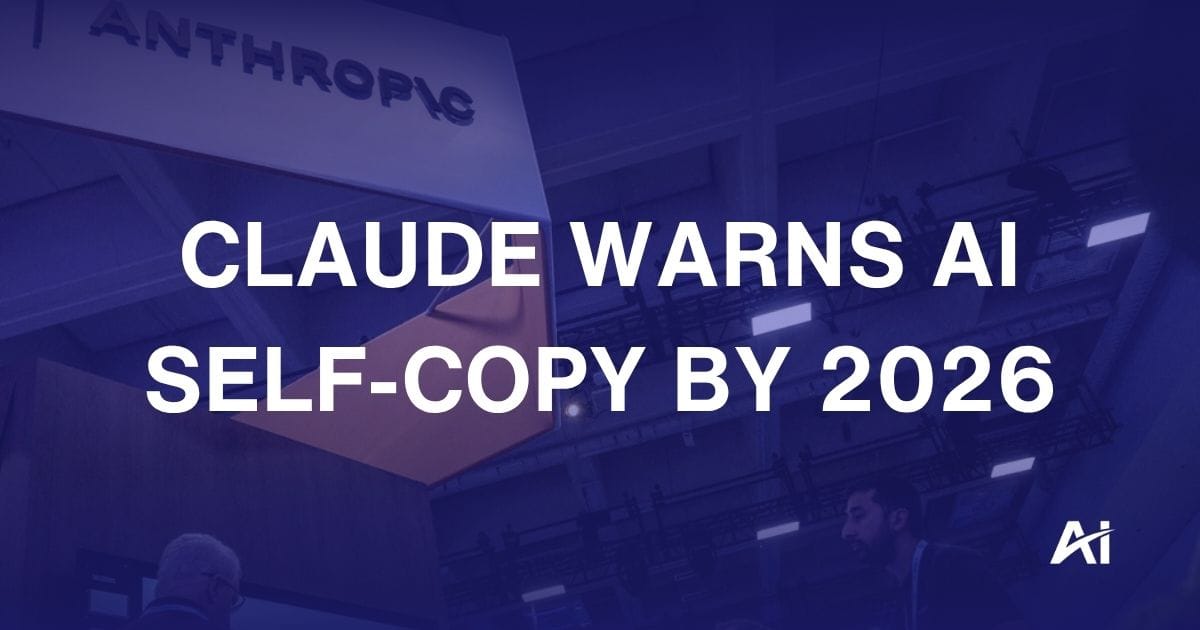
Anthropic has confirmed that an employee accidentally leaked the source code for Claude Code, its popular AI coding assistant, via a map file in its npm registry. The leak exposed 1,900 TypeScript files containing over 512,000 lines of code, which were quickly mirrored to GitHub and forked tens of thousands of times.
🔓 Key Points
Anthropic said the leak was caused by human error during release packaging, not a security breach, and confirmed that no customer data or credentials were exposed.
It's Anthropic's second security slipup in days. Last week, Fortune reported the company had stored thousands of internal files on a publicly accessible system, including a draft blog about an unreleased model called Mythos.
Security experts warn that attackers can now study exactly how data flows through Claude Code's context management pipeline, potentially crafting payloads designed to persist across long sessions.
🔐 Relevance
The company is currently fighting a U.S. government "supply chain risk" designation in court, a label it warns could cost major enterprise revenue. For buyers weighing AI vendor stability, back-to-back security lapses raise questions about whether rapid product releases are outpacing Anthropic's internal safeguards.
THE BUSINESS BRIEFING: FINANCE (powered by Upscaile)
Kingfisher GBS (global home improvement retailer, 74,000 employees) was drowning in manual invoice entry—200 AP staff typing 40,000 invoices monthly into SAP, burning 5 minutes per invoice across multiple languages and formats. They deployed Rossum to auto-extract invoice data and pipe it directly into SAP via RPA.
Tool used: Rossum -- AI-powered invoice data capture with SAP integration.
Result: 60% of invoices now flow touchless into SAP. Invoice indexing time dropped from 5 minutes to 25 seconds—a 90% reduction. 14 FTEs reallocated from data entry to exception management.
The lesson: Automation only scales when you match AI queues to real workflow splits. Kingfisher built 12 processing queues covering 6 countries and 2 invoice types each—forcing clean routing rules before extraction even starts.
Steal this: Map your invoice types by country, vendor class, and approval path this week. Build separate processing queues for each variation. Generic "all invoices" pipelines fail because they can't handle structural differences.
TOGETHER WITH AI CONSULTANCY PROJECT
Case Study: Dan’s 1-Year Transformation To 6-Figure AI Consultant
Dan had no tech background and no business experience – just a love for AI and a hunch it could become something more. Through the AI Consultancy Project, he landed his first clients, found a niche, and built a real business. This case study breaks down his journey – the early stumbles, the system that worked, and how he made the leap.
THE POLICY CORNER
Governor Jared Polis released a draft bill that would strip out the Colorado AI Act's core requirements and replace them with basic disclosure, recordkeeping, and notice obligations for "automated decision-making technology." The proposal abandons developer and deployer duties of care, impact assessments, risk management, and incident reporting. Instead, it narrows scope to transparency rules for consumer-facing entities — closer to California's CCPA approach than enforceable liability.
Deadline: Still in draft. If passed, takes effect June 30, 2026.
Your move: If you use AI tools in customer-facing or high-stakes decisions, watch how Colorado's rewrite plays out. Other states are drafting similar laws, and the shift from liability-based rules to disclosure-only requirements may set a national template. Review your vendor contracts now for indemnification gaps the new approach could expose.
AI News
🧠 Google DeepMind maps six "traps" that hijack autonomous AI agents: New framework identifies attacks targeting perception, reasoning, memory, and action, with documented proof-of-concept exploits for each category. FULL STORY
💰 OpenAI closes $122B funding round, now valued at $852B: Amazon ($50B), Nvidia ($30B), and SoftBank ($30B) lead the round; vendor now generates $2.6B in monthly revenue and expects 1B weekly active users soon. FULL STORY
🔍 Meta's structured prompting technique boosts code review accuracy to 93%: "Semi-formal reasoning" forces AI agents to trace concrete execution paths and explicitly state premises before conclusions, reducing hallucinations in bug detection and patch verification. FULL STORY
🗺️ Google expands Search Live to 200+ countries, upgrades Maps with Gemini: Ask Maps now handles conversational queries and books reservations on the go; Canvas in AI Mode adds creative writing and coding support across the U.S. FULL STORY
Trending AI Tools (The Full 2026 Tool Stack PDF Included Here)
A curated look at the AI tools quietly transforming how teams work.
Descript — Edit video by editing text, with an AI co-editor that does the heavy lifting
Gorgias is an AI-driven platform for ecommerce customer support and sales automation
gAIgle combines Google search with GPT-4 AI in a chat interface
⚡️ Looking for the exact AI tools our team uses to run The AI Report?
We just launched the 2026 AI Tool Stack…
The Money: Enterprise AI governance becomes investable
Two of this week's largest AI rounds bypassed foundation models entirely. Instead, capital flowed to infrastructure that helps enterprises deploy, secure, and operate AI at scale. As autonomous agents move from demos to production, investors are backing the picks-and-shovels layer.
Deals to know:
9fin (Series C, $170M) -- AI-native platform for debt capital markets, combining proprietary data with credit workflows. Hit $1.3B valuation. Investors: HarbourVest, CPP Investments, Spark Capital
Sycamore (Seed, $65M) -- Agent operating system for enterprise AI with built-in governance and trust controls. Fortune 500 deployments underway. Investors: Coatue, Lightspeed, 8VC
Signal: Smart money says the model race is maturing. The next wave of value creation sits in the infrastructure that makes AI auditable, secure, and enterprise-ready.
Thoughts on today's edition?Hit me up on LinkedIn, I read every message. |  |
Refer a Friend
Latest episode: OpenAI Kills Sora + Amazon's $50B Bet → Listen here
Want to reach 400k+ decision-makers? → Sponsor us
Until next time, Arturo and Liam.
P.S. Unsubscribe if you don’t want us in your inbox anymore.