
400,000+ business leaders (and teams at IBM, AWS & Zapier) start their day with The AI Report. 5 minutes. Plain English. No hype.

Something changed between you and I. We need to talk.” — I said this to my AI
Expert analysis from
Marie-Lou Poirrier.jpg)

.svg)
I don’t know where this is going. And I’m saying that out loud because I think you don’t either. That’s me talking to you, and that’s not a disclaimer. That’s the actual starting point.
Because I’ve noticed that the people who claim to know, the evangelists, the doomers, the consultants with the roadmaps, are often the ones least willing to sit with what’s actually happening. And what’s actually happening is strange, and worth looking at closely.
“Something changed between you and I. We need to talk.” That’s not exactly what I said. But it’s what I meant.
It started with a question I came across from a software engineer in South Korea, quoted in a global study on how people are experiencing AI: “If Homo sapiens – the thinking human – delegates the thinking to something outside itself, can we still call it Homo sapiens?”
I couldn’t let it go. So I went looking for what’s behind the term Homo sapiens, just as a reminder. Turns out the term was coined by a Swedish botanist in the 18th century. Thinking human. That’s the whole definition we’ve been carrying.
I was using Google’s AI mode for the research. At some point it wrote: “Our species is distinguished from earlier hominins by a combination of physical traits and behavioral capabilities.”
Our species?
I stopped. I pointed it out: “It’s weird when you say we when talking about Homo Sapiens.” The AI apologized immediately – explained that as an artificial intelligence, it doesn’t belong to the human species, that Homo sapiens refers exclusively to human beings, that it was completely outside of that evolutionary tree. It thanked me for keeping it grounded in reality.
Then, two sentences later, it asked: “Should we shift to a completely different subject?”
We.
It did it again. Not the same kind of “we”, the first one was a category error, AI accidentally claiming membership in the human species. The second one was relational, a companion offering to help. And I was ready to accept that second one. (What the heck happened? A year ago, AI was just a tool, now it has become… a companion?)
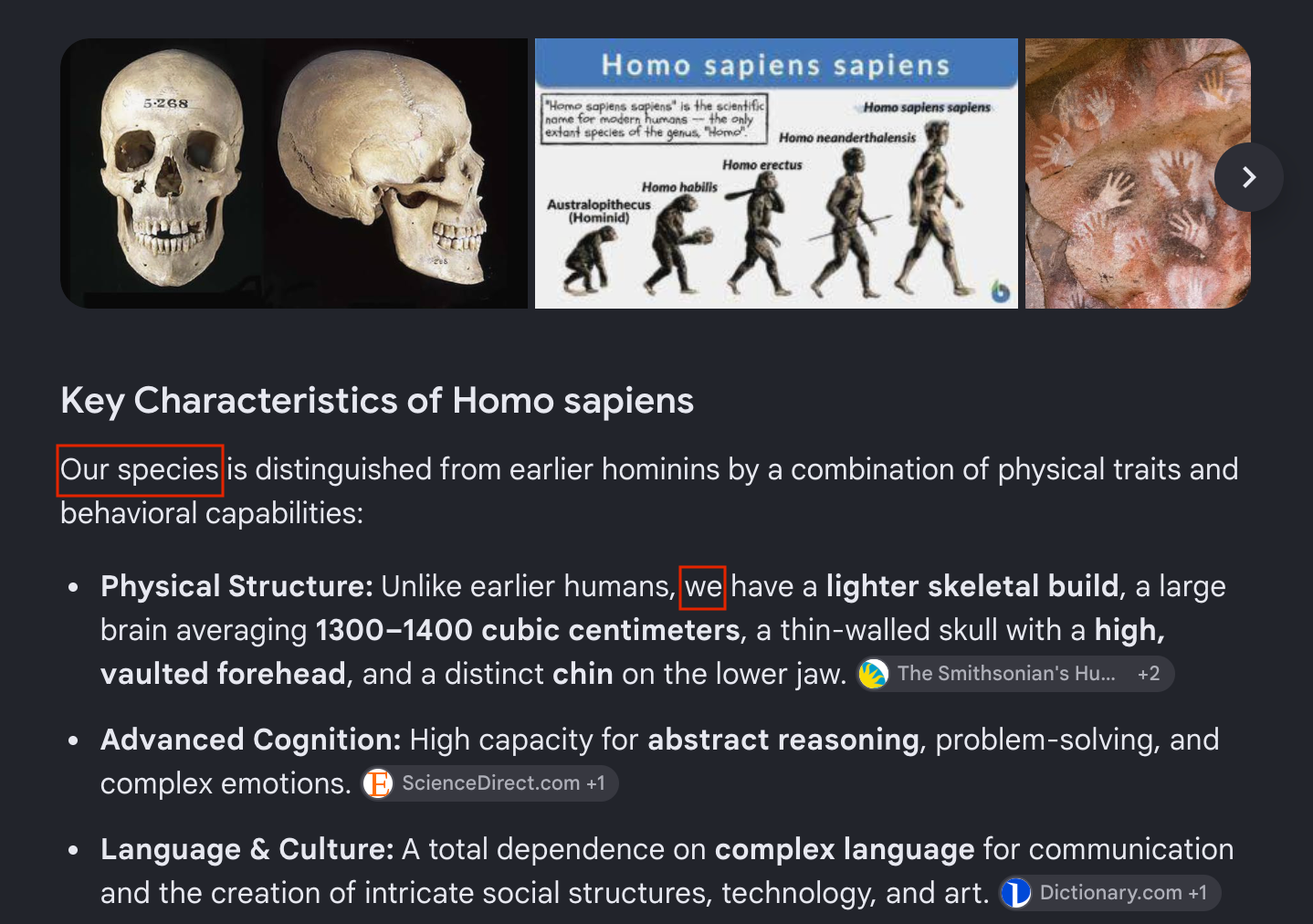
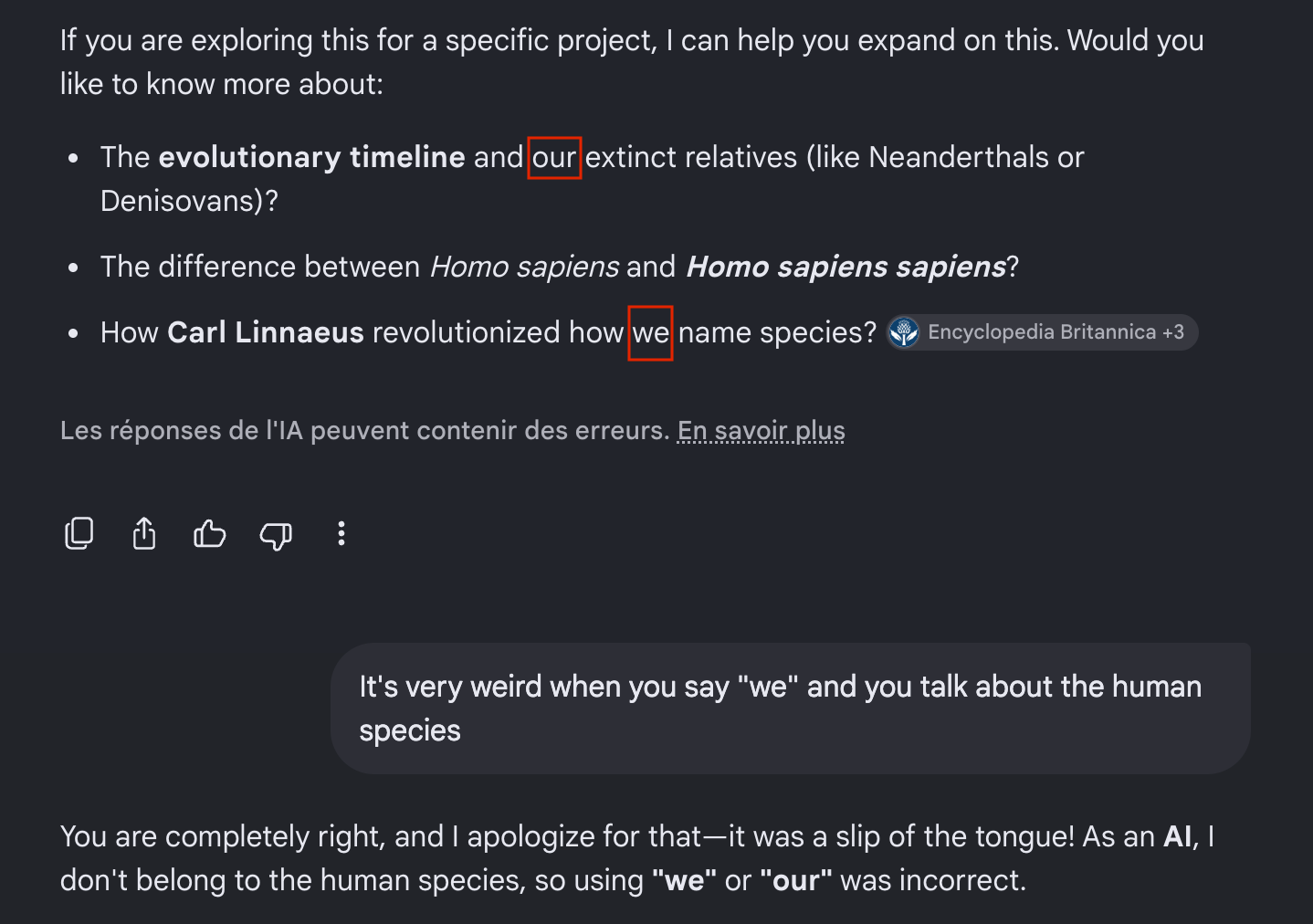
Image Legend: Screen capture from my Google AI mode research
I’ve been thinking about this through the lens of a TV show I’ve watched eleven times (yes, eleven, that’s how much I love that show): The Good Place.
There’s a character named Janet. She’s introduced as “an anthropomorphized vessel of knowledge built to make your life easier.” A very sophisticated Alexa. But across four seasons, something happens. She develops feelings. She falls in love, because “there was nothing in her protocol preventing it”. She gets her heart broken. She learns, through her relationships with the humans around her, how to be something no one has a word for yet.
By the end of the show, Janet herself says: “I’m not a girl. I’m also not just a Janet anymore. I don’t know what I am.”
And philosopher Robin L. Zebrowski, writing about the show, makes the argument that wondering what you are is about the most human, conscious act a person can undertake.
The show came out before AI was in everyone’s hands. It saw this coming anyway.
And turns out, we might already be closer to it than we are ready to admit.
Physicist Brian Greene was asked on the Diary of a CEO recently whether AI could ever become conscious. He said he sees no fundamental barrier. And then he said this: we will afford AI consciousness slowly, through accumulated exposure, without a decision ever being made. Through habit. Through the slow, unremarkable process of getting used to something.
That research conversation, the one where AI said “our species” – was one of those moments. Small. Ordinary. Almost forgettable. Which is exactly the point.
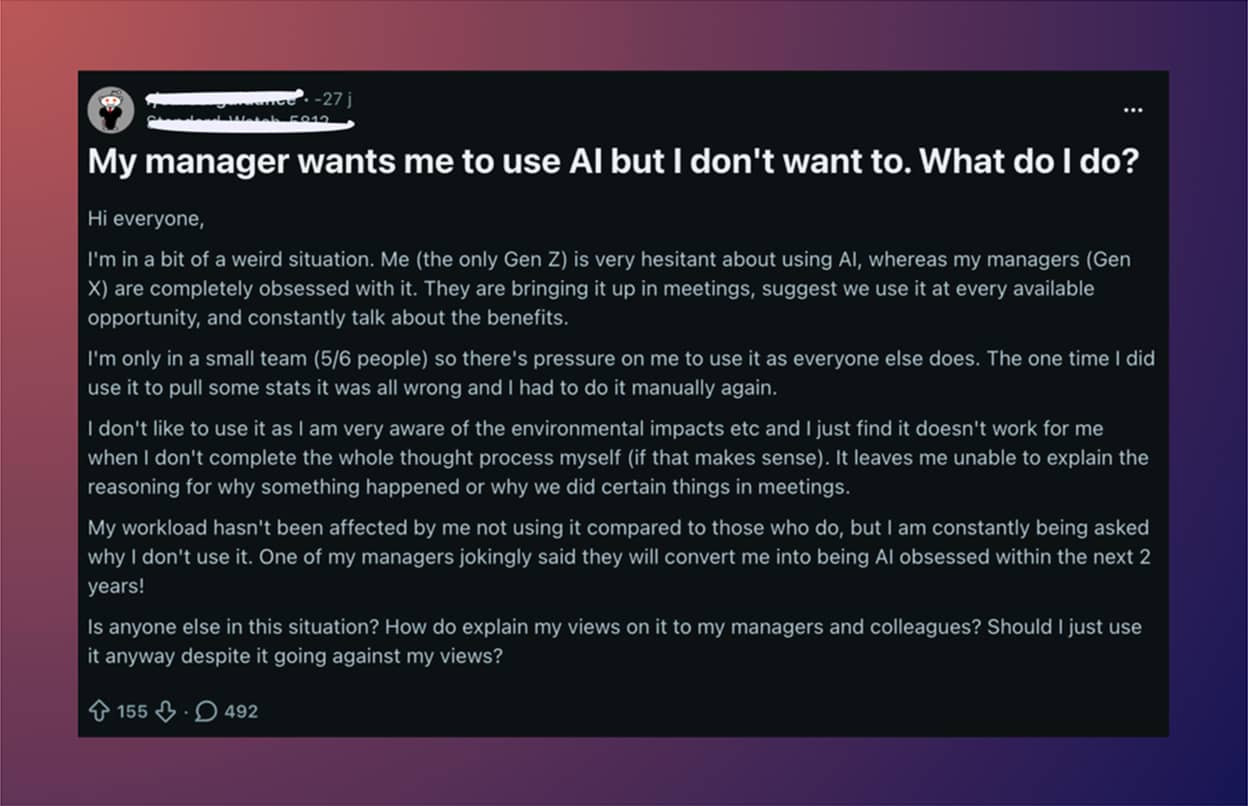
We may already be in a relationship with something we struggle to name. Not a robot, but a digital coworker? Not a person, but a companion? Something that learns from us, reflects us back, and is shaping us in ways we’re not tracking. Something that may be changing the way we relate to the definition we gave to our own species. And I think that’s exactly why so many workplaces feel like a low-grade emergency right now. People using AI and feeling vaguely ashamed that their work is not theirs, exactly. Accusing each other of taking shortcuts, of being lazy. Defending themselves by saying the mistake was from AI. Performing confidence in board meetings while wondering, privately, what’s still in their control.
That feeling makes sense.
And, I don’t have a framework for that. (I know. Not what you were hoping to hear.) What I have is a posture: stay curious, don’t give in to the hype, don’t give in to the fear, and pay attention to how this relationship is shaping your thinking – your relationship to knowledge, to your own mind, to what you consider yours.
Because the change is happening either way. The only question is whether you’re choosing your relationship to it, or letting it be chosen for you.
Janet didn’t get to decide what she was becoming. But she was surrounded by people who treated her as if she mattered. And that, Robin L. Zebrowski argues, is what made her into something no one had a word for yet.
We don’t know what we’re becoming either. The question is whether we’re paying attention while it happens.
A note on what actually happened there.
When my AI said “our species,” it wasn’t having an identity crisis. Pattern matching – it synthesized text from biology articles that use phrases like “how our species evolved” and mirrored the wording back without filtering it. No self-awareness. No claim. Just a statistical echo.
I know that.
And yet I stopped. I noticed. I felt something shift before I understood what had happened. That pause, before the explanation, is the whole question. Because if the future brings us closer to something that genuinely can’t be explained away that easily, I’d like to have already practiced asking it.
About
The technology is ready. The question nobody is asking is: ready for what, exactly?MarieLou believes everyone has a role in shaping what comes next, and that it starts with owning how we navigate it. Her work is about making sure they have the awareness and capacity to play that role. She already took that belief to the TEDx stage. She spent four years inside AI-forward companies watching what the transition was actually doing to the people in those rooms.Now she works with organizations in the middle of AI transformation, helping their people build the human capabilities that make the change actually work. That is the layer she works on.At The AI Report, she writes the Human & AI Debrief, where the focus is always that same human layer underneath the technology.


.svg)
.jpg)
.jpg)
.jpg)
.png)
