400,000+ business leaders (and teams at IBM, AWS & Zapier) start their day with The AI Report. 5 minutes. Plain English. No hype.
Automating HR: A Guide for Executives
A practical guide for HR leaders on using AI to streamline hiring, onboarding, and employee operations without losing the human touch.
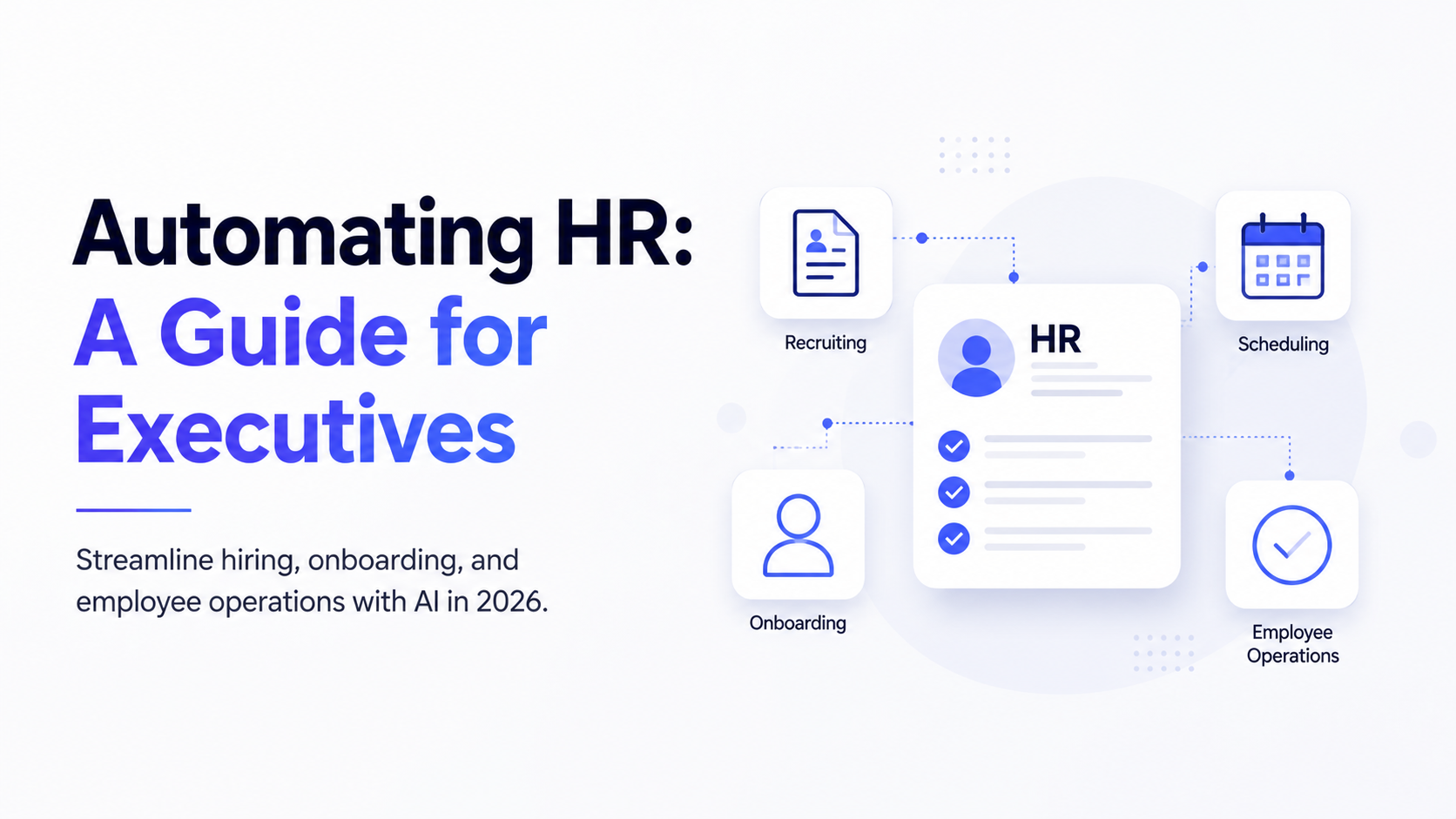

Ask any HR professional where most of their time goes, and the answer is rarely the work they went into HR to do. It is the administrative layer: hiring paperwork, onboarding checklists, benefits questions, policy lookups, payroll queries. High-volume, predictable tasks that happen to require a human to move them along.
AI is changing that. Not by replacing HR teams, but by taking the repetitive work off their plate so they can focus on the parts of the job that actually need them.
This guide covers where AI is making the most practical difference in HR right now, what real implementations look like, and how to think about getting started.
Where AI Is Already Making a Difference in HR
The clearest wins tend to cluster around the same areas.
Recruiting and hiring. Resume screening is one of the highest-volume tasks in any HR department. AI can process applications, surface strong candidates based on defined criteria, and handle initial scheduling, before a recruiter ever needs to get involved. The pipeline moves faster and the team spends more time on the conversations that matter.
Onboarding. New employees generate a predictable wave of questions: where to find the benefits portal, how to submit expenses, what the vacation policy is, who to contact for IT access. AI can answer all of these instantly and consistently, giving new hires a better first experience without burying HR in repeat questions.
Employee self-service. This one surprises people, but it is one of the most practical applications out there. Instead of emailing HR to check a vacation balance, update a direct deposit, or find out how to submit a leave request, employees message an AI assistant directly in Slack or Teams and get an answer in seconds. It is the same interaction they would have had with an HR team member, just faster and available around the clock. The Hitachi example later in this article shows exactly what this looks like at scale.
Learning and development. AI is helping HR teams build personalized training paths for employees based on their role, skill gaps, and how they learn. Rather than sending everyone through the same generic program, organizations can use AI to tailor development plans and track progress without the manual overhead that used to make this kind of personalization impossible.
What This Looks Like at an Enterprise Level
AI in HR does not operate as one tool doing everything. It works as a set of connected workflows, each built around a specific part of the employee lifecycle, from the day someone is hired to the day they leave.
Swati Trehan, co-founder and COO of enterprise AI company Ema, spoke about this in a recent episode of The AI Report podcast. Her team has spent several years building AI specifically for HR functions, working alongside organizations like PwC to understand how work actually moves through an HR department.
What she found surprised her. When Ema started selling into enterprises, she expected IT departments and technical leaders to be the first adopters. Instead, it was Chief Human Resources Officers (CHROs), the most senior HR leaders in an organization, who raised their hands first. As she put it, HR had been overlooked for too long. Nobody had been paying enough attention to improving the employee experience, and AI gave them a real way to do it.
Today, close to half of Ema's enterprise implementations start in HR before expanding into finance, IT, and other functions. That pattern is not unique to Ema. HR is consistently one of the fastest-moving departments when it comes to AI adoption, because the need is real and the volume of repetitive work is hard to ignore.
Upscaile's enterprise training programs work with HR and operations teams specifically on building these workflows in a way that sticks. If your organization is figuring out where to start, that is a good place to look.
A Real Example: How Hitachi Rolled AI Out to 300,000 Employees
One of the most useful examples of AI adoption in HR at scale is Hitachi. With over 300,000 employees globally, the rollout was not a small undertaking, and the way they handled it is worth paying attention to.
Rather than simply launching a tool and sending an announcement email, Hitachi involved their entire workforce from the beginning. They ran a company-wide vote on what to name the AI assistant. Employees submitted suggestions and cast votes. The winner was Skye, a name that came with a personality employees had asked for: casual, approachable, and easy to talk to.
By the time Skye launched, people were not being handed new software. They were welcoming a colleague they had helped create. The adoption followed naturally.
That is what good change management looks like. The technology is only half the challenge. Getting people genuinely on board with it is the other half, and it deserves just as much planning.
Watch the full conversation with Swati Trehan on The AI Why podcast.
Where to Begin
AI adoption in HR does not have to be a full transformation from day one. The organizations that do it well start small, prove the value, and expand from there.
A few honest questions worth asking before you begin. Where is your HR team spending the most time on work that does not actually require their judgment? That is your starting point. Are your processes documented clearly enough that someone else could follow them? If not, writing them down properly is the first step, and a useful exercise regardless of what you do with AI afterward. And how are you going to bring employees along? The Hitachi example is a useful reminder that the rollout plan matters as much as the tool.
The goal is not to automate HR. It is to give HR teams the space to do the work that only they can do.
This article is part of our Workforce Automation series.
For a broader look at AI automation across your business, see our Ultimate Guide to AI Automation in 2026.
Ready to bring AI into your HR operations? Talk to Upscaile about training your team.


.png)
.png)
.png)
.png)
.png)
.png)
.png)
.png)
.png)
.png)
.png)
.png)
.png)
.png)
.png)
.png)
.png)