

400,000+ business leaders (and teams at IBM, AWS & Zapier) start their day with The AI Report. 5 minutes. Plain English. No hype.
Fractile raises $720M for faster AI chips; 15% run AI at scale
Fractile raised $720M to build chips that make AI answer faster. Our benchmark finds just 15% of business leaders run AI in daily operations or at scale.


Fractile, which builds chips and systems to make AI models answer faster, has raised a $720M Series C. The round was led by Thrive Capital, Founders Fund, Lightspeed Venture Partners and Redpoint, according to the company. For business leaders, the question is when faster AI starts to matter. Our benchmark suggests that is still a minority: 15% of 13,882 business leaders say AI already runs in their daily operations or is scaling, the stage where the speed and cost of every answer start to add up.
Key takeaways
- A big bet on speed. Fractile raised $720M in a Series C, following a $220M round in May 2026.
- Few companies run AI at scale yet. 15% of 13,882 business leaders say AI runs in daily operations or is scaling. 62% are still exploring or experimenting.
- Usage grows as AI matures. 64% of leaders at the scaling stage use three or more AI tools, against 46% of those still exploring.
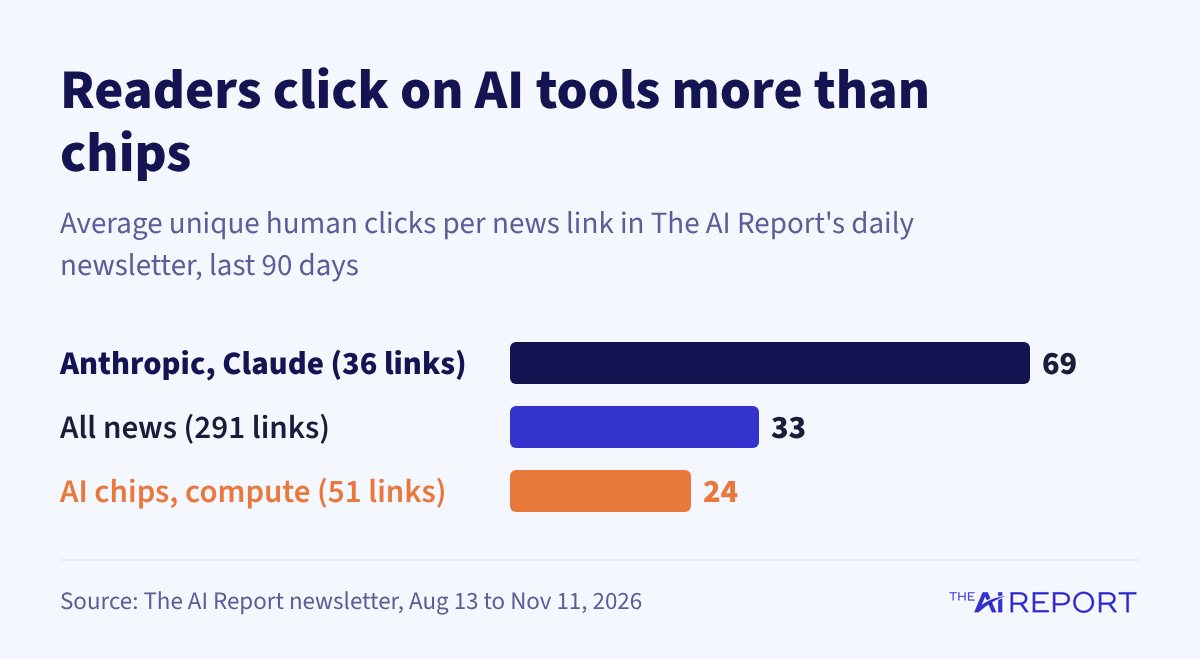
- Readers click on tools more than chips. Over the last 90 days, newsletter links about AI chips and computing drew 24 unique human clicks each on average, against 33 for all news links and 69 for Anthropic and Claude news.
What did Fractile announce?
Fractile raised a $720M Series C led by Thrive Capital, Founders Fund, Lightspeed Venture Partners and Redpoint. New investors include Dragoneer, DST Global, Elad Gil, BlackRock, CapitalG, Shopify, Balderton and British Business Bank, among others, and returning investors include Accel, Conviction and Felicis, according to the company. The round follows a $220M raise in May 2026. Fractile did not give a valuation in its announcement. It is hiring across its offices in London, Bristol, Palo Alto and Taipei.
What does Fractile build?
Chips and full systems for inference, the step where a trained AI model produces an answer. Fractile was founded on the view that the time it takes to produce useful outputs would limit what increasingly capable AI systems can do, the company says. One part of its approach is stacked DRAM: it places memory directly on top of the logic chip, aiming for more memory bandwidth than HBM, the high-bandwidth memory used in today's AI chips, alongside more capacity than SRAM, the fast memory built into chips. Its stated goal is output at thousands of tokens per second, where a token is roughly a word or part of one.
Why that matters to a business: an AI agent that works through a task step by step calls a model many times, so every wait adds up. Faster answers mean shorter waits for people and more steps an agent can take in the same time.
How many companies run AI at scale?
Not many yet. Of 13,882 business leaders who told us their AI stage, 33% are still exploring, 29% are experimenting and 23% are piloting. 8.4% say AI runs in daily operations and 6.5% say it is scaling across the business, 15% combined.
As companies move along, they run more AI. 64% of leaders at the scaling stage use three or more AI tools, against 46% of those still exploring, and the average climbs from 2.9 tools to 3.8. That growing demand, more tools, more agents and more answers per person, is what inference chips are built to serve.
How does your company compare? Take our 2-minute AI benchmark, the same nine questions 15,000+ business leaders have answered, and get The AI Report free every weekday.
Do business leaders care about AI chips?
Less than about the tools built on top of them, judging by what our readers click. Over the last 90 days, the 51 news links about AI chips, GPUs and computing in our daily newsletter drew 24 unique human clicks each on average, against 33 for all 291 news links and 69 for news about Anthropic and Claude.
The chip race reaches business leaders mostly through what it does to the price, speed and reliability of the AI they already use. For a guide to those tools, read our ChatGPT vs Claude vs Gemini comparison.
Why does AI infrastructure matter to businesses?
Because capacity is still scarce. Zachary Smith, CEO and co-founder of Datum and earlier the founder of Packet, explained on The AI Report podcast that inference providers are "usually running in dozens or hundreds of data centers because capacity is so hard to get in one location."
Chips that produce more answers per second are one way to stretch that scarce capacity. For companies buying AI, the effect shows up later, in faster responses and in what vendors can afford to charge.
What should business leaders do now?
- Know your stage. If you are still exploring or experimenting, like 62% of leaders, chip news will not change your plans this year. Skills and tool choice will.
- Measure speed and cost per task. Once AI runs in daily operations, track how long each task takes and what it costs, not only the price per seat.
- Ask vendors where your AI runs. Find out what happens to response times at peak demand and whether you can choose faster or cheaper models.
- Plan for agents that take many steps. Agent workflows multiply model calls. Our explainer on agents and automation shows where agents are worth the extra cost.
See where your company stands
Compare your company with 15,000+ business leaders in the AI Adoption Index, then take the 2-minute benchmark yourself. It is free, and so is The AI Report, read by 400,000+ business leaders every weekday.
About this data
The figures come from The AI Report's AI benchmark, answered by business leaders between July 20 and November 11, 2026, counting one answer per person. 13,882 leaders who named their AI tools also told us their AI stage; the stage and tool-count figures come from them. Click figures are unique human clicks, with bot clicks removed, on news links in The AI Report's daily newsletter over the 90 days to November 11, 2026, grouped by topic; no advertiser's results are included. Percentages may not add to 100 because of rounding. The quote from Zachary Smith comes from his August 2026 episode of The AI Report podcast. Readers chose to subscribe to an AI newsletter, so they are likely further along than average. We never show groups under 300 people.
Cite this: The AI Report, "Fractile raises $720M for faster AI chips; 15% run AI at scale," November 11, 2026, theaireport.ai.
