400,000+ business leaders (and teams at IBM, AWS & Zapier) start their day with The AI Report. 5 minutes. Plain English. No hype.
AI Agents vs. Traditional Automation: What's the Difference?
AI agents vs automation explained: how rules-based automation, RPA, generative AI, and autonomous agents differ.
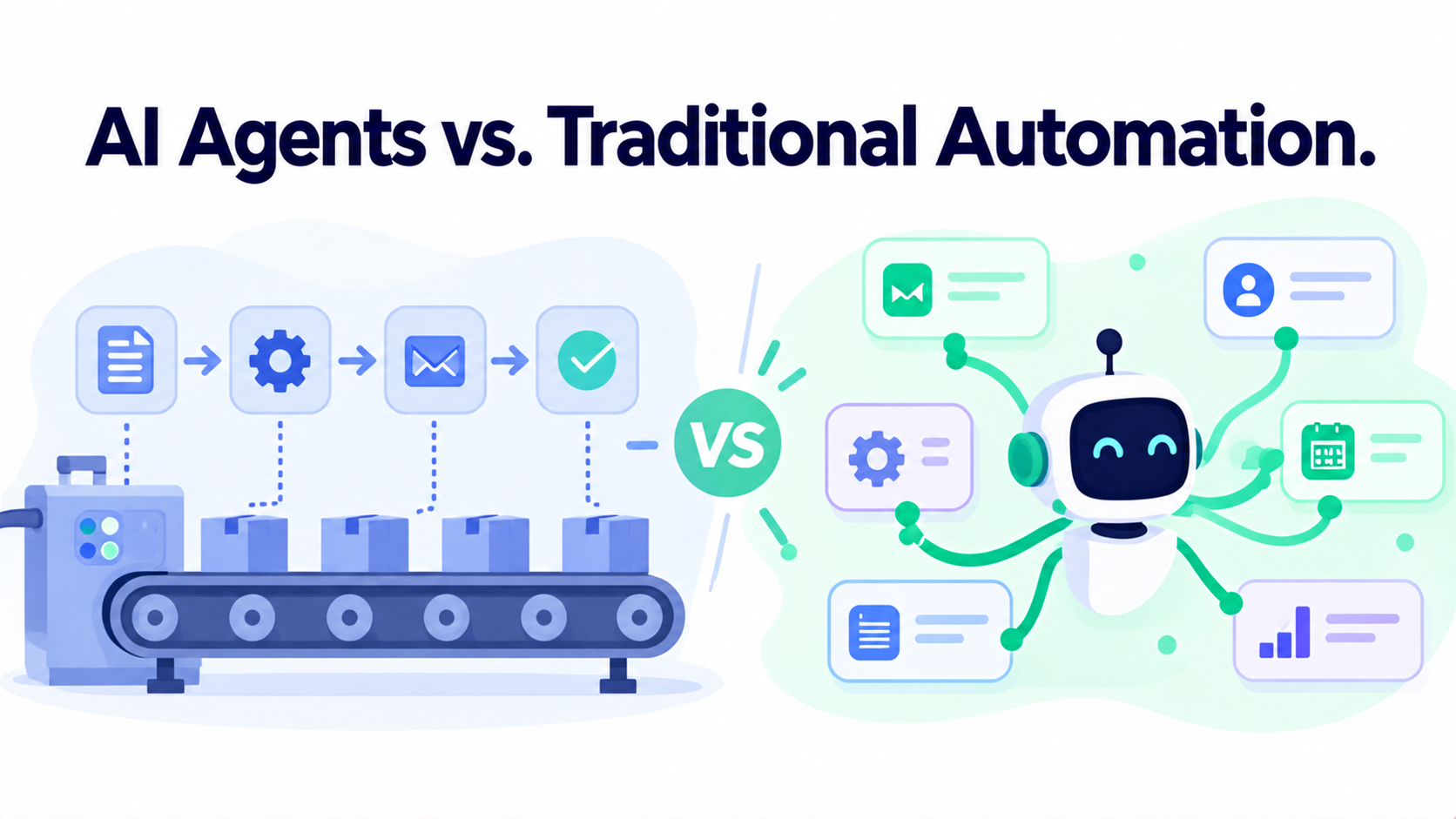

Almost every software vendor now sells an "AI agent." Gartner has a name for the habit of relabeling older products to fit: agent washing, meaning chatbots, assistants, and robotic process automation tools rebranded as agentic without real autonomy. Gartner estimates that only about 130 of the thousands of vendors using the label offer genuine agentic capabilities, and it expects more than 40% of agentic AI projects to be canceled by the end of 2027 because of cost, unclear value, and weak risk controls. The AI agents vs automation question is a purchasing question, and a clear set of definitions is the first defense.
Where each type fits, with real examples
Rules-based automation. Andrew Warner, who hosts the podcast Mixergy, once needed PayPal purchases connected to a CRM so handwritten cards could go to buyers. That is a clean rules problem: a purchase triggers a record, which triggers a task. Input is structured, the steps never change, and nothing needs judgment. A rule is cheap, fast, and predictable, and it is the right tool whenever those conditions hold.
RPA. Swati Trehan, co-founder of Emma, describes RPA as roughly twenty years old and rigid, an if-then-else approach that covers perhaps 10% to 20% of real-world use cases because human work is too variable to codify. She also notes that legacy RPA vendors are structurally slow to disrupt their own model. RPA still earns its keep where a legacy system offers no other way in and the screens rarely change.
Generative AI. A generative tool works when a person stays in the loop for each step. Michael Domanic, Head of AI at UserTesting, describes a company-wide custom GPT for writing OKRs. It was built on John Doerr's OKR method and loaded with the company's actual objectives at each level, so employees got guidance tied to real priorities instead of generic advice. Nothing in it acts on its own. It helps a person produce better output.
Autonomous agents. Trehan's flagship customer Hitachi uses an assistant for employee support with more than 50 integrated actions across several backend systems of record, so it can act in those systems and not only answer questions. Roy Mann, CEO of monday.com, describes a social media agent that can report on its own recent performance and, when given critical feedback about tone, inspect and modify its own code or prompting. Gartner's guidance is consistent with these examples: use agents where decisions are needed, ordinary automation for routine workflows, and assistants for simple retrieval.
A useful way to think about the ladder
OneDigital's Mike Sullivan and Vinay Gidwaney sort AI into three categories: coworkers, which help you think and collaborate, builders, which produce an asset such as a document or software, and agents, which carry out tasks autonomously or semi-autonomously. They deliberately start with coworkers. Their reasoning is that agentic AI needs reliable data infrastructure underneath it and only pays off at real scale, hundreds of workers and not twenty.
Trehan describes a similar ladder with three rungs: rigid automation, single-task assistants embedded in one application, and coordinated meshes of agents that run an entire business process such as onboarding.
Podcast host Liam Lawson's own setup shows how the rungs combine. A scheduled task checks his calendar each day, and when an event matches a known pattern it triggers a research brief using Perplexity and Claude, saves it to Notion, and pings him. The trigger is a rule. The research and writing are AI. The whole thing is a small, useful hybrid and a reminder that most real workflows blend categories.
The hybrid trap
Dan Klein of Scale Cognition names two tempting shortcuts that fail. The first is constraining a language model to routing decisions inside a rigid, old-style finite automaton, like a phone-tree menu. It is reliable, and it strips out the fluid, contextual conversation that made the model worth using. The second is chaining models to check one another. Klein says this does not compound accuracy the way people assume and instead adds latency and cascading errors on exactly the hard cases that confuse every model in the chain. Neither shortcut replaces choosing the right kind of automation for the task.
How to choose
When weighing AI agents vs automation for a specific process, ask four questions about it:
- Is the input structured and predictable? If yes, a rule or RPA may be enough.
- Can every step be written down in advance? If yes, use deterministic automation, which is cheaper and easier to audit.
- Does the work need judgment across several systems? If yes, an agent may earn its cost.
- What does a wrong step cost? If the answer is high, keep a human approval in front of the action, however capable the agent.
Gartner adds that bolting agents onto legacy systems is technically complex and often disrupts workflows, and that rethinking the workflow from the ground up usually works better.
Questions to ask a vendor selling "agents"
Ask what decisions the product makes without a person, which tools and systems it can act on, how every action is logged, what happens when a step fails, and who approves actions that cannot be undone. A product that answers every one of these with "the model decides" deserves caution. A genuine agentic pattern, such as the auto-research loop Andrew McNamara of Shopify describes, has clear mechanics: a model evaluates results against a target metric, proposes and applies changes, then evaluates again and repeats. Shopify uses it in its Campaign Autopilot feature. The loop works because the metric, the permitted changes, and the review points are all defined.
Stay current as the definitions shift
Vendors keep stretching these terms, and the technology underneath is moving quickly. Subscribe to The AI Report for plain-English coverage of the AI agents vs automation debate and how real companies are choosing between them.