400,000+ business leaders (and teams at IBM, AWS & Zapier) start their day with The AI Report. 5 minutes. Plain English. No hype.
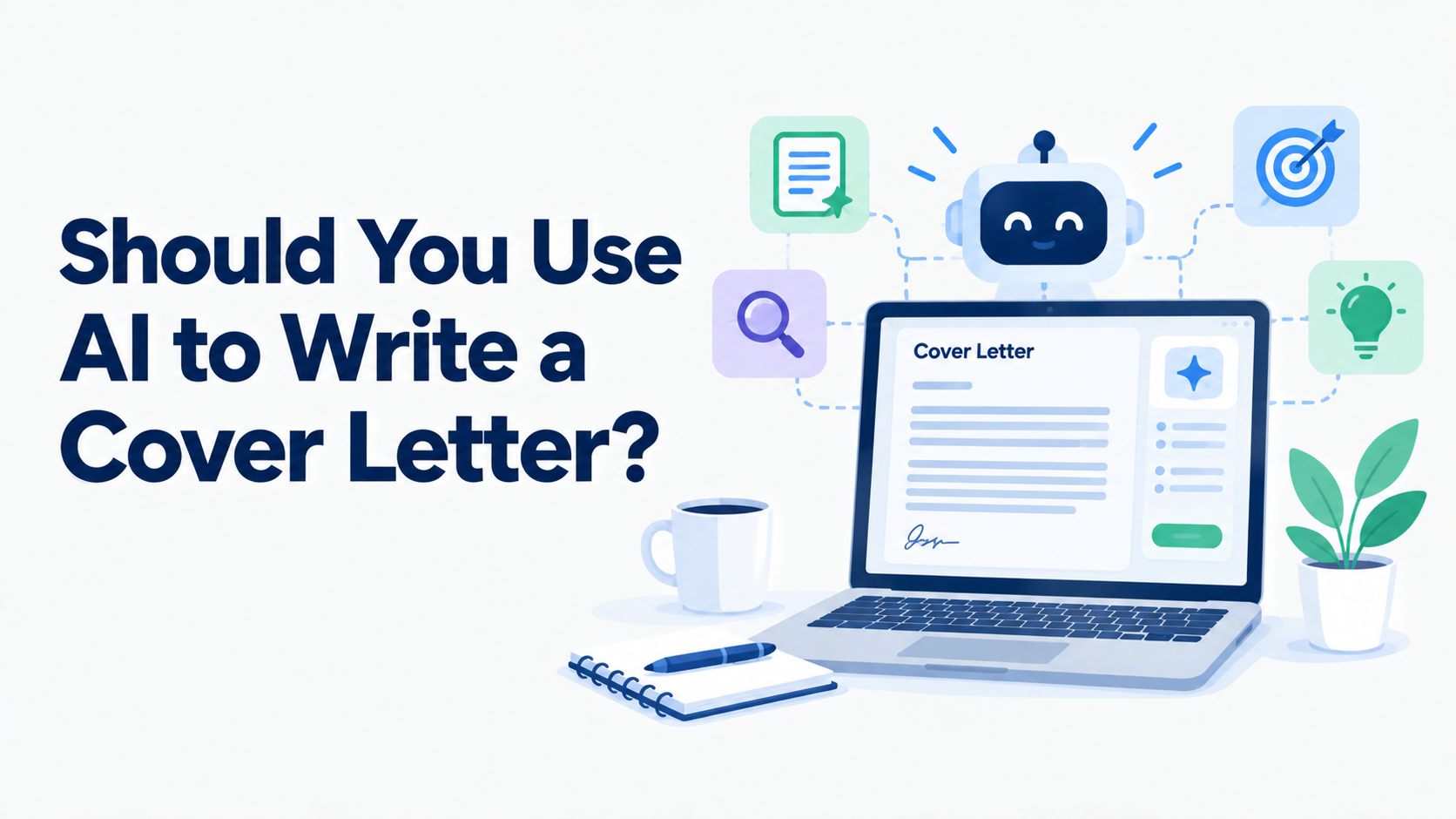
Should You Use AI to Write a Cover Letter?
An honest look at using AI for a cover letter: where it genuinely helps, where it backfires with hiring managers, and how to edit an AI cover letter.
Short answer: yes, with real editing. Long answer: it depends heavily on how much of the actual writing you hand over. Surveys from 2026 show hiring managers are split on this in a way that reflects genuine tension rather than a clean rule. One recent poll found a majority of hiring managers view an AI cover letter favorably when it's personalized and accurate, while a separate study found a large share of hiring managers can spot generic AI content on sight and rate it negatively when they do. Those two findings aren't actually in conflict. They're describing two different things: an AI cover letter that's been genuinely edited, and one that hasn't.
Here's where AI helps, where it hurts, and how to land on the right side of that line.
Where an AI cover letter genuinely helps
The blank-page problem is real, and it's the single biggest reason cover letters get skipped or phoned in. Facing eight or ten applications in a week, most people either recycle the same generic letter for every posting or skip the cover letter entirely. AI removes that specific friction. Given your background and a job posting, it can produce a structured first draft in under a minute, hitting a standard shape (opening hook, relevant experience, closing interest) that would otherwise take thirty minutes to build from scratch.
AI is also useful for company-specific customization at scale. Feeding it a company's recent news, stated values, or a specific challenge mentioned in the job posting, and asking it to weave that context into a draft, is something most job seekers skip when writing manually simply because it's time-consuming across many applications. Cover letters still matter for this reason specifically: a large share of hiring managers say they influence interview decisions, especially for roles where writing, judgment, or cultural fit matter, and letters that show a candidate actually understood the role and the company continue to outperform generic ones.
Where an AI cover letter hurts
The failure mode is well documented at this point. Left unedited, AI defaults to a narrow set of patterns: confident superlatives with nothing concrete behind them, uniformly paced sentences, and a tone that reads the same whether you're applying to a five-person startup or a law firm. Hiring managers who read dozens of applications a week pick up on this fast. One survey found hiring managers spend well under a minute on a letter they suspect was generated and left unedited, compared to several minutes on one that reads as genuinely written by the applicant.
There's also a credibility problem specific to cover letters. A resume lists what you did. A cover letter is supposed to explain why you did it and what it says about how you'll approach the new role, and that kind of specific, personal reasoning is exactly what AI can't generate on its own. It doesn't know which project you're actually proud of or why a particular company caught your attention. When a letter skips that and leans entirely on generic phrasing instead, it reads as hollow even to a reader who isn't specifically hunting for AI tells.
The line that actually matters: editing, not avoidance
The data on this is fairly consistent once you separate "used AI" from "submitted raw AI output." Roughly half of job seekers now use AI somewhere in their application process, and most career advice from 2026 has converged on the same rough guideline: let AI handle structure and a first pass, but the substance, the voice, and the specific proof points need to come from you. One common way this gets described is a 70-30 split, where AI provides the shape and flow of the letter, but roughly a third of the final content, the parts that carry real detail and personality, gets rewritten or added by hand.
Practically, that means:
- Never let AI invent an achievement, number, or motivation you don't actually have. This crosses from editing assistance into fabrication, and it's the one use of an AI cover letter that's genuinely dishonest rather than just risky.
- Add at least one detail only you would know. A specific project name, a number you can defend in an interview, or a genuine reason the role or company caught your attention does more to signal authenticity than any amount of polished phrasing.
- Read it out loud before sending. If a sentence doesn't sound like something you'd actually say, rewrite it. This single step catches most of the generic phrasing that gets an AI cover letter flagged.
- Vary the structure across applications. If you're reusing an AI-generated template with only the company name swapped out, that's the pattern hiring managers are trained to catch. Change the opening, the example you lead with, and the closing line each time.
When to skip the AI draft entirely
For roles where writing quality is itself being evaluated, technical writing positions, communications roles, anything where the posting explicitly emphasizes writing samples, it's worth writing the first draft yourself and using AI only for a light editing pass afterward, rather than the reverse. The same goes for smaller companies and smaller hiring teams, where the person reading your letter is more likely to notice a generic tone and where a genuinely personal letter has more room to stand out.
The honest answer
Using AI to help write a cover letter isn't the ethical or practical problem some job seekers worry it is. Submitting one without editing it is. The hiring managers who react badly to an AI cover letter aren't reacting to the fact that a tool was involved. They're reacting to a letter that reads like it wasn't reviewed by the person whose name is on it. Use AI for the draft, keep the proof and the voice your own, and read the final version like someone deciding whether to interview you would.
Keep up with how hiring is actually changing
Hiring manager attitudes toward AI-assisted applications are shifting quickly as more of them experiment with the same tools on their own end. Subscribe to The AI Report for ongoing coverage of how AI is reshaping hiring and job searching, so you know where the line actually sits before you hit submit.