400,000+ business leaders (and teams at IBM, AWS & Zapier) start their day with The AI Report. 5 minutes. Plain English. No hype.
What AI Skills Will Employers Want in the Future?
Identifies technical and non-technical skills that complement AI rather than compete directly with automation.
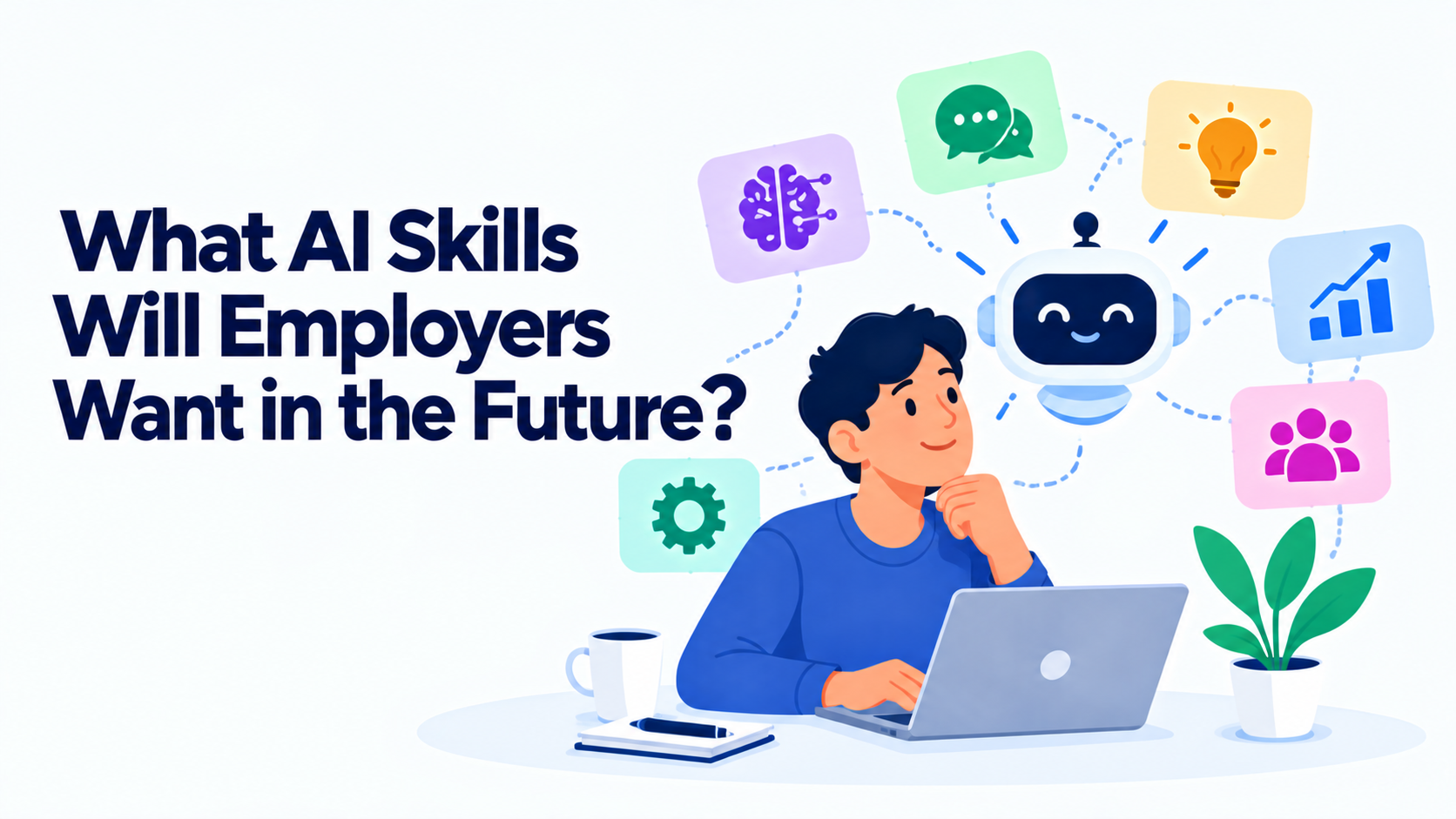

The easy assumption is that employers mainly want people who can prompt an AI tool well. The people actually doing the hiring are telling a more specific story. The AI skills employers want are shifting away from raw technical execution and toward the judgment needed to verify, direct, and complement what AI already does well, on both the technical and non-technical side of a job description.
Technical skills: verification over execution
Brad Axen, who built the open-source agent framework Goose at Block, describes a direct change in what his own team screens for. He no longer runs "how well do you know Python" interviews, something he did as recently as about ten years ago when he joined. Interviews now center on problem-solving with full AI tool access. But the shift isn't toward hiring generalists who are simply comfortable with AI tools. Axen is explicit that Block still wants senior domain experts capable of catching an AI's incorrect outputs, not just AI-fluent generalists. Raw coding execution is becoming table stakes. The ability to recognize when an AI-generated answer is subtly wrong is what's actually scarce, and it requires real domain depth, not just tool fluency.
A related technical skill is emerging around how organizations evaluate AI systems themselves, not just use them. Jason Li, CTO of the legal and accounting timekeeping company Laurel, described an internal evaluation pipeline where new features are tested first against the newest, most expensive frontier model to validate a use case, then progressively migrated down to smaller, cheaper models once proven. That's a specific, learnable technical skill in its own right: knowing how to benchmark and compare AI systems against each other rather than committing to one tool and assuming it stays reliable indefinitely.
Zachary Smith, founder of the network infrastructure company Datum, raises a more structural technical concern worth building into this list. He argues coding agents are equally good at finding security vulnerabilities as they are at building software, and predicts that as more of computing becomes agent-mediated, the technical skill that matters shifts toward architecting trust and access into systems, not just writing functional code. He draws a direct analogy to how the Visa payment network vets and segments access among banks and merchants, arguing agent traffic will eventually need the same kind of deliberate, permissioned architecture. For technical professionals, this points toward security and access-architecture skills becoming more valuable precisely because agents are closing the gap on raw coding ability.
Non-technical skills: the ones AI genuinely can't do for itself
Dan Klein, founder of the AI agent company Scale Cognition, offers one of the sharpest explanations for why a specific non-technical skill is becoming so valuable: metacognition, meaning the ability to know what you don't know. He demonstrates this live in conversation by asking someone to estimate a city's population, pointing out that humans have a built-in sense of their own uncertainty, while a language model has no equivalent mechanism. A base model doesn't know it lacks a fact. It simply produces its best-guess output regardless. Klein goes further, reframing "hallucination" itself as a category error, arguing it's more accurate to think of all AI output as a kind of hallucination, some of it correct and some not, because genuine deception or honest uncertainty both require an awareness of the gap between what you're saying and what's true, which the underlying technology doesn't have.
This is precisely why metacognitive judgment, knowing when to trust an answer and when to dig further, is one of the clearest AI skills employers want from a human in the loop. It's not a skill AI can simply be trained to replace, since the model would need the exact self-awareness it currently lacks.
Michael Domanic, Head of AI at UserTesting, names a second non-technical skill directly in his own hiring framework for AI transformation roles, and ranks it as the most commonly overlooked: creativity. His stated reasoning is that AI deployment isn't a fixed set of buttons and levers the way past enterprise technology rollouts were. It's an open-ended set of possibilities that requires someone who can creatively frame a problem in the first place, rather than someone simply executing a known process. Employers building out AI strategy roles are increasingly screening for this kind of open-ended problem framing over technical credentials.
A third non-technical skill shows up clearly in how Aaron, who works in enterprise AI marketing at Adobe, frames the future of work itself. She predicts work will involve less screen and machine interaction over time, not more, reasoning that as AI handles more of the mechanical task layer, what's freed up is time for relationship-building, trust, and intimacy, qualities she frames as permanently non-automatable. Her own formula for this, trust equals reliability times intimacy times credibility divided by self-orientation, is a genuinely practical way to think about which of your non-technical skills are actually safe from automation. The parts of a job built on an ongoing relationship, not a single deliverable, are structurally harder to replace.
Don't mistake AI literacy itself for the whole skill set
Tudor Achim, CEO of the formal-math AI company Harmonic, offers an important caution on this entire conversation. He argues directly against treating AI literacy as a new core skill priority, even in education, contending that genuine critical-thinking ability needs to already be in place before AI tool fluency becomes useful on top of it. Scott Likens, PwC's Chief AI Engineer, points to a real example of this principle in practice: a school in Austin called Alpha School that rebuilt its curriculum around AI-assisted academic learning in the morning paired with hands-on, project-based human skills work in the afternoon, fixing a bike, gardening, working across age groups.
The implication for employers and employees both is the same. The AI skills employers want aren't really about AI at all, underneath the surface. They're the foundational judgment, critical thinking, and domain expertise that make AI tool fluency actually useful once it's layered on top, rather than a substitute for having that foundation in the first place.
Keep learning from where the hiring signal is actually pointing
The clearest evidence for which AI skills employers want isn't in a generic skills report. It's in how real companies are actually changing their hiring and evaluation criteria right now. Subscribe to The AI Report for ongoing, firsthand coverage of how companies are actually hiring and evaluating talent in the AI era, straight from the people making those calls.