400,000+ business leaders (and teams at IBM, AWS & Zapier) start their day with The AI Report. 5 minutes. Plain English. No hype.
AI Workforce Transformation: What Changes After Automation?
What AI workforce transformation looks like after deployment: how roles, processes, management structures, and employee responsibilities change, with examples from Block, OneDigital, and monday.com.
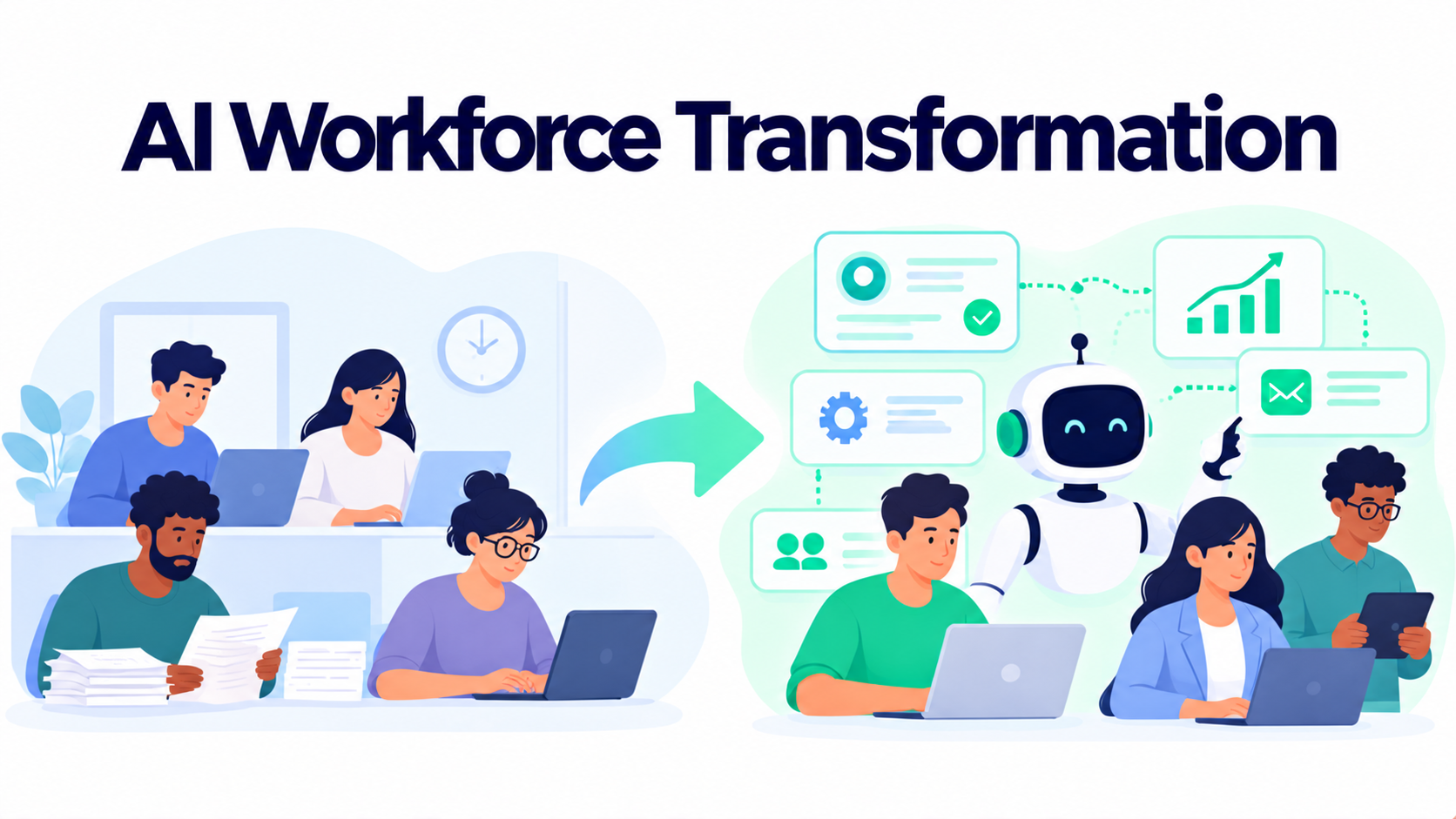

Most planning for AI stops at go-live. The interesting part starts afterward, when the tool is running and the organization around it has to adjust. Gartner's research on CIOs shows how little preparation exists: only about 4% of surveyed CIOs said their organizations had explicit plans to redesign roles for a human-agent workforce. AI workforce transformation is therefore mostly improvised, and the improvisations of early adopters are the best guide available. Here is what changes across roles, processes, management, and the daily responsibilities of employees.
Roles: new jobs appear next to old ones
The most striking new role comes from OneDigital. Mike Sullivan and Vinay Gidwaney built an AI coworker named Ben for the company's employee-benefits consulting business by cloning one of their strongest client managers, an employee named Shelly. She left her day-to-day account work to become Ben's full-time manager and trainer. About 1,600 benefits consultants now interact with Ben daily, with hundreds of thousands of conversations over roughly 18 months. The job did not disappear. Its subject-matter expertise moved into a supervisory and teaching position.
OneDigital also runs an internal staffing function for AI, with recruiters and onboarders, and each AI coworker starts from a written job description. Sullivan and Gidwaney wrote their book for HR leaders because they believe HR, which sees faces and not headcount, should lead this change. Michael Domanic, Head of AI at UserTesting, describes a Center of Excellence of about 24 people drawn from across the company, chosen mainly for tool fluency and creativity and not for deep expertise in every department.
Their financial planning shifted too. OneDigital had modeled growth from roughly 6,000 employees and $1.6 billion in revenue to 10,000 to 12,000 employees and $3 billion, and now says that headcount path will not play out as planned because of AI-driven changes to staffing.
Processes: knowledge gets captured in systems
Block shows what happens to know-how. Brad Axen, who built the Goose agent framework there, says the company cut roughly 40% of its workforce and built systems so that internal bots could answer detailed questions about any part of its systems. The aim was to remove the need to find the one expert for a given service after headcount dropped. He argues that AI memory should belong to the business and not to an individual chatbot, implemented as shared files that multiple employees can read. He also describes a "meat proxy" pattern, a human spending the day copying AI output between coworkers and tools instead of letting agents talk to each other directly, as a sign that workflows have not yet been redesigned around agents.
Brian Alvey, CTO of WordPress VIP, names the underlying work: encoding an organization's implicit rules, such as brand voice and unwritten procedures, in enough detail that an intern or an agent could follow them. After automation, this documentation is operating infrastructure.
Management structures: more reports, new kinds of supervision
When agents absorb coordination, scheduling, status tracking, and reporting, the manager's job changes shape. One workforce analysis of Gallup's 2026 data puts the average number of direct reports per US manager at 12.1, up from 10.9 in 2024, though the rise cannot be pinned on AI alone. Gartner predicted that through 2026, one in five organizations would use AI to flatten their structure and remove more than half of their middle-management roles. Treat that as a forecast and not a measured result.
Roy Mann, CEO of monday.com, offers a design idea for the agent side. He argues against building agent teams around human-style job titles such as front-end developer, architect, and back-end developer, because that recreates routing overhead. He proposes organizing agents around cross-cutting concerns such as security, UI quality, and performance, which any agent can address as needed.
Jason Li, CTO of Laurel, argues that granular time data could end cookie-cutter roles. Companies could discover that one person is an exceptional lead-generation specialist and let that person focus there, a kind of zone-of-genius staffing that was previously invisible and unmanageable.
Employee responsibilities: from doing to directing
Mann tells a story about a developer on his own team who was terrified watching an AI agent implement and deploy UI fixes faster than he could read the change requests. Within a week the employee moved from feeling he was competing with the agent to feeling he operated it. Mann attributes the change to how the employee positioned himself in the process, with no change in the technology.
Axen reports a similar shift in hiring. His interviews center on problem-solving with full AI tool access, and the company still wants senior domain experts who can catch an AI's wrong outputs. Day to day, responsibilities move toward framing problems, supervising work, verifying results, and owning outcomes.
Scott Likens, PwC's Chief AI Engineer, flags who struggles most with this shift. In his three-group view of adoption, leadership is largely bought in and digitally native junior staff adopt on their own, while a "frozen middle" of experienced employees with ten to twenty years in the job is hardest to move, because their existing methods already work. Sullivan and Gidwaney offer a practical lever: when managers actively use AI coworkers, their teams' own usage roughly doubles. Rana Gujral of Behavioral Signals suggests a test for each person's own use: does the tool leave you more capable when you are using it and when you are not.
Trust and change management
Employees who feel an AI system is imposed on them resist it. Swati Trehan, co-founder of Emma, describes a Hitachi rollout in which roughly 300,000 employees voted to name their internal AI assistant "Skye" and shape its personality. Giving people a say in what a tool becomes is a cheap way to build a stake in its success. Sullivan and Gidwaney also avoid framing success as token counts or hours saved, which can sound like a countdown to cuts, and anchor their messaging on time returned to employees and better insights.
Domanic is honest about the limits of anyone's foresight. Asked whether AI will take jobs, he answers "we don't know," and he rejects the comparison to the Industrial Revolution, which lasted about 80 painful years for those living through it. Leaders who plan for uncertainty, with retraining, transparent communication, and flexible structures, will be better placed than those who promise a clean outcome.
A checklist for the months after deployment
Name an owner for each AI system, the way OneDigital assigns a human supervisor. Update job descriptions to reflect supervision and verification duties. Write down the rules the system follows so they survive staff turnover. Review span of control and decision rights before removing management layers, since someone still has to own outcomes. Track how time freed by automation is actually used. Check in with the frozen middle, and with new hires whose entry-level tasks are changing.
Keep following how organizations adapt
Org charts, job descriptions, and management practices are all being rewritten in real time. Subscribe to The AI Report for ongoing coverage of AI workforce transformation and how companies are handling life after automation.