400,000+ business leaders (and teams at IBM, AWS & Zapier) start their day with The AI Report. 5 minutes. Plain English. No hype.
How to Identify the Best Business Processes for AI Automation
A scoring framework for choosing business processes to automate with AI, rating each workflow on repetition, data availability, complexity, risk, and ROI.
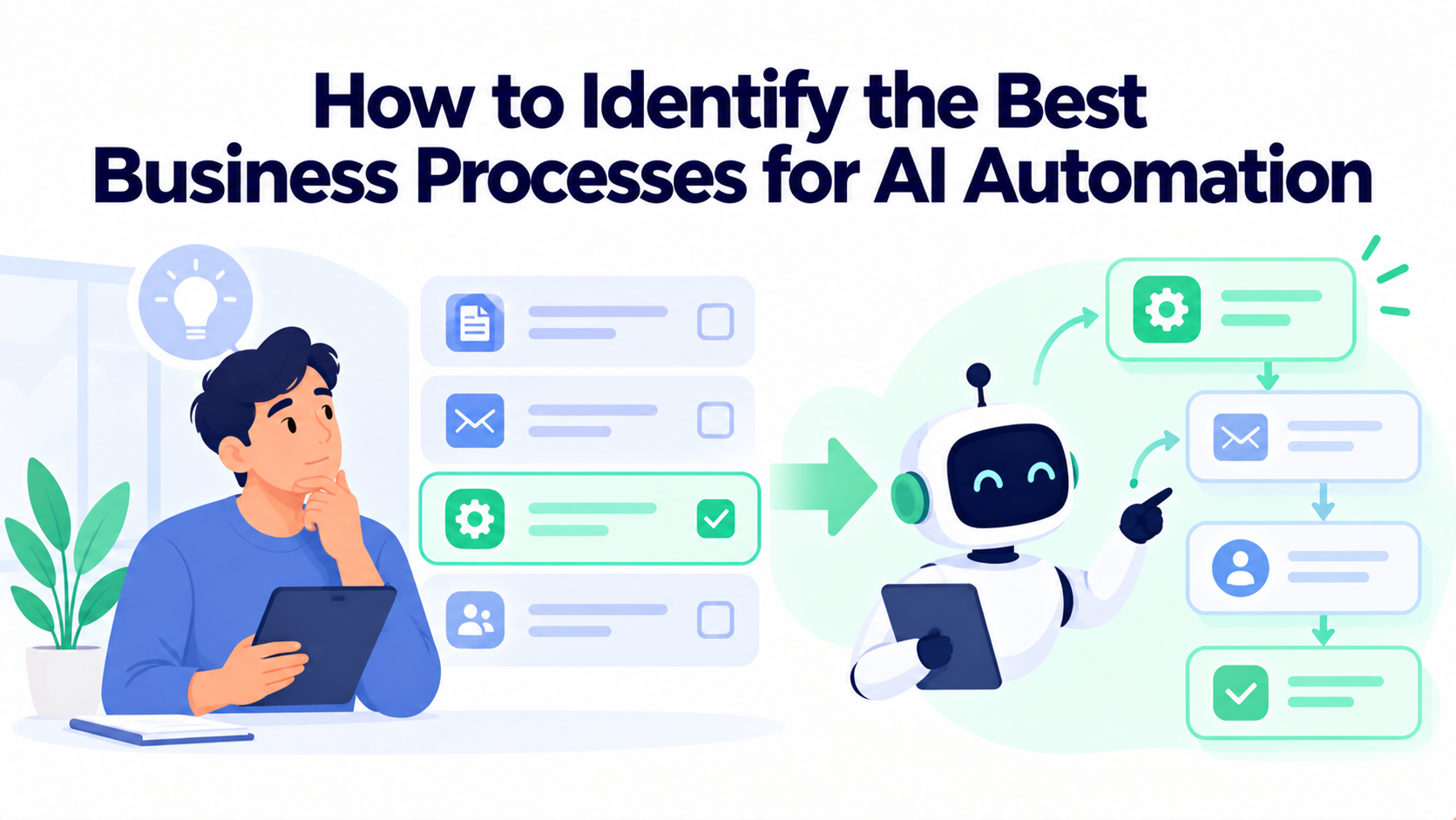

Most automation programs stall at the first decision: where to start. Teams pick the process that is most annoying, or the one a vendor demo happened to cover, and then discover it was a poor fit. A scoring method replaces that guesswork. Gartner's advice on agentic projects points the same way, favoring use cases with clear returns and a focus on enterprise productivity over scattered individual-task fixes. Here is a framework for ranking the business processes to automate with AI, followed by lessons from operators who learned the criteria the hard way.
Why scattered wins disappoint
Scott Likens, PwC's Chief AI Engineer, describes a pattern at underperforming clients. They chase many small, disconnected gains, a minute saved here and two minutes there, across departments. The companies that do better pick one process and transform it end to end, then measure it against revenue or market share and not against vanity numbers such as token usage. That advice shapes the framework below: score candidates, then commit to a few.
The five criteria
Rate each candidate process from 1 to 5 on every criterion, where 5 always means more favorable for automation.
1. Repetition and volume (weight 20%). How often does the process run, and how similar is each run? High-frequency, uniform work pays back fastest. OneDigital's Mike Sullivan and Vinay Gidwaney add a scale warning for agents: agentic AI needs reliable data infrastructure underneath it and only pays off at genuine scale, hundreds of workers and not twenty.
2. Data availability and documentation (weight 25%). Can the system get the information it needs, and are the rules written down anywhere? This carries the most weight because it fails most often. David McIntosh of Instacart offers a vivid case. Most retailers, even at chain level, lack accurate shelf maps, only averaged approximations that often do not match a store's real layout. His company had to build its own live shelf detection from camera feeds because recommendations depend on knowing what is physically beside the shopper. Brian Alvey, CTO of WordPress VIP, calls the real bottleneck for automation the work of writing down a business's implicit rules, its brand voice, editorial judgment, and unwritten procedures, in enough detail that an intern or an agent could follow them. If nobody has documented how the process really works, score it low.
3. Complexity and variability (weight 20%, scored so that simpler is higher). How many exceptions, systems, and judgment calls does a normal run contain? McIntosh notes that even a question as simple as whether a shopping cart's basket is empty is hard, because the system must tell abandoned items from receipts, trash, or a shopper's own bag. Swati Trehan, co-founder of Emma, offers another example: even frontier models struggle to reliably write back into complex enterprise spreadsheets, since cross-cell relationships and embedded logic are easy to break, although reading from them is largely solved. Processes that look simple on a flowchart can hide this kind of difficulty.
4. Risk (weight 20%, scored so that lower risk is higher). What does an error cost in money, compliance exposure, safety, or customer trust? Ian, who leads Adobe Express, describes hospitality customers who worry about AI inventing a feature of a property, such as a Bahamas bay that does not exist. Score high-stakes, hard-to-reverse processes low, or plan human approval from the start.
5. Potential ROI (weight 15%). Estimate hours removed, errors avoided, cycle time cut, and revenue gained, against realistic costs. Michael Domanic, Head of AI at UserTesting, points to a hard return from his own company, a 130% increase in booked discovery calls after deploying an AI sales tool, and says his team reviews its ten highest-value AI implementations each quarter to decide what to scale.
Test before you commit
Once a process scores well, test it cheaply. Andrew McNamara of Shopify describes SimGym, in which simulated shoppers attempt a task on one version of a store while another set uses a different version, so many candidate changes can be tried before a live test with real customers. The team checks the simulator by confirming that its predictions match what happened after past real changes. You can borrow the idea in a lighter form: replay a month of historical cases through the automation and compare its results with what your people actually did.
Jason Li, CTO of Laurel, shows another way to find candidates. His product builds a granular record of how knowledge workers spend their time, and he argues that the timesheet is only the interface to that dataset. Time data of this kind shows which tasks consume the most hours, which is where a volume score should come from.
Redesign the process, then automate it
Gartner notes that retrofitting agents into legacy systems is technically complex and often disrupts workflows, and that rethinking the workflow from the ground up is often the better route. A messy process automated as it stands produces a faster mess. Before building, remove steps that exist only because of old software limits, define who owns exceptions, and write the rules down.
Keep the scorecard alive
The best business processes to automate with AI change as data gets cleaner, models improve, and risk tolerance shifts, so rescore every quarter. Subscribe to The AI Report for ongoing coverage of which business processes to automate with AI and how companies are deciding.