400,000+ business leaders (and teams at IBM, AWS & Zapier) start their day with The AI Report. 5 minutes. Plain English. No hype.
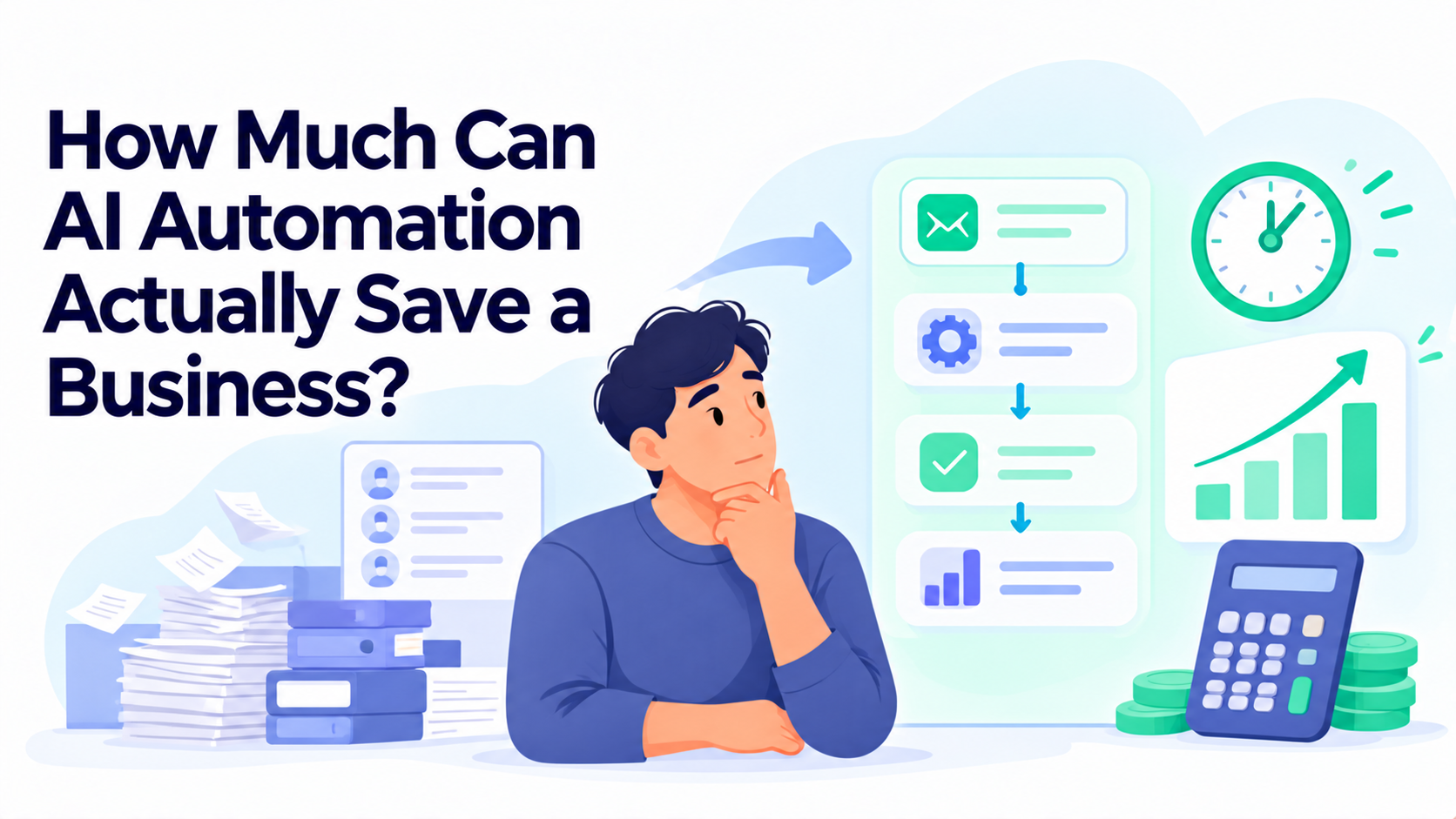
How Much Can AI Automation Actually Save a Business?
A practical method for estimating AI automation cost savings, covering labor, error reduction, cycle time, and real implementation costs.

Vendor decks often promise double-digit savings. Surveys of executives paint a less comfortable picture. Bain's 2026 automation survey, which included 951 respondents, found that 40% of companies tracking their spending recorded savings under 10%, while a similar share of executives had expected savings of up to 20%. Deloitte's research, as summarized in one 2026 analysis, puts the typical use case at two to four years to reach satisfactory ROI, with only about 6% paying back in under a year. KPMG's second-quarter 2026 pulse adds a revealing detail: companies with full transparency over the running costs of their AI systems were five times more likely to prove a return.
So the honest answer to "how much can AI automation actually save" is that it depends on measurement. AI automation cost savings are real when the estimate is built on the right inputs, and the usual failure is an estimate that skips half of them.
The four benefit levers
Labor. Hours removed per run, times volume, times the loaded hourly cost of the people doing the work. This is the easiest number to calculate and the easiest to overstate, because freed hours turn into cash only if you avoid a hire, reduce overtime, or redeploy people to work that earns revenue. A realization factor belongs in every labor estimate.
Errors. Reduction in error rate, times volume, times the cost to find and fix one error. Include downstream costs such as refunds, rework, and compliance exposure.
Cycle time. Days saved per run, valued through faster cash collection, faster customer response, or shorter project timelines. Jason Li, CTO of Laurel, says an Ernst & Young tax group uses his product to bill faster, which tightens feedback loops on whether work is on track. Shorter cycles pay off as cash arriving sooner and problems surfacing earlier.
Revenue and quality. Some gains show up as new revenue and not as lower cost. Michael Domanic, Head of AI at UserTesting, cites a 130% increase in booked discovery calls after his sales team adopted an AI tool, a directly tracked number. David McIntosh of Instacart cites a figure from an earnings call: a "did you forget" prompt at checkout produced roughly a 0.9% increase in incremental purchases. A small percentage on large volume is large money.
The cost side people undercount
One 2026 cost breakdown estimates that the software subscription is only 20% to 40% of the true first-year cost, with implementation, integration, training, and ongoing oversight making up the rest. Build a cost line for each:
- Licenses, usage fees, and model costs, which can grow with volume.
- Implementation and integration with existing systems.
- Training and change management.
- Ongoing human review of exceptions and spot checks.
- Maintenance, monitoring, and periodic rework as models and systems change.
Small operational details can decide the outcome. McIntosh explains that before Instacart's smart carts had stackable, daisy-chained charging, store staff had to plug in each cart individually. That stopped happening after a few days, carts died, and shoppers never formed the habit. He credits that humble hardware decision with more influence on adoption than the flashier AI components. No spreadsheet row would have predicted it, which is why a pilot with real users belongs in any estimate.
A worked example
Take an accounts payable team that processes 2,000 invoices a month.
Inputs. Each invoice takes 15 minutes by hand, or 500 hours a month. Automation handles 70% of the work, removing 350 hours. The loaded hourly rate is $40. The manual error rate is 2.5% and falls to 1.0%, and each error costs $60 to resolve.
Benefits per month.
- Labor capacity: 350 hours x $40 = $14,000. Assume 50% turns into cash, so $7,000.
- Errors: 2,000 x 1.5 percentage points = 30 fewer errors x $60 = $1,800.
- Total monthly benefit: $8,800.
Running costs per month. Software at $2,000, exception review of 40 hours x $40 = $1,600, and maintenance of $400, for a total of $4,000.
One-time costs. Integration and implementation of $30,000 plus training and change management of $6,000, for $36,000.
Result. Net monthly savings are $8,800 minus $4,000, or $4,800. Payback is $36,000 divided by $4,800, about 7.5 months. First-year net savings are 12 x $4,800 minus $36,000, which is $21,600.
The realization factor drives everything
Run the same example with different realization rates. If all freed hours convert to cash, the monthly benefit rises to $15,800, net savings to $11,800, and payback falls to about 3 months. If only 25% convert, the labor benefit is $3,500, the monthly benefit is $5,300, net savings are $1,300, and payback stretches to nearly 28 months. The technology is identical in all three cases. What changes is whether anyone decides what happens to the saved time. This is a large part of why surveyed payback periods run so long.
Measure what you can defend
Scott Likens of PwC warns against vanity metrics and favors revenue or market share. OneDigital's Mike Sullivan and Vinay Gidwaney avoid measuring success by token usage, which rewards waste, or by hours saved alone, which can reward cutting corners. They anchor their messaging on time returned to employees and better insights. Domanic splits returns into two groups. Hard ROI is directly tracked, such as booked calls. He treats employee satisfaction and retention effects as a softer category, closer to a utility than a line item to justify one use at a time.
Practical rules for a defensible estimate of AI automation cost savings:
- Record a baseline before the pilot so you have something to compare against.
- Run a control group where you can, since one survey of talent acquisition leaders found that only 8% of teams claiming measurable AI ROI had used a control group or A/B test.
- Track costs monthly, including the unglamorous ones.
- Review the top ten implementations each quarter, as Domanic's team does, to decide what to expand.
Keep your estimate honest
Savings estimates age quickly as prices, models, and your own processes change. Subscribe to The AI Report for ongoing coverage of AI automation cost savings and how companies are measuring them.