
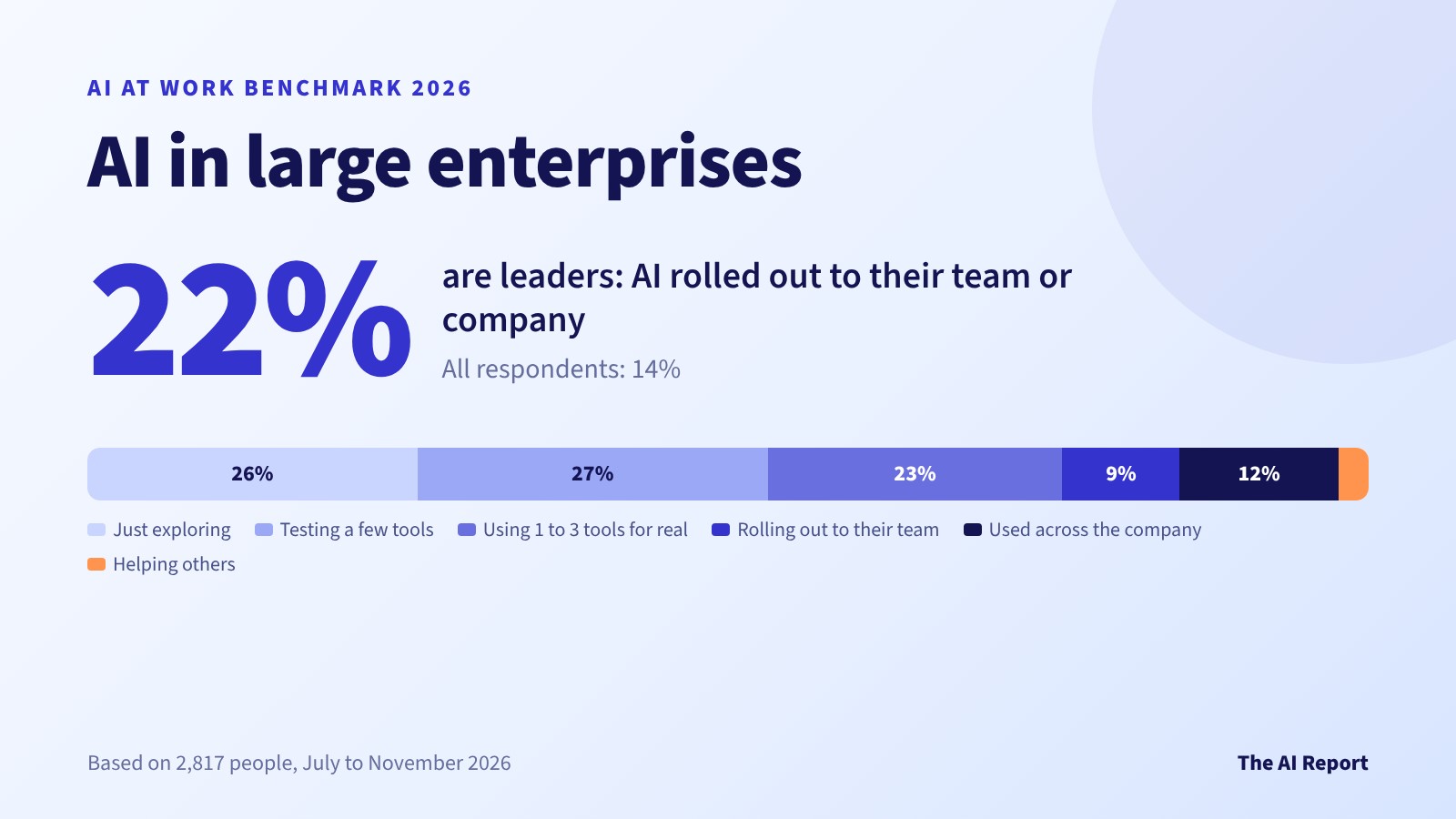
We asked 2,817 people who work at companies with more than 1,000 people how they use AI at work. They answered The AI Report’s Where You Stand benchmark between July 20, 2026 and November 2, 2026. Here is how far along they are, what holds them back, what they want from AI next and which tools the most advanced teams use, compared with all 14,452 people in the benchmark.
Key findings
- People at large enterprises are further along than everyone else in the benchmark. 22% are leaders, against 14% of all respondents, and 53% are still early.
- The biggest blocker is the skills gap (32%), followed by picking the right tools (25%). More people here name security or legal concerns: 5% against 3% across the benchmark.
- Their top goal is to save time (47%). More of them than average want to make better decisions: 7% against 5%.
- ChatGPT is the most used AI tool (77% of those who named a tool), then Claude (68%) and Gemini (45%). Tableau stands out: 6% use it, against 2% of all respondents.
- Leaders lean on Claude. 76% of leaders use it, against 60% of those still early.
How far along people at large enterprises are with AI
The largest share of people at large enterprises say they are “testing a few tools” (27%). 12% say AI is used across their company and 9% are rolling it out to their team.
- Just exploring
- Testing a few tools
- Using 1 to 3 tools for real
- Rolling out to their team
- Used across the company
- Helping others with AI
What holds people at large enterprises back
We asked for the single biggest blocker. Skills gap leads at 32%. If that is you too: join the free live Claude session.
- Large enterprises (1,001+)
- All respondents
What they want from AI in the next 90 days
47% want to save time, 33% want to build their AI skills and 7% want to make better decisions.
- Large enterprises (1,001+)
- All respondents
The AI tools people at large enterprises use
People named 3.3 AI tools each on average. These are the 12 most used, as a share of the 2,639 people here who named at least one. Compare any of them in our AI tool database.
- Large enterprises (1,001+)
- All respondents
What the leaders use differently
Leaders are the 607 people at large enterprises whose AI is rolled out to their team or used across their company. They named 3.5 tools each, against 3.1 for the 1,496 who are still early. These are the clearest differences.
| Tool | Leaders | Early | Gap |
|---|---|---|---|
| Claude | 76% | 60% | +16 pts |
| Microsoft Copilot | 24% | 14% | +10 pts |
| Power BI | 21% | 15% | +5 pts |
| Salesforce | 12% | 9% | +3 pts |
| ChatGPT | 73% | 78% | -5 pts |
- Share of each group who use the tool. Leaders: 580 people, early: 1,381 people.
Where they use AI at work
Writing comes first (68%), then personal productivity (66%) and research (49%). People could pick several areas.
- Large enterprises (1,001+)
- All respondents
- Asked July 20 to August 31, 2026: 1,779 answers.
Budget for a first AI project
61% are not sure yet. The most common amount named is under $500 (16%).
- Large enterprises (1,001+)
- All respondents
- Asked from September 1, 2026: 1,038 answers.
Who answered
37% decide, recommend or have a say in what their company buys.
Role
- Large enterprises (1,001+)
- All respondents
Top industries
- Large enterprises (1,001+)
- All respondents
Say in what their company buys
- Large enterprises (1,001+)
- All respondents
What leaders told The AI Report podcast
“If you're not talking to Ben before you're talking to your client, you're not doing your job in today's world.”
Vinay Gidwaney and Mike Sullivan, Chief Product Officer (Vinay); Co-founder and Chief Growth Officer (Mike) at OneDigital. OneDigital took one of its most talented client managers out of her role to become the full-time manager of an AI coworker called Ben, loading it with her knowledge and best practices. Eighteen months later, 1,600 benefits consultants use Ben every day, so advice to clients is consistent and consultants spend less time preparing and more time with clients. Watch or read the episode.
“You understand that you are now delegating your work to AI. It's not another tool.”
Roy Mann, Co-founder at monday.com. Most of the shift is mental. A developer on Roy's team was frightened when an agent began shipping UI fixes faster than he could read the requests. A week later he was happy, because he had stopped competing with the agent and started operating it. Treat AI as work you delegate, not as a better search box. Watch or read the episode.
“We figured that it was better to go more narrow and deep and really scale agents on what is our core process, which is recruitment.”
Denis Machuel, CEO at The Adecco Group. Adecco started with AI pilots scattered across the business, then switched to going narrow and deep: it picked its core process, recruitment, and scaled agents there first. If your pilots are spread thin, choose the one workflow that drives the business and go deep on it. Watch or read the episode.
Next steps
- Join the free live Claude session. Every Tuesday at 2pm ET, free for every reader.
- Set up simple AI governance. A step-by-step guide to auditing, approving and tracking new AI tools.
- Get a plan built for you. The AI Report Pro turns your benchmark answers into a 90-day AI plan, step by step.
How do you compare?
Answer the same nine quick questions as these 14,452 people. See which of five AI types you are, how you compare with readers like you, and get a free 30-day AI roadmap by email.
Free. You also get The AI Report, the five-minute AI briefing, every weekday. Unsubscribe anytime.
Compare with other groups
The full benchmark: AI at Work Benchmark 2026, with every industry, role and company size side by side.
By industry: Professional services, Healthcare, Software and tech, Education, Marketing and media, Manufacturing, Nonprofits and government, Financial services, Retail and e-commerce, Real estate, Legal.
By role: Executives and founders, Directors, Managers and team leads, Individual contributors, Consultants and advisors, Students and career switchers.
By company size: Solo professionals, Small businesses (2 to 50), Mid-size companies (51 to 1,000).
About this data
These numbers come from The AI Report’s Where You Stand benchmark. Between July 20, 2026 and November 2, 2026, 14,452 people completed it. This page covers the 2,817 people who work at companies with more than 1,000 people.
- Answers are self-reported. People chose their own industry, role, company size and stage.
- “Early” means just exploring or testing a few tools. “Leaders” means AI is rolled out to their team or used across their company.
- People could pick more than one tool, so tool shares add up to more than 100%. Tool shares are out of the 2,639 people here who named at least one tool.
- Where people use AI was asked from July 20 to August 31, 2026 (1,779 answers here).
- Budget was asked from September 1, 2026 (1,038 answers here).
- Percentages are rounded to whole numbers.
- We never publish individual answers. A group only gets a page with 100 or more people, and we only compare groups of 30 or more.
- People who take an AI newsletter's quiz are more interested in AI than the average worker, so read these numbers as a benchmark of people actively working on AI, not a national average.
Last updated November 2, 2026. To cite this page: The AI Report, AI at Work Benchmark 2026, theaireport.ai/tools/benchmark.