400,000+ business leaders (and teams at IBM, AWS & Zapier) start their day with The AI Report. 5 minutes. Plain English. No hype.
Anthropic lets firms self-host agents; 22% of big firms scale AI
Anthropic now lets companies run Claude Managed Agents in their own cloud. Our benchmark finds 22% of leaders at firms of over 1,000 staff already scale AI.


Anthropic will now let companies run its AI agent platform inside their own walls. On November 12, 2026, it launched self-hosted Claude Managed Agents in private beta, so a business can keep the agents, their credentials and their session history in its own cloud or data center, according to Anthropic's announcement. Our benchmark shows who this is built for: 22% of leaders at companies with more than 1,000 employees say AI already runs in their daily operations or is scaling, against 8% of solo operators.
Key takeaways
- Big companies are furthest along. 22% of leaders at companies with more than 1,000 employees say AI runs in daily operations or is scaling, against 14% of all business leaders and 8% of solo operators.
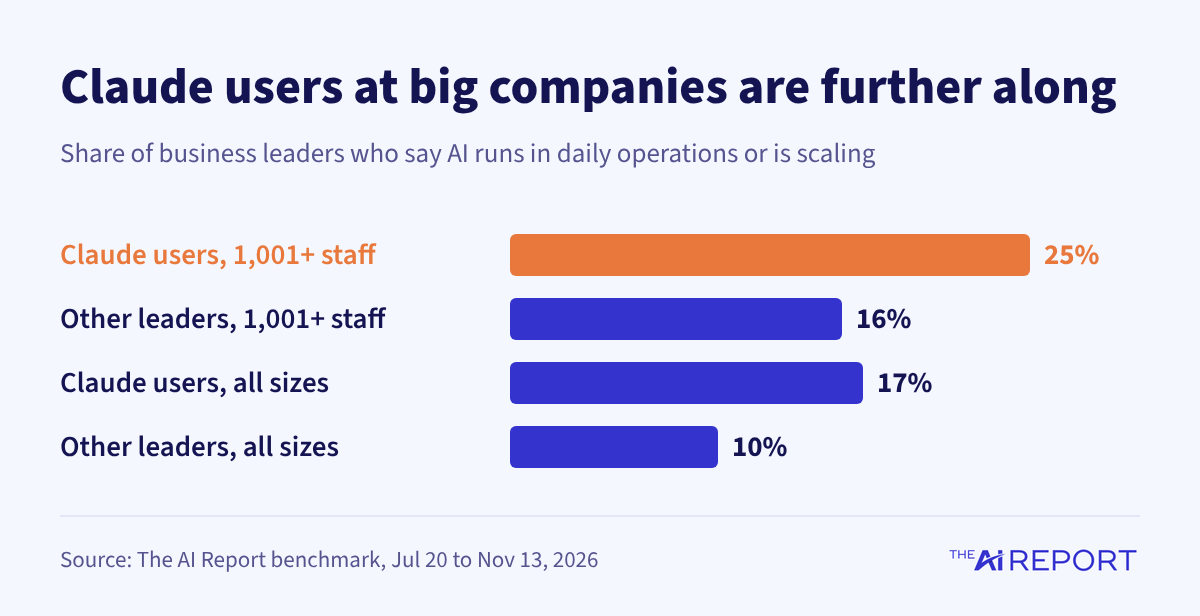
- Claude users at big companies lead. 25% of Claude users at companies with more than 1,000 employees are operating or scaling AI, against 16% of other leaders at companies that size.
- Claude is already a majority tool. 70% of 14,631 business leaders who named their AI tools use Claude. Only ChatGPT is more common, at 78%.
- Compliance is rarely the main brake. At companies with more than 1,000 employees, 5% of leaders name compliance as their biggest AI blocker. 32% name the skills gap.
- Claude users run more tools. 26% of Claude users use five or more AI tools, against 5% of other leaders.
What did Anthropic announce?
Anthropic announced that self-hosted Claude Managed Agents is available in private beta, according to its November 12 post. Managed Agents is Anthropic's set of APIs for building and running autonomous agents, and it supplies the agent harness, the sandboxes where agents run code, credential handling and session history. It first launched as a service that Anthropic hosts. Teams that needed their code to stay in their own environment were then offered self-hosted sandboxes, and this launch extends self-hosting to the whole service, Anthropic says.
- Everything can run in-house. The harness, sandboxes, credentials and session history can all run in a company's own cloud or on its own servers. The company operates the Managed Agents server, its database and the workers where agents run their tools.
- Companies choose where requests go. Requests to Claude can go to Anthropic directly, through Amazon Bedrock, Google's Agent Platform or Microsoft Foundry, or through a company's own gateway. Developers use the same core APIs as the hosted service.
- Credentials stay out of reach. The agent loop, session history and stored secrets sit outside the sandbox where code runs. For supported tools, a proxy outside the sandbox adds the credential to each request, and self-hosting companies can keep credentials in their own secrets manager.
- Network access can be locked down. Each environment can be limited to a list of approved hosts, such as a git host and a package registry, and requests to anything else are blocked.
- Every step is recorded. Managed Agents keeps a record of each step, including tool calls and their results, and exports it to existing monitoring tools through OpenTelemetry.
Anthropic summed up the offer in one line: "You host the agents, credentials, and session history, and choose where requests to Claude are sent." Companies with a zero data retention agreement with Anthropic keep it for these requests, the company says. Access is through a company's Anthropic account team, and the self-hosting documentation is public.
What is a self-hosted AI agent?
A self-hosted AI agent is one whose whole service runs on infrastructure the company controls, instead of on the AI vendor's servers. The agent's memory, code, passwords and activity log stay inside the company's own security perimeter. Anthropic says agents now do work such as fixing broken builds, testing releases and triaging alerts, often unattended and with access to internal systems, which is why some teams want the whole service in their own environment. For how agents differ from older automation, read our guide to AI agents vs traditional automation.
How many companies run AI at scale?
About one in seven overall, and more than one in five at large companies. 14% of the 15,414 business leaders who told us their AI stage say AI runs in daily operations or is scaling across the business. The share climbs with company size: 8% of solo operators, 14% at companies of 2 to 50 people, 18% at 51 to 1,000, and 22% at companies with more than 1,000 employees.
How does your company compare? Take our 2-minute AI benchmark, the same nine questions 15,000+ business leaders have answered, and get The AI Report free every weekday.
Are Claude users further along with AI?
Yes. 17% of leaders who use Claude say AI runs in daily operations or is scaling, against 10% of leaders who do not. The gap holds at large companies: 25% of Claude users at companies with more than 1,000 employees are operating or scaling AI, against 16% of other leaders there. Claude users also run more tools, with 26% using five or more AI tools against 5% of everyone else. Claude itself is used by 70% of the 14,631 leaders who named their tools, second only to ChatGPT at 78%, with Gemini at 47%. Our coverage of Claude's new team features and our ChatGPT vs Claude vs Gemini comparison go deeper.
What holds big companies back with AI?
People, more than rules. Among 3,072 leaders at companies with more than 1,000 employees, 32% name the skills gap as their biggest AI blocker, 25% name choosing the right tools and 19% say they have no time. Only 5% name compliance, and another 5% name unreliable output. Self-hosting may remove one reason security teams say no, but it does not train anyone to use agents well.
Why do agents need private networks?
Because an agent that can reach anything can leak anything. Zachary Smith, CEO and co-founder of Datum, on The AI Report podcast: "you write an agent, it should never be able to talk to the internet. Should only be able to talk to what you want it to. And that means you're gonna have to have a private network."
Anthropic's allowed-hosts list is that idea in product form: each agent environment talks only to the systems a company approves. More in Zachary Smith on why AI agents need private networks.
What should business leaders do now?
- List the systems your agents would touch. Each needs a clear yes or no before any agent runs unattended.
- Decide where agent data must live. If session history or credentials cannot leave your environment, self-hosting may unblock projects that were stuck with security reviews.
- Start with an allowed-hosts list. Give each agent only the hosts it needs, and block everything else by default.
- Plug agent records into your monitoring. A full log of tool calls and results is only useful if someone reviews it.
- Close the skills gap first. It is the top blocker at large companies, at 32%. Our guide to choosing processes for AI automation can help pick the first agent job.
See where your company stands
Compare your company with 15,000+ business leaders in the AI Adoption Index, then take the 2-minute benchmark yourself. It is free, and so is The AI Report, read by 400,000+ business leaders every weekday.
About this data
The figures come from The AI Report's AI benchmark, answered by business leaders between July 20 and November 13, 2026, counting one answer per person. 15,414 told us their AI stage, and "operating or scaling" means they chose operating or scaling from five stages (exploring, experimenting, piloting, operating, scaling); company size comes from the same answers. 14,631 named at least one AI tool they use, and the Claude, ChatGPT, Gemini and five-or-more-tools figures come from them. The blocker figures for large companies come from the 3,072 leaders at companies with more than 1,000 employees who answered the biggest blocker question. The quote from Zachary Smith comes from his August 2026 episode of The AI Report podcast. Readers chose to subscribe to an AI newsletter, so they are likely further along than average, and many joined through our Claude guides, which lifts Claude's share. We never show groups under 300 people. Facts about the launch come from Anthropic's own post and documentation.
Cite this: The AI Report, "Anthropic lets firms self-host agents; 22% of big firms scale AI," November 13, 2026, theaireport.ai.