

400,000+ business leaders (and teams at IBM, AWS & Zapier) start their day with The AI Report. 5 minutes. Plain English. No hype.
Tableau Studio launches as 72% of its users juggle 5+ AI tools
Tableau launched Tableau Studio, an agentic workspace for vibe coding analytics. Our benchmark finds 72% of Tableau users already run five or more AI tools.
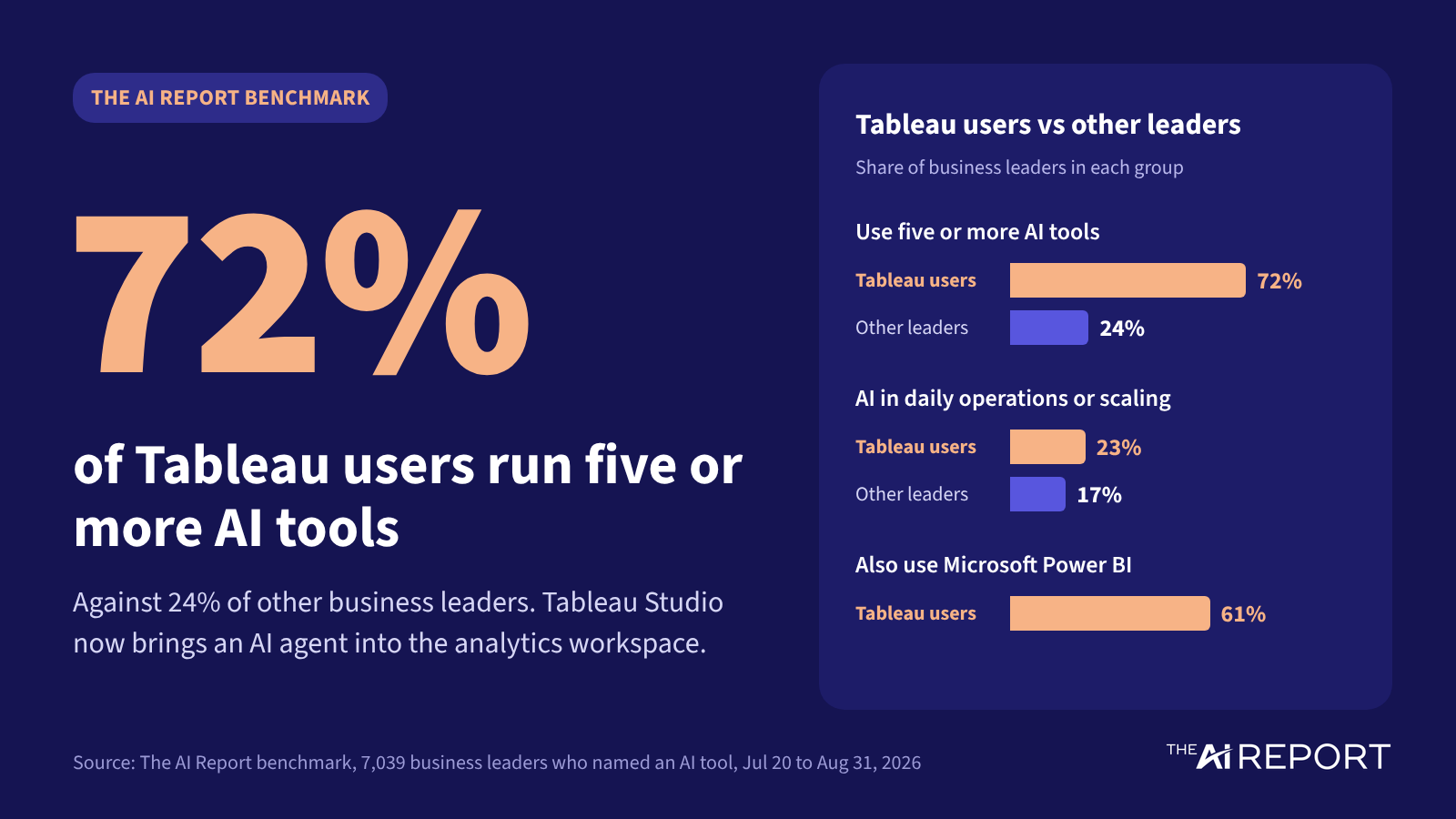

Tableau wants analysts to build dashboards by talking to an AI agent, without leaving the governed data their company already trusts. On November 17, 2026, Tableau launched Tableau Studio, which it calls "a new agentic workspace for vibe coding analytics." Our benchmark shows who it is selling to: Tableau users are already heavy AI users. 72% of them use five or more AI tools, three times the 24% of other business leaders.
Key takeaways
- Tableau users run more AI. 72% use five or more AI tools, against 24% of other business leaders.
- It is a big-company tool. 9% of leaders at companies with more than 1,000 employees use Tableau, against 2% of people who work alone. Half of all Tableau users work at those large companies.
- Further along with AI. 23% of Tableau users say AI runs in daily operations or is scaling, against 17% of other leaders.
- Power BI is the overlap. 61% of Tableau users also use Microsoft Power BI, and 15% of all leaders use at least one of the two.
- Trust is the pitch. Tableau says Studio's agent works inside the governed data, business definitions and permissions a company already has.
What is Tableau Studio?
Tableau Studio is a new workspace where analysts build analytics by talking to Tableau's AI agent as well as by dragging and dropping, according to Tableau's launch post. Tableau's release notes describe it as the evolution of Tableau Desktop, with all classic authoring features still supported. The main parts, as Tableau describes them:
- Tableau Agent points out notable changes and patterns when you open a governed data source, then builds views, calculations and visualizations from plain-language requests inside the live workbook.
- Tableau Skills are reusable analytics best practices that guide the agent, for example steering it away from a hard-to-read chart. A set comes built in, and more can be downloaded from Tableau Exchange.
- Tableau Data Apps are custom, interactive analytics web apps. Teams can build them in Studio or with any third-party agent, then publish and share them through Tableau, where they inherit the company's existing security and permissions.
- Tableau Knowledge, when it is turned on, gives the agent a knowledge graph of a company's data sources, workbooks, dashboards, metrics and business context.
The release notes also list an external client API and headless authoring with your own agent. To try Studio, Tableau points people to a free Tableau Cloud trial and the latest Tableau Desktop app. The launch post does not give pricing.
What does vibe coding analytics mean?
Vibe coding means describing what you want in plain language and letting an AI agent do the building. In analytics, you ask a question and an agent can build a dashboard in seconds, as Tableau puts it. Tableau's argument is that speed is not the hard part. Standalone AI tools can produce a chart fast, the company says, but they often leave analysts with a black box that is hard to refine and cut off from the governed data, business definitions and permissions their organization relies on. Studio keeps that work inside Tableau, where those rules already apply, and analysts can switch between the conversation and normal drag-and-drop editing to check the result. If agents versus traditional automation is new to you, start with our plain-English explainer.
How many business leaders use Tableau?
About 4 in 100. Of the 7,039 business leaders in our benchmark who named the AI tools they use, 4.4% use Tableau and 13% use Microsoft Power BI. Tableau use climbs steeply with company size: 9.3% at companies with more than 1,000 employees, 4.5% at companies with 51 to 1,000, 2.6% at companies with 2 to 50 and 1.8% among people who work alone. Half of all Tableau users (50%) work at companies with more than 1,000 employees, against 24% of all the leaders we surveyed. By industry, Tableau use is highest in healthcare (7.5%) and financial services (7.0%).

How does your company compare? Take our 2-minute AI benchmark, the same nine questions 15,000+ business leaders have answered, and get The AI Report free every weekday.
How much AI do Tableau users already use?
A lot. 72% of Tableau users use five or more AI tools, against 24% of other leaders. 23% say AI already runs in their daily operations or is scaling, against 17% of everyone else. Besides Power BI (61%), the tools they use most are ChatGPT (86%), Claude (77%) and Gemini (62%), and 34% also use Salesforce, which owns Tableau.

That fits Tableau's pitch. Its users do not need another general AI tool. What Tableau is selling is an agent that works on the governed data and definitions they already keep in Tableau. Their blockers look much like everyone else's: a skills gap (29%), choosing the right tools (28%) and finding the time (16%). Other leaders are more likely to say choosing tools holds them back (34%).
Other software makers are making the same case. Workday argued this fall that its agents win because of the rules and data underneath, as we covered in Workday aims AI agents at HR. Salesforce made a similar point about its own work agent in Agentforce Coworker tops 185,000 users.
Why does trusted data matter for AI analytics?
Because a business answer has to be right, not just fast. Yasmeen Ahmad, Managing Director of Product Management for Data & AI Cloud at Google Cloud, on The AI Report podcast: "But in an enterprise context, if I'm asking about revenue and sales and failure rates, I expect a very precise answer." In the episode, she argues that business context and definitions, more than more powerful models, are the next big unlock for enterprise AI.
What should data and business leaders do now?
- Agree on your definitions first. An agent is only as accurate as the business definitions it reads. Settle what counts as revenue, a new customer or a failure before you let an agent build on them.
- Start with one recurring report. Pick a dashboard your team rebuilds every week and test whether an agent can produce it from governed data. Our guide to choosing processes for AI automation shows how to pick one.
- Check permissions before you share. An app built by an agent should follow the same access rules as the data underneath. Test it with a colleague who should not see everything.
- Count your AI tools. Most Tableau users already run five or more. Decide which jobs belong next to governed data and which can stay in a general assistant. Our ChatGPT vs Claude vs Gemini comparison can help with the second list.
- Keep a person checking the numbers. Tableau built Studio so analysts can inspect and change the agent's work. Make that review a required step.
See where your company stands
Compare your company with 15,000+ business leaders in the AI Adoption Index, then take the 2-minute benchmark yourself. It is free, and so is The AI Report, read by 400,000+ business leaders every weekday.
About this data
The figures come from The AI Report's AI benchmark, counting one answer per person. Tableau and Power BI were answer options in the AI tools question from July 20 to August 31, 2026, so every figure in this article uses the 7,039 business leaders who answered in that period and named at least one AI tool. 309 of them use Tableau. Readers could pick several tools. "AI runs in daily operations or is scaling" means readers who chose the operating or scaling stage, as a share of everyone in the group. Blockers are each reader's single biggest blocker. Company size groups each have at least 1,500 people, and both industries shown have more than 600. Many readers joined through our Claude guides, which lifts Claude's share. The quote is from our April 2026 podcast episode with Yasmeen Ahmad of Google Cloud. Readers chose to subscribe to an AI newsletter, so they are likely further along with AI than average. We never show groups under 300 people.
Cite this: The AI Report, "Tableau Studio launches as 72% of its users juggle 5+ AI tools," November 19, 2026, theaireport.ai.
Disclosure: Salesforce, which owns Tableau, has advertised with The AI Report. This article was written independently by our editorial team.


