400,000+ business leaders (and teams at IBM, AWS & Zapier) start their day with The AI Report. 5 minutes. Plain English. No hype.
Is ChatGPT Safe for Corporate Data?
A clear breakdown of what actually happens to your data in consumer versus enterprise ChatGPT, and what that means for your business.
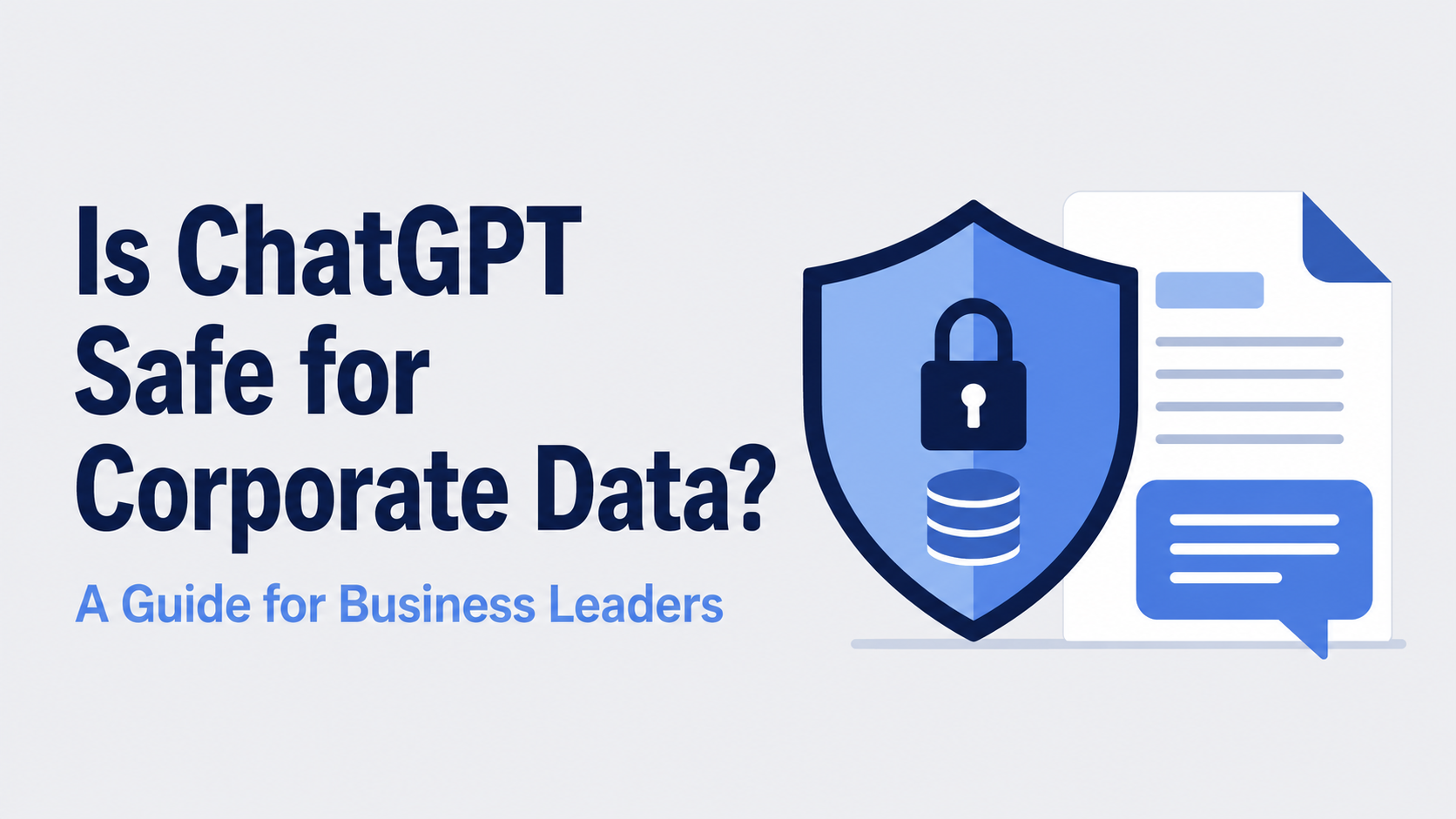

The question most executives are asking about ChatGPT is not whether it is useful. By now that is well established. The question is whether it is safe to use with company data, and the honest answer is: it depends entirely on which version your employees are using.
That distinction is where most of the risk lives, and most companies are not making it clearly enough. Employees are often using consumer ChatGPT accounts for work without understanding that the privacy rules governing their personal account are fundamentally different from those that apply to a business or enterprise plan. The result is a gap between what leadership assumes is happening and what is actually happening with company data.
For executives building their AI governance framework, The AI Report's Leaders Launch program offers a curated library of AI implementation resources and guides for business leaders. See what's inside.
The Most Important Distinction Most Companies Miss
ChatGPT Free and ChatGPT Plus, the $20 per month individual subscription, are consumer products. On both of these plans, OpenAI's default setting allows conversations to be used to improve its models. Upgrading from Free to Plus buys you access to more powerful models and higher usage limits. It does not buy you stronger data privacy. The training defaults are the same.
This surprises many executives who assume that paying for a subscription means their data is protected. It is not, unless they have specifically gone into Settings, navigated to Data Controls, and manually disabled the "Improve the model for everyone" setting. Even then, OpenAI retains conversations for up to 30 days after deletion for abuse monitoring purposes.
The practical implication is straightforward: if your employees are using personal ChatGPT accounts for work, including Plus accounts paid for out of pocket, your company data may be feeding into OpenAI's training pipeline unless each individual has manually opted out. For a company where employees regularly handle client information, proprietary processes, or sensitive financial data, that is a meaningful exposure.
What Changes on Business and Enterprise Plans
The data handling rules change significantly once you move to plans designed for organizational use.
On ChatGPT Business ($25 per user per month) and ChatGPT Enterprise (custom pricing), OpenAI explicitly states that business data is not used to train its models by default. This is confirmed directly in OpenAI's enterprise privacy commitments: inputs and outputs from business and enterprise accounts are excluded from training unless the organization explicitly opts in. Data is secured using industry-standard encryption, both when it is stored and when it is being transmitted, so it cannot be intercepted or accessed by unauthorized parties. ChatGPT Business also meets SOC 2 Type 2 certification, an independent security audit standard that many regulated industries require their vendors to hold before they will work with them.
ChatGPT Enterprise goes further. Administrators have control over how long data is retained, can access full audit logs of employee conversations, and can configure data residency, meaning where data is stored geographically, which matters for organizations subject to EU data sovereignty requirements or similar regulations. For healthcare organizations, OpenAI offers a Business Associate Agreement (BAA) with ChatGPT for Healthcare to support HIPAA compliance requirements.
The cost difference between a consumer Plus account and a business plan is not large in absolute terms. The governance difference is significant.
Beyond the Interface: Enterprise APIs and Local Options
For organizations that want the strongest possible data controls, there are options beyond the standard ChatGPT interface. Enterprise API access and local deployment configurations allow businesses to use AI capabilities without their data passing through consumer infrastructure at all. These paths require more technical setup but give legal, compliance, and IT teams the highest level of control over where data goes and how long it is retained. If your organization operates in a heavily regulated industry or handles particularly sensitive data, these options are worth exploring with your IT or security team.
What This Means in Practice
The risk is not theoretical. In 2023, employees at a major electronics company shared proprietary source code with consumer ChatGPT, not realizing the data could be used in ways outside their control. That incident prompted significant policy reviews across industries and is now widely cited as a reference point for why governing which version of an AI tool your employees use matters as much as governing whether they use it at all.
The practical guidance for most organizations comes down to three things. First, identify which version of ChatGPT your employees are actually using. The governance meaning changes completely depending on whether they are using a personal account, a business workspace, or the API. Second, if employees are using consumer accounts for work, move them to a business plan before addressing anything else. Third, build the distinction into your employee training so that people understand the difference between their personal AI tools and the approved company workspace, and why that difference matters.
The same consumer versus enterprise distinction applies across other major AI tools beyond ChatGPT. The underlying principle is consistent: consumer products are built for individuals and carry different privacy defaults than products built for organizational use.
Getting Started
Understanding data privacy is one piece of a broader AI governance picture. If your organization is working through AI policy and implementation, The AI Report's Leaders Launch program gives business leaders access to a curated library of resources and guides to support that process.
Access the Leaders Launch Program
This article is part of our AI Policy and Safety content hub. You may also find this useful: How to Write a Corporate AI Policy.


.png)
.png)
.png)
.png)
.png)
.png)
.png)
.png)
.png)
.png)
.png)
.png)
.png)
.png)
.png)
.png)
.png)