400,000+ business leaders (and teams at IBM, AWS & Zapier) start their day with The AI Report. 5 minutes. Plain English. No hype.
How Shopify Is Betting on Agentic Commerce
Orders from AI to Shopify stores are up 13x. Here is what Sidekick, Campaign Autopilot, and SimGym mean for merchants navigating agentic commerce.
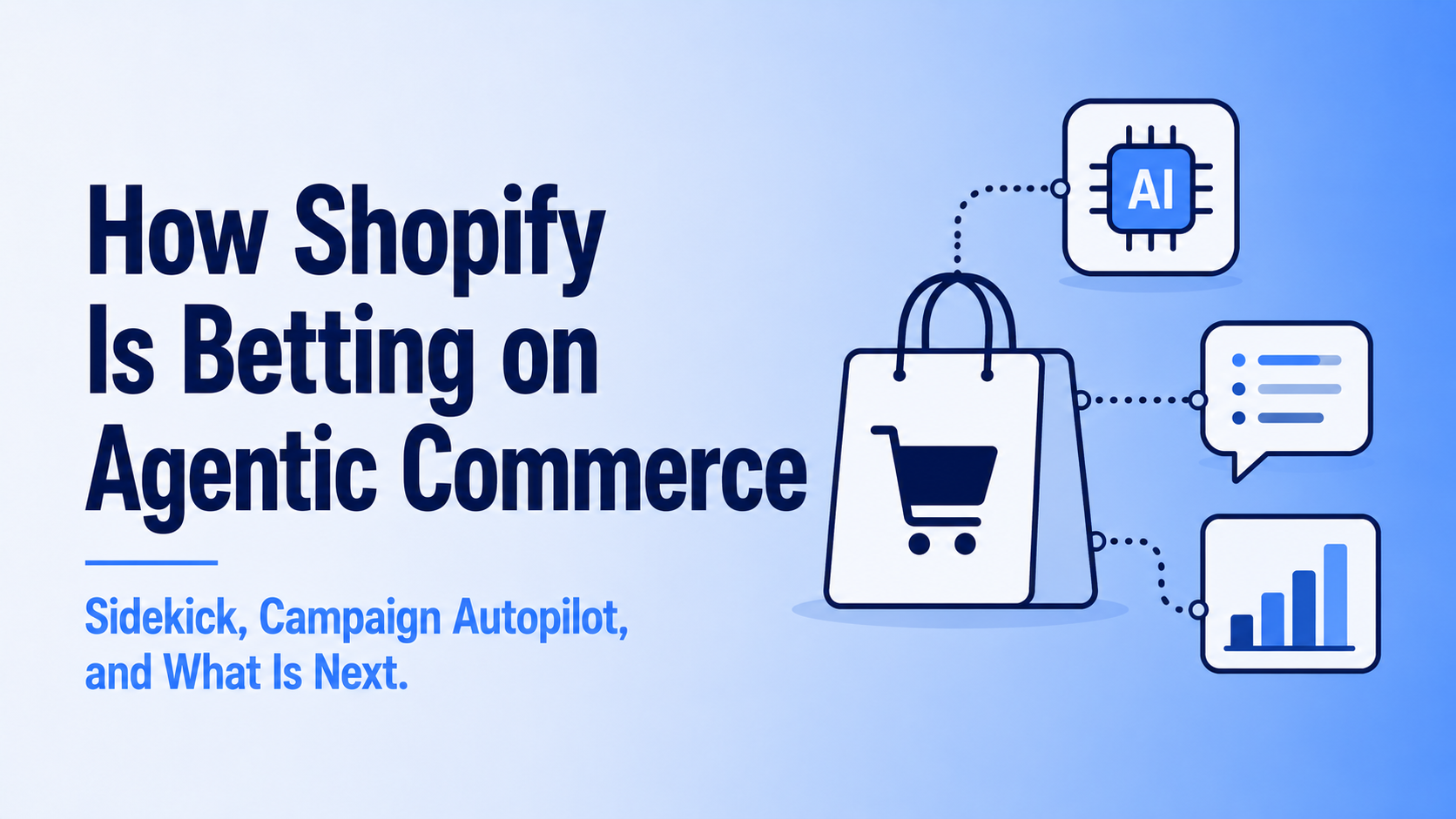

AI-driven orders on Shopify are up 13x. Catalog-powered AI search converts at twice the rate of general AI search. And according to Andrew McNamara, VP of Applied ML at Shopify, AI commerce is growing nine times faster than social commerce did at the same stage, and three times faster than mobile. For a company that has spent the last year shipping agentic features across its entire merchant platform, those numbers validate a significant bet.
Andrew returned to The AI Report podcast to break down what is actually shipping at Shopify right now, how it works, and what it means for the millions of merchants on the platform.
The Universal Commerce Protocol
A significant part of what is driving Shopify's AI commerce growth is the Universal Commerce Protocol (UCP), a shared standard developed by a coalition of eCommerce companies including Meta, Etsy, Shopify, and Mastercard. UCP exposes merchant catalogs through a standardized API, which means AI tools like ChatGPT, Claude, and Perplexity can surface Shopify products in their responses when users ask about buying something.
Merchants can choose to enable this sales channel or not. When they do, their products become available to AI-powered shopping agents across the ecosystem. When a user asks an AI assistant to find hiking boots, the catalog is there, structured, and accessible in a way that general web search is not. That is why catalog-powered AI search converts twice as well as general AI search, the product data is clean, structured, and directly integrated.
Shopify has also built merchant-facing tooling to track what is happening with this traffic. Merchants can now see which AI platforms are driving orders and conversions, which queries are surfacing their products, and where products are appearing in AI conversations but not converting, along with suggestions for what to fix.
Sidekick: An AI Co-Founder for Every Merchant
Sidekick is Shopify's AI assistant for merchants, and in this episode Andrew described it as an AI co-founder available from day one. The insight behind it came from research showing that merchants who had an experienced entrepreneur in their network to ask questions were significantly more likely to succeed than those who did not. Sidekick is designed to be that resource for every merchant, regardless of their network.
It runs on Anthropic's Claude Sonnet model, hosted on Google Cloud, though Andrew noted the architecture is model-agnostic. Through natural language, merchants can query their store analytics, make changes to their store, and get deep business insights without needing technical knowledge.
At Shopify's recent Editions event, Sidekick app extensions launched for partners. Twenty or so companies including Klaviyo, Loop, and Judge Me integrated at launch, allowing Sidekick to pull data from and take actions across third-party apps within the Shopify ecosystem. Andrew described it as MCP-shaped, a framework where Sidekick identifies which installed apps are relevant to a merchant's query and routes accordingly. More partners have been integrating since launch.
Campaign Autopilot
Campaign Autopilot is Shopify's newest merchant-facing AI tool and the one generating the most interest right now. Andrew described it as an auto research loop: the merchant sets a budget and guardrails, and the system continuously tests campaign variations, measures results, and iterates, without human involvement in each cycle.
Andrew drew an explicit parallel to reinforcement learning: a metric is defined, an LLM runs tests toward that metric, evaluates the results, makes suggestions for the next round, and the loop repeats. In Campaign Autopilot's case, that metric is campaign performance for the specific merchant's store. It is not drawing on other merchants' data. It is running a hyper-specific optimization loop for each individual business.
SimGym
The least-publicized of the three features Andrew discussed is SimGym, and arguably the most technically ambitious. Shopify is training AI shoppers, virtual simulated buyers, that can be run against different versions of a merchant's store to predict the outcome before changes go live.
The practical application is A/B testing without real traffic. If a merchant wants to test moving a button, changing a color, enabling reviews, or adjusting the layout, they can run those experiments with simulated AI shoppers first. The system validates that its simulated results match what actually happened on real stores historically before those AI shoppers are trusted to make predictions on new changes. Andrew noted he ran it on his own maple syrup store.
The implication is that merchants can test many ideas cheaply with SimGym, identify the most promising two or three, and only then run live A/B tests on real customers.
What This Means for Merchants
The picture Andrew painted is one where Shopify's AI layer is increasingly doing the work that used to require either technical expertise or significant time investment. Analytics through natural language, campaign optimization through auto research loops, store changes tested before they touch real customers, and product catalogs structured for discovery by AI assistants.
Andrew offered a real-life example from Shopify's own leadership. Tobi Lütke, Shopify's CEO, recently gave his own personal AI agent a budget connected to UCP and now receives gifts in the mail that his agent proactively purchased on his behalf.
That story is illustrative rather than instructive for most merchants right now, but it points at where the platform is heading. The agent is becoming a new layer between the shopper and the store, and Shopify is building specifically for that layer.
Watch the full conversation with Andrew McNamara on The AI Report podcast.
Stay up to date with the latest AI news and analysis. Subscribe to The AI Report.





.png)
.png)
.png)
.png)
.png)
.png)
.png)
.png)
.png)
.png)
.png)
.png)
.png)
.png)
.png)
.png)
.png)