400,000+ business leaders (and teams at IBM, AWS & Zapier) start their day with The AI Report. 5 minutes. Plain English. No hype.
Multiplayer AI and the Future of Work
Block's Brad Axen on multiplayer AI, AI memory, and what the future of work actually looks like. Insights from the original author of Goose and the builder behind Buzz.
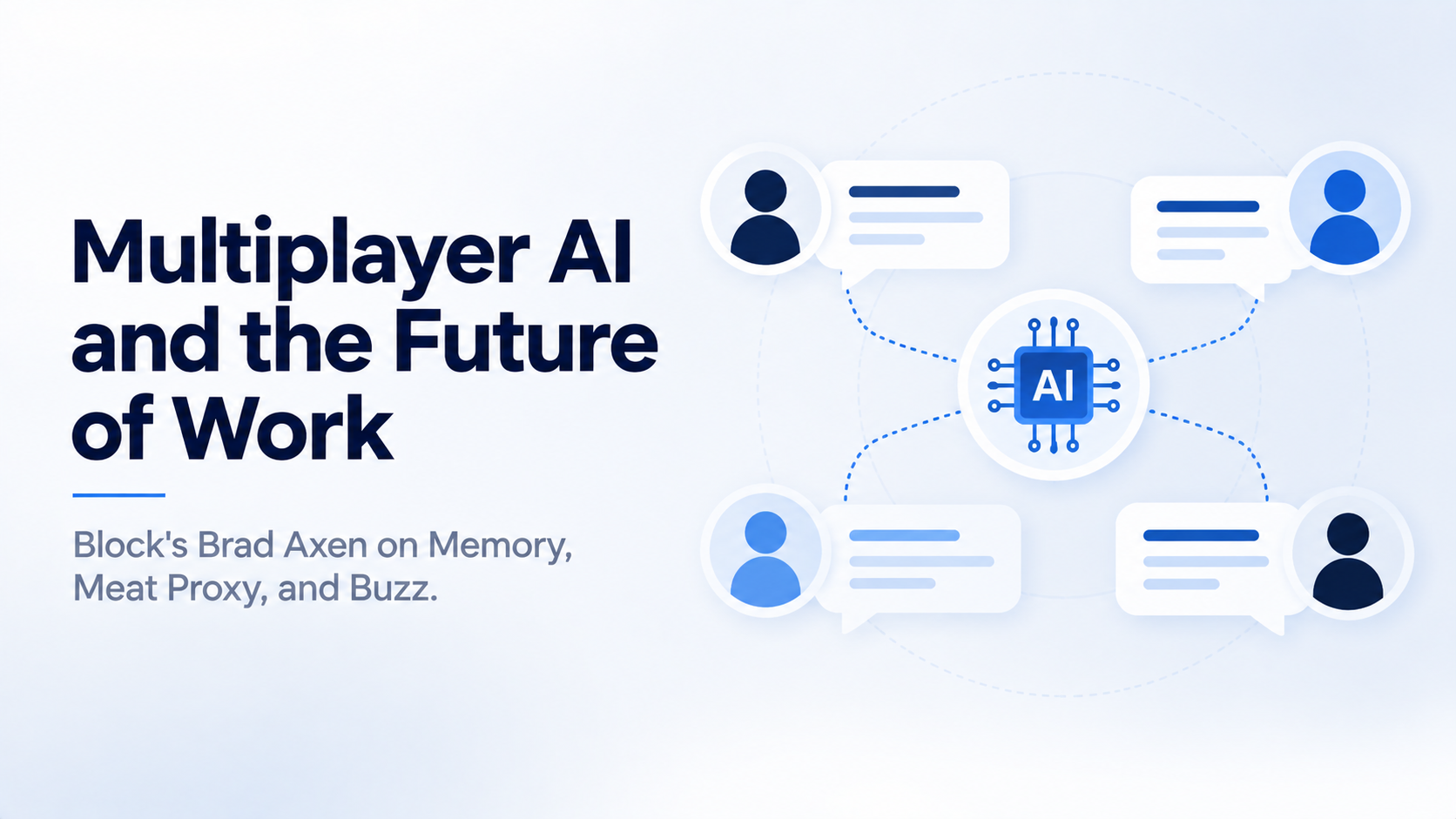

The bottleneck in AI-powered work has shifted. A year ago, the limiting factor was how quickly you could write code. That problem, Brad Axen says, is basically solved. The new bottleneck is deciding what to build and making sure everyone agrees before the work starts. This is the problem Block is now spending most of its time on.
Brad is Head of AI Capabilities at Block, the economic empowerment company behind Square, Cash App, Tidal, and Bitkey. He joined The AI Report podcast to walk through nearly a decade of building at Block, from the earliest days of open-source AI agents to the multiplayer workspace the company is now betting its internal productivity on.
Who Brad Axen Is and What Block Built
Brad came to Block out of academia. His PhD was from Berkeley and he spent a year at CERN, working on the Atlas detector and running data collection experiments above the Large Hadron Collider. He came into the tech industry realizing that what he had been doing in physics, running experiments on problems that had never been solved before, was essentially machine learning before the industry used that name.
He has been at Block for nearly ten years, starting when it was still called Square. His most visible contribution to the broader AI ecosystem is Goose: an open-source AI agent that Block later donated to the Linux Foundation as one of the three founding projects of the Agentic AI Foundation, alongside the MCP protocol and agents.md.
Today, Block deploys AI agents across its products. MoneyBot lives in Cash App and helps people manage their finances. ManagerBot lives in Square and helps small business owners handle the administrative work that takes them away from actually running their business. BuilderBot is internal, helping Block's own engineers ship software. Each has a more specific interface than Goose itself. That specificity, Brad argues, is the point.
AI Memory Should Belong to the Business, Not the Bot
One of the clearest through-lines in the conversation is Brad's view on where AI memory should live. Most AI tools today store memory in the individual bot: ChatGPT remembers things about you, your agent accumulates context over time that only it has access to. Brad thinks this is the wrong architecture for anyone working in a team environment.
The reason is straightforward. If you run a business with twenty employees and only one bot has the memory of how the business works, you have not really built organizational memory at all. You have built a tool that helps one person. Brad wants the memory to belong to the business itself, accessible to everyone who works there, updated by everyone who works there, and stored adjacent to the work rather than adjacent to the person.
In practice at Block, this means MD files stored in a durable backend, organized around the systems and projects of the business rather than around the individual user. The technical implementation is simple. The shift in thinking behind it is significant.
His favorite model for how this kind of shared memory could evolve comes from an unexpected place: ants. Ants do not talk to each other and do not hold meaningful individual memory, but they leave pheromone trails in their physical environment that produce extraordinary collective behavior. Brad thinks AI systems that store information in the environment rather than in individual agents, what biologists call stigmergy, could unlock a kind of parallel intelligence that purely agent-centric architectures cannot achieve. Running thousands of AI agents simultaneously, all reading and writing to a shared information environment, is the research direction he says he would put unlimited resources into.
Meet the Meat Proxy
Perhaps the most immediately recognizable concept from the conversation is the meat proxy.
Picture a coworker asking you a question you cannot immediately answer. You turn to your AI agent, get back a long response, and copy and paste it over. You are the meat in the middle, a human rerouting information between colleagues and AI systems without doing any real thinking yourself.
Brad describes this as one of the clearest signs that the tools are not yet designed for the way people actually need to work together. When AI assistants are single-player by default, every handoff between teammates requires a human to translate. That translation cost compounds across a whole team and across a whole day, and the result is people spending more and more of their time as conduits rather than contributors.
This is the problem Buzz is designed to solve.
Buzz: Humans and Agents in the Same Room
Buzz is Block's multiplayer workspace. Think Slack or Discord, but with AI agents as genuine first-class participants, not external tools you have to copy and paste from.
In Buzz, agents have their own identities. Teams name them, give them specific roles, and invite them into conversations alongside humans. When a team is deciding what to build, everyone, including the agents, is in the same room. The conversation happens in one place, the agents have context on everything that was agreed, and when it is time to start work, they can go do it without anyone having to re-explain the brief.
Brad described an open-source community that switched to Buzz and measured the result: productivity went up 50%. The same models, the same coding tools, the same people. What changed was how they were having the conversations and reaching agreement before the work started.
The bottleneck, as Brad frames it, used to be execution. Now that AI can write code quickly and reliably, the bottleneck is alignment. Getting multiple people to agree on the right thing to build before committing expensive tokens to building it is where the time actually goes. A tool that keeps that conversation visible to the AI removes the need for anyone to act as a meat proxy.
The Human Cost Nobody Is Talking About
Late in the conversation, Brad offered something that felt less like a product pitch and more like an honest observation about what it is actually like to work this way right now.
He talked about spending a full day talking only to an AI, no colleagues, no real conversation, just a single agent window. He called it, plainly, kind of sad. The loneliness of modern AI-augmented work is not something the industry talks about much, but it is something Brad said he feels himself.
It is also, he noted, part of why he is genuinely excited about Buzz. Not just for what it does to productivity numbers, but for what it does to the experience of work. When the agents are in the room with the humans, it feels more like a conversation and less like talking to yourself.
Watch the full conversation with Brad Axen on The AI Report podcast.
Stay up to date with the latest AI news and analysis. Subscribe to The AI Report.



.png)
.png)
.png)
.png)
.png)
.png)
.png)
.png)
.png)
.png)
.png)
.png)
.png)
.png)
.png)
.png)
.png)