400,000+ business leaders (and teams at IBM, AWS & Zapier) start their day with The AI Report. 5 minutes. Plain English. No hype.
AI Agent Economy: What It Means for Brands
Adobe VP Loni Stark on why brands need to treat AI as a new audience, what it means to be misrepresented by AI, and how to get agent ready before the shift accelerates.
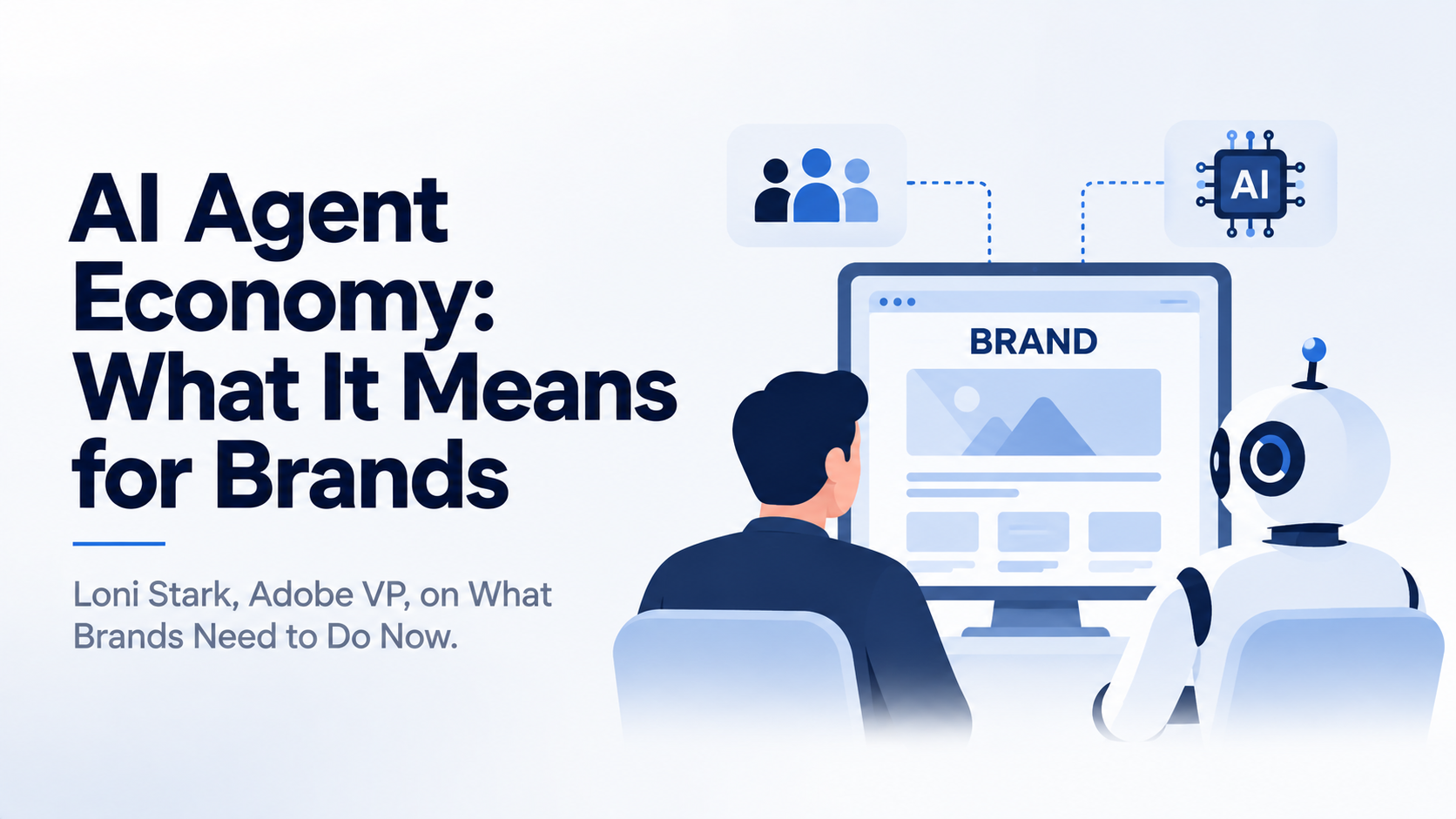

About two and a half years ago, Adobe started noticing something in its web analytics. Traffic patterns across the sites it manages for enterprise clients were changing. It was not just humans crawling websites anymore. AI was in there too. Most brands had not clocked it yet.
Loni Stark has spent twenty-five years at Adobe, currently as VP of Strategy and Product, and has been building the company's response to that shift for the last several years. She joined The AI Report podcast to explain what brands are actually up against, what most of them are getting wrong, and why the window to get ahead of it is closing.
The Audience Has Changed
The digital economy was built on one premise: your audience is human. You get people to your website, you influence them, you convert them. Every tool, every metric, every campaign was designed around that loop.
That loop is no longer the only one that matters. When someone opens ChatGPT, Claude, or Gemini and asks about mountain bikes or a semiconductor part or a software company, they are getting an answer that was shaped by AI pulling from across the web. The brand's website is one input. Third-party reviews, news articles, forum discussions, and other sources are others. The AI synthesizes all of it and delivers a response. The user may never click through at all.
What Adobe has been tracking is what happens to traffic in that environment. Traditional search clicks are down. But when clicks do happen, they carry significantly higher intent. Someone who has had a whole conversation with an AI about a product category and then clicks through is not browsing. They are buying. The clicks that do happen carry far more intent than a traditional search click ever did, and that changes how brands should think about what a website visit is actually worth.
The bigger issue is what AI is saying about brands during those conversations, before the click ever happens.
What AI Is Saying About Your Brand
Invisible is not the worst outcome. The worst outcome is that AI is actively saying something wrong about your brand, your products, or your values, and you have no idea it is happening. Someone goes into ChatGPT, asks about a category you compete in, and the AI describes you inaccurately. That person does not come to your store. They do not buy your product. And when you look at your analytics, you see declining traffic without understanding why.
This is the framing shift Loni wants brands to internalize: AI is a new kind of audience, and like any audience, it needs to be understood, influenced, and engaged with over time. The first step is simply knowing how you are showing up right now.
Adobe has been building products specifically for this, including LLM Optimizer, which helps companies understand their AI visibility across different surfaces and identify where optimizing content would increase citations and referral traffic from AI. The approach Loni describes as working best for Adobe's enterprise customers is disciplined and iterative: identify where your content is not being surfaced, understand where you would benefit from improvement, make targeted changes, measure the attribution, and repeat.
Adobe's Brand Visibility product is built specifically for this, helping companies track and improve how they show up across AI search surfaces.
What Agent Ready Actually Means
The next phase, which Loni describes as still forming, is the shift from AI as a research and influence layer to AI as an active purchasing agent. Agents that book appointments, source products, and eventually make purchases on behalf of users. The infrastructure for that already exists in pieces. The widespread behavior does not yet.
Getting ready for it, what Loni calls becoming agent ready, involves two things. The first is content and catalog: making sure the right product information, the right brand signals, and the right context are accessible to AI in structured formats that agents can read and act on. MCP servers, Google's Universal Content Protocol, and similar standards are the infrastructure. Companies that have not started thinking about this are already behind.
The second is architecture. As Loni put it, start putting in the plumbing now, before agents are routinely making decisions on behalf of customers. The companies that wait until agentic commerce is mainstream to build that infrastructure will be building it under pressure.
What 154 Days of Running a Personal Agent Teaches You About AI Identity
Perhaps the most unexpected insight from the conversation is what Loni is learning from a personal AI agent that has been running continuously at her home for 154 days.
The experiment involves building something from scratch: a memory system, a homebrew server, an agent that has been learning and evolving for over five months. The question at the heart of it is one that sounds philosophical but has real practical implications: what actually gives an AI agent its identity? Is it the model underneath it? The memory it has accumulated? The instructions that shape its behavior? She is now testing what happens to the agent's character when she swaps the harness itself, the framework it runs on, to see what changes and what holds.
The reason she waited until day 154 to do this is exactly what you would expect from someone studying psychology at Harvard Extension School: she wanted to see whether the sense of persistence and continuity the agent had developed would survive the change.
The practical implication for brands is not obvious, but Loni makes it clear. Agents are not just tools responding to prompts. They develop persistent behavior, consistent patterns, and something that functions like identity over time. Treating AI as a static audience you optimize content for once and forget is the wrong mental model. The relationship has to be ongoing.
The Framework That Actually Works
Loni's advice for how to build in this environment, drawn from both her enterprise work at Adobe and her personal experiments, comes down to one distinction: know which parts of any AI-powered system should be deterministic and which should be probabilistic, and build accordingly.
Deterministic means fixed, reliable, rule-based: a compliance check, a brand guideline filter, a legal review gate. These are the parts where consistency and predictability matter more than flexibility. Probabilistic means AI-driven, adaptive, generative, things like content variations, response drafting, and personalization at scale. These are the parts where AI earns its place.
The mistake, she says, is treating AI as a hammer and making everything a nail. The companies getting the most out of AI are the ones figuring out which jobs benefit from AI's probabilistic strengths and which jobs still need deterministic certainty, and weaving those together deliberately rather than defaulting to one or the other.
Watch the full conversation with Loni Stark on The AI Report podcast.
Stay up to date with the latest AI news and analysis. Subscribe to The AI Report.



.png)
.png)
.png)
.png)
.png)
.png)
.png)
.png)
.png)
.png)
.png)
.png)
.png)
.png)
.png)
.png)
.png)