400,000+ business leaders (and teams at IBM, AWS & Zapier) start their day with The AI Report. 5 minutes. Plain English. No hype.
Beyond Chatbots: Agentic AI for Business
What are agentic workflows and how do they differ from chatbots? A practical guide for business leaders on deploying agentic AI systems in 2026.
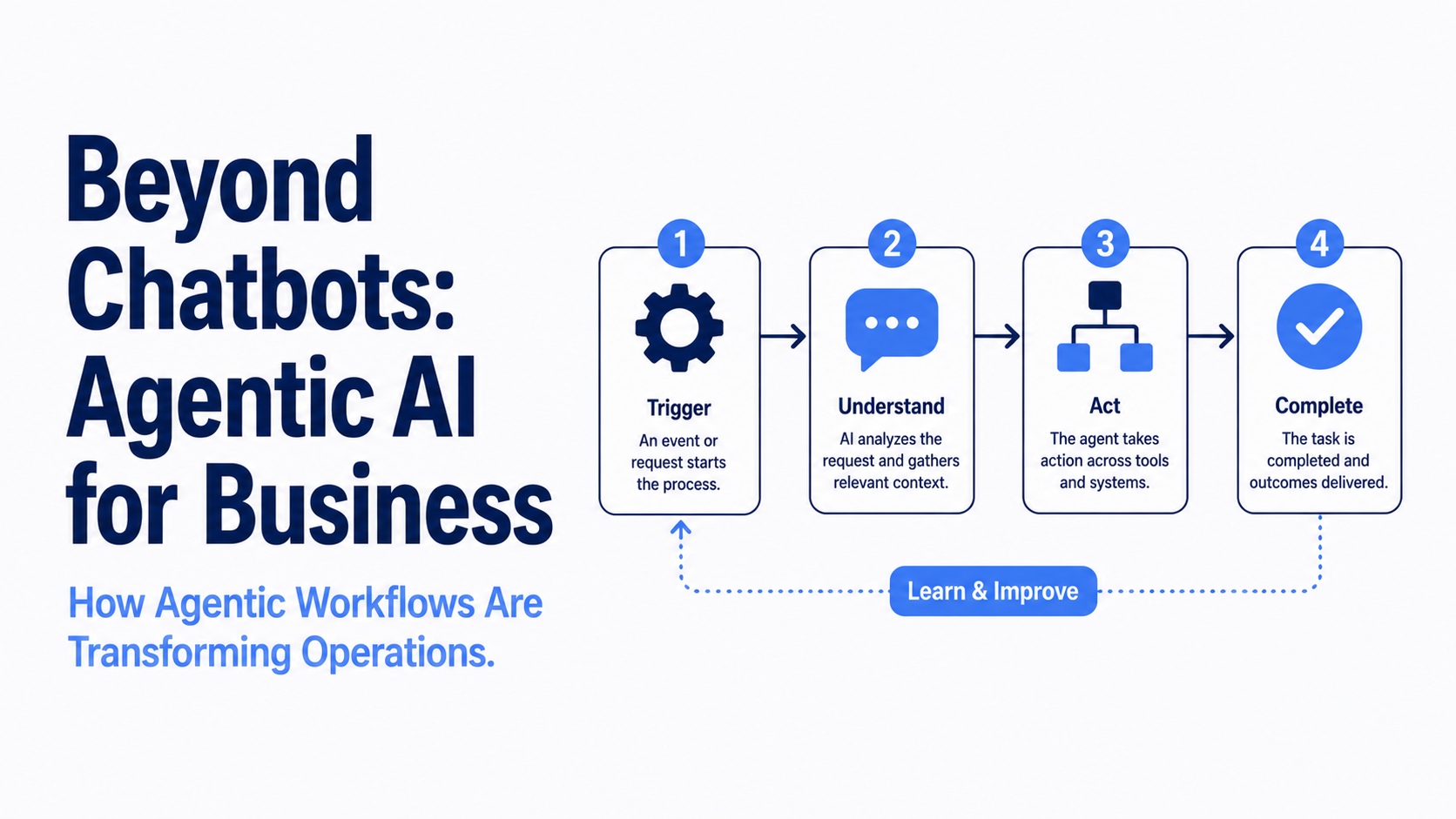

Chatbots answer questions. Agentic AI completes tasks. That is the simplest way to describe the shift that is happening in how businesses are deploying artificial intelligence right now, and it is a meaningful distinction.
A chatbot waits for you to ask something. An agentic system can receive a trigger, decide what to do, execute a multi-step process, use other tools and data sources along the way, and either deliver a result or escalate to a human when it hits something it cannot handle. It does this without someone manually prompting it at each step.
According to Gartner, less than 5% of enterprise applications had integrated task-specific AI agents in 2025. They project that figure will reach 40% by the end of 2026, one of the fastest adoption curves the firm has ever tracked for enterprise technology. The global agentic AI market has already surpassed $9 billion in 2026 and is growing at more than 40% annually. This guide explains what agentic workflows actually are, how they work in practice, and what businesses need to understand before deploying them.
What Makes an AI System Agentic
A standard AI tool responds to an input. An agentic AI system takes action toward a goal. The difference is in what happens between the prompt and the result.
Agentic systems have several capabilities that standard AI tools do not. They can break a goal into steps and execute those steps in sequence. They can use external tools, whether that is searching a database, sending a message, updating a record, or calling another system. They maintain context and memory across a workflow so they know what has already been done. And they can make decisions along the way, including the decision to stop and involve a human when the situation requires it.
That last point is important. The most useful agentic systems are not fully autonomous. They operate with what is sometimes called bounded autonomy: they run independently within defined parameters, but when something falls outside those parameters, they flag it for a human rather than guessing. A well-designed agentic system knows what it should not do, not just what it can do.
Three Types of Agentic Systems in Practice
Jake George and Joe Jepsen of Agentic Brain joined The AI Report podcast to demonstrate three working agentic systems they have built for enterprise clients. Their taxonomy is useful for anyone trying to understand how these systems differ from each other in practice.
The first type is an interactive agent. This is the most conversational form of agentic AI: a system that an employee or customer talks to directly, where the agent manages a structured process across multiple turns. The example they demonstrated was a training agent that lives inside Slack or Microsoft Teams and guides employees through a course module by module, adapting to the pace of each individual, running knowledge checks, and allowing users to skip forward or revisit earlier material. The agent operates within the existing tech stack rather than requiring employees to learn a new platform, which significantly reduces the adoption barrier.
The second type is a background agent. This agent runs automatically in the background without direct human interaction during its operation. The example demonstrated was a sales call analysis agent. When a call recording is uploaded, the agent processes the transcript, scores the salesperson against a customized rubric, identifies strengths and gaps, and generates a report. A sales trainer can then review dozens of calls in the time it would previously have taken to listen to one. The human role shifts from processing to reviewing and coaching. Jake described companies where this agent has produced consistently positive results on close rates across every client they have implemented it for.
The third type is a customer-facing agent. This handles inbound communications from customers or prospects, managing conversations autonomously and escalating to humans when needed. The example was a messaging dashboard that handles new lead inquiries across SMS, email, and web chat. When someone fills out a form showing interest, the agent responds immediately, qualifies the lead, handles common objections, and books an appointment. If a customer asks about a billing dispute, the agent recognizes it is outside its scope, flags it as needing human attention, and stops responding until a person takes over. That escalation logic, knowing what not to handle, is what separates a useful customer-facing agent from one that creates problems.
If your team is working through where agentic workflows could apply to your operations, Upscaile runs hands-on AI training built around real workflows to help teams move from curiosity to practical deployment. Talk to the Upscaile team.
The Bounded Autonomy Principle
The billing escalation example above illustrates something worth understanding clearly. The most effective agentic systems are not the most autonomous ones. They are the ones with the clearest rules about what they will and will not do.
When a customer message about a disputed charge arrives, the agent in the Agentic Brain demo does not attempt to resolve it. It does not say it will sort it out and then fail. It categorizes the message, surfaces it at the top of the human review queue with an explanation of why it needs attention, and switches off its automated responses for that conversation. The human takes over from there.
This kind of design, which Jake describes as knowing what to raise versus what to handle, is more valuable than raw capability in most business deployments. An agent that does 80% of the work reliably and surfaces the other 20% clearly is more useful than one that attempts 100% and makes unpredictable errors on the difficult cases.
What This Means for Operations Teams
The practical implication for businesses is that agentic AI is most valuable where you have high-volume, repetitive processes with clear rules and predictable inputs. Lead follow-up, sales call review, employee training delivery, customer service routing, invoice processing, and onboarding workflows are all strong candidates because they are well-defined enough that an agent can be built to handle them reliably.
Where it tends to work less well is in processes that are genuinely ambiguous, where the right answer changes significantly based on context that is difficult to capture in rules, or where the cost of an error is high enough that reliable escalation is more important than automation.
Jake is direct about this in practice: when a company approaches Agentic Brain about deploying AI agents, the first conversation is always about understanding the actual business problem rather than which agent to build. Three inbound leads per month do not justify an agentic system. Fifty calls per week going unreviewed do.
Getting Started
Gartner also notes that over 40% of agentic AI projects are at risk of being canceled by 2027, most commonly because of governance gaps, unclear ROI, and underestimated complexity. The businesses that succeed with agentic AI are not necessarily the ones that move fastest. They are the ones that start with the clearest definition of the problem, choose the right type of agent for the task, and build in the right human oversight from the start.
A narrow, well-scoped agent that handles one process reliably is more valuable than an ambitious multi-agent system that underperforms across several. Start with the highest-volume, most rule-based process in your operations and go from there.
Watch the full conversation with Jake George and Joe Jepsen on The AI Report podcast.
This article is part of our Workforce Automation content hub. For a broader overview of AI automation in business operations, see our Ultimate Guide to AI Automation in 2026. You may also find this useful: How to Streamline Core Business Workflows.
Ready to bring agentic AI into your operations? Talk to Upscaile about hands-on AI training for your team.


.png)
.png)
.png)
.png)
.png)
.png)
.png)
.png)
.png)
.png)
.png)
.png)
.png)
.png)
.png)
.png)
.png)