400,000+ business leaders (and teams at IBM, AWS & Zapier) start their day with The AI Report. 5 minutes. Plain English. No hype.
Scaling AI Literacy: Lessons from Coursera
What does it take to reskill a workforce for AI? Coursera's data from 7,000+ organizations reveals the four phases every company goes through.

Coursera's own Job Skills Report found that 84% of business leaders plan to increase their AI investment in the next year. In the same report, only 38% said their teams were actually ready to use AI effectively. That gap between intention and readiness is the problem Anthony Salcito is focused on solving.
Salcito is VP of Enterprise at Coursera, the online learning platform partnering with more than 7,000 organizations globally to reskill workforces on AI. In a recent episode of The AI Report podcast, he shared what that vantage point has revealed about how companies actually navigate AI adoption and what separates the ones that make real progress from those that stall.
The Demand Is Bigger Than Most Organizations Realize
The scale of interest in AI reskilling has outpaced most predictions. Coursera saw a 234% increase in generative AI course enrollments year over year. The platform now runs roughly 15 enrollments every single minute on its AI curriculum, up from eight the previous year, across more than 1,100 generative AI courses.
One of the more surprising findings from that growth is how globally distributed it is. AI reskilling demand is not concentrated in major tech hubs or wealthy countries. Kazakhstan and Uzbekistan both rank in the top five countries globally for AI course enrollments on Coursera. Salcito attributes that to a combination of government commitment, university alignment, and active senior leadership in local businesses. The demand, he notes, is universal.
Something else the enrollment data reveals: AI skills are not the only thing growing. Critical thinking enrollments on Coursera grew 185% in the same period. That pattern reflects what Salcito sees consistently across organizations: as AI takes over more routine tasks, the human skills required to work alongside it, leadership, judgment, decision-making, are becoming more valued, not less.
The Four Phases Every Organization Goes Through
Drawing on experience across thousands of enterprise clients, Salcito describes a consistent pattern in how organizations move through AI adoption. Understanding where your organization sits in this pattern is one of the more useful things for a leader to figure out early.
The first phase is displacement fear. Employees worry that the technology is coming for their jobs, and that fear creates resistance before anyone has even tried the tools. Salcito is direct about this: organizations that skip the step of addressing displacement fear before rolling out AI training tend to see lower engagement regardless of how good the content is.
The second phase is skills erosion worry, the concern that relying on AI will make employees worse at their jobs over time. This is not a new pattern. The same concern appeared when calculators entered classrooms. It tends to fade once people experience AI as a capability amplifier rather than a replacement for their own thinking.
The third phase is the one Salcito describes as the hardest to escape: complacency. Employees become comfortable using AI for a limited set of tasks and stay there indefinitely. They are technically using the tools, but they are not transforming how they work. Most organizations that claim AI adoption have a large portion of their workforce sitting in this phase.
The fourth phase is genuine reinvention, where people start rethinking business processes, customer engagement, and ways of working from the ground up rather than just adding AI as a layer on top of what already exists. This is where organizations start to see real returns, and it is where most have not yet arrived.
What Actually Makes Reskilling Work
Salcito outlines several elements that consistently distinguish effective AI training programs from ones that produce course completions without behavior change.
The first is meeting learners where they are. Effective programs start with an assessment of what employees already know rather than putting everyone through the same starting point. Without that grounding, you either lose people who feel overwhelmed or disengage those who are already ahead.
The second is mixed modalities. Learning that sticks uses a combination of formats: longer structured courses for foundational concepts, shorter bursts for specific skills, role play and dialogue for applying judgment, and hands-on exercises for practical application. Coursera's own data from its AI coaching feature, which gives learners a conversational AI tutor embedded in the learning experience, shows a 94% improvement in reported learning experience, a 9.5% higher quiz pass rate, and an 11.6% increase in lessons completed per hour compared to learners without it.
The third is skills verification. Course completions alone do not tell an organization much about whether skills have actually been acquired. Salcito describes verified skills paths as increasingly important, stackable learning that builds toward demonstrable competencies rather than just logged hours.
The fourth is direct connection to business outcomes. The organizations that see the fastest adoption are the ones that customize learning to their specific context rather than rolling out generic AI courses. Coursera's Course Builder tool lets organizations pull content from industry partners and universities and layer in their own internal context, role plays, and scenarios so the learning connects directly to decisions employees are actually facing.
If your organization is building this kind of training program internally, Upscaile works with enterprise teams specifically on hands-on AI training designed around real workflows rather than generic theory. Talk to the Upscaile team.
The Shift to Lifelong Learning
One of the more striking observations Salcito shares is a reframe of how we think about education and work. For most of the last century, the model was roughly four years of education followed by forty years of applying those skills. He argues that model is inverting: the pace of change now requires something closer to continuous reskilling every few years for the entirety of a career.
That shift has real implications for how organizations think about learning and development. It is no longer an onboarding program or an annual compliance exercise. It is an ongoing operational function, as central to how a business runs as finance or product development.
This is also why Salcito consistently redirects the conversation away from technology and toward people. The organizations that are furthest ahead on reskilling are not the ones with the best tools. They are the ones that have made a genuine commitment to their workforce's development as a strategic priority, embedded it into leadership conversations, and measured it the same way they measure other business outcomes.
Listen to the full conversation with Anthony Salcito on The AI Report podcast.
Where to Start
For organizations early in this process, Salcito's practical starting point is consistent: before choosing a platform or designing a curriculum, start by understanding what AI is actually supposed to do for the business. What processes are you trying to improve? What decisions are you trying to make faster or better? What does success look like in twelve months?
Reskilling programs that start with those questions, and then build learning pathways that connect directly to the answers, consistently outperform programs that start with a course catalog and work backward.
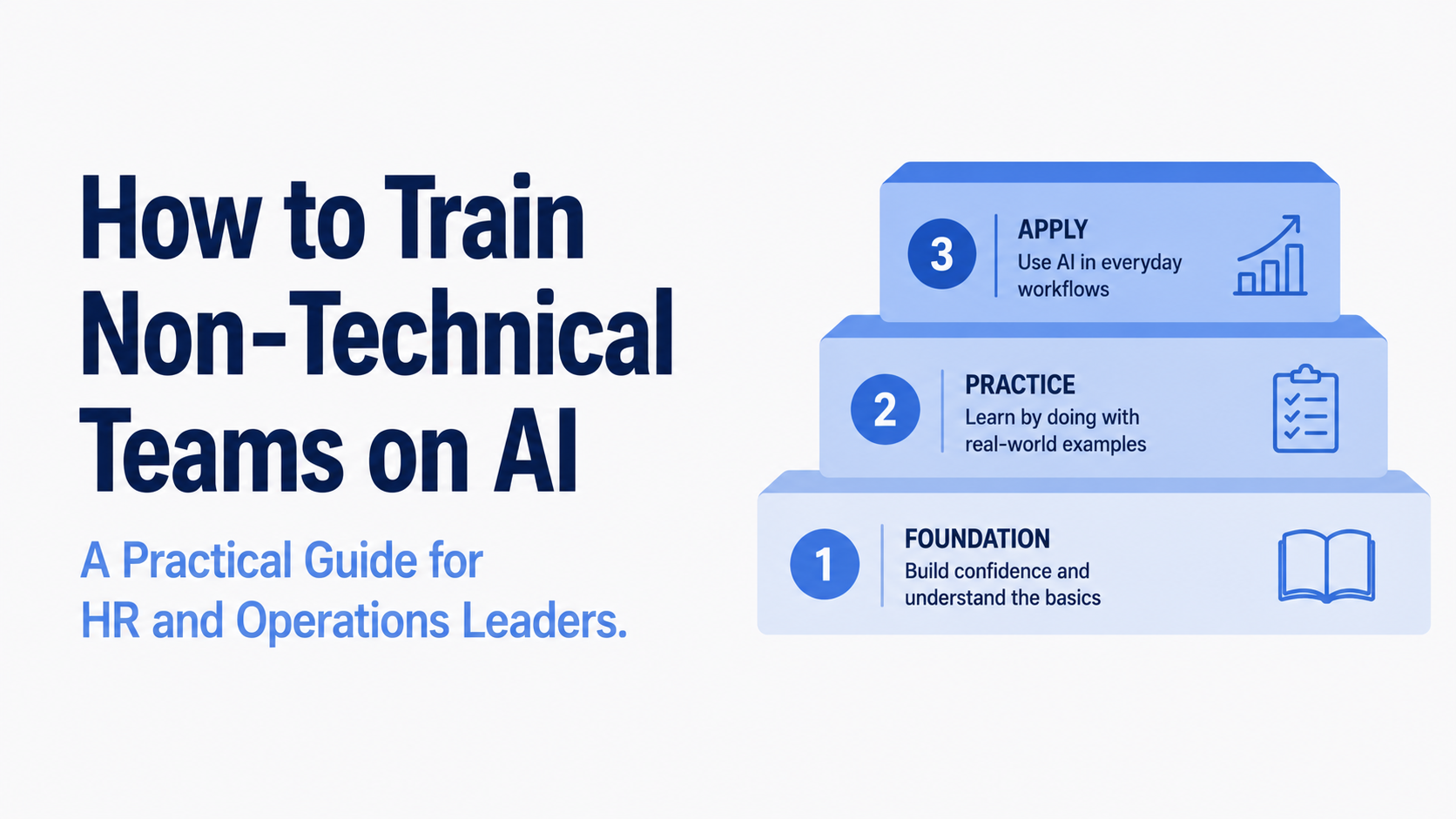
This article is part of our Corporate Upskilling content series. You may also find these useful: How UserTesting Got 70% of Staff Using AI and How to Train Non-Technical Teams on AI.
Ready to build an AI reskilling program for your team? Talk to Upscaile about hands-on AI training.


.png)
.png)
.png)
.png)
.png)
.png)
.png)
.png)
.png)
.png)
.png)
.png)
.png)
.png)
.png)
.png)
.png)