400,000+ business leaders (and teams at IBM, AWS & Zapier) start their day with The AI Report. 5 minutes. Plain English. No hype.
AI Model Strategy: Build, Buy, or Fine-Tune
When should your company use commercial AI APIs, fine-tune open source models, or build custom? A decision framework for enterprise leaders.
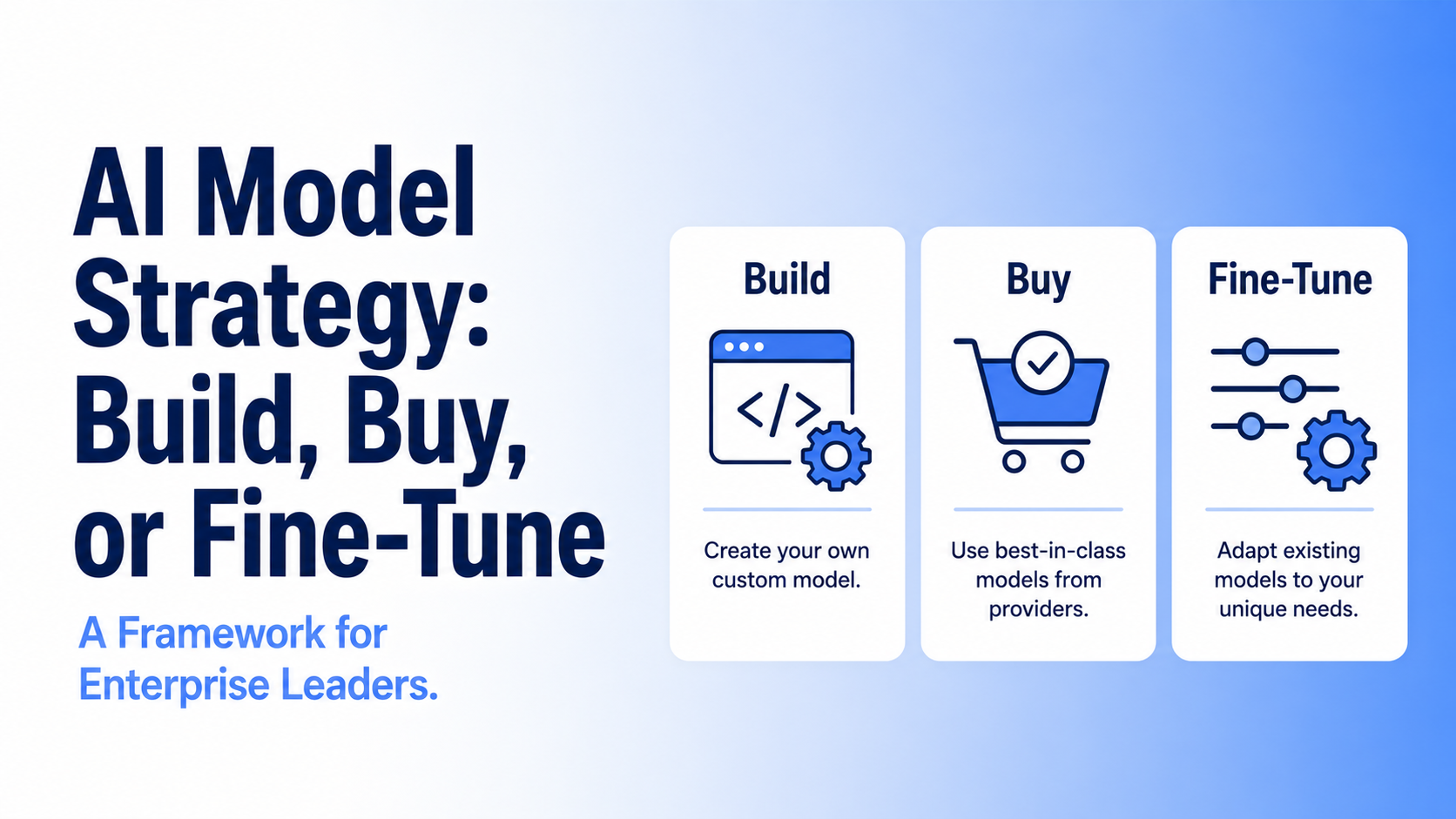

Most enterprise AI programs are still built on the same assumption: pick a commercial API, write some prompts, and plug it into your workflows. For many use cases, that is the right call. For others, it is the reason AI programs plateau before they deliver real competitive value.
The organizations moving furthest and fastest on AI in 2026 are making deliberate choices about their model strategy, specifically about when to use commercial APIs, when to fine-tune an existing open source model, and when to build something proprietary. This guide lays out the decision framework.
The Three Options and What Each One Actually Means
Commercial APIs are the services provided by companies like OpenAI, Anthropic, and Google, accessed over the internet rather than running on your own infrastructure. You pay per use, you get access to powerful general-purpose models, and you can integrate them quickly. This is where most enterprise AI programs start, and for many tasks, it is where they should stay.
Fine-tuning open source models means taking a publicly available model and training it further on your own data, on your own infrastructure. The model becomes specialized to your domain, your terminology, and your tasks. It requires technical expertise and computing resources, but it keeps your data on your own systems and can produce meaningfully better results for specific, well-defined use cases.
Building a custom model means designing and training a model from a different starting point, with the architecture built specifically for your requirements rather than for general-purpose use. This is the most resource-intensive path. It is also the one that can deliver properties that commercial APIs simply cannot offer.
When Commercial APIs Are the Right Answer
The default should be commercial APIs for most enterprise use cases, and for good reason. They are fast to deploy, require no infrastructure investment, and the models are genuinely powerful across a wide range of tasks. If you need AI to summarize documents, draft communications, support customer queries, or assist with research, commercial APIs from the major providers are mature, capable, and cost-effective.
The case for staying on commercial APIs also extends to situations where your requirements are still evolving. When you are figuring out what you need AI to do, locking into a custom build is premature. The flexibility to switch providers, update to newer models, and experiment with different approaches is valuable.
It is also worth noting that commercial model quality improves continuously. A capability gap that might seem to justify a custom build today could be closed by a commercial release in six months, though predicting that timeline with any confidence is genuinely difficult.
When Fine-Tuning Makes Sense
Fine-tuning is the middle path, and it is often underused. It makes sense when you have domain-specific language, terminology, or knowledge that general-purpose models handle poorly. Legal, medical, scientific, and highly regulated industries frequently encounter this. A model trained on your contract templates, your compliance documentation, or your internal knowledge base will outperform a general model on those specific tasks without requiring you to build from scratch.
Fine-tuning also offers benefits when cost at scale is a factor. API usage charges add up at high volume. Running a smaller, specialized model on your own infrastructure can be significantly cheaper if you are processing large numbers of requests.
Data privacy is the third driver. If your use case involves data you cannot send to a third-party service, whether for regulatory reasons, competitive sensitivity, or contractual obligations, fine-tuning on your own infrastructure gives you the capability without the exposure.
The AI Executives Pass gives leaders access to preferred pricing on enterprise AI tools across multiple categories, which can meaningfully reduce the cost of both commercial API usage and cloud infrastructure for fine-tuning. Learn more about what is included.
When to Build a Custom Model
This is where most executives need the clearest thinking, because building a custom model is expensive, slow, and requires capabilities most organizations do not have in-house. The cases where it genuinely makes sense are narrower than the conversation around AI might suggest.
The primary case for building custom is when reliability guarantees matter more than your current tools can deliver. Dan Klein, CTO and co-founder of Scaled Cognition and professor of computer science at UC Berkeley, made this point clearly on The AI Report podcast. Commercial AI models are fundamentally designed to generate the most plausible answer, which is fine for most tasks but not enough when errors have real consequences. Scaled Cognition, which raised a $100 million Series A from Khosla Ventures in June 2026 and is in production with Fortune 500 companies across financial services, healthcare, telecom, and insurance, built their model specifically to make guaranteed statements about what it will and will never do. That level of certainty is not achievable through prompt adjustments on a general-purpose model.
A practical signal that you have hit this wall: if your team has spent significant time rewriting and rearranging instructions and the output is still unpredictable at the level your use case requires, you are likely hitting a limit of the model itself rather than a prompting problem.
The second case for building custom is when you have genuinely unique proprietary data that would train a meaningfully better model, and when that capability represents a durable competitive advantage worth the cost and time to build.
The honest trade-off is that building custom comes with real downsides: high upfront investment, long build timelines, ongoing maintenance, and the risk that a commercial model improves enough to close the gap before you finish building. It is the right choice in a small number of situations, not a general strategy.
Watch the full conversation with Dan Klein on The AI Report podcast.
A Practical Decision Framework
Before choosing a path, it helps to work through a few core questions.
What does failure cost in your target use case? If errors have serious downstream consequences, financial, legal, medical, or reputational, the bar for reliability is higher and the case for custom grows stronger.
How domain-specific is your use case? Specialized language and proprietary knowledge favor fine-tuning, while tasks requiring architectural reliability guarantees favor custom.
Do your data constraints prevent you from using third-party services? If so, commercial APIs are off the table, but fine-tuning an open source model on your own infrastructure remains a viable path.
At what volume will you be running this? At high and predictable volume, the economics of running your own model can shift significantly compared to usage-based API pricing.
Most organizations will find that commercial APIs are the right answer for the majority of their use cases, fine-tuning is appropriate for a handful of specialized, high-volume tasks, and custom builds are reserved for a very small number of situations where reliability guarantees or competitive differentiation genuinely justify the investment.
The executives getting this right are not necessarily the ones building the most custom infrastructure. They are the ones asking the right questions before they build anything.
The AI Executives Pass gives business leaders access to premium AI tool discounts, executive-level AI training, and done-for-you AI content to help navigate decisions like these.
This article is part of our C-Suite AI Strategy content series, you may also find these useful:
Calculating AI ROI: A CFO’s Framework and AI Agents are Transforming the SaaS Model



.png)
.png)
.png)
.png)
.png)
.png)
.png)
.png)
.png)
.png)
.png)
.png)
.png)
.png)
.png)
.png)
.png)