400,000+ business leaders (and teams at IBM, AWS & Zapier) start their day with The AI Report. 5 minutes. Plain English. No hype.
Is AI Creating More Work?
EY's Mike Flynn on why AI hasn't killed consulting, what Design for Zero means for enterprise transformation, and how to measure what your AI agents actually cost.
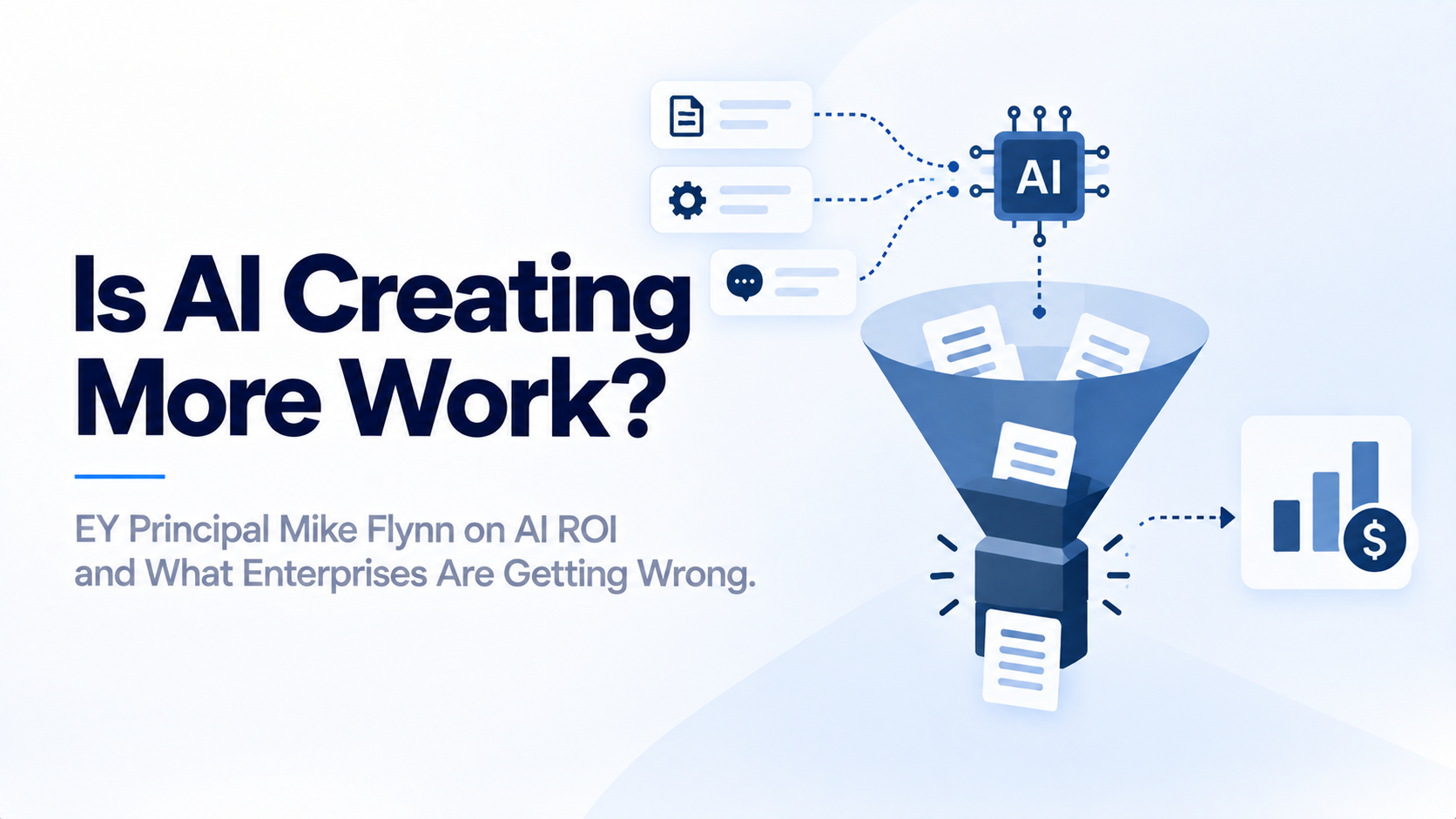

When generative AI started taking off, the consulting industry was supposed to be one of its first casualties. Why pay someone to give you advice when the advice is free and instant? It was a reasonable question. The answer, at least according to what EY is seeing on the ground, is that AI has done the opposite. It has generated more consulting work, not less, and the reason is not what most people expect.
Mike Flynn has spent over twenty years in consulting, starting at EY in 2003, working a nine-year stint at PwC, and coming back to EY to lead the technology sector for their consulting business. He joined The AI Report podcast to talk through why that counter-intuitive dynamic is playing out, and what the next phase of enterprise AI actually looks like.
The AI That Was Supposed to Replace Consultants
The argument for AI eliminating consulting went something like this: companies would feed their data into models, the models would surface insights, and the need for expensive consultants would shrink. What has happened instead is that AI has made enterprise transformation harder to navigate, not easier.
Mike described the current moment as companies coming out of an eighteen-month cycle of experimentation where boards and executives were largely unhappy with the return on what they had spent. Budgets that had been pushed out for people to explore AI tools are now being pulled back into the executive suite. Leaders want to see end-to-end transformation, not individual productivity improvements that are difficult to track back to business outcomes.
Figuring out what to build, in what order, against what definition of value, is exactly what consulting firms exist to help with.
Design for Zero
One of the most useful concepts Mike uses with clients is what EY calls Design for Zero: start with the assumption that a business process is going to run without any human involvement at all, and then add people back in where they are genuinely needed.
This sounds straightforward, however, it's not how most companies actually do it.
What typically happens is a company takes a business process that was designed with humans at the center, and asks where AI can be inserted to make it faster or cheaper. You can get some value that way. You can remove some steps, automate some of the manual work. But you are still working within a process that was originally optimized for people. The AI is layered on top, not built in. Mike calls the result trapped work: real efficiency gains that are stuck inside a process that was never designed for AI, which caps how far they can actually go.
Design for Zero flips the starting point. You ask what you can get AI to do if you were designing this from scratch. Then you figure out where a human genuinely needs to be involved, whether to monitor the process, manage exceptions, or stay in the loop for reasons of judgment or accountability. Mike has seen the most traction with this approach in software development, where coding agents have become deeply integrated across the value stack. But he is seeing clients increasingly apply it to their G and A functions too, across finance, sales, and operational processes that have historically been very human-heavy.
When Agents Start Burning Your Budget Without Asking
Alongside the design question is a cost question that most enterprises have not yet figured out how to answer properly.
For most of the software era, companies budgeted for technology on a per-seat basis: you know how many people need access to a tool, you negotiate an annual price, you plan from there. AI agents break that model entirely. What drives your exposure now is not how many seats you have. It is how many tokens your agents are consuming in real time, across how many tasks, using which models, calling which tools.
Mike referenced a paper from researchers at the University of Michigan, Stanford, and MIT on how coding agents spend money. One of its findings was that AI models are not particularly good at predicting their own token consumption before you run a query. A seemingly simple task can turn into something much more expensive if a tool calls another tool which calls another tool, and suddenly you have turned a routine request into 80,000 tokens worth of compute. He describes companies that have started to navigate this the same way they navigated cloud costs in the early days: getting a bill they do not fully understand, with not enough visibility into where the spend is actually going.
EY has been developing a framework for thinking about this more precisely. The framework breaks the cost of an AI agent task into six components: model cost, retrieval cost, tool and API cost, infrastructure cost, human review cost, and retry and rework cost. Those together give you a cost per completed task. Measured against the value of the work the agent avoided doing manually, you have something that starts to look like a real ROI calculation.
Mike is direct that this is still a forward-looking framework for most companies. Getting there requires a level of detail that most organizations are not yet operating at. But he draws a direct parallel to cloud cost management: what changed there was not the technology, it was the tooling and cultural shift that let finance teams drive accountability down to the right level of detail. AI cost management is heading the same direction.
What Enterprises Actually Want
On the question of where the opportunity is for startups and new businesses, Mike had a clear view: build what enterprises are struggling to get.
He listed what large organizations are looking for from their AI vendors: predictability, quality, risk management, security, value, transparency, and flexibility. His point was that no single platform is currently delivering all of those things at enterprise scale. Companies that have gotten AI working well have usually had to assemble it themselves, from multiple tools, with significant internal investment. A startup that can reliably provide even a meaningful subset of that list, at the scale and with the reliability enterprises require, is in a compelling position.
He was also candid that there is still a significant gap between what AI is delivering in people's personal lives and what it is delivering inside corporations. Organizations move slower, which is part of the frustration. But it also means there is still a lot of value to unlock, and most enterprises are, in his view, still near the beginning of that journey.
Why AI Created More Work for Consultants
The consulting question is worth returning to, because Mike's answer is more nuanced than "we got lucky."
What he is seeing is that AI-native companies are actively seeking out partnerships with consulting firms precisely because they lack the things consulting firms have: deep client relationships, industry domain knowledge, and the ability to manage large-scale organizational change. EY is working with AI-first companies on projects where the technology partner brings the engineering capability and EY brings the understanding of how to actually get something deployed inside a large, complex organization. Neither can do it alone.
The consulting work that AI will reduce, he expects, is the kind that involves gathering, formatting, and processing information, the work that was already repetitive and rule-based. What it will not replace, and what he is actively building around, is the work that requires trust, judgment, and a deep understanding of a specific industry or client.
That work, if anything, has become more valuable.
Watch the full conversation with Mike Flynn on The AI Report podcast.
Stay up to date with the latest AI news and analysis. Subscribe to The AI Report.


.png)
.png)
.png)
.png)
.png)
.png)
.png)
.png)
.png)
.png)
.png)
.png)
.png)
.png)
.png)
.png)
.png)