400,000+ business leaders (and teams at IBM, AWS & Zapier) start their day with The AI Report. 5 minutes. Plain English. No hype.
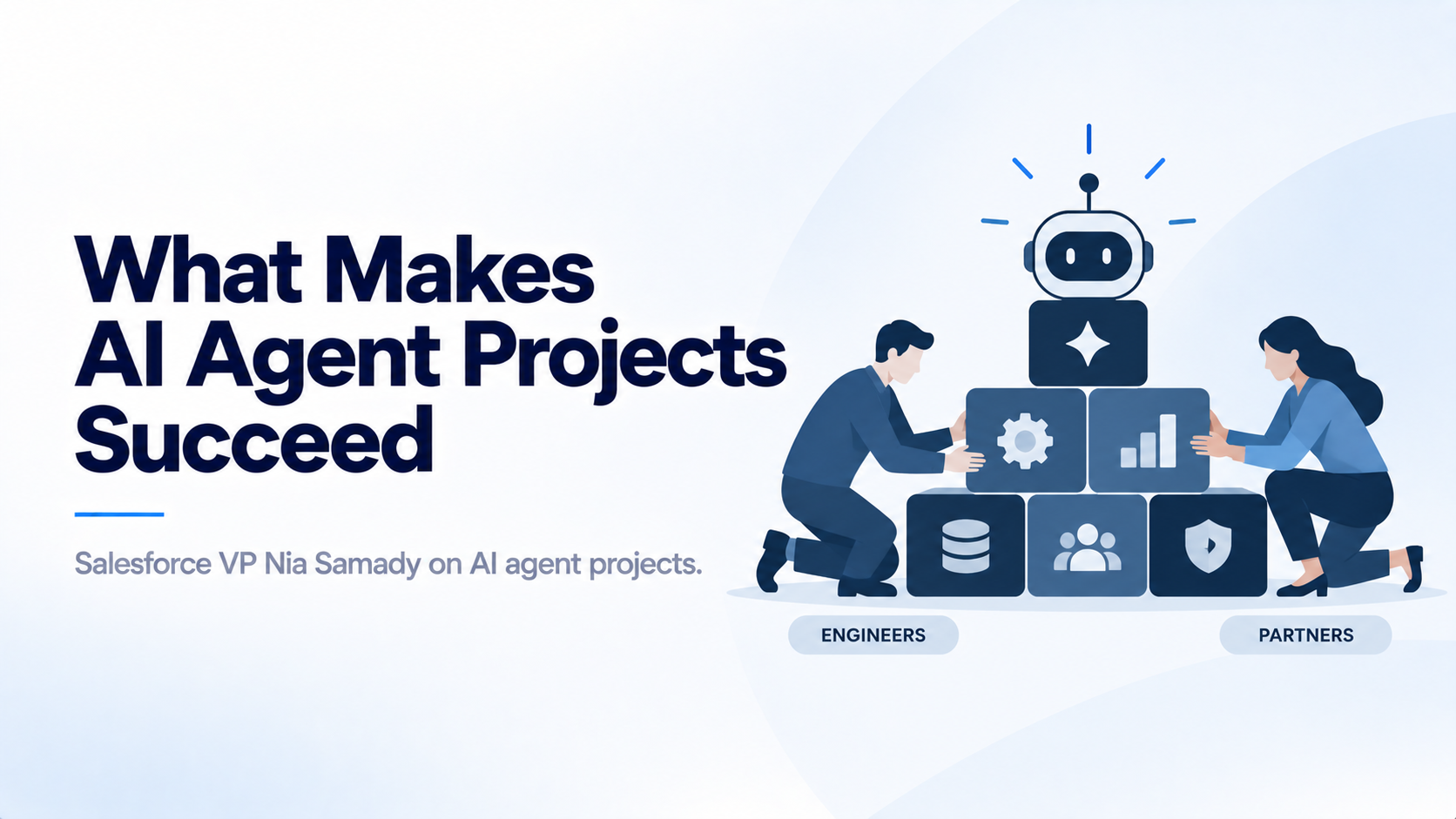
What Makes AI Agent Projects Succeed
Salesforce VP Nia Samady on what makes Agentforce projects succeed, how forward deployed engineers help, and where AI agent usage is delivering ROI.

When Nia Samady joined Salesforce twenty-two years ago, she was a new college graduate on a QA and developer support team, supporting some of the company's earliest API versions. It was the first major technology transformation she had seen up close. She had done the work academically, and now she was watching it play out in the real world. Twenty-two years later, she says the agentic era has brought that feeling back: "for the first time in a very long time, I'm getting those feelings back."
Today Nia is VP of Global Partner Success at Salesforce. She leads a technical team that works alongside the company's consulting partners. Those range from global systems integrators like Accenture and Deloitte to regional firms covering mid-market and commercial customers. She sat down with The AI Report at Dreamforce 2026 to talk about what Claudeforce means for customers, what it takes for Agentforce projects to succeed, where AI agents are already delivering returns, and how the profile of the people building them is changing.
Meeting Customers Where They Already Work
Nia's team works with partners across the entire customer lifecycle, from pre-sales before a deal closes through everything that happens after. When Salesforce announces something new, her team works out what it means in practice. That covers the go-to-market messaging and value propositions, but also the technical question of how partners can actually deliver it to customers.
Claudeforce, Salesforce's partnership with Anthropic, is a good example. Nia describes it as part of a broader headless approach that takes Salesforce to customers in whatever interface they already use, rather than asking them to come to Salesforce. For people who already work inside Claude, it arrives as a plugin that lets them start working with their Salesforce data there. To Nia, the real value is choice, and Claude is one of several interfaces she expects to keep growing in number.
The early signals from the pilot are practical rather than flashy. Partners are telling Nia's team that customers are already updating opportunity data and doing real work from inside these interfaces. The focus for her team now is growing that usage, helping partners get more users working that way.
Getting the Foundations Right
The backdrop to everything Nia's team does is speed. As she put it, "It's not a matter of months or years, it is truly weeks, days, hours." That pace creates opportunity, but it also means the basics have to keep pace.
When Agentforce projects need extra support, Nia sees the same areas come up again and again. Processes aren't ready for an agent. Data isn't ready, when customers need to make sure "their data is the king and queen." Customers themselves aren't always ready for the change. The work also often needs more applied AI expertise than the team has, including knowing which AI tools to bring in when deploying Agentforce and Salesforce's newer headless solutions.
Salesforce's answer was the Forward Deployed Engineering Partner Network, which launched this April. Nia is quick to point out that forward deployed engineering is an industry term rather than a Salesforce invention, and credits Palantir as the first company to show what the model looks like. According to Nia, the network now includes 84 partner firms of all sizes around the world.
Firms in the network get access to Salesforce's technical resources. Their engineers go through the same training as Salesforce's own internal teams, earn the same certifications, and receive a verified practitioner designation. For Nia, the network is how Salesforce tackled those recurring problems directly, by putting engineers with applied AI expertise inside the partners doing the delivery work.
An Interlock, Not a Handoff
Forward deployed engineers do look closely at data when they diagnose a project, but Nia says that is only part of it. What she values most is how early they arrive. Increasingly, FDEs appear in pre-sales conversations, when the customer is still working through the basic questions. What exactly do you want to do? What business problem are you trying to solve?
That timing changes the shape of the whole engagement. "It's not about a handoff, it's an interlock," Nia said. In a field moving this fast, the more an FDE understands early on, the better the deployment goes. That includes the customer's goals, their business landscape, and how ready their data is. The same engineers then stay involved through the deployment itself.
Data is not the exciting part of an AI project, but Nia sees it as the foundation everything else sits on. An agent can only work with what it has access to, which is why so much of the early assessment comes back to whether the data is ready.
Partners have told her this approach works. Customers want that early engagement, and working with Salesforce in a unified way from the start has been rewarding for partners. The combination also plays to each side's strengths. Salesforce brings the technical depth, and partners bring the domain and industry expertise that Nia describes as the magic part of the formula.
Where the Returns Are Showing Up
Asked where AI agents are delivering real returns today, Nia points first to service. Some service teams are seeing case deflection upwards of 70%. In these deployments the human stays in the loop, but the agent handles a large share of the work. For Nia, that pairing of knowledge worker and agent is where some of the clearest impact is happening right now.
She also highlights regulated industries, particularly health and financial services. These are environments where policy, legal processes, and guardrails are critical. Nia's view is that if partners can make agents work there, it is strong evidence that agents can work almost anywhere.
The partner ecosystem itself is changing too. Years ago, Salesforce saw a wave of what were called "born in the cloud" partners, firms built natively around Salesforce and the cloud model. Nia now sees something similar happening with AI. She is clear she did not coin the term, but she calls them AI native, or AI forward, partners. More of them are appearing across the ecosystem, especially around Salesforce's headless direction.
A Different Kind of New Grad
The people doing this work are changing as well. Salesforce now has a builder org. According to Nia, builder teams sit across fifteen or sixteen of its sales operating units and can include solution engineers, forward deployed engineers, and AI research specialists.
Within that org there is new interest in hiring new grads. That includes grads from computer engineering programs, and also grads with non-technical backgrounds such as design. What matters is having "both the technical and the business acumen," blended together. Nia is clear this is not about hunting for unicorns. It is about balance, after years in which the industry tended to hire either purely technical or purely business profiles. She sees the same shift among partners, where new grads are moving into FDE and builder roles. Those roles, she notes, look very different today than they did when she started, or even ten years ago.
Nia's advice for technical graduates comes from her own experience. She started out as a technical person with what she describes as a binary mindset, and had to learn the business side as she went. She encourages technical people to get ahead of that early. That means keeping up with what is happening across the industry and in AI research, and understanding the seller and go-to-market side of the house. Many technical people assume they can focus purely on the technical work, and she thinks that is a mistake.
Networking matters too. She encourages people to listen to podcasts, learn who the key people are in the space, and show up at local events to start building real connections.
A Beginner's Mind, and Permission to Pace Yourself
Nia's own path at Salesforce started with a chance encounter. On the day of her interview, she was leaving Salesforce's offices at The Landmark at One Market. A very tall man stepped into the elevator with his dog, Koa, who came over to her, and she stopped to pet him. She did not realize until after she got the job that the man was Marc Benioff.
She went on to read his book, Behind the Cloud, and found that her own values aligned closely with the company's culture. That includes the beginner's mind philosophy Benioff often talks about. The innovation and that mindset, she says, are why she has stayed for twenty-two years, and the beginner's mind is something she tries to pass on to her own teams.
For anyone worried about keeping up with AI, Nia's message is reassuring. Salesforce puts significant effort into internal enablement and field readiness, helping people understand how AI applies to their specific roles. But she is honest that the pace is fast, and that you have to pace yourself too: "you don't have to feel so rushed." In her view, the goal is to understand new tools and apply them to your own work, not to memorize and repeat them. The useful question is always how something applies to your role.
Her own career was shaped by mentors and also by sponsors. Sponsors are leaders who vouched for her work and spoke on her behalf in meetings she was not part of. Early in a career, she says, it helps to sit down and ask what you actually want to do and where you want to learn. Staying curious builds confidence, and mentorship and sponsorship help carry it forward.
Looking ahead to Dreamforce 2027, Nia expects to see the customer stories that bring all of this to life. She sees Salesforce's foundation of trust and governance as the groundwork that has to be in place first. As she put it, "you need the plumbing in the house."
Watch the full conversation with Nia Samady on The AI Report podcast.
Stay up to date with the latest AI news and analysis. Subscribe to The AI Report.